第7章仕事と運動エネルギー
Summaryまとめ
- Because the net force on a particle is equal to its mass times the derivative of its velocity, the integral for the net work done on the particle is equal to the change in the particle’s kinetic energy. This is the work-energy theorem.
英語のヒント
粒子に働く合力は、質量と速度の時間微分の積に等しい。そのため、粒子にされる正味の仕事の積分は、粒子の運動エネルギーの変化に等しい。これが仕事とエネルギーの定理である。 - You can use the work-energy theorem to find certain properties of a system, without having to solve the differential equation for Newton’s second law.
英語のヒント
仕事とエネルギーの定理を使えば、ニュートンの第二法則の微分方程式を解かずに、系のある種の性質を求められる。
Conceptual Questions概念に関する問題
Exercises 38–43練習問題 38–43
Exercise 38問題 38
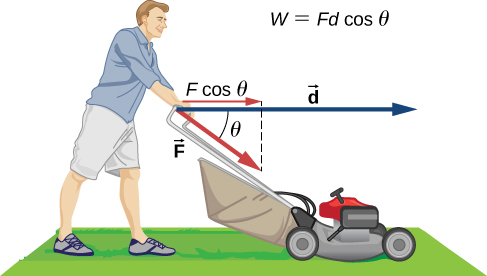
The person shown below does work on the lawn mower. Under what conditions would the mower gain energy from the person pushing the mower? Under what conditions would it lose energy?
英語のヒント
下図の人は芝刈り機に仕事をしている。どのような条件で、芝刈り機は押す人からエネルギーを受け取るか。どのような条件ではエネルギーを失うか。
Solution解き方
The mower would gain energy if It would lose energy if The mower may also lose energy due to friction with the grass while pushing; however, we are not concerned with that energy loss for this problem.
英語のヒント
なら芝刈り機はエネルギーを得て、なら失う。押している間に草との摩擦によってもエネルギーを失いうるが、この問題ではその損失を考えない。
Exercise 39問題 39
Work done on a system puts energy into it. Work done by a system removes energy from it. Give an example for each statement.
英語のヒント
系にされる仕事は、系にエネルギーを加える。系がする仕事は、系からエネルギーを取り去る。それぞれについて例を挙げよ。
Exercise 40問題 40
Two marbles of masses m and 2m are dropped from a height h. Compare their kinetic energies when they reach the ground.
英語のヒント
質量mと2mの二つのビー玉を、高さhから落とす。地面に達したときの運動エネルギーを比較せよ。
Solution解き方
The second marble has twice the kinetic energy of the first because kinetic energy is directly proportional to mass, like the work done by gravity.
英語のヒント
二つ目のビー玉の運動エネルギーは、一つ目の2倍である。重力のする仕事と同様に、運動エネルギーも質量に正比例するからである。
Exercise 41問題 41
Compare the work required to accelerate a car of mass 2000 kg from 30.0 to 40.0 km/h with that required for an acceleration from 50.0 to 60.0 km/h.
英語のヒント
質量2000 kgの車を30.0 km/hから40.0 km/hへ加速するのに必要な仕事と、50.0 km/hから60.0 km/hへ加速するのに必要な仕事を比較せよ。
Exercise 42問題 42
Suppose you are jogging at constant velocity. Are you doing any work on the environment and vice versa?
英語のヒント
一定の速度でジョギングしているとする。周囲に何らかの仕事をしているか。また逆に、周囲はあなたに仕事をしているか。
Solution解き方
Unless the environment is nearly frictionless, you are doing some positive work on the environment to cancel out the frictional work against you, resulting in zero total work producing a constant velocity.
英語のヒント
周囲にほとんど摩擦がないのでなければ、あなたは自分に逆らう摩擦の仕事を打ち消すため、周囲に正の仕事をしている。その結果、仕事の合計がゼロとなり、一定の速度が保たれる。
Exercise 43問題 43
Two forces act to double the speed of a particle, initially moving with kinetic energy of 1 J. One of the forces does 4 J of work. How much work does the other force do?
英語のヒント
初め1 Jの運動エネルギーをもつ粒子に二つの力が働き、その速さを2倍にする。一方の力は4 Jの仕事をする。他方の力のする仕事はいくらか。
Problems問題
Exercises 44–60練習問題 44–60
Exercise 44問題 44
(a) Calculate the force needed to bring a 950-kg car to rest from a speed of 90.0 km/h in a distance of 120 m (a fairly typical distance for a non-panic stop). (b) Suppose instead the car hits a concrete abutment at full speed and is brought to a stop in 2.00 m. Calculate the force exerted on the car and compare it with the force found in part (a).
英語のヒント
(a) 質量950 kgの車を、速さ90.0 km/hから距離120 mで停止させる力を求めよ。120 mは、急停止でない通常の停止距離の目安である。(b) 代わりに、車がその速さのままコンクリートの橋台に衝突し、2.00 mで止まったとする。車に及ぼされる力を求め、(a)の力と比較せよ。
Exercise 45問題 45
A car’s bumper is designed to withstand a 4.0-km/h (1.1-m/s) collision with an immovable object without damage to the body of the car. The bumper cushions the shock by absorbing the force over a distance. Calculate the magnitude of the average force on a bumper that collapses 0.200 m while bringing a 900-kg car to rest from an initial speed of 1.1 m/s.
英語のヒント
車のバンパーは、動かない物体に4.0 km/h(1.1 m/s)で衝突しても車体が損傷しないように設計されている。バンパーはある距離にわたって力を受け止め、衝撃を和らげる。質量900 kgの車を初速度1.1 m/sから停止させる間に、バンパーが0.200 mつぶれる場合、バンパーに働く平均の力の大きさを求めよ。
Solution解き方
2.72 kN
Exercise 46問題 46
Boxing gloves are padded to lessen the force of a blow. (a) Calculate the force exerted by a boxing glove on an opponent’s face, if the glove and face compress 7.50 cm during a blow in which the 7.00-kg arm and glove are brought to rest from an initial speed of 10.0 m/s. (b) Calculate the force exerted by an identical blow in the days when no gloves were used, and the knuckles and face would compress only 2.00 cm. Assume the change in mass by removing the glove is negligible. (c) Discuss the magnitude of the force with glove on. Does it seem high enough to cause damage even though it is lower than the force with no glove?
英語のヒント
ボクシンググローブには、打撃の力を弱めるための詰め物がある。(a) 質量7.00 kgの腕とグローブが、初速度10.0 m/sから停止する打撃で、グローブと顔が合わせて7.50 cm縮む。グローブが相手の顔に及ぼす力を求めよ。(b) グローブを使わなかった時代の同じ打撃を考える。拳の関節と顔が合わせて2.00 cmしか縮まないときの力を求めよ。グローブを外すことによる質量の変化は無視できるとする。(c) グローブを着けた場合の力の大きさを考察せよ。グローブなしの場合より小さくても、損傷を与えるには十分大きいだろうか。
Exercise 47問題 47
Using energy considerations, calculate the average force a 60.0-kg sprinter exerts backward on the track to accelerate from 2.00 to 8.00 m/s in a distance of 25.0 m, if he encounters a headwind that exerts an average force of 30.0 N against him.
英語のヒント
質量60.0 kgの短距離走者が、25.0 mの距離で2.00 m/sから8.00 m/sへ加速する。平均30.0 Nの力を進行方向と逆に及ぼす向かい風を受けるとき、走者が地面を後方へ押す平均の力を、エネルギーから求めよ。
Solution解き方
102 N
Exercise 48問題 48
A 5.0-kg box has an acceleration of when it is pulled by a horizontal force across a surface with Find the work done over a distance of 10 cm by (a) the horizontal force, (b) the frictional force, and (c) the net force. (d) What is the change in kinetic energy of the box?
英語のヒント
質量5.0 kgの箱を、の面上で水平方向の力で引くと、加速度はとなる。10 cmの距離で、(a) 水平力、(b) 摩擦力、(c) 合力のする仕事を求めよ。(d) 箱の運動エネルギーの変化はいくらか。
Exercise 49問題 49
A constant 10-N horizontal force is applied to a 20-kg cart at rest on a level floor. If friction is negligible, what is the speed of the cart when it has been pushed 8.0 m?
英語のヒント
水平な床の上で静止している質量20 kgの台車に、一定の水平力10 Nを加える。摩擦を無視できるなら、8.0 m押したときの台車の速さはいくらか。
Solution解き方
2.8 m/s
Exercise 50問題 50
In the preceding problem, the 10-N force is applied at an angle of below the horizontal. What is the speed of the cart when it has been pushed 8.0 m?
英語のヒント
前の問題で、10 Nの力を水平方向から下への角度で加える。8.0 m押したときの台車の速さはいくらか。
Exercise 51問題 51
Compare the work required to stop a 100-kg crate sliding at 1.0 m/s and an 8.0-g bullet traveling at 500 m/s.
英語のヒント
1.0 m/sで滑る質量100 kgの木箱と、500 m/sで飛ぶ質量8.0 gの弾丸を止めるのに必要な仕事を比較せよ。
Solution解き方
Exercise 52問題 52
A wagon with its passenger sits at the top of a hill. The wagon is given a slight push and rolls 100 m down a incline to the bottom of the hill. What is the wagon’s speed when it reaches the end of the incline. Assume that the retarding force of friction is negligible.
英語のヒント
人を乗せたワゴンが丘の頂上に止まっている。軽く押すと、傾斜角の斜面を100 m下って丘のふもとに達する。斜面の終わりでの速さはいくらか。運動を妨げる摩擦力は無視できるとする。
Exercise 53問題 53
An 8.0-g bullet with a speed of 800 m/s is shot into a wooden block and penetrates 20 cm before stopping. What is the average force of the wood on the bullet? Assume the block does not move.
英語のヒント
速さ800 m/s、質量8.0 gの弾丸を木片に撃ち込むと、20 cm入り込んで止まった。木材が弾丸に及ぼす平均の力はいくらか。木片は動かないとする。
Solution解き方
12.8 kN
Exercise 54問題 54
A 2.0-kg block starts with a speed of 10 m/s at the bottom of a plane inclined at to the horizontal. The coefficient of sliding friction between the block and plane is (a) Use the work-energy principle to determine how far the block slides along the plane before momentarily coming to rest. (b) After stopping, the block slides back down the plane. What is its speed when it reaches the bottom? (Hint: For the round trip, only the force of friction does work on the block.)
英語のヒント
質量2.0 kgの物体が、水平面となす角の斜面の最下部から、速さ10 m/sで上り始める。物体と斜面の間の動摩擦係数はである。(a) 仕事とエネルギーの関係を使い、物体が一瞬止まるまでに斜面に沿って滑る距離を求めよ。(b) 停止後、物体は斜面を滑り戻る。最下部に戻ったときの速さはいくらか。(ヒント:往復全体では、摩擦力だけが物体に仕事をする。)
Exercise 55問題 55
When a 3.0-kg block is pushed against a massless spring of force constant the spring is compressed 8.0 cm. The block is released, and it slides 2.0 m (from the point at which it is released) across a horizontal surface before friction stops it. What is the coefficient of kinetic friction between the block and the surface?
英語のヒント
質量3.0 kgの物体を、ばね定数で質量のないばねに押し付けると、ばねが8.0 cm縮む。物体を放すと、水平面を放した位置から2.0 m滑り、摩擦によって止まる。物体と面の間の動摩擦係数はいくらか。
Solution解き方
0.25
Exercise 56問題 56
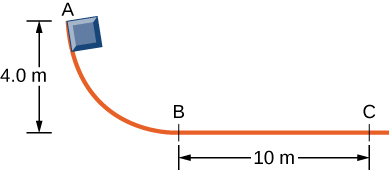
A small block of mass 200 g starts at rest at A, slides to B where its speed is then slides along the horizontal surface a distance 10 m before coming to rest at C. (See below.) (a) What is the work of friction along the curved surface? (b) What is the coefficient of kinetic friction along the horizontal surface?
英語のヒント
質量200 gの小物体がAで静止状態から出発し、Bまで滑る。Bでの速さはで、その後は水平面を10 m滑ってCで止まる(下図)。(a) 曲面に沿って摩擦がする仕事はいくらか。(b) 水平面の動摩擦係数はいくらか。
Exercise 57問題 57
A small object is placed at the top of an incline that is essentially frictionless. The object slides down the incline onto a rough horizontal surface, where it stops in 5.0 s after traveling 60 m. (a) What is the speed of the object at the bottom of the incline and its acceleration along the horizontal surface? (b) What is the height of the incline?
英語のヒント
摩擦をほぼ無視できる斜面の頂上に小物体を置く。物体は斜面を滑り下りて粗い水平面に入り、60 m進んで5.0 s後に止まる。(a) 斜面最下部での物体の速さと、水平面上の加速度はいくらか。(b) 斜面の高さはいくらか。
Solution解き方
a. 24 m/s, −4.8 m/s2; b. 29.4 m
a. 24 m/s、−4.8 m/s2、b. 29.4 m
Exercise 58問題 58
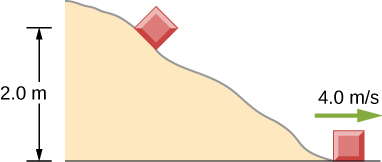
When released, a 100-g block slides down the path shown below, reaching the bottom with a speed of 4.0 m/s. How much work does the force of friction do?
英語のヒント
質量100 gの物体を放すと、下図の経路を滑り下り、最下部で速さ4.0 m/sになる。摩擦力はどれだけの仕事をするか。


Exercise 59問題 59
A 0.22LR-caliber bullet like that mentioned in Example 7.10 is fired into a door made of a single thickness of 1-inch pine boards. How fast would the bullet be traveling after it penetrated through the door?
英語のヒント
例題7.10のような.22 LR口径の弾丸を、1インチの松板を厚さ方向に1枚使ったドアに撃ち込む。ドアを貫通した直後の弾丸の速さはいくらか。
Solution解き方
313 m/s
Exercise 60問題 60
A sled starts from rest at the top of a snow-covered incline that makes a angle with the horizontal. After sliding 75 m down the slope, its speed is 14 m/s. Use the work-energy theorem to calculate the coefficient of kinetic friction between the runners of the sled and the snowy surface.
英語のヒント
水平面となす角の、雪で覆われた斜面の頂上から、そりが静止状態で滑り始める。斜面を75 m下ると速さは14 m/sになる。仕事とエネルギーの定理を使い、そりの滑走部と雪面の間の動摩擦係数を求めよ。
net work
正味の仕事
work done by all the forces acting on an object
英語のヒント
物体に働くすべての力がする仕事。
work-energy theorem
仕事とエネルギーの定理
net work done on a particle is equal to the change in its kinetic energy
英語のヒント
粒子にされる正味の仕事は、その運動エネルギーの変化に等しいという定理。