第7章仕事と運動エネルギー
7.4 Power7.4 仕事率
Learning Objectives学習目標
Learning Objectives学習目標
By the end of this section, you will be able to:
英語のヒント
この節を終えると、次のことができるようになる。
- Relate the work done during a time interval to the power delivered
英語のヒント
ある時間間隔でされた仕事を、供給された仕事率と結び付ける。 - Find the power expended by a force acting on a moving body
英語のヒント
動く物体に働く力の仕事率を求める。
The concept of work involves force and displacement; the work-energy theorem relates the net work done on a body to the difference in its kinetic energy, calculated between two points on its trajectory. None of these quantities or relations involves time explicitly, yet we know that the time available to accomplish a particular amount of work is frequently just as important to us as the amount itself. In the chapter-opening figure, several sprinters may have achieved the same velocity at the finish, and therefore did the same amount of work, but the winner of the race did it in the least amount of time.
英語のヒント
仕事という考えには力と変位が含まれ、仕事とエネルギーの定理は、物体にされる正味の仕事を、軌道上の二点で計算した運動エネルギーの差と結び付ける。これらの量や関係には、時間が明示的には含まれていない。しかし、ある量の仕事をするために使える時間は、仕事量そのものと同じくらい重要なことが多い。章の冒頭の図では、複数の短距離走者がゴールで同じ速度に達し、したがって同じ量の仕事をしたかもしれないが、優勝者は最も短い時間でそれを成し遂げた。
We express the relation between work done and the time interval involved in doing it, by introducing the concept of power. Since work can vary as a function of time, we first define average power as the work done during a time interval, divided by the interval,
英語のヒント
された仕事と、それに要した時間の関係を表すために、仕事率という概念を導入する。仕事は時間の関数として変わりうるので、まず平均仕事率を、ある時間間隔の間にされた仕事を、その時間間隔で割ったものと定義する。
Then, we can define the instantaneous power (frequently referred to as just plain power).
英語のヒント
次に、瞬間仕事率を定義できる。これは単に仕事率と呼ばれることが多い。
If the power is constant over a time interval, the average power for that interval equals the instantaneous power, and the work done by the agent supplying the power is . If the power during an interval varies with time, then the work done is the time integral of the power,
英語のヒント
ある時間間隔で仕事率が一定なら、その間の平均仕事率は瞬間仕事率に等しく、その仕事率を供給する作用主体のする仕事はである。仕事率が時間とともに変化するなら、された仕事は仕事率の時間積分になる。
The work-energy theorem relates how work can be transformed into kinetic energy. Since there are other forms of energy as well, as we discuss in the next chapter, we can also define power as the rate of transfer of energy. Work and energy are measured in units of joules, so power is measured in units of joules per second, which has been given the SI name watts, abbreviation W: . Another common unit for expressing the power capability of everyday devices is horsepower: .
英語のヒント
仕事とエネルギーの定理は、仕事が運動エネルギーへ変わる関係を表す。次の章で扱うように、エネルギーにはほかの形もあるので、仕事率はエネルギーが移される速さとしても定義できる。仕事とエネルギーの単位はジュールなので、仕事率の単位は毎秒ジュールである。このSI単位はワット、記号Wと名付けられており、である。身近な装置の出力を表すためによく使われる別の単位に、馬力がある。
Example 7.11例題 7.11
Pull-Up Power懸垂の仕事率
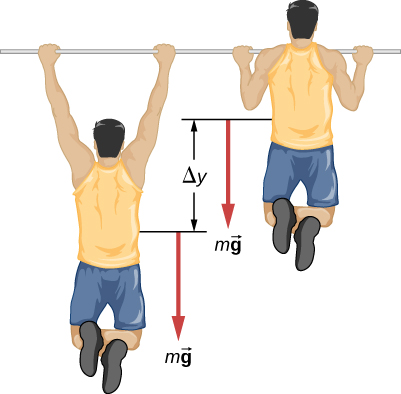
An 80-kg army trainee does pull-ups on a horizontal bar (Figure 7.15). It takes the trainee 0.8 seconds to raise the body from a lower position to where the chin is above the bar. How much power do the trainee’s muscles supply moving his body from the lower position to where the chin is above the bar? (Hint: Make reasonable estimates for any quantities needed.)
英語のヒント
質量80 kgの陸軍訓練兵が、鉄棒で懸垂をする(図7.15)。体を下げた位置から、あごが棒より上になるまで持ち上げるのに0.8 sかかる。この間、訓練兵の筋肉はどれだけの仕事率を供給するか。(ヒント:必要な量は妥当に見積もる。)
OpenStax / Rice University, University Physics Volume 1, CC BY 4.0. Source-book artwork retained. · CC BY 4.0 · Source出典

Figure 7.15図 7.15
What is the power expended in doing ten pull-ups in ten seconds?
英語のヒント
10 sで10回懸垂するときの仕事率はいくらか。
Strategy方針
The work done against gravity, going up or down a distance , is Let’s assume that Also, assume that the arms comprise 10% of the body mass and are not included in the moving mass. With these assumptions, we can calculate the work done.
英語のヒント
距離だけ上がる、または下がるとき、重力に逆らってする仕事はである。と仮定する。また、両腕は体重の10%を占め、動く質量には含まれないと仮定する。この仮定から、された仕事を計算できる。
Solution解答
The result we get, applying our assumptions, is
英語のヒント
仮定を適用して、次の結果を得る。
Significance考察
This is typical for power expenditure in strenuous exercise; in everyday units, it’s somewhat more than one horsepower
英語のヒント
これは激しい運動で費やす仕事率として典型的な値であり、日常の単位では1馬力を少し超えるである。
The power involved in moving a body can also be expressed in terms of the forces acting on it. If a force acts on a body that is displaced in a time dt, the power expended by the force is
英語のヒント
物体を動かす際の仕事率は、物体に働く力でも表せる。時間dtの間にだけ変位する物体に、力が働くとき、その力による仕事率は、
where is the velocity of the body. The fact that the limits implied by the derivatives exist, for the motion of a real body, justifies the rearrangement of the infinitesimals.
英語のヒント
となる。ここでは物体の速度である。実際の物体の運動では、微分で意味される極限が存在するため、微小量をこのように並べ替えてよい。
Example 7.12例題 7.12
Automotive Power Driving Uphill坂を上る自動車の出力
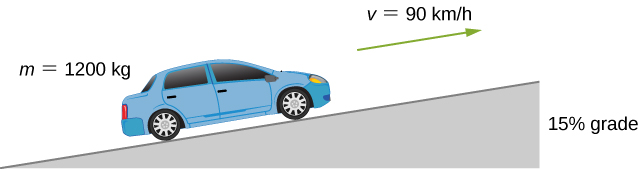
How much power must an automobile engine expend to move a 1200-kg car up a 15% grade at 90 km/h (Figure 7.16)? Assume that 25% of this power is dissipated overcoming air resistance and friction.
英語のヒント
質量1200 kgの車が、15%勾配の坂を90 km/hで上るには、エンジンはどれだけの仕事率を供給しなければならないか(図7.16)。その出力の25%は、空気抵抗と摩擦に逆らうために散逸するとする。
OpenStax / Rice University, University Physics Volume 1, CC BY 4.0. Source-book artwork retained. · CC BY 4.0 · Source出典

Figure 7.16図 7.16
We want to calculate the power needed to move a car up a hill at constant speed.
英語のヒント
車が一定の速さで坂を上るために必要な仕事率を求める。
Strategy方針
At constant velocity, there is no change in kinetic energy, so the net work done to move the car is zero. Therefore the power supplied by the engine to move the car equals the power expended against gravity and air resistance. By assumption, 75% of the power is supplied against gravity, which equals where is the angle of the incline. A 15% grade means This reasoning allows us to solve for the power required.
英語のヒント
速度が一定なら運動エネルギーは変化せず、車を動かす正味の仕事はゼロである。したがって、車を動かすためにエンジンが供給する仕事率は、重力と空気抵抗に逆らうための仕事率に等しい。仮定から、出力の75%が重力に逆らうために使われ、これはに等しい。は斜面の角度である。15%勾配はを意味する。この考え方から、必要な仕事率を求められる。
Solution解答
Carrying out the suggested steps, we find
英語のヒント
示した手順を実行すると、
or
英語のヒント
すなわち、
or about 78 hp. (You should supply the steps used to convert units.)
英語のヒント
すなわち約78 hpとなる。(単位換算の手順は自分で補うこと。)
Significance考察
This is a reasonable amount of power for the engine of a small to mid-size car to supply Note that this is only the power expended to move the car. Much of the engine’s power goes elsewhere, for example, into waste heat. That’s why cars need radiators. Any remaining power could be used for acceleration, or to operate the car’s accessories.
英語のヒント
これは、小型から中型の車のエンジンが供給する出力として妥当な値である。ただし、これは車を動かすためだけの出力である。エンジンの出力の多くは、廃熱など、ほかのところへ流れる。車にラジエーターが必要なのはそのためである。残りの出力は、加速や車の付属機器の作動に使える。