第1章単位と測定
Introductionはじめに
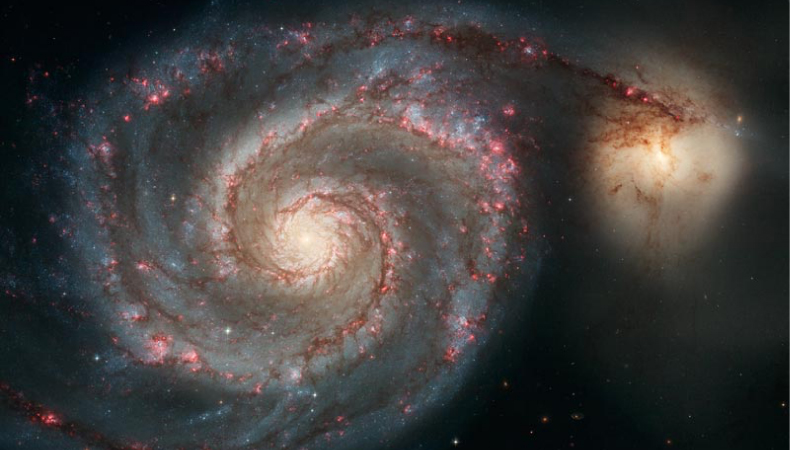
NASA, ESA, S. Beckwith (STScI), and The Hubble Heritage Team (STScI/AURA). Modified in OpenStax University Physics Volume 1. · CC BY 4.0 · Source出典

Figure 1.1図 1.1
This image might be showing any number of things. It might be a whirlpool in a tank of water or perhaps a collage of paint and shiny beads done for art class. Without knowing the size of the object in units we all recognize, such as meters or inches, it is difficult to know what we’re looking at. In fact, this image shows the Whirlpool Galaxy (and its companion galaxy), which is about 60,000 light-years in diameter (about across). (credit: modification of work by S. Beckwith (STScI) Hubble Heritage Team, (STScI/AURA), ESA, NASA)
英語のヒント
この画像には、さまざまなものが写っていると考えられる。水槽の水の渦かもしれないし、美術の授業で絵の具と光るビーズを使って作ったコラージュかもしれない。メートルやインチなど、誰もが知っている単位で物体の大きさが分からなければ、何を見ているのか判断するのは難しい。実際には、この画像は子持ち銀河とその伴銀河を示しており、直径は約6万光年(端から端まで約)である。(出典:S. Beckwith(STScI)、Hubble Heritage Team(STScI/AURA)、ESA、NASAの作品を改変)
As noted in the figure caption, the chapter-opening image is of the Whirlpool Galaxy, which we examine in the first section of this chapter. Galaxies are as immense as atoms are small, yet the same laws of physics describe both, along with all the rest of nature—an indication of the underlying unity in the universe. The laws of physics are surprisingly few, implying an underlying simplicity to nature’s apparent complexity. In this text, you learn about the laws of physics. Galaxies and atoms may seem far removed from your daily life, but as you begin to explore this broad-ranging subject, you may soon come to realize that physics plays a much larger role in your life than you first thought, no matter your life goals or career choice.
英語のヒント
図の説明にあるとおり、章の冒頭の画像は子持ち銀河であり、この章の最初の節で取り上げる。原子が小さいのと同じくらい銀河は巨大である。それでも、同じ物理法則がその両方と自然界のほかのあらゆるものを記述する。これは、宇宙の根底にある統一性を示している。物理法則の数は驚くほど少なく、見かけ上複雑な自然の根底には単純さがあることを示唆する。この教科書では、こうした物理法則を学ぶ。銀河や原子は日常生活からかけ離れているように思えるかもしれない。しかし、この広範な学問を探究し始めれば、人生の目標や選ぶ職業が何であっても、物理学が生活の中で当初考えたよりもはるかに大きな役割を果たしていると、間もなく気づくだろう。