第7章仕事と運動エネルギー
Work Done by Forces that Vary変化する力がする仕事
In general, forces may vary in magnitude and direction at points in space, and paths between two points may be curved. The infinitesimal work done by a variable force can be expressed in terms of the components of the force and the displacement along the path,
英語のヒント
一般に、力の大きさと向きは空間の位置によって変わり、二点間の経路も曲線になりうる。変化する力の微小な仕事は、力と経路に沿う変位の成分で表せる。
Here, the components of the force are functions of position along the path, and the displacements depend on the equations of the path. (Although we chose to illustrate dW in Cartesian coordinates, other coordinates are better suited to some situations.) Equation 7.2 defines the total work as a line integral, or the limit of a sum of infinitesimal amounts of work. The physical concept of work is straightforward: you calculate the work for tiny displacements and add them up. Sometimes the mathematics can seem complicated, but the following example demonstrates how cleanly they can operate.
英語のヒント
ここで力の成分は経路上の位置の関数で、変位は経路の式によって決まる。dWを直交座標で示したが、状況によっては別の座標のほうが適している。式7.2は全仕事を、線積分、すなわち微小な仕事の和の極限として定義する。物理的な考え方は単純で、小さな変位ごとの仕事を計算して足せばよい。数学的には複雑に見えることもあるが、次の例は、計算がどれほどすっきり進むかを示す。
Example 7.4例題 7.4
Work Done by a Variable Force over a Curved Path曲線経路で変化する力がする仕事
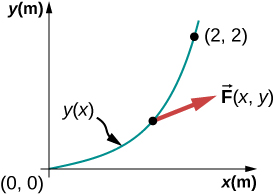
An object moves along a parabolic path from the origin to the point under the action of a force (Figure 7.6). Calculate the work done.
英語のヒント
物体が力を受け、原点から点まで放物線に沿って動く(図7.6)。力のする仕事を求めよ。
OpenStax / Rice University, University Physics Volume 1, CC BY 4.0. Source-book artwork retained. · CC BY 4.0 · Source出典

Figure 7.6図 7.6
The parabolic path of a particle acted on by a given force.
英語のヒント
与えられた力を受ける粒子の放物線軌道。
Strategy方針
The components of the force are given functions of x and y. We can use the equation of the path to express y and dy in terms of x and dx; namely,
英語のヒント
力の成分はxとyの関数として与えられる。経路の式を使えば、yとdyをxとdxで表せる。すなわち、
Then, the integral for the work is just a definite integral of a function of x.
英語のヒント
すると、仕事の積分はxの関数の定積分になる。
Solution解答
The infinitesimal element of work is
英語のヒント
仕事の微小要素は、
The integral of is so
英語のヒント
の積分はなので、
Significance考察
This integral was not hard to do. You can follow the same steps, as in this example, to calculate line integrals representing work for more complicated forces and paths. In this example, everything was given in terms of x- and y-components, which are easiest to use in evaluating the work in this case. In other situations, magnitudes and angles might be easier.
英語のヒント
この積分は難しくなかった。より複雑な力や経路でも、この例と同じ手順で、仕事を表す線積分を計算できる。今回はすべてx・y成分で与えられており、それを使うのが最も容易だった。別の状況では、大きさと角度を使うほうが簡単な場合もある。
One very important and widely applicable variable force is the force exerted by a perfectly elastic spring, which satisfies Hooke’s law where k is the spring constant, and is the displacement from the spring’s unstretched (equilibrium) position (Newton’s Laws of Motion). Note that the unstretched position is only the same as the equilibrium position if no other forces are acting (or, if they are, they cancel one another). Forces between molecules, or in any system undergoing small displacements from a stable equilibrium, behave approximately like a spring force.
英語のヒント
変化する力の中でも、非常に重要で幅広く使えるのが、完全弾性のばねの力である。フックの法則を満たし、kはばね定数、は伸びていないつり合いの位置からの変位である(「ニュートンの運動の法則」)。自然長の位置とつり合いの位置が一致するのは、ほかの力が働かない場合、または働いても互いに打ち消す場合だけである。分子間の力や、安定なつり合いからわずかに変位する系の力は、ばねの力に近い振る舞いをする。
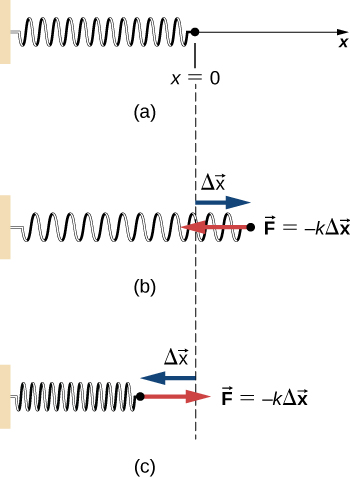
To calculate the work done by a spring force, we can choose the x-axis along the length of the spring, in the direction of increasing length, as in Figure 7.7, with the origin at the equilibrium position (Then positive x corresponds to a stretch and negative x to a compression.) With this choice of coordinates, the spring force has only an x-component,, and the work done when x changes from to is
英語のヒント
ばねのする仕事を求めるには、図7.7のように、ばねの長さに沿って伸びる方向をx軸の正とし、つり合いの位置を原点にする。このとき正のxは伸び、負のxは圧縮を表す。この座標では、ばねの力はx成分だけをもち、xがからへ変わる間の仕事は、
OpenStax / Rice University, University Physics Volume 1, CC BY 4.0. Source-book artwork retained. · CC BY 4.0 · Source出典

Figure 7.7図 7.7
(a) The spring exerts no force at its equilibrium position. The spring exerts a force in the opposite direction to (b) an extension or stretch, and (c) a compression.
英語のヒント
(a) つり合いの位置では、ばねは力を及ぼさない。(b) 伸ばした場合も、(c) 圧縮した場合も、変位と逆向きに力を及ぼす。
Notice that depends only on the starting and ending points, A and B, and is independent of the actual path between them, as long as it starts at A and ends at B. That is, the actual path could involve going back and forth before ending.
英語のヒント
は始点Aと終点Bだけに依存する。Aから始まりBで終わる限り、途中の経路には依存しない。つまり、途中で行きつ戻りつしてもよい。
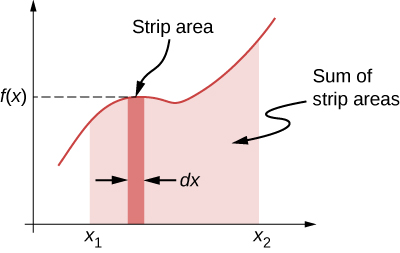
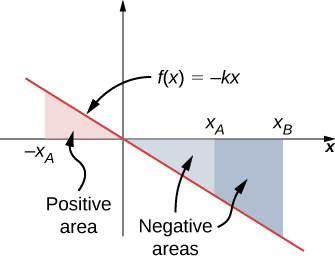
Another interesting thing to notice about Equation 7.5 is that, for this one-dimensional case, you can readily see the correspondence between the work done by a force and the area under the curve of the force versus its displacement. Recall that, in general, a one-dimensional integral is the limit of the sum of infinitesimals,, representing the area of strips, as shown in Figure 7.8. In Equation 7.5, since is a straight line with slope , when plotted versus x, the “area” under the line is just an algebraic combination of triangular “areas,” where “areas” above the x-axis are positive and those below are negative, as shown in Figure 7.9. The magnitude of one of these “areas” is just one-half the triangle’s base, along the x-axis, times the triangle’s height, along the force axis. (There are quotation marks around “area” because this base-height product has the units of work, rather than square meters.)
英語のヒント
OpenStax / Rice University, University Physics Volume 1, CC BY 4.0. Source-book artwork retained. · CC BY 4.0 · Source出典

Figure 7.8図 7.8
A curve of f(x) versus x showing the area of an infinitesimal strip, f(x)dx, and the sum of such areas, which is the integral of f(x) from to .
英語のヒント
f(x)のグラフ上に微小な帯の面積f(x)dxと、その和を示す。和はからまでのf(x)の積分である。
OpenStax / Rice University, University Physics Volume 1, CC BY 4.0. Source-book artwork retained. · CC BY 4.0 · Source出典

Figure 7.9図 7.9
Curve of the spring force versus x, showing areas under the line, between and , for both positive and negative values of . When is negative, the total area under the curve for the integral in Equation 7.5 is the sum of positive and negative triangular areas. When is positive, the total area under the curve is the difference between two negative triangles.
英語のヒント
ばねの力とxのグラフ。が正の場合と負の場合について、からまでの線の下の面積を示す。が負なら、ばねの仕事の積分式の面積は、正と負の三角形の面積の和になる。が正なら、二つの負の三角形の面積の差になる。
Example 7.5例題 7.5
Work Done by a Spring Forceばねの力がする仕事
A perfectly elastic spring requires 0.54 J of work to stretch 6 cm from its equilibrium position, as in Figure 7.7(b). (a) What is its spring constant k? (b) How much work is required to stretch it an additional 6 cm?
英語のヒント
図7.7(b)のように、完全弾性のばねをつり合いの位置から6 cm伸ばすには、0.54 Jの仕事が必要である。(a) ばね定数kはいくらか。(b) さらに6 cm伸ばすには、どれだけの仕事が必要か。
Strategy方針
Work “required” means work done against the spring force, which is the negative of the work in Equation 7.5, that is
英語のヒント
「必要な」仕事とは、ばねの力に逆らってする仕事であり、ばねの仕事の式の符号を逆にしたものになる。すなわち、
For part (a), and ; for part (b), and . In part (a), the work is given and you can solve for the spring constant; in part (b), you can use the value of k, from part (a), to solve for the work.
英語のヒント
(a)では、、(b)では、である。(a)では仕事が与えられ、ばね定数を求められる。(b)ではそのkを使って仕事を求めればよい。
Solution解答
- , so
英語のヒント
なので、。
Significance考察
Since the work done by a spring force is independent of the path, you only needed to calculate the difference in the quantity at the end points. Notice that the work required to stretch the spring from 0 to 12 cm is four times that required to stretch it from 0 to 6 cm, because that work depends on the square of the amount of stretch from equilibrium, . In this circumstance, the work to stretch the spring from 0 to 12 cm is also equal to the work for a composite path from 0 to 6 cm followed by an additional stretch from 6 cm to 12 cm. Therefore, , or , as we found above.
英語のヒント
ばねの仕事は経路によらないので、端点でのの差を計算するだけでよかった。つり合いからの伸びの2乗に依存するため、0から12 cmまで伸ばす仕事は、0から6 cmまでの4倍になる。この場合、0から12 cmまで伸ばす仕事は、0から6 cmまでと、その後6 cmから12 cmまでを足したものに等しい。したがって、すなわちとなり、先の結果を得る。