第7章仕事と運動エネルギー
Work Done by Constant Forces and Contact Forces一定の力と接触力がする仕事
The simplest work to evaluate is that done by a force that is constant in magnitude and direction. In this case, we can factor out the force; the remaining integral is just the total displacement, which only depends on the end points A and B, but not on the path between them:
英語のヒント
最も計算しやすいのは、大きさも向きも一定の力がする仕事である。力を積分の外へ出せば、残る積分は全変位になる。これは端点AとBだけで決まり、その間の経路には依存しない。
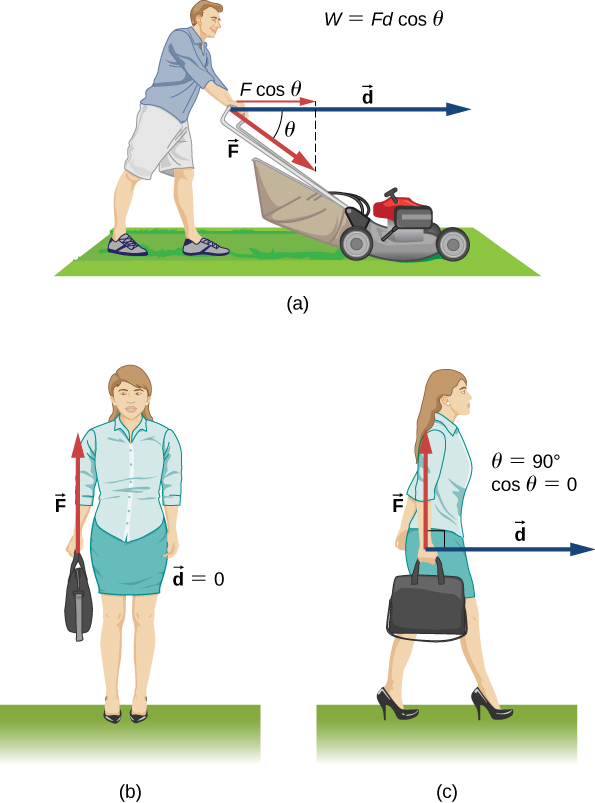
Figure 7.3(a) shows a person exerting a constant force along the handle of a lawn mower, which makes an angle with the horizontal. The horizontal displacement of the lawn mower, over which the force acts, is The work done on the lawn mower is, which the figure also illustrates as the horizontal component of the force times the magnitude of the displacement.
英語のヒント
図7.3(a)では、水平との角をなす芝刈り機の取っ手に沿って、人が一定の力を加える。力が働く間の水平変位はである。芝刈り機にする仕事はで、図では力の水平成分と変位の大きさの積としても示している。
OpenStax / Rice University, University Physics Volume 1, CC BY 4.0. Source-book artwork retained. · CC BY 4.0 · Source出典

Figure 7.3図 7.3
Work done by a constant force. (a) A person pushes a lawn mower with a constant force. The component of the force parallel to the displacement is the work done, as shown in the equation in the figure. (b) A person holds a briefcase. No work is done because the displacement is zero. (c) The person in (b) walks horizontally while holding the briefcase. No work is done because is zero.
英語のヒント
一定の力がする仕事。(a) 人が芝刈り機を一定の力で押す。図の式のように、変位に平行な力の成分が仕事になる。(b) 人がかばんを持つ。変位が0なので仕事はしない。(c) (b)の人が、かばんを持って水平に歩く。が0なので、仕事はしない。
Figure 7.3(b) shows a person holding a briefcase. The person must exert an upward force, equal in magnitude to the weight of the briefcase, but this force does no work, because the displacement over which it acts is zero.
英語のヒント
図7.3(b)は、かばんを持つ人を示す。かばんの重さと同じ大きさの上向きの力が必要だが、その力が働く間の変位は0なので、仕事はしない。
In Figure 7.3(c), where the person in (b) is walking horizontally with constant speed, the work done by the person on the briefcase is still zero, but now because the angle between the force exerted and the displacement is ( perpendicular to ) and .
英語のヒント
図7.3(c)では、(b)の人が水平に一定の速さで歩く。この場合も、かばんにする仕事は0である。今度は、力と変位のなす角がで、とが垂直になり、だからである。
Example 7.1例題 7.1
Calculating the Work You Do to Push a Lawn Mower芝刈り機を押すときの仕事を計算する
How much work is done on the lawn mower by the person in Figure 7.3(a) if he exerts a constant force of 75.0 N at an angle below the horizontal and pushes the mower 25.0 m on level ground?
英語のヒント
図7.3(a)の人が、水平より下向きに一定の75.0 Nの力を加え、平らな地面で芝刈り機を25.0 m押す。芝刈り機にする仕事はいくらか。
Strategy方針
We can solve this problem by substituting the given values into the definition of work done on an object by a constant force, stated in the equation . The force, angle, and displacement are given, so that only the work W is unknown.
英語のヒント
一定の力が物体にする仕事の定義に、与えられた値を代入すればよい。力、角度、変位は既知なので、未知量は仕事Wだけである。
Solution解答
The equation for the work is
英語のヒント
仕事の式は、
Substituting the known values gives
英語のヒント
既知の値を代入すると、
Significance考察
Even though one and a half kilojoules may seem like a lot of work, we will see in Potential Energy and Conservation of Energy that it’s only about as much work as you could do by burning one sixth of a gram of fat.
英語のヒント
1.5 kJは大きな仕事に思えるかもしれない。しかし「位置エネルギーとエネルギー保存」で見るように、脂肪をわずか6分の1 g燃やしてできる程度の仕事である。
When you mow the grass, other forces act on the lawn mower besides the force you exert—namely, the contact force of the ground and the gravitational force of Earth. Let’s consider the work done by these forces in general. For an object moving on a surface, the displacement is tangent to the surface. The part of the contact force on the object that is perpendicular to the surface is the normal force Since the cosine of the angle between the normal and the tangent to a surface is zero, we have
英語のヒント
芝を刈るとき、芝刈り機には人の力以外にも、地面からの接触力と地球の重力が働く。これらがする仕事を一般的に考えよう。面上を動く物体の変位は、その面の接線方向になる。接触力のうち面に垂直な成分が、垂直抗力である。面の法線と接線のなす角の余弦は0なので、
The normal force never does work under these circumstances. (Note that if the displacement did have a relative component perpendicular to the surface, the object would either leave the surface or break through it, and there would no longer be any normal contact force. However, if the object is more than a particle, and has an internal structure, the normal contact force can do work on it, for example, by displacing it or deforming its shape. This will be mentioned in the next chapter.)
英語のヒント
この条件では、垂直抗力は決して仕事をしない。変位が面に垂直な相対成分をもてば、物体は面を離れるか突き抜け、垂直な接触力はなくなる。ただし物体を質点とみなさず内部構造まで考える場合、垂直抗力は物体を動かしたり形を変えたりして仕事をすることがある。これは次の章で扱う。
The part of the contact force on the object that is parallel to the surface is friction, For this object sliding along the surface, kinetic friction is opposite to relative to the surface, so the work done by kinetic friction is negative. If the magnitude of is constant (as it would be if all the other forces on the object were constant), then the work done by friction is
英語のヒント
接触力のうち面に平行な部分が、摩擦である。面に沿って滑る物体では、動摩擦は面に対すると逆向きなので、負の仕事をする。の大きさが一定なら、たとえばほかの力がすべて一定の場合には、摩擦の仕事は次のようになる。
where is the path length on the surface. The force of static friction does no work in the reference frame between two surfaces because there is never displacement between the surfaces. As an external force, static friction can do work. Static friction can keep someone from sliding off a sled when the sled is moving and perform positive work on the person. If you’re driving your car at the speed limit on a straight, level stretch of highway, the negative work done by air resistance is balanced by the positive work done by the static friction of the road on the drive wheels. You can pull the rug out from under an object in such a way that it slides backward relative to the rug, but forward relative to the floor. In this case, kinetic friction exerted by the rug on the object could be in the same direction as the displacement of the object, relative to the floor, and do positive work. The bottom line is that you need to analyze each particular case to determine the work done by the forces, whether positive, negative or zero.
英語のヒント
ここでは面に沿う経路の長さである。二つの面の間の基準系では、相対変位がないため静止摩擦は仕事をしない。しかし外力としてなら、仕事をすることがある。たとえば、動くそりから人が滑り落ちるのを静止摩擦が防ぎ、人に正の仕事をする。まっすぐで水平な高速道路を制限速度で走る車では、空気抵抗の負の仕事が、駆動輪に路面の静止摩擦がする正の仕事とつり合う。また、物体の下の敷物を引き、物体が敷物に対して後ろへ滑りながら、床に対して前へ動くようにもできる。この場合、敷物が物体に及ぼす動摩擦は、床に対する変位と同方向になり、正の仕事をすることがある。力のする仕事が正・負・0のどれになるかは、個別の状況ごとに分析する必要がある。
Example 7.2例題 7.2
Moving a Couchソファを動かす
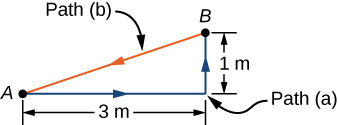
You decide to move your couch to a new position on your horizontal living room floor. The normal force on the couch is 1 kN and the coefficient of friction is 0.6. (a) You first push the couch 3 m parallel to a wall and then 1 m perpendicular to the wall (A to B in Figure 7.4). How much work is done by the frictional force? (b) You don’t like the new position, so you move the couch straight back to its original position (B to A in Figure 7.4). What was the total work done against friction moving the couch away from its original position and back again?
英語のヒント
OpenStax / Rice University, University Physics Volume 1, CC BY 4.0. Source-book artwork retained. · CC BY 4.0 · Source出典

Figure 7.4図 7.4
Top view of paths for moving a couch.
英語のヒント
ソファを動かす経路の上面図。
Strategy方針
The magnitude of the force of kinetic friction on the couch is constant, equal to the coefficient of friction times the normal force, . Therefore, the work done by it is , where d is the path length traversed. The segments of the paths are the sides of a right triangle, so the path lengths are easily calculated. In part (b), you can use the fact that the work done against a force is the negative of the work done by the force.
英語のヒント
動摩擦力の大きさは一定で、摩擦係数と垂直抗力の積である。その仕事はで、dはたどった経路の長さである。経路は直角三角形の辺なので、長さは容易に求まる。(b)では、力に逆らってする仕事は、その力がする仕事の符号を逆にしたものだと利用できる。
Solution解答
- The work done by friction i
英語のヒント
摩擦がする仕事は、 - The length of the path along the hypotenuse is , so the total work done against friction is
英語のヒント
斜辺に沿う経路の長さはなので、摩擦に逆らってする仕事の合計は、
Significance考察
The total path over which the work of friction was evaluated began and ended at the same point (it was a closed path), so that the total displacement of the couch was zero. However, the total work was not zero. The reason is that forces like friction are classified as nonconservative forces, or dissipative forces, as we discuss in the next chapter.
英語のヒント
仕事を求めた経路は、同じ点から始まって同じ点へ戻る閉じた経路なので、ソファの全変位は0である。しかし仕事の合計は0ではない。摩擦のような力は、次の章で述べる非保存力、または散逸力に分類されるためである。
The other force on the lawn mower mentioned above was Earth’s gravitational force, or the weight of the mower. Near the surface of Earth, the gravitational force on an object of mass m has a constant magnitude, mg, and constant direction, vertically down. Therefore, the work done by gravity on an object is the dot product of its weight and its displacement. In many cases, it is convenient to express the dot product for gravitational work in terms of the x-, y-, and z-components of the vectors. A typical coordinate system has the x-axis horizontal and the y-axis vertically up. Then the gravitational force is so the work done by gravity, over any path from A to B, is
英語のヒント
先に挙げた芝刈り機へのもう一つの力は、地球の重力、つまり芝刈り機の重さである。地表付近では、質量mの物体への重力は大きさmgで一定、向きも鉛直下向きで一定である。そのため、重力のする仕事は重さと変位の内積となる。多くの場合、x・y・z成分で表すと便利である。典型的な座標系ではx軸を水平、y軸を鉛直上向きに取る。このとき重力はなので、AからBへのどの経路でも、重力の仕事は次のようになる。
The work done by a constant force of gravity on an object depends only on the object’s weight and the difference in height through which the object is displaced. Gravity does negative work on an object that moves upward (), or, in other words, you must do positive work against gravity to lift an object upward. Alternately, gravity does positive work on an object that moves downward (), or you do negative work against gravity to “lift” an object downward, controlling its descent so it doesn’t drop to the ground. (“Lift” is used as opposed to “drop”.)
英語のヒント
一定の重力がする仕事は、物体の重さと移動前後の高さの差だけで決まる。上へ動く物体には、重力は負の仕事をする。言い換えれば、物体を上へ持ち上げるには、重力に逆らって正の仕事をしなければならない。逆に、下へ動く物体には重力が正の仕事をする。物体が地面へ落ちないように下降を制御し、手で下へ「持ち下ろす」場合、人は重力に逆らって負の仕事をする。「持つ」は「落とす」と区別するための表現である。
Example 7.3例題 7.3
Shelving a Book本を棚へ戻す
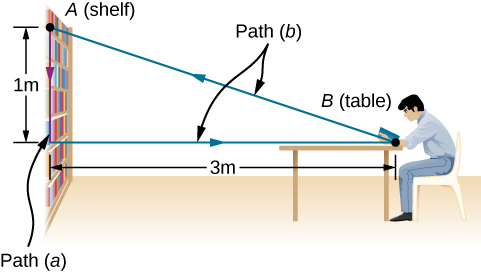
You lift an oversized library book, weighing 20 N, 1 m vertically down from a shelf, and carry it 3 m horizontally to a table (Figure 7.5). (a) How much work does gravity do on the book? (b) When you’re finished, you move the book in a straight line back to its original place on the shelf. What was the total work done against gravity, moving the book away from its original position on the shelf and back again?
英語のヒント
重さ20 Nの大型の図書館の本を、棚から鉛直に1 m持ち下ろし、水平に3 m離れたテーブルへ運ぶ(図7.5)。(a) 重力が本にする仕事はいくらか。(b) 用が済んだら直線で棚の元の位置へ戻す。行きと帰りを合わせ、重力に逆らってした仕事はいくらか。
OpenStax / Rice University, University Physics Volume 1, CC BY 4.0. Source-book artwork retained. · CC BY 4.0 · Source出典

Figure 7.5図 7.5
Side view of the paths for moving a book to and from a shelf.
英語のヒント
本を棚から運び、戻す経路の側面図。
Strategy方針
We have just seen that the work done by a constant force of gravity depends only on the weight of the object moved and the difference in height for the path taken, . We can evaluate the difference in height to answer (a) and (b).
英語のヒント
一定の重力がする仕事は、動かす物体の重さと、経路の始めと終わりの高さの差だけで決まり、となる。高さの差を求めれば、(a)、(b)に答えられる。
Solution解答
- Since the book starts on the shelf and is lifted down , we have
英語のヒント
本は棚からだけ持ち下ろされるので、 - There is zero difference in height for any path that begins and ends at the same place on the shelf, so
英語のヒント
棚の同じ場所から出て戻る経路では、高さの差は0なので、となる。
Significance考察
Gravity does positive work (20 J) when the book moves down from the shelf. The gravitational force between two objects is an attractive force, which does positive work when the objects get closer together. Gravity does zero work (0 J) when the book moves horizontally from the shelf to the table and negative work (−20 J) when the book moves from the table back to the shelf. The total work done by gravity is zero Unlike friction or other dissipative forces, described in Example 7.2, the total work done against gravity, over any closed path, is zero. Positive work is done against gravity on the upward parts of a closed path, but an equal amount of negative work is done against gravity on the downward parts. In other words, work done against gravity, lifting an object up, is “given back” when the object comes back down. Forces like gravity (those that do zero work over any closed path) are classified as conservative forces and play an important role in physics.
英語のヒント
棚から本を下ろすとき、重力は正の仕事20 Jをする。二物体間の重力は引力なので、互いに近づくとき正の仕事をする。本を水平にテーブルへ運ぶときは0 J、テーブルから棚へ戻すときは負の仕事−20 Jである。合計の仕事は0となる。例題7.2の摩擦などの散逸力と異なり、閉じたどの経路でも、重力に逆らってする仕事の合計は0である。上昇部分で正の仕事をするが、下降部分では等しい量の負の仕事をする。言い換えると、持ち上げる際にした仕事は、戻ってくるときに「返される」。このように、どの閉じた経路でも仕事の合計が0になる重力のような力は、保存力と呼ばれ、物理学で重要な役割を担う。