第7章仕事と運動エネルギー
7.1 Work7.1 仕事
Learning Objectives学習目標
Learning Objectives学習目標
By the end of this section, you will be able to:
英語のヒント
この節を終えると、次のことができるようになる。
- Represent the work done by any force
英語のヒント
任意の力がする仕事を表す。 - Evaluate the work done for various forces
英語のヒント
さまざまな力がする仕事を求める。
In physics, work is done on an object when energy is transferred to the object. In other words, work is done when a force acts on something that undergoes a displacement from one position to another. Forces can vary as a function of position, and displacements can be along various paths between two points. We first define the increment of work dW done by a force acting through an infinitesimal displacement as the dot product of these two vectors:
英語のヒント
物理学では、物体へエネルギーが移るとき、その物体に仕事がなされる。言い換えると、ある位置から別の位置へ変位するものに力が働くと、仕事がなされる。力は位置の関数として変わり、二点間の変位の経路もさまざまである。まず、力が微小変位の間にする仕事の増分dWを、二つのベクトルの内積として定義する。
Then, we can add up the contributions for infinitesimal displacements, along a path between two positions, to get the total work.
英語のヒント
次に、二つの位置の間の経路に沿って、微小変位ごとの寄与を足し合わせれば、全仕事を得られる。
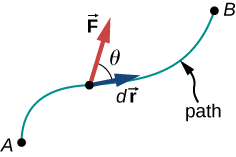
The vectors involved in the definition of the work done by a force acting on a particle are illustrated in Figure 7.2. While in general, Equation 7.2 requires mathematics beyond the scope of this text, in many simple situations this integral becomes a familiar integral in one variable. We will examine several such examples and restrict our discussion to these cases.
英語のヒント
OpenStax / Rice University, University Physics Volume 1, CC BY 4.0. Source-book artwork retained. · CC BY 4.0 · Source出典

Figure 7.2図 7.2
Vectors used to define work. The force acting on a particle and its infinitesimal displacement are shown at one point along the path between A and B. The infinitesimal work is the dot product of these two vectors; the total work is the integral of the dot product along the path.
英語のヒント
仕事を定義するベクトル。AからBへの経路上の一点で、粒子に働く力と微小変位を示す。微小な仕事は二つのベクトルの内積であり、全仕事は経路に沿ってその内積を積分したものである。
We choose to express the dot product in terms of the magnitudes of the vectors and the cosine of the angle between them, because the meaning of the dot product for work can be put into words more directly in terms of magnitudes and angles. We could equally well have expressed the dot product in terms of the various components introduced in Vectors. In two dimensions, these were the x- and y-components in Cartesian coordinates, or the r- and -components in polar coordinates; in three dimensions, it was just x-, y-, and z-components. Which choice is more convenient depends on the situation. In words, you can express Equation 7.1 for the work done by a force acting over a displacement as a product of one component acting parallel to the other component. From the properties of vectors, it doesn’t matter if you take the component of the force parallel to the displacement or the component of the displacement parallel to the force—you get the same result either way.
英語のヒント
Recall that the magnitude of a force times the cosine of the angle the force makes with a given direction is the component of the force in the given direction. The components of a vector can be positive, negative, or zero, depending on whether the angle between the vector and the component-direction is between and or and , or is equal to . As a result, the work done by a force can be positive, negative, or zero, depending on whether the force is generally in the direction of the displacement, generally opposite to the displacement, or perpendicular to the displacement. The maximum work is done by a given force when it is along the direction of the displacement (), and zero work is done when the force is perpendicular to the displacement ().
英語のヒント
力の大きさに、力とある方向との角の余弦を掛けると、その方向の力の成分になることを思い出そう。ベクトルと成分方向の角が〜、〜、またはであるかによって、成分は正・負・0になる。その結果、力が概ね変位と同じ向きか、逆向きか、垂直かによって、仕事も正・負・0になる。一定の力が最大の仕事をするのは、変位と同じ方向を向く場合であり、変位に垂直なら、仕事は0である。
The units of work are units of force multiplied by units of length, which in the SI system is newtons times meters, This combination is called a joule, for historical reasons that we will mention later, and is abbreviated as J. In the English system, still used in the United States, the unit of force is the pound (lb) and the unit of distance is the foot (ft), so the unit of work is the foot-pound
英語のヒント
仕事の単位は、力の単位と長さの単位の積である。SIではニュートンとメートルの積となる。この組合せを、後で述べる歴史的な理由からジュールと呼び、Jと略す。米国で今も使われるヤード・ポンド法では、力はポンドlb、距離はフィートftなので、仕事の単位はフィート・ポンドになる。