第7章仕事と運動エネルギー
7.3 Work-Energy Theorem7.3 仕事とエネルギーの定理
Learning Objectives学習目標
Learning Objectives学習目標
By the end of this section, you will be able to:
英語のヒント
この節を終えると、次のことができるようになる。
- Apply the work-energy theorem to find information about the motion of a particle, given the forces acting on it
英語のヒント
粒子に働く力から、仕事とエネルギーの定理を使って粒子の運動の情報を得る。 - Use the work-energy theorem to find information about the forces acting on a particle, given information about its motion
英語のヒント
粒子の運動の情報から、仕事とエネルギーの定理を使って粒子に働く力の情報を得る。
We have discussed how to find the work done on a particle by the forces that act on it, but how is that work manifested in the motion of the particle? According to Newton’s second law of motion, the sum of all the forces acting on a particle, or the net force, determines the rate of change in the momentum of the particle, or its motion. Therefore, we should consider the work done by all the forces acting on a particle, or the net work, to see what effect it has on the particle’s motion.
英語のヒント
粒子に働く力が粒子にする仕事の求め方を考えてきた。では、その仕事は粒子の運動にどう現れるのだろうか。ニュートンの運動の第二法則によれば、粒子に働くすべての力の和、すなわち合力が、粒子の運動量の変化率、つまりその運動を決める。したがって、粒子の運動への影響を知るには、粒子に働くすべての力がする仕事、すなわち正味の仕事を考える必要がある。
Let’s start by looking at the net work done on a particle as it moves over an infinitesimal displacement, which is the dot product of the net force and the displacement: Newton’s second law tells us that so For the mathematical functions describing the motion of a physical particle, we can rearrange the differentials dt, etc., as algebraic quantities in this expression, that is,
英語のヒント
まず、粒子が微小変位する間に粒子にされる正味の仕事を考える。これは合力と変位の内積である。ニュートンの第二法則からなので、となる。物理的な粒子の運動を記述する数学の関数では、この式のdtなどの微分を代数的な量として並べ替えられる。すなわち、
where we substituted the velocity for the time derivative of the displacement and used the commutative property of the dot product [Equation 2.30]. Since derivatives and integrals of scalars are probably more familiar to you at this point, we express the dot product in terms of Cartesian coordinates before we integrate between any two points A and B on the particle’s trajectory. This gives us the net work done on the particle:
英語のヒント
ここでは、変位の時間微分を速度に置き換え、内積の交換法則(式2.30)を使った。現段階では、スカラーの微分と積分のほうになじみがあるだろう。そこで、粒子の軌道上の任意の二点A、Bの間で積分する前に、内積を直交座標で表す。すると、粒子にされる正味の仕事は次のようになる。
In the middle step, we used the fact that the square of the velocity is the sum of the squares of its Cartesian components, and in the last step, we used the definition of the particle’s kinetic energy. This important result is called the work-energy theorem (Figure 7.12).
英語のヒント
途中の段階では、速度の大きさの2乗が直交座標成分の2乗の和に等しいことを使い、最後の段階では粒子の運動エネルギーの定義を使った。この重要な結果を、仕事とエネルギーの定理と呼ぶ(図7.12)。
Image omitted because its reuse rights could not be verified.権利の確認ができないため画像を割愛。
Figure 7.12図 7.12
Horse pulls are common events at state fairs. The work done by the horses pulling on the load results in a change in kinetic energy of the load, ultimately going faster. (credit: modification of work by “Jassen”/ Flickr)
英語のヒント
馬による牽引競技は、州の農業祭でよく行われる。馬が荷を引いてする仕事によって、荷の運動エネルギーが変化し、荷は次第に速くなる。(クレジット:“Jassen”/Flickrの作品を改変)
According to this theorem, when an object slows down, its final kinetic energy is less than its initial kinetic energy, the change in its kinetic energy is negative, and so is the net work done on it. If an object speeds up, the net work done on it is positive. When calculating the net work, you must include all the forces that act on an object. If you leave out any forces that act on an object, or if you include any forces that don’t act on it, you will get a wrong result.
英語のヒント
この定理によれば、物体が減速すると、最後の運動エネルギーは最初より小さくなる。運動エネルギーの変化は負であり、物体にされる正味の仕事も負になる。物体が加速して速くなるなら、物体にされる正味の仕事は正である。正味の仕事を計算するときは、物体に働くすべての力を含めなければならない。働いている力を一つでも除いたり、働いていない力を加えたりすれば、誤った結果になる。
The importance of the work-energy theorem, and the further generalizations to which it leads, is that it makes some types of calculations much simpler to accomplish than they would be by trying to solve Newton’s second law. For example, in Newton’s Laws of Motion, we found the speed of an object sliding down a frictionless plane by solving Newton’s second law for the acceleration and using kinematic equations for constant acceleration, obtaining
英語のヒント
仕事とエネルギーの定理、およびそこから導かれるさらに一般的な考え方が重要なのは、ニュートンの第二法則を解こうとするよりも、ある種の計算をずっと簡単にできるからである。たとえば「ニュートンの運動の法則」では、摩擦のない斜面を滑り下りる物体の速さを求めた。第二法則を加速度について解き、等加速度運動の式を使うと、次の結果が得られた。
where s is the displacement down the plane.
英語のヒント
ここでsは斜面に沿って下向きに測った変位である。
We can also get this result from the work-energy theorem in Equation 7.1. Since only two forces are acting on the object-gravity and the normal force-and the normal force doesn't do any work, the net work is just the work done by gravity. The work dW is the dot product of the force of gravity or and the displacement . After taking the dot product and integrating from an initial position to a final position , one finds the net work as
英語のヒント
この結果は、仕事の微小量を表す式を使い、仕事とエネルギーの定理からも得られる。物体に働く力は重力と垂直抗力の二つだけで、垂直抗力は仕事をしないので、正味の仕事は重力のする仕事だけである。仕事dWは、重力と変位の内積である。内積を計算し、初期位置から最終位置まで積分すると、正味の仕事は、
where y is positive up. The work-energy theorem says that this equals the change in kinetic energy:
英語のヒント
となる。yは上向きを正とする。仕事とエネルギーの定理によれば、これは運動エネルギーの変化に等しい。
Using a right triangle, we can see that so the result for the final speed is the same.
英語のヒント
直角三角形からとわかるので、最後の速さについて同じ結果が得られる。
What is gained by using the work-energy theorem? The answer is that for a frictionless plane surface, not much. However, Newton’s second law is easy to solve only for this particular case, whereas the work-energy theorem gives the final speed for any shaped frictionless surface. For an arbitrary curved surface, the normal force is not constant, and Newton’s second law may be difficult or impossible to solve analytically. Constant or not, for motion along a surface, the normal force never does any work, because it’s perpendicular to the displacement. A calculation using the work-energy theorem avoids this difficulty and applies to more general situations.
英語のヒント
仕事とエネルギーの定理を使うと、何が得られるのだろうか。摩擦のない平面に限れば、利点はあまり大きくない。しかし、ニュートンの第二法則を簡単に解けるのはこの特別な場合だけなのに対し、仕事とエネルギーの定理なら、摩擦のない面がどんな形でも最後の速さを求められる。任意の曲面では垂直抗力は一定でなく、第二法則を解析的に解くのは難しいか、不可能かもしれない。垂直抗力が一定かどうかにかかわらず、面に沿う運動では垂直抗力は変位に垂直なので、仕事をしない。仕事とエネルギーの定理による計算は、この難しさを避け、より一般的な状況に適用できる。
Example 7.9例題 7.9
Loop-the-Loop宙返りコース
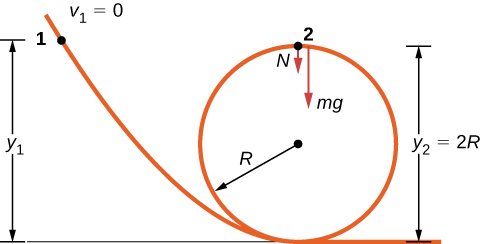
The frictionless track for a toy car includes a loop-the-loop of radius R. How high, measured from the bottom of the loop, must the car be placed to start from rest on the approaching section of track and go all the way around the loop?
英語のヒント
おもちゃの車が走る摩擦のないレールに、半径Rの宙返りループがある。手前のレール上で車を静かに放し、ループを一周させるには、ループの最下点から測ってどれだけの高さに車を置けばよいか。
OpenStax / Rice University, University Physics Volume 1, CC BY 4.0. Source-book artwork retained. · CC BY 4.0 · Source出典

Figure 7.13図 7.13
A frictionless track for a toy car has a loop-the-loop in it. How high must the car start so that it can go around the loop without falling off?
英語のヒント
おもちゃの車の摩擦のないレールには宙返りループがある。途中で落ちずに一周するには、どれだけの高さから出発すればよいか。
Strategy方針
The free-body diagram at the final position of the object is drawn in Figure 7.13. The gravitational work is the only work done over the displacement that is not zero. Since the weight points in the same direction as the net vertical displacement, the total work done by the gravitational force is positive. From the work-energy theorem, the starting height determines the speed of the car at the top of the loop,
英語のヒント
最終位置での力の図を図7.13に示す。この変位の間にゼロでない仕事をするのは重力だけである。重力は全体の鉛直変位と同じ向きなので、重力のする仕事の合計は正である。仕事とエネルギーの定理から、出発点の高さによってループ頂点での車の速さが決まる。
where the notation is shown in the accompanying figure. At the top of the loop, the normal force and gravity are both down and the acceleration is centripetal, so
英語のヒント
記号は図に示した。ループ頂点では垂直抗力と重力がともに下向きで、加速度は向心加速度なので、
The condition for maintaining contact with the track is that there must be some normal force, however slight; that is, . Substituting for and N, we can find the condition for .
英語のヒント
レールとの接触を保つ条件は、どれだけ小さくても垂直抗力が存在すること、すなわちである。とNを代入すれば、の条件を求められる。
Solution解答
Implement the steps in the strategy to arrive at the desired result:
英語のヒント
方針に示した手順を実行すると、求める結果に至る。
Significance考察
On the surface of the loop, the normal component of gravity and the normal contact force must provide the centripetal acceleration of the car going around the loop. The tangential component of gravity slows down or speeds up the car. A child would find out how high to start the car by trial and error, but now that you know the work-energy theorem, you can predict the minimum height (as well as other more useful results) from physical principles. By using the work-energy theorem, you did not have to solve a differential equation to determine the height.
英語のヒント
ループの面上では、重力の法線方向成分と垂直抗力が、周回する車に向心加速度を与える。重力の接線方向成分は車を減速または加速する。子どもなら試行錯誤で出発点の高さを見つけるだろう。しかし、仕事とエネルギーの定理がわかれば、物理法則から最小の高さを予測できる(さらに役立つほかの結果も得られる)。この定理を使うと、高さを求めるのに微分方程式を解く必要がなかった。
Additional Resources追加教材
In situations where the motion of an object is known, but the values of one or more of the forces acting on it are not known, you may be able to use the work-energy theorem to get some information about the forces. Work depends on the force and the distance over which it acts, so the information is provided via their product.
英語のヒント
物体の運動はわかっているが、働く力の一つ以上の値がわからない場合、仕事とエネルギーの定理を使って、力についての情報を得られることがある。仕事は力と、その力が働く距離に依存するので、情報は両者の積を通して得られる。
Example 7.10例題 7.10
Determining a Stopping Force停止させる力を求める
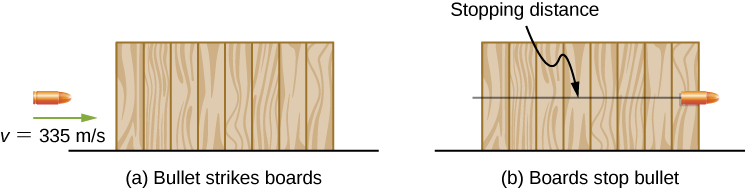
A bullet has a mass of 40 grains (2.60 g) and a muzzle velocity of 1100 ft./s (335 m/s). It can penetrate eight 1-inch pine boards, each with thickness 0.75 inches. What is the average stopping force exerted by the wood, as shown in Figure 7.14?
英語のヒント
質量40グレーン(2.60 g)、銃口速度1100 ft./s(335 m/s)の弾丸がある。この弾丸は、実際の厚さがそれぞれ0.75インチの「1インチ」の松板8枚を貫通する。図7.14に示すように、木材が及ぼす平均の制動力はいくらか。
OpenStax / Rice University, University Physics Volume 1, CC BY 4.0. Source-book artwork retained. · CC BY 4.0 · Source出典

Figure 7.14図 7.14
The boards exert a force to stop the bullet. As a result, the boards do work and the bullet loses kinetic energy.
英語のヒント
板は弾丸を止める力を及ぼす。その結果、板が仕事をし、弾丸は運動エネルギーを失う。
Strategy方針
We can assume that under the general conditions stated, the bullet loses all its kinetic energy penetrating the boards, so the work-energy theorem says its initial kinetic energy is equal to the average stopping force times the distance penetrated. The change in the bullet’s kinetic energy and the net work done stopping it are both negative, so when you write out the work-energy theorem, with the net work equal to the average force times the stopping distance, that’s what you get. The total thickness of eight 1-inch pine boards that the bullet penetrates is
英語のヒント
示された条件では、弾丸が板に入り込む間に運動エネルギーをすべて失うと仮定できる。仕事とエネルギーの定理から、最初の運動エネルギーは平均制動力と貫入距離の積に等しい。弾丸の運動エネルギーの変化も、停止までにされる正味の仕事も負である。正味の仕事を平均力と停止距離の積として定理を書けば、この関係が得られる。弾丸が貫く「1インチ」の松板8枚の合計の厚さはである。
Solution解答
Applying the work-energy theorem, we get
英語のヒント
仕事とエネルギーの定理を適用すると、
so
英語のヒント
したがって、
Significance考察
We could have used Newton’s second law and kinematics in this example, but the work-energy theorem also supplies an answer to less simple situations. The penetration of a bullet, fired vertically upward into a block of wood, is discussed in one section of Asif Shakur’s recent article [“Bullet-Block Science Video Puzzle.” The Physics Teacher (January 2015) 53(1): 15-16]. If the bullet is fired dead center into the block, it loses all its kinetic energy and penetrates slightly farther than if fired off-center. The reason is that if the bullet hits off-center, it has a little kinetic energy after it stops penetrating, because the block rotates. The work-energy theorem implies that a smaller change in kinetic energy results in a smaller penetration. You will understand more of the physics in this interesting article after you finish reading Angular Momentum.
英語のヒント
この例題はニュートンの第二法則と運動学でも解けたが、仕事とエネルギーの定理は、もっと複雑な状況にも答えを与える。鉛直上向きに発射された弾丸が木片に入り込む状況は、Asif Shakurの論文 “Bullet-Block Science Video Puzzle,” The Physics Teacher, 2015年1月, 53(1): 15–16の一節で扱われている。弾丸を木片の真ん中に撃ち込むと、運動エネルギーをすべて失い、中心を外して撃ち込む場合よりわずかに深く入る。中心を外して当たると木片が回転し、貫入が止まった後も弾丸が少し運動エネルギーをもつからである。仕事とエネルギーの定理から、運動エネルギーの変化が小さいほど貫入距離も小さい。「角運動量」を読み終えると、この興味深い論文の物理をよりよく理解できるだろう。