第7章仕事と運動エネルギー
Additional Problems追加問題
Exercises 84–98練習問題 84–98
Exercise 84問題 84
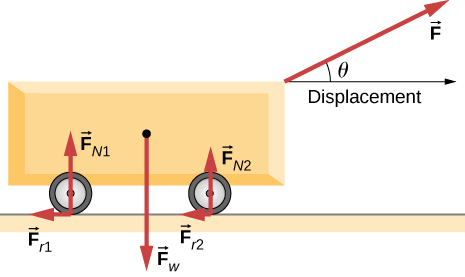
A cart is pulled a distance D on a flat, horizontal surface by a constant force F that acts at an angle with the horizontal direction. The other forces on the object during this time are gravity (), normal forces () and (), and rolling frictions and , as shown below. What is the work done by each force?
英語のヒント
台車を、水平面となす角の一定の力Fで、平らな水平面上を距離Dだけ引く。この間に働くほかの力は、下図の重力、垂直抗力と、転がり摩擦とである。それぞれの力がする仕事はいくらか。
Exercise 85問題 85
Consider a particle on which several forces act, one of which is known to be constant in time: As a result, the particle moves along the x-axis from to in some time interval. What is the work done by ?
英語のヒント
複数の力が働く粒子を考える。そのうち一つは時間によらず一定で、である。その結果、粒子はある時間間隔の間に、x軸に沿ってからへ動く。のする仕事はいくらか。
Solution解き方
Exercise 86問題 86
Consider a particle on which several forces act, one of which is known to be constant in time: As a result, the particle moves first along the x-axis from to and then parallel to the y-axis from to What is the work done by ?
英語のヒント
複数の力が働く粒子を考える。そのうち一つは時間によらず一定で、である。その結果、粒子はまずx軸に沿ってからへ動き、その後y軸に平行にからへ動く。のする仕事はいくらか。
Exercise 87問題 87
Consider a particle on which several forces act, one of which is known to be constant in time: As a result, the particle moves along a straight path from a Cartesian coordinate of (0 m, 0 m) to (5 m, 6 m). What is the work done by ?
英語のヒント
複数の力が働く粒子を考える。そのうち一つは時間によらず一定で、である。その結果、粒子は直交座標(0 m, 0 m)から(5 m, 6 m)まで直線上を動く。のする仕事はいくらか。
Solution解き方
Exercise 88問題 88
Consider a particle on which a force acts that depends on the position of the particle. This force is given by Find the work done by this force when the particle moves from the origin to a point 5 meters to the right on the x-axis.
英語のヒント
粒子の位置に依存する力が働く粒子を考える。この力はで与えられる。粒子が原点からx軸上の右へ5 mの点まで動く間に、この力がする仕事を求めよ。
Exercise 89問題 89
A boy pulls a 5-kg cart with a 20-N force at an angle of above the horizontal for a length of time. Over this time frame, the cart moves a distance of 12 m on the horizontal floor. (a) Find the work done on the cart by the boy. (b) What will be the work done by the boy if he pulled with the same force horizontally instead of at an angle of above the horizontal over the same distance?
英語のヒント
少年が質量5 kgの台車を、水平から上へ角度の向きに20 Nの力で、ある時間引く。その間に台車は水平な床を12 m動く。(a) 少年が台車にする仕事を求めよ。(b) 同じ距離を、水平から上への向きではなく、水平方向に同じ大きさの力で引いたら、仕事はいくらになるか。
Solution解き方
a. ; b.
a. 、b.
Exercise 90問題 90
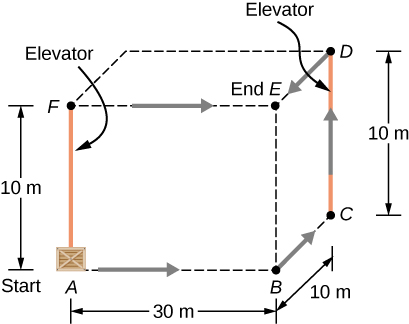
A crate of mass 200 kg is to be brought from a site on the ground floor to a third floor apartment. The workers know that they can either use the elevator first, then slide it along the third floor to the apartment, or first slide the crate to another location marked C below, and then take the elevator to the third floor and slide it on the third floor a shorter distance. The trouble is that the third floor is very rough compared to the ground floor. Given that the coefficient of kinetic friction between the crate and the ground floor is 0.100 and between the crate and the third floor surface is 0.300, find the work needed by the workers for each path shown from A to E. Assume that the force the workers need to do is just enough to slide the crate at constant velocity (zero acceleration). Note: The work by the elevator against the force of gravity is not done by the workers.
英語のヒント
質量200 kgの木箱を、地上階のある場所から3階の部屋へ運ぶ。作業員には二つの方法がある。まずエレベーターを使い、3階を滑らせて部屋まで運ぶか、先に下図のCまで滑らせ、それからエレベーターで3階へ運んで、短い距離だけ滑らせるかである。問題は、3階の床が地上階に比べて非常に粗いことだ。木箱と地上階の床の動摩擦係数は0.100、3階の床とは0.300である。図に示したAからEへの各経路について、作業員がする仕事を求めよ。作業員の力は、木箱を一定の速度(加速度ゼロ)で滑らせるのにちょうど十分だとする。なお、エレベーターが重力に逆らってする仕事は、作業員の仕事には含めない。


Exercise 91問題 91
A hockey puck of mass 0.17 kg is shot across a rough floor with the roughness different at different places, which can be described by a position-dependent coefficient of kinetic friction. For a puck moving along the x-axis, the coefficient of kinetic friction is the following function of x, where x is in m: Find the work done by the kinetic frictional force on the hockey puck when it has moved (a) from to , and (b) from to .
英語のヒント
質量0.17 kgのホッケーパックを、場所によって粗さの異なる床の上で滑らせる。その違いは、位置に依存する動摩擦係数で表せる。パックがx軸に沿って動くとき、動摩擦係数はxの関数で与えられる。xの単位はmである。(a) からまで、(b) からまで動くとき、動摩擦力がパックにする仕事を求めよ。
Solution解き方
a. ; b.
a. 、b.
Exercise 92問題 92
A horizontal force of 20 N is required to keep a 5.0 kg box traveling at a constant speed up a frictionless incline for a vertical height change of 3.0 m. (a) What is the work done by gravity during this change in height? (b) What is the work done by the normal force? (c) What is the work done by the horizontal force?
英語のヒント
質量5.0 kgの箱が、摩擦のない斜面を一定の速さで上り、鉛直に3.0 m高くなるように動かすには、水平方向に20 Nの力が必要である。(a) この高さの変化の間に重力がする仕事はいくらか。(b) 垂直抗力のする仕事はいくらか。(c) 水平力のする仕事はいくらか。
Exercise 93問題 93
A 7.0-kg box slides along a horizontal frictionless floor at 1.7 m/s and collides with a relatively massless spring that compresses 23 cm before the box comes to a stop. (a) How much kinetic energy does the box have before it collides with the spring? (b) Calculate the work done by the spring. (c) Determine the spring constant of the spring.
英語のヒント
質量7.0 kgの箱が、摩擦のない水平な床を1.7 m/sで滑り、質量を無視できるばねに衝突する。ばねは23 cm縮み、箱は止まる。(a) 衝突前の箱の運動エネルギーはいくらか。(b) ばねのする仕事を求めよ。(c) ばね定数を求めよ。
Solution解き方
a. 10. J; b. –10. J; c. 380 N/m
a. 10. J、b. −10. J、c. 380 N/m
Exercise 94問題 94
You are driving your car on a straight road with a coefficient of friction between the tires and the road of 0.55. A large piece of debris falls in front of your view and you immediate slam on the brakes, leaving a skid mark of 30.5 m (100-feet) long before coming to a stop. A policeman sees your car stopped on the road, looks at the skid mark, and gives you a ticket for traveling over the 13.4 m/s (30 mph) speed limit. Should you fight the speeding ticket in court?
英語のヒント
タイヤと路面の摩擦係数が0.55の直線道路を車で走っている。目の前に大きながれきが落ちてきたため、すぐにブレーキを強く踏み、30.5 m(100 ft)のスリップ痕を残して止まった。警察官が、道路上に止まった車とスリップ痕を見て、制限速度13.4 m/s(30 mph)を超えていたとして違反切符を切った。裁判で速度違反の処分を争うべきか。
Exercise 95問題 95
A crate is being pushed across a rough floor surface. If no force is applied on the crate, the crate will slow down and come to a stop. If the crate of mass 50 kg moving at speed 8 m/s comes to rest in 10 seconds, what is the rate at which the frictional force on the crate takes energy away from the crate?
英語のヒント
木箱が粗い床の上を押されている。力を加えなければ、木箱は減速して止まる。質量50 kg、速さ8 m/sの木箱が10 sで止まるなら、摩擦力が木箱からエネルギーを奪う平均の速さはいくらか。
Solution解き方
160 J/s
Exercise 96問題 96
Suppose a horizontal force of 20 N is required to maintain a speed of 8 m/s of a 50 kg crate. (a) What is the power of this force? (b) Note that the acceleration of the crate is zero despite the fact that 20 N force acts on the crate horizontally. What happens to the energy given to the crate as a result of the work done by this 20 N force?
英語のヒント
質量50 kgの木箱の速さを8 m/sに保つには、水平に20 Nの力が必要だとする。(a) この力の仕事率はいくらか。(b) 水平な20 Nの力が働いているのに、木箱の加速度はゼロである。この力の仕事によって木箱に渡されたエネルギーはどうなるか。
Exercise 97問題 97
Grains from a hopper falls at a rate of 10 kg/s vertically onto a conveyor belt that is moving horizontally at a constant speed of 2 m/s. (a) What force is needed to keep the conveyor belt moving at the constant velocity? (b) What is the minimum power of the motor driving the conveyor belt?
英語のヒント
ホッパーから穀物が10 kg/sの割合で鉛直に落ち、一定の速さ2 m/sで水平に動くベルトコンベヤーに載る。(a) ベルトを一定の速度で動かし続けるには、どれだけの力が必要か。(b) ベルトを駆動するモーターの最小出力はいくらか。
Solution解き方
a. 20 N; b. 40 W
a. 20 N、b. 40 W
Exercise 98問題 98
A cyclist in a race must climb a hill at a speed of 8 m/s. If the mass of the bike and the biker together is 80 kg, what must be the power output of the biker to achieve the goal?
英語のヒント
自転車レースの選手が、傾斜角の坂を8 m/sで上らなければならない。自転車と選手の合計質量が80 kgなら、必要な選手の出力はいくらか。