第11章角運動量
Summaryまとめ
- The angular momentum of a single particle about a designated origin is the vector product of the position vector in the given coordinate system and the particle’s linear momentum.
英語のヒント
指定した原点に関する一つの粒子の角運動量は、その座標系での位置ベクトルと粒子の運動量の外積である。 - The angular momentum of a system of particles about a designated origin is the vector sum of the individual momenta of the particles that make up the system.
英語のヒント
指定した原点に関する粒子の系の角運動量は、系を構成する各粒子の角運動量のベクトル和である。 - The net torque on a system about a given origin is the time derivative of the angular momentum about that origin: .
英語のヒント
ある原点に関して系に働く合トルクは、同じ原点に関する角運動量の時間微分、に等しい。 - A rigid rotating body has angular momentum directed along the axis of rotation. The time derivative of the angular momentum gives the net torque on a rigid body and is directed along the axis of rotation.
英語のヒント
回転する剛体は、回転軸方向の角運動量を持つ。その時間微分は剛体に働く合トルクを与え、その向きは回転軸に沿う。
Conceptual Questions概念に関する問題
Exercises 21–25練習問題 21–25
Exercise 21問題 21
Can you assign an angular momentum to a particle without first defining a reference point?
英語のヒント
先に基準点を定めずに、粒子の角運動量を定められるか。
Exercise 22問題 22
For a particle traveling in a straight line, are there any points about which the angular momentum is zero? Assume the line intersects the origin.
英語のヒント
直線上を運動する粒子について、その点に関する角運動量がゼロになるような点はあるか。直線は原点を通るものとする。
Solution解き方
All points on the straight line will give zero angular momentum, because a vector crossed into a parallel vector is zero.
英語のヒント
直線上のすべての点で角運動量はゼロになる。互いに平行なベクトルの外積はゼロだからである。
Exercise 23問題 23
Under what conditions does a rigid body have angular momentum but not linear momentum?
英語のヒント
剛体が角運動量を持ち、運動量を持たないのは、どのような条件の下か。
Exercise 24問題 24
If a particle is moving with respect to a chosen origin it has linear momentum. What conditions must exist for this particle’s angular momentum to be zero about the chosen origin?
英語のヒント
選んだ原点に対して運動している粒子は、運動量を持つ。その粒子の、同じ原点に関する角運動量がゼロとなるには、どのような条件が必要か。
Solution解き方
The particle must be moving on a straight line that passes through the chosen origin.
英語のヒント
粒子は、選んだ原点を通る直線上を運動していなければならない。
Exercise 25問題 25
If you know the velocity of a particle, can you say anything about the particle’s angular momentum?
英語のヒント
粒子の速度が分かれば、その角運動量について何か言えるか。
Problems問題
Exercises 26–43練習問題 26–43
Exercise 26問題 26
A 0.2-kg particle is travelling along the line with a velocity . What is the angular momentum of the particle about the origin?
英語のヒント
質量0.2 kgの粒子が、直線に沿って速度で進む。原点に関する粒子の角運動量はいくらか。
Exercise 27問題 27
A bird flies overhead from where you stand at an altitude of 300.0 m and at a speed horizontal to the ground of 20.0 m/s. The bird has a mass of 2.0 kg. The radius vector to the bird makes an angle with respect to the ground. The radius vector to the bird and its momentum vector lie in the xy-plane. What is the bird’s angular momentum about the point where you are standing?
英語のヒント
質量2.0 kgの鳥が、観測者の立つ位置の上空、高度300.0 mを、地面に水平な20.0 m/sの速さで飛ぶ。鳥への位置ベクトルは、地面となす角がである。位置ベクトルと運動量ベクトルはxy平面内にある。観測者の立つ点に関する鳥の角運動量はいくらか。
Solution解き方
The magnitude of the cross product of the radius to the bird and its momentum vector yields , which gives as the altitude of the bird h. The direction of the angular momentum is perpendicular to the radius and momentum vectors, which we choose arbitrarily as , which is in the plane of the ground:
英語のヒント
鳥への位置ベクトルと運動量ベクトルの外積の大きさはとなる。ここで、は鳥の高度hである。角運動量の向きは、位置ベクトルと運動量ベクトルの両方に垂直である。この方向をと選ぶと、これは地面の平面内にある。したがって、となる。
Exercise 28問題 28
A Formula One race car with mass 750.0 kg is speeding through a course in Monaco and enters a circular turn at 220.0 km/h in the counterclockwise direction about the origin of the circle. At another part of the course, the car enters a second circular turn at 180 km/h also in the counterclockwise direction. If the radius of curvature of the first turn is 130.0 m and that of the second is 100.0 m, compare the angular momenta of the race car in each turn taken about the origin of the circular turn.
英語のヒント
質量750.0 kgのF1レーシングカーがモナコのコースを走り、220.0 km/hで円弧状のカーブに入る。円の中心に関して反時計回りに進む。コースの別の場所では、180 km/hで二つ目の円弧状のカーブに入り、やはり反時計回りに進む。最初のカーブの曲率半径が130.0 m、二つ目が100.0 mなら、それぞれの円の中心に関する車の角運動量を比較せよ。
Exercise 29問題 29
A particle of mass 5.0 kg has position vector at a particular instant of time when its velocity is with respect to the origin. (a) What is the angular momentum of the particle? (b) If a force acts on the particle at this instant, what is the torque about the origin?
英語のヒント
質量5.0 kgの粒子が、ある瞬間に原点に対して位置ベクトル、速度を持つ。(a) 粒子の角運動量はいくらか。(b) この瞬間に力が働くなら、原点に関するトルクはいくらか。
Solution解き方
a. ;
b.
b.
(a) 。(b) 。
Exercise 30問題 30
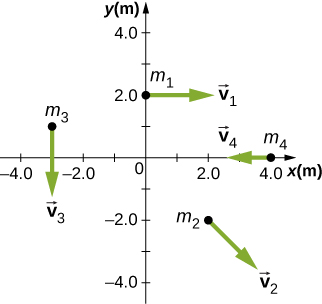
Use the right-hand rule to determine the directions of the angular momenta about the origin of the particles as shown below. The z-axis is out of the page.
英語のヒント
右手の規則を使い、下図の粒子の原点に関する角運動量の向きを定めよ。z軸は紙面の手前向きである。
Exercise 31問題 31
Suppose the particles in the preceding problem have masses . The velocities of the particles are , , , . (a) Calculate the angular momentum of each particle about the origin. (b) What is the total angular momentum of the four-particle system about the origin?
英語のヒント
前問の粒子の質量が、で、速度が、、、だとする。(a) 各粒子の原点に関する角運動量を計算せよ。(b) 4粒子系の原点に関する全角運動量はいくらか。
Solution解き方
a. , ,
; b.
; b.
(a) 、、。(b) 。
Exercise 32問題 32
Two particles of equal mass travel with the same speed in opposite directions along parallel lines separated by a distance d. Show that the angular momentum of this two-particle system is the same no matter what point is used as the reference for calculating the angular momentum.
英語のヒント
質量の等しい2個の粒子が、距離dだけ離れた平行な直線に沿い、互いに逆向きに同じ速さで進む。角運動量を計算する基準点をどこに選んでも、この2粒子系の角運動量は同じになることを示せ。
Exercise 33問題 33
An airplane of mass flies horizontally at an altitude of 10 km with a constant speed of 250 m/s relative to Earth. (a) What is the magnitude of the airplane’s angular momentum relative to a ground observer directly below the plane? (b) Does the angular momentum change as the airplane flies along a constant altitude?
英語のヒント
質量の飛行機が高度10 kmを、地球に対して一定の速さ250 m/sで水平に飛行する。(a) 飛行機の真下の地上にいる観測者に関する角運動量の大きさはいくらか。(b) 飛行機が高度を一定に保って進むと、角運動量は変わるか。
Solution解き方
a. ; b. No, the angular momentum stays the same since the cross-product involves only the perpendicular distance from the plane to the ground no matter where it is along its path.
英語のヒント
(a) 。(b) 変わらない。外積に関係する距離は飛行機から地面までの垂直距離だけなので、飛行経路上のどこにいても角運動量は同じである。
Exercise 34問題 34
At a particular instant, a 1.0-kg particle’s position is , its velocity is , and the force on it is . (a) What is the angular momentum of the particle about the origin? (b) What is the torque on the particle about the origin? (c) What is the time rate of change of the particle’s angular momentum at this instant?
英語のヒント
ある瞬間、質量1.0 kgの粒子の位置は、速度は、働く力はである。(a) 原点に関する角運動量はいくらか。(b) 原点に関するトルクはいくらか。(c) この瞬間の角運動量の時間変化率はいくらか。
Exercise 35問題 35
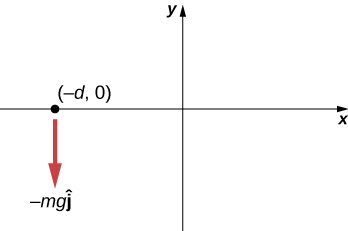
A particle of mass m is dropped at the point and falls vertically in Earth’s gravitational field (a) What is the expression for the angular momentum of the particle around the z-axis, which points directly out of the page as shown below? (b) Calculate the torque on the particle around the z-axis. (c) Is the torque equal to the time rate of change of the angular momentum?
英語のヒント
質量mの粒子を点で静かに放すと、地球の重力場内を鉛直に落下する。(a) 下図のように紙面の手前を向くz軸の周りの角運動量を、式で表せ。(b) z軸の周りで粒子に働くトルクを計算せよ。(c) トルクは角運動量の時間変化率に等しいか。


Solution解き方
a. ;
b. ; c. yes
b. ; c. yes
(a) 。(b) 。(c) 等しい。
Exercise 36問題 36
(a) Calculate the angular momentum of Earth in its orbit around the Sun. (b) Compare this angular momentum with the angular momentum of Earth about its axis.
英語のヒント
(a) 太陽の周りの公転による地球の角運動量を計算せよ。(b) これを、自転軸の周りの地球の角運動量と比較せよ。
Exercise 37問題 37
A boulder of mass 20 kg and radius 20 cm rolls down a hill 15 m high from rest. What is its angular momentum when it is half way down the hill? (b) At the bottom?
英語のヒント
質量20 kg、半径20 cmの大きな岩が、高さ15 mの丘の上で静止した状態から転がり下りる。(a) 高さの半分まで下りたとき、角運動量はいくらか。(b) 下端ではいくらか。
Solution解き方
a. ;
;
;
b. ;
;
;
b. ;
(a) より、、。(b) 、。
Exercise 38問題 38
A satellite is spinning at 6.0 rev/s. The satellite consists of a main body in the shape of a sphere of radius 2.0 m and mass 10,000 kg, and two antennas projecting out from the center of mass of the main body that can be approximated with rods of length 3.0 m each and mass 10 kg. The antenna’s lie in the plane of rotation. What is the angular momentum of the satellite?
英語のヒント
人工衛星が6.0 rev/sで回転している。本体は半径2.0 m、質量10,000 kgの球形で、本体の質量中心から2本のアンテナが突き出している。アンテナはそれぞれ長さ3.0 m、質量10 kgの棒で近似でき、回転の平面内にある。衛星の角運動量はいくらか。
Exercise 39問題 39
A propeller consists of two blades each 3.0 m in length and mass 120 kg each. The propeller can be approximated by a single rod rotating about its center of mass. The propeller starts from rest and rotates up to 1200 rpm in 30 seconds at a constant rate. (a) What is the angular momentum of the propeller at (b) What is the torque on the propeller?
英語のヒント
プロペラは、1枚につき長さ3.0 m、質量120 kgの羽根2枚からなる。プロペラは、質量中心の周りを回転する1本の棒で近似できる。静止状態から一定の割合で加速し、30秒で1200 rpmとなる。(a) での角運動量はいくらか。(b) プロペラに働くトルクはいくらか。
Solution解き方
a. ; ;
; ;
;
b.
; ;
;
b.
(a) 、、、、。(b) 。
Exercise 40問題 40
A pulsar is a rapidly rotating neutron star. The Crab nebula pulsar in the constellation Taurus has a period of , radius 10.0 km, and mass The pulsar’s rotational period will increase over time due to the release of electromagnetic radiation, which doesn’t change its radius but reduces its rotational energy. (a) What is the angular momentum of the pulsar? (b) Suppose the angular velocity decreases at a rate of . What is the torque on the pulsar?
英語のヒント
パルサーは、高速で回転する中性子星である。おうし座のかに星雲パルサーは、周期、半径10.0 km、質量を持つ。電磁放射を放出すると、半径は変わらずに回転エネルギーが減るため、自転周期は時間とともに長くなる。(a) パルサーの角運動量はいくらか。(b) 角速度がの割合で減少するとしたら、パルサーに働くトルクはいくらか。
Exercise 41問題 41
The blades of a wind turbine are 30 m in length and rotate at a maximum rotation rate of 20 rev/min. (a) If the blades are 6000 kg each and the rotor assembly has three blades, calculate the angular momentum of the turbine at this rotation rate. (b) What is the torque require to rotate the blades up to the maximum rotation rate in 5 minutes?
英語のヒント
風力タービンの羽根は長さ30 mで、最大回転数は20 rev/minである。(a) 羽根1枚の質量が6000 kgで、回転部に3枚の羽根があるとき、この回転数でのタービンの角運動量を計算せよ。(b) 5分間で最大回転数まで加速するのに必要なトルクはいくらか。
Solution解き方
a. ;
b.
b.
(a) 。(b) 。
Exercise 42問題 42
A roller coaster has mass 3000.0 kg and needs to make it safely through a vertical circular loop of radius 50.0 m. What is the minimum angular momentum of the coaster at the bottom of the loop to make it safely through? Neglect friction on the track. Take the coaster to be a point particle.
英語のヒント
質量3000.0 kgのジェットコースターが、半径50.0 mの鉛直な円形ループを安全に通過しなければならない。そのために必要な、ループ最下点での最小の角運動量はいくらか。軌道の摩擦は無視し、コースターを質点とみなす。
Exercise 43問題 43
A mountain biker takes a jump in a race and goes airborne. The mountain bike is travelling at 10.0 m/s before it goes airborne. If the mass of the front wheel on the bike is 750 g and has radius 35 cm, what is the angular momentum of the spinning wheel in the air the moment the bike leaves the ground?
英語のヒント
マウンテンバイクの選手がレース中にジャンプして空中に出る。離地する前の速さは10.0 m/sである。前輪の質量が750 g、半径が35 cmなら、地面を離れた瞬間の、空中で回る前輪の角運動量はいくらか。
Solution解き方
angular momentum
角運動量
rotational analog of linear momentum, found by taking the product of moment of inertia and angular velocity
英語のヒント
運動量に対応する回転の量で、慣性モーメントと角速度の積として求められる。