第11章角運動量
Summaryまとめ
- In the absence of external torques, a system’s total angular momentum is conserved. This is the rotational counterpart to linear momentum being conserved when the external force on a system is zero.
英語のヒント
外力によるトルクがなければ、系の全角運動量は保存される。これは、系に働く外力がゼロのときに運動量が保存されることに対応する、回転の法則である。 - For a rigid body that changes its angular momentum in the absence of a net external torque, conservation of angular momentum gives . This equation says that the angular velocity is inversely proportional to the moment of inertia. Thus, if the moment of inertia decreases, the angular velocity must increase to conserve angular momentum.
英語のヒント
外力による合トルクがない状態で角運動量が変化する剛体について、角運動量保存よりとなる。この式は、角速度が慣性モーメントに反比例することを示す。したがって、慣性モーメントが減ると、角運動量を保存するために角速度が増さなければならない。 - Systems containing both point particles and rigid bodies can be analyzed using conservation of angular momentum. The angular momentum of all bodies in the system must be taken about a common axis.
英語のヒント
質点と剛体の両方を含む系も、角運動量保存を使って解析できる。系に含まれるすべての物体の角運動量は、共通の軸に関して測らなければならない。
Conceptual Questions概念に関する問題
Exercises 44–49練習問題 44–49
Exercise 44問題 44
What is the purpose of the small propeller at the back of a helicopter that rotates in the plane perpendicular to the large propeller?
英語のヒント
ヘリコプターの後部には、大きなプロペラの面に垂直な面内で回転する、小さなプロペラがある。その目的は何か。
Solution解き方
Without the small propeller, the body of the helicopter would rotate in the opposite sense to the large propeller in order to conserve angular momentum. The small propeller exerts a thrust at a distance R from the center of mass of the aircraft to prevent this from happening.
英語のヒント
小さなプロペラがなければ、角運動量を保存するために、機体が大きなプロペラと逆向きに回転する。小さなプロペラは機体の質量中心から距離Rの位置で推力を生じ、機体の回転を防ぐ。
Exercise 45問題 45
Suppose a child walks from the outer edge of a rotating merry-go-round to the inside. Does the angular velocity of the merry-go-round increase, decrease, or remain the same? Explain your answer. Assume the merry-go-round is spinning without friction.
英語のヒント
回転遊具の外縁から内側へ子どもが歩くとする。遊具の角速度は増えるか、減るか、それとも変わらないか。理由も説明せよ。遊具は摩擦なく回転しているとする。
Exercise 46問題 46
As the rope of a tethered ball winds around a pole, what happens to the angular velocity of the ball?
英語のヒント
棒につながれた球のロープが棒に巻き付いていくと、球の角速度はどうなるか。
Solution解き方
The angular velocity increases because the moment of inertia is decreasing.
英語のヒント
慣性モーメントが減っているので、角速度は増える。
Exercise 47問題 47
Suppose the polar ice sheets broke free and floated toward Earth’s equator without melting. What would happen to Earth’s angular velocity?
英語のヒント
極地の氷床が離れ、溶けずに地球の赤道へ向かって漂ったとする。地球の角速度はどうなるか。
Exercise 48問題 48
Explain why stars spin faster when they collapse.
英語のヒント
恒星が収縮すると、自転が速くなる理由を説明せよ。
Solution解き方
More mass is concentrated near the rotational axis, which decreases the moment of inertia causing the star to increase its angular velocity.
英語のヒント
より多くの質量が回転軸の近くに集まるため、慣性モーメントが減り、恒星の角速度が増す。
Exercise 49問題 49
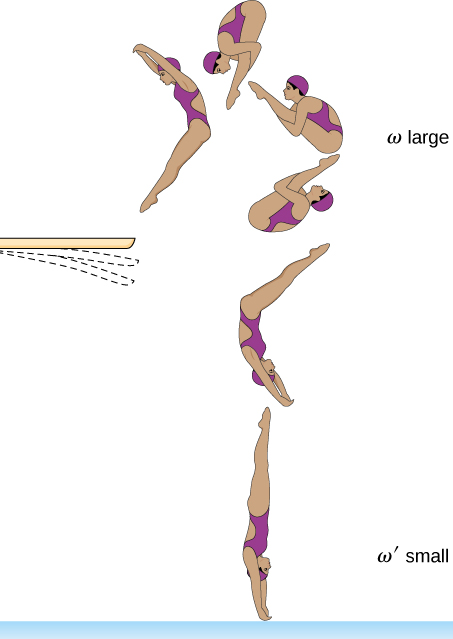
Competitive divers pull their limbs in and curl up their bodies when they do flips. Just before entering the water, they fully extend their limbs to enter straight down (see below). Explain the effect of both actions on their angular velocities. Also explain the effect on their angular momentum.
英語のヒント
飛込競技の選手は、宙返りの際に手足を引き寄せ、体を丸める。入水直前には手足を完全に伸ばして、まっすぐ下向きに入水する(下図)。二つの動作が角速度にどう影響するかを説明せよ。また、角運動量への影響も説明せよ。
Problems問題
Exercises 50–72練習問題 50–72
Exercise 50問題 50
A disk of mass 2.0 kg and radius 60 cm with a small mass of 0.05 kg attached at the edge is rotating at 2.0 rev/s. The small mass, while attached to the disk, slides gradually to the center of the disk. What is the disk’s final rotation rate?
英語のヒント
質量2.0 kg、半径60 cmの円盤の縁に、質量0.05 kgの小物体が取り付けられ、円盤は2.0 rev/sで回転している。小物体は円盤に付いたまま、徐々に中心へ滑っていく。最後の回転数はいくらか。
Exercise 51問題 51
The Sun’s mass is its radius is and it has a rotational period of approximately 28 days. If the Sun should collapse into a white dwarf of radius what would its period be if no mass were ejected and a sphere of uniform density can model the Sun both before and after?
英語のヒント
太陽の質量は、半径はで、自転周期は約28日である。太陽が半径の白色矮星へ収縮するとしたら、自転周期はいくらになるか。質量は放出されず、収縮の前後とも一様な密度の球で太陽を表せるとする。
Solution解き方
,
、。
Exercise 52問題 52
A cylinder with rotational inertia rotates clockwise about a vertical axis through its center with angular speed A second cylinder with rotational inertia rotates counterclockwise about the same axis with angular speed . If the cylinders couple so they have the same rotational axis what is the angular speed of the combination? What percentage of the original kinetic energy is lost to friction?
英語のヒント
回転慣性の円柱が、中心を通る鉛直軸の周りを、角速さで時計回りに回転する。回転慣性の別の円柱は、同じ軸の周りを角速さで反時計回りに回転する。二つの円柱が同じ回転軸で結合すると、全体の角速さはいくらになるか。初めの運動エネルギーの何パーセントが摩擦で失われるか。
Exercise 53問題 53
A diver off the high board imparts an initial rotation with their body fully extended before going into a tuck and executing three back somersaults before hitting the water. If their moment of inertia before the tuck is and after the tuck during the somersaults is , what rotation rate must the diver impart to their body directly off the board and before the tuck if they take 1.4 s to execute the somersaults before hitting the water?
英語のヒント
高飛込の選手が、体を完全に伸ばして踏み切るときに初めの回転を与え、その後、抱え込み姿勢で後方宙返りを3回して入水する。抱え込み前の慣性モーメントは、抱え込み中はである。入水までの宙返りに1.4 sかかるなら、踏切直後、抱え込み前に、体にどれだけの回転数を与える必要があるか。
Solution解き方
Exercise 54問題 54
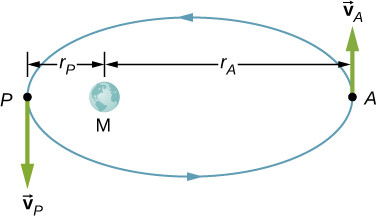
An Earth satellite has its apogee at 2500 km above the surface of Earth and perigee at 500 km above the surface of Earth. At apogee its speed is 6260 m/s. What is its speed at perigee? Earth’s radius is 6370 km (see below).
英語のヒント
地球の人工衛星が、地表から2500 kmの遠地点と、地表から500 kmの近地点を持つ。遠地点の速さは6260 m/sである。近地点の速さはいくらか。地球の半径は6370 kmである(下図)。
Exercise 55問題 55
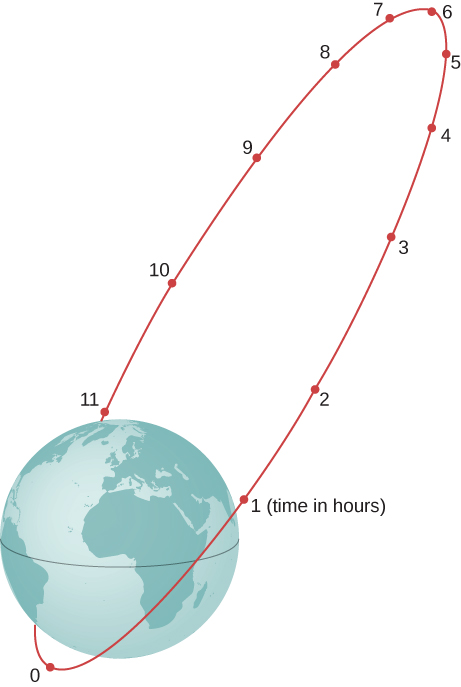
A Molniya orbit is a highly eccentric orbit of a communication satellite so as to provide continuous communications coverage for Scandinavian countries and adjacent Russia. The orbit is positioned so that these countries have the satellite in view for extended periods in time (see below). If a satellite in such an orbit has an apogee at 40,000.0 km as measured from the center of Earth and a velocity of 1.68 km/s, what would be its velocity at perigee measured at 200.0 km altitude?
英語のヒント
モルニヤ軌道は、スカンディナヴィア諸国と近隣のロシアを継続的に通信で覆うための、離心率の大きい通信衛星軌道である。衛星がこれらの国から長時間見えるように配置される(下図)。この軌道の衛星の遠地点が地球の中心から40,000.0 kmにあり、その速さが1.68 km/sなら、高度200.0 kmの近地点での速さはいくらか。
Solution解き方
Exercise 56問題 56
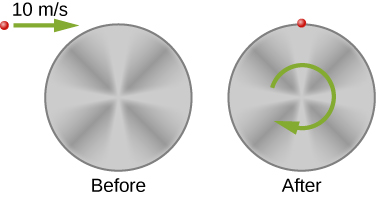
Shown below is a small particle of mass 20 g that is moving at a speed of 10.0 m/s when it collides and sticks to the edge of a uniform solid cylinder. The cylinder is free to rotate about its axis through its center and is perpendicular to the page. The cylinder has a mass of 0.5 kg and a radius of 10 cm, and is initially at rest. (a) What is the angular velocity of the system after the collision? (b) How much kinetic energy is lost in the collision?
英語のヒント
下図の質量20 gの小粒子が、速さ10.0 m/sで進み、一様な中実円柱の縁に衝突して付着する。円柱は、中心を通って紙面に垂直な軸の周りに自由に回転できる。質量は0.5 kg、半径は10 cmで、初めは静止している。(a) 衝突後の系の角速度はいくらか。(b) 衝突で失われる運動エネルギーはいくらか。
Exercise 57問題 57
A bug of mass 0.020 kg is at rest on the edge of a solid cylindrical disk rotating in a horizontal plane around the vertical axis through its center. The disk is rotating at 10.0 rad/s. The bug crawls to the center of the disk. (a) What is the new angular velocity of the disk? (b) What is the change in the kinetic energy of the system? (c) If the bug crawls back to the outer edge of the disk, what is the angular velocity of the disk then? (d) What is the new kinetic energy of the system? (e) What is the cause of the increase and decrease of kinetic energy?
英語のヒント
質量0.020 kgの虫が、中実円盤の縁で円盤に対して静止している。円盤は中心を通る鉛直軸の周りを、水平面内で10.0 rad/sで回転する。虫が中心まで這っていく。(a) 円盤の新しい角速度はいくらか。(b) 系の運動エネルギーの変化はいくらか。(c) 虫が再び外縁へ戻ると、角速度はいくらになるか。(d) そのときの系の運動エネルギーはいくらか。(e) 運動エネルギーが増減する原因は何か。
Solution解き方
a. ,
,
b. ;
c. back to the original value;
d. back to the original value;
e. work of the bug crawling on the disk
,
b. ;
c. back to the original value;
d. back to the original value;
e. work of the bug crawling on the disk
英語のヒント
(a) 、、。(b) 。(c) となり、元の値に戻る。(d) となり、元の値に戻る。(e) 虫が円盤上を這うときにする仕事。
Exercise 58問題 58
A uniform rod of mass 200 g and length 100 cm is free to rotate in a horizontal plane around a fixed vertical axis through its center, perpendicular to its length. Two small beads, each of mass 20 g, are mounted in grooves along the rod. Initially, the two beads are held by catches on opposite sides of the rod’s center, 10 cm from the axis of rotation. With the beads in this position, the rod is rotating with an angular velocity of 10.0 rad/s. When the catches are released, the beads slide outward along the rod. (a) What is the rod’s angular velocity when the beads reach the ends of the rod? (b) What is the rod’s angular velocity if the beads fly off the rod?
英語のヒント
質量200 g、長さ100 cmの一様な棒が、中心を通り棒に垂直な鉛直固定軸の周りを、水平面内で自由に回転できる。質量20 gの小さなビーズ2個が、棒に沿う溝にはめ込まれている。初めは、棒の中心の両側、回転軸から10 cmの位置に留め具で固定され、棒は10.0 rad/sで回転する。留め具を外すと、ビーズは棒に沿って外向きに滑る。(a) ビーズが棒の両端に達したときの角速度はいくらか。(b) ビーズが棒から飛び出した場合、棒の角速度はいくらか。
Exercise 59問題 59
A merry-go-round has a radius of 2.0 m and a moment of inertia A boy of mass 50 kg runs tangent to the rim at a speed of 4.0 m/s and jumps on. If the merry-go-round is initially at rest, what is the angular velocity after the boy jumps on?
英語のヒント
回転遊具の半径は2.0 m、慣性モーメントはである。質量50 kgの少年が縁の接線方向に4.0 m/sで走ってきて飛び乗る。遊具が初め静止していたなら、飛び乗った後の角速度はいくらか。
Solution解き方
,
,
,
Exercise 60問題 60
A playground merry-go-round has a mass of 120 kg and a radius of 1.80 m and it is rotating with an angular velocity of 0.500 rev/s. What is its angular velocity after a 22.0-kg child gets onto it by grabbing its outer edge? The child is initially at rest.
英語のヒント
遊び場の回転遊具は質量120 kg、半径1.80 mで、角速度0.500 rev/sで回転している。初め静止していた質量22.0 kgの子どもが外縁をつかんで乗ると、角速度はいくらになるか。
Exercise 61問題 61
Three children are riding on the edge of a merry-go-round that is 100 kg, has a 1.60-m radius, and is spinning at 20.0 rpm. The children have masses of 22.0, 28.0, and 33.0 kg. If the child who has a mass of 28.0 kg moves to the center of the merry-go-round, what is the new angular velocity in rpm?
英語のヒント
質量100 kg、半径1.60 mの回転遊具が20.0 rpmで回り、その縁に子ども3人が乗っている。子どもの質量は22.0 kg、28.0 kg、33.0 kgである。28.0 kgの子どもが中心へ移動したら、新しい角速度は何rpmになるか。
Solution解き方
,
,
,
Exercise 62問題 62
(a) Calculate the angular momentum of an ice skater spinning at 6.00 rev/s given his moment of inertia is . (b) He reduces his rate of spin (his angular velocity) by extending his arms and increasing his moment of inertia. Find the value of his moment of inertia if his angular velocity decreases to 1.25 rev/s. (c) Suppose instead he keeps his arms in and allows friction of the ice to slow him to 3.00 rev/s. What average torque was exerted if this takes 15.0 s?
英語のヒント
(a) 慣性モーメントのスケート選手が6.00 rev/sでスピンするとき、角運動量を計算せよ。(b) 腕を伸ばして慣性モーメントを大きくし、回転の速さ(角速度)を落とす。角速度が1.25 rev/sになったときの慣性モーメントを求めよ。(c) 代わりに腕を引き寄せたまま、氷との摩擦で3.00 rev/sまで減速するとする。15.0 sかかったなら、働いた平均トルクはいくらか。
Exercise 63問題 63
Twin skaters approach one another as shown below and lock hands. (a) Calculate their final angular velocity, given each had an initial speed of 2.50 m/s relative to the ice. Each has a mass of 70.0 kg, and each has a center of mass located 0.800 m from their locked hands. You may approximate their moments of inertia to be that of point masses at this radius. (b) Compare the initial kinetic energy and final kinetic energy.
英語のヒント
双子のスケート選手が下図のように近づき、手をつなぐ。(a) 初めはそれぞれ氷に対して2.50 m/sで進んでいたとして、最後の角速度を計算せよ。各選手の質量は70.0 kg、質量中心はつないだ手から0.800 mの位置にある。この半径にある質点として慣性モーメントを近似してよい。(b) 初めと最後の運動エネルギーを比較せよ。
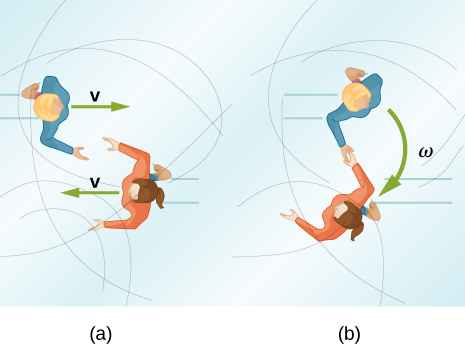


Solution解き方
a. ,
,
; b. ,
,
; b. ,
(a) 、、。(b) 、。
Exercise 64問題 64
A baseball catcher extends his arm straight up to catch a fast ball with a speed of 40 m/s. The baseball is 0.145 kg and the catcher’s arm length is 0.5 m and mass 4.0 kg. (a) What is the angular velocity of the arm immediately after catching the ball as measured from the arm socket? (b) What is the torque applied if the catcher stops the rotation of his arm 0.3 s after catching the ball?
英語のヒント
野球の捕手が腕を真上に伸ばし、速さ40 m/sの速球を捕る。球の質量は0.145 kg、腕の長さは0.5 m、質量は4.0 kgである。(a) 捕球直後の腕の角速度を、肩の関節を基準に求めよ。(b) 捕球後0.3 sで腕の回転を止めたなら、加えたトルクはいくらか。
Exercise 65問題 65
In 2015, in Warsaw, Poland, Olivia Oliver of Nova Scotia broke the world record for being the fastest spinner on ice skates. She achieved a record 342 rev/min, beating the existing Guinness World Record by 34 rotations. If an ice skater extends her arms at that rotation rate, what would be her new rotation rate? Assume she can be approximated by a 45-kg rod that is 1.7 m tall with a radius of 15 cm in the record spin. With her arms stretched take the approximation of a rod of length 130 cm with of her body mass aligned perpendicular to the spin axis. Neglect frictional forces.
英語のヒント
2015年、ポーランドのワルシャワで、ノバスコシア出身のオリヴィア・オリヴァーが、アイススケートのスピン速度の世界記録を更新した。342 rev/minを達成し、それまでのギネス世界記録を34回転上回った。この回転数で回る選手が腕を伸ばすと、新しい回転数はいくらになるか。記録のスピンでは、質量45 kg、高さ1.7 m、半径15 cmの棒で近似する。腕を伸ばした状態は、体重のを持つ長さ130 cmの棒が、回転軸に垂直に置かれたものとして近似する。摩擦力は無視する。
Solution解き方
Moment of inertia in the record spin: ,
,
,
英語のヒント
記録のスピンでの慣性モーメントは。腕を伸ばすととなり、を得る。
Exercise 66問題 66
A satellite in a geosynchronous circular orbit is 42,164.0 km from the center of Earth. A small asteroid collides with the satellite sending it into an elliptical orbit of apogee 45,000.0 km. What is the speed of the satellite at apogee? Assume its angular momentum is conserved.
英語のヒント
地球同期円軌道を回る人工衛星が、地球の中心から42,164.0 kmにある。小さな小惑星が衝突し、衛星は遠地点45,000.0 kmの楕円軌道へ移る。遠地点での速さはいくらか。角運動量は保存されるものとする。
Exercise 67問題 67
A gymnast does cartwheels along the floor and then launches herself into the air and executes several flips in a tuck while she is airborne. If her moment of inertia when executing the cartwheels is and her spin rate is 0.5 rev/s, how many revolutions does she do in the air if her moment of inertia in the tuck is and she has 2.0 s to do the flips in the air?
英語のヒント
体操選手が床で側転した後、空中に跳び、抱え込み姿勢で数回の宙返りをする。側転中の慣性モーメントはで、回転数は0.5 rev/sである。抱え込み中の慣性モーメントがで、空中で宙返りをする時間が2.0 sなら、何回転するか。
Solution解き方
Her spin rate in the air is: ;
She can do four flips in the air.
She can do four flips in the air.
英語のヒント
空中での回転数はである。空中で4回の宙返りができる。
Exercise 68問題 68
The centrifuge at NASA Ames Research Center has a radius of 8.8 m and can produce forces on its payload of 20 gs or 20 times the force of gravity on Earth. (a) What is the angular momentum of a 20-kg payload that experiences 10 gs in the centrifuge? (b) If the driver motor was turned off in (a) and the payload lost 10 kg, what would be its new spin rate, taking into account there are no frictional forces present?
英語のヒント
NASAエイムズ研究センターの遠心機は半径8.8 mで、搭載物に最大20g、すなわち地球の重力の20倍の力を与えられる。(a) 遠心機内で10gを受ける質量20 kgの搭載物の角運動量はいくらか。(b) (a)の状態で駆動モーターを止め、搭載物の質量が10 kg減ったなら、新しい回転数はいくらか。摩擦力は働かないものとする。
Exercise 69問題 69
A ride at a carnival has four spokes to which pods are attached that can hold two people. The spokes are each 15 m long and are attached to a central axis. Each spoke has mass 200.0 kg, and the pods each have mass 100.0 kg. If the ride spins at 0.2 rev/s with each pod containing two 50.0-kg children, what is the new spin rate if all the children jump off the ride?
英語のヒント
遊園地の乗り物が4本の放射状の腕を持ち、それぞれに2人乗りの座席カプセルが付いている。腕は中央の軸に取り付けられ、長さは各15 m、質量は各200.0 kgである。カプセルの質量は各100.0 kgである。各カプセルに質量50.0 kgの子どもが2人ずつ乗り、0.2 rev/sで回転しているとき、全員が飛び降りると新しい回転数はいくらになるか。
Solution解き方
Moment of inertia with all children aboard:
;
;
;
;
英語のヒント
子どもが全員乗っているときの慣性モーメントは。降りた後はで、となる。
Exercise 70問題 70
An ice skater is preparing for a jump with turns and has his arms extended. His moment of inertia is while his arms are extended, and he is spinning at 0.5 rev/s. If he launches himself into the air at 9.0 m/s at an angle of with respect to the ice, how many revolutions can he execute while airborne if his moment of inertia in the air is ?
英語のヒント
スケート選手が腕を伸ばし、回転を伴うジャンプに備えている。この状態の慣性モーメントはで、0.5 rev/sで回転している。氷面となす角の方向へ9.0 m/sで跳ぶとき、空中で何回転できるか。空中での慣性モーメントはとする。
Exercise 71問題 71
A space station consists of a giant rotating hollow cylinder of mass including people on the station and a radius of 100.00 m. It is rotating in space at 3.30 rev/min in order to produce artificial gravity. If 100 people of an average mass of 65.00 kg spacewalk to an awaiting spaceship, what is the new rotation rate when all the people are off the station?
英語のヒント
宇宙ステーションは、内部の人を含む質量、半径100.00 mの巨大な中空円柱である。人工重力を生むために、宇宙で3.30 rev/minで回転している。平均質量65.00 kgの100人が宇宙遊泳して待機中の宇宙船へ移ると、全員がステーションを離れた後の回転数はいくらになるか。
Solution解き方
,
,
,
Exercise 72問題 72
Neptune has a mass of and is from the Sun with an orbital period of 165 years. Planetesimals in the outer primordial solar system 4.5 × 10⁹ years ago coalesced into Neptune over hundreds of millions of years. If the primordial disk that evolved into our present day solar system had a radius of km and if the matter that made up these planetesimals that later became Neptune was spread out evenly on the edges of it, what was the orbital period of the outer edges of the primordial disk?
英語のヒント
海王星の質量は、太陽からの距離はで、公転周期は165年である。4.5 × 10⁹年前の原始太陽系の外側にあった微惑星が、数億年かけて合体し、海王星になった。現在の太陽系へと発達した原始円盤の半径が kmであり、後に海王星となる微惑星を構成した物質が、その外縁に均等に広がっていたとする。原始円盤の外縁の公転周期はいくらだったか。
law of conservation of angular momentum
角運動量保存の法則
angular momentum is conserved, that is, the initial angular momentum is equal to the final angular momentum when no external torque is applied to the system
英語のヒント
系に外力のトルクが働かなければ角運動量は保存される。すなわち、初めの角運動量と最後の角運動量が等しい。