第11章角運動量
11.2 Angular Momentum11.2 角運動量
Learning Objectives学習目標
Learning Objectives学習目標
By the end of this section, you will be able to:
英語のヒント
この節を終えると、次のことができるようになる。
- Describe the vector nature of angular momentum
英語のヒント
角運動量のベクトルとしての性質を説明する。 - Find the total angular momentum and torque about a designated origin of a system of particles
英語のヒント
指定した原点に関して、粒子の系の全角運動量とトルクを求める。 - Calculate the angular momentum of a rigid body rotating about a fixed axis
英語のヒント
固定軸の周りを回転する剛体の角運動量を計算する。 - Calculate the torque on a rigid body rotating about a fixed axis
英語のヒント
固定軸の周りを回転する剛体に働くトルクを計算する。 - Use conservation of angular momentum in the analysis of objects that change their rotation rate
英語のヒント
回転の速さが変化する物体を、角運動量保存を使って解析する。
Why does Earth keep on spinning? What started it spinning to begin with? Why doesn’t Earth’s gravitational attraction bring the Moon crashing in toward Earth? And how does an ice skater manage to spin faster and faster simply by pulling her arms in? Why does she not have to exert a torque to spin faster?
英語のヒント
地球はなぜ回り続けるのか。そもそも何が地球を回転させ始めたのか。地球の重力に引かれて、月が地球へ落ちてこないのはなぜか。スケート選手は、腕を引き寄せるだけで、どうしてますます速く回転できるのか。速く回るためにトルクを加える必要がないのはなぜか。
Questions like these have answers based in angular momentum, the rotational analog to linear momentum. In this chapter, we first define and then explore angular momentum from a variety of viewpoints. First, however, we investigate the angular momentum of a single particle. This allows us to develop angular momentum for a system of particles and for a rigid body that is cylindrically symmetric.
英語のヒント
こうした問いには、運動量に対応する回転の量である、角運動量を基に答えられる。この章では、まず角運動量を定義し、さまざまな観点から調べる。そのために最初に、一つの粒子の角運動量を考える。これにより、粒子の系や、円筒対称な剛体へと角運動量の考え方を発展させられる。
Angular Momentum of a Single Particle一つの粒子の角運動量
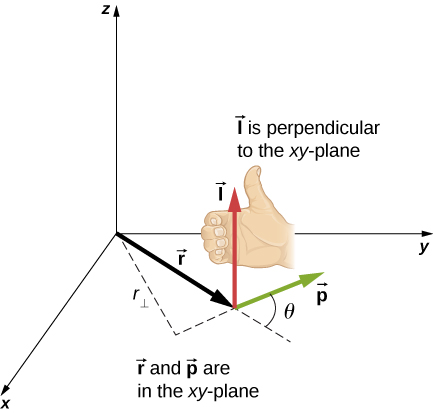
Figure 11.9 shows a particle at a position with linear momentum with respect to the origin. Even if the particle is not rotating about the origin, we can still define an angular momentum in terms of the position vector and the linear momentum.
英語のヒント
図11.9は、原点に対して位置にあり、運動量を持つ粒子を示す。粒子が原点の周りを回転していなくても、位置ベクトルと運動量を使って角運動量を定義できる。
OpenStax / Rice University, University Physics Volume 1, CC BY 4.0. Source-book artwork retained. · CC BY 4.0 · Source出典

Figure 11.9図 11.9
In three-dimensional space, the position vector locates a particle in the xy-plane with linear momentum . The angular momentum with respect to the origin is , which is in the z-direction. The direction of is given by the right-hand rule, as shown.
英語のヒント
3次元空間で、位置ベクトルはxy平面上の粒子の位置を示し、粒子は運動量を持つ。原点に関する角運動量はで、z方向を向く。図のように、の向きは右手の規則で決まる。
The intent of choosing the direction of the angular momentum to be perpendicular to the plane containing and is similar to choosing the direction of torque to be perpendicular to the plane of as discussed in Fixed-Axis Rotation. The magnitude of the angular momentum is found from the definition of the cross-product,
英語のヒント
角運動量をとを含む平面に垂直な向きに定める考え方は、「固定軸の周りの回転」でトルクの向きをの平面に垂直に定めたのと同様である。角運動量の大きさは、外積の定義から求められる。
where is the angle between and The units of angular momentum are .
英語のヒント
ここで、はとのなす角である。角運動量の単位はである。
As with the definition of torque, we can define a lever arm that is the perpendicular distance from the momentum vector to the origin, With this definition, the magnitude of the angular momentum becomes
英語のヒント
トルクの定義と同様に、運動量ベクトルの作用線から原点までの垂直距離を、腕の長さとして定められる。すなわち、である。この定義を使うと、角運動量の大きさは次のようになる。
We see that if the direction of is such that it passes through the origin, then and the angular momentum is zero because the lever arm is zero. In this respect, the magnitude of the angular momentum depends on the choice of origin.
英語のヒント
の向きが原点を通るような場合には、となる。腕の長さがゼロなので、角運動量もゼロである。このように、角運動量の大きさは原点の選び方に依存する。
If we take the time derivative of the angular momentum, we arrive at an expression for the torque on the particle:
英語のヒント
角運動量を時間で微分すると、粒子に働くトルクの式を得る。
Here we have used the definition of and the fact that a vector crossed into itself is zero. From Newton’s second law, the net force acting on the particle, and the definition of the net torque, we can write
英語のヒント
ここでは、の定義と、ベクトルとそれ自身の外積がゼロになることを使った。ニュートンの第2法則によれば、は粒子に働く合力である。さらに、合トルクの定義から次のように書ける。
Note the similarity with the linear result of Newton’s second law, . The following problem-solving strategy can serve as a guideline for calculating the angular momentum of a particle.
英語のヒント
並進運動でのニュートンの第2法則、との類似に注目しよう。次の問題解決の手順は、粒子の角運動量を計算する指針となる。
Example 11.4例題 11.4
Angular Momentum and Torque on a Meteor流星の角運動量とトルク
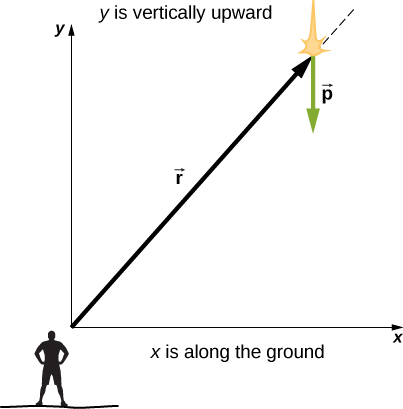
A meteor enters Earth’s atmosphere (Figure 11.10) and is observed by someone on the ground before it burns up in the atmosphere. The vector gives the position of the meteor with respect to the observer. At the instant the observer sees the meteor, it has linear momentum , and it is accelerating at a constant along its path, which for our purposes can be taken as a straight line. (a) What is the angular momentum of the meteor about the origin, which is at the location of the observer? (b) What is the torque on the meteor about the origin?
英語のヒント
地球の大気に流星が入り(図11.10)、燃え尽きる前に地上の観測者がそれを見つけた。観測者に対する流星の位置は、ベクトルで与えられる。見つけた瞬間の流星の運動量はであり、軌道に沿って一定のの加速度を持つ。ここでの目的には、軌道を直線とみなせる。(a) 観測者の位置を原点とすると、流星の原点に関する角運動量はいくらか。(b) 原点に関して、流星に働くトルクはいくらか。
OpenStax / Rice University, University Physics Volume 1, CC BY 4.0. Source-book artwork retained. · CC BY 4.0 · Source出典

Figure 11.10図 11.10
An observer on the ground sees a meteor at position with linear momentum .
英語のヒント
地上の観測者が、位置にあり運動量を持つ流星を見る。
Strategy方針
We resolve the acceleration into x- and y-components and use the kinematic equations to express the velocity as a function of acceleration and time. We insert these expressions into the linear momentum and then calculate the angular momentum using the cross-product. Since the position and momentum vectors are in the xy-plane, we expect the angular momentum vector to be along the z-axis. To find the torque, we take the time derivative of the angular momentum.
英語のヒント
加速度をx成分とy成分に分解し、運動学の式で速度を加速度と時間の関数として表す。これを運動量に代入し、外積を使って角運動量を計算する。位置ベクトルと運動量ベクトルはxy平面内にあるので、角運動量ベクトルはz軸方向を向くはずである。トルクは、角運動量を時間で微分して求める。
Solution解答
The meteor is entering Earth’s atmosphere at an angle of below the horizontal, so the components of the acceleration in the x- and y-directions are
英語のヒント
流星は水平から下への角度で地球の大気に入ってくる。したがって、加速度のx成分とy成分は次のようになる。
We write the velocities using the kinematic equations.
英語のヒント
運動学の式を使って速度を表す。
- The angular momentum is
英語のヒント
角運動量は次のようになる。At , the angular momentum of the meteor about the origin is英語のヒント
での流星の原点に関する角運動量は、次の値となる。This is the instant that the observer sees the meteor.英語のヒント
これは、観測者が流星を見つける瞬間である。 - To find the torque, we take the time derivative of the angular momentum. Taking the time derivative of as a function of time, which is the second equation immediately above, we have
英語のヒント
トルクを求めるため、角運動量を時間で微分する。すぐ上の二つ目の式で、時間の関数として表されているを微分すると、次のようになる。Then, since , we have英語のヒント
すると、より、次の結果を得る。The units of torque are given as newton-meters, not to be confused with joules. As a check, we note that the lever arm is the x-component of the vector in Figure 11.10 since it is perpendicular to the force acting on the meteor, which is along its path. By Newton’s second law, this force is英語のヒント
トルクの単位はニュートンメートルで表され、ジュールと混同してはならない。確認のために図11.10を見ると、腕の長さは、ベクトルのx成分である。これは、流星の軌道に沿って働く力に垂直だからである。ニュートンの第2法則によれば、この力は次のようになる。The lever arm is英語のヒント
腕の長さは次の値である。Thus, the torque is英語のヒント
したがって、トルクは次のようになる。
Significance考察
Since the meteor is accelerating downward toward Earth, its radius and velocity vector are changing. Therefore, since , the angular momentum is changing as a function of time. The torque on the meteor about the origin, however, is constant, because the lever arm and the force on the meteor are constants. This example is important in that it illustrates that the angular momentum depends on the choice of origin about which it is calculated. The methods used in this example are also important in developing angular momentum for a system of particles and for a rigid body.
英語のヒント
流星は地球へ向かって下向きに加速するので、位置ベクトルと速度ベクトルが変化する。したがって、より、角運動量は時間の関数として変化する。しかし、原点に関して流星に働くトルクは一定である。腕の長さと流星に働く力が一定だからである。この例題は、角運動量が計算の基準となる原点の選び方に依存することを示す点で重要である。用いた方法は、粒子の系や剛体の角運動量を考える上でも重要となる。