第11章角運動量
11.3 Conservation of Angular Momentum11.3 角運動量保存
Learning Objectives学習目標
Learning Objectives学習目標
By the end of this section, you will be able to:
英語のヒント
この節を終えると、次のことができるようになる。
- Apply conservation of angular momentum to determine the angular velocity of a rotating system in which the moment of inertia is changing
英語のヒント
慣性モーメントが変わる回転系について、角運動量保存を用いて角速度を求める。 - Explain how the rotational kinetic energy changes when a system undergoes changes in both moment of inertia and angular velocity
英語のヒント
系の慣性モーメントと角速度の両方が変化するとき、回転の運動エネルギーがどのように変わるかを説明する。
So far, we have looked at the angular momentum of systems consisting of point particles and rigid bodies. We have also analyzed the torques involved, using the expression that relates the external net torque to the change in angular momentum, Equation 11.8. Examples of systems that obey this equation include a freely spinning bicycle tire that slows over time due to torque arising from friction, or the slowing of Earth’s rotation over millions of years due to frictional forces exerted on tidal deformations.
英語のヒント
これまで、質点や剛体からなる系の角運動量を見てきた。また、外力による合トルクと角運動量の変化を結ぶ式を使って、関係するトルクも解析した。この式に従う例には、自由に回転する自転車のタイヤが、摩擦によるトルクで次第に遅くなる場合がある。また、潮汐変形に働く摩擦力によって、地球の自転が数百万年かけて遅くなる場合もある。
However, suppose there is no net external torque on the system, In this case, Equation 11.8 becomes the law of conservation of angular momentum.
英語のヒント
ここで、系に働く外力による合トルクがなく、であるとしよう。この場合、角運動量の変化率とトルクの式は、角運動量保存の法則となる。
Note that the total angular momentum is conserved. Any of the individual angular momenta can change as long as their sum remains constant. This law is analogous to linear momentum being conserved when the external force on a system is zero.
英語のヒント
保存されるのは、全角運動量であることに注意しよう。和が一定に保たれる限り、個々の角運動量は変化してもよい。この法則は、系に働く外力がゼロなら運動量が保存されることに対応する。
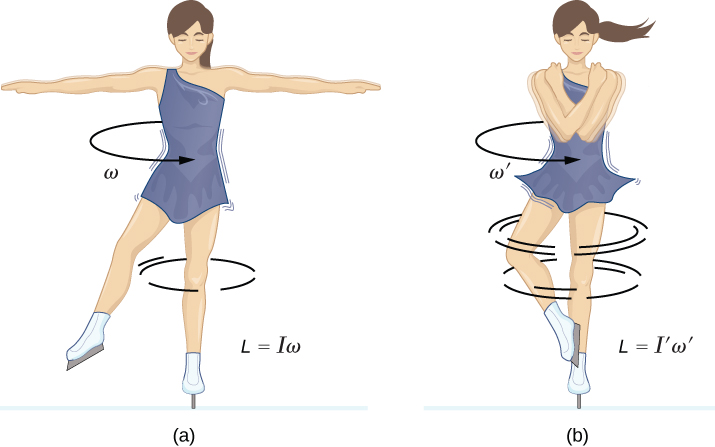
As an example of conservation of angular momentum, Figure 11.14 shows an ice skater executing a spin. The net torque on her is very close to zero because there is relatively little friction between her skates and the ice. Also, the friction is exerted very close to the pivot point. Both are small, so is negligible. Consequently, she can spin for quite some time. She can also increase her rate of spin by pulling her arms and legs in. Why does pulling her arms and legs in increase her rate of spin? The answer is that her angular momentum is constant, so that
英語のヒント
角運動量保存の例として、図11.14はスピンをするスケート選手を示す。スケート靴と氷の間の摩擦は比較的小さいので、選手に働く合トルクはほぼゼロである。摩擦が働く場所も回転の支点に非常に近い。がどちらも小さいため、は無視できる。したがって、選手はかなり長い間回り続けられる。腕や脚を引き寄せると、回転の速さを増すこともできる。なぜ引き寄せると速く回るのか。角運動量が一定なので、次式が成り立つからである。
or
英語のヒント
すなわち、
where the primed quantities refer to conditions after she has pulled in her arms and reduced her moment of inertia. Because is smaller, the angular velocity must increase to keep the angular momentum constant.
英語のヒント
ここで、プライム付きの量は、腕を引き寄せて慣性モーメントを小さくした後の状態を表す。が小さくなるので、角運動量を一定に保つには、角速度が大きくならなければならない。
OpenStax / Rice University, University Physics Volume 1, CC BY 4.0. Source-book artwork retained. · CC BY 4.0 · Source出典

Figure 11.14図 11.14
(a) An ice skater is spinning on the tip of her skate with her arms extended. Her angular momentum is conserved because the net torque on her is negligibly small. (b) Her rate of spin increases greatly when she pulls in her arms, decreasing her moment of inertia. The work she does to pull in her arms results in an increase in rotational kinetic energy.
英語のヒント
(a) スケート選手が腕を伸ばし、スケート靴の先端を軸に回転している。合トルクが無視できるほど小さいので、角運動量は保存される。(b) 腕を引き寄せて慣性モーメントを減らすと、回転の速さは大きく増す。腕を引き寄せるためにする仕事によって、回転の運動エネルギーが増加する。
It is interesting to see how the rotational kinetic energy of the skater changes when she pulls her arms in. Her initial rotational energy is
英語のヒント
選手が腕を引き寄せたとき、回転の運動エネルギーがどう変わるかも興味深い。初めの回転エネルギーは次式である。
whereas her final rotational energy is
英語のヒント
これに対し、最後の回転エネルギーは次式となる。
Since we can substitute for and find
英語のヒント
なので、を置き換えると次の結果を得る。
Because her moment of inertia has decreased, her final rotational kinetic energy has increased. The source of this additional rotational kinetic energy is the work required to pull her arms inward. Note that the skater’s arms do not move in a perfect circle—they spiral inward. This work causes an increase in the rotational kinetic energy, while her angular momentum remains constant. Since she is in a frictionless environment, no energy escapes the system. Thus, if she were to extend her arms to their original positions, she would rotate at her original angular velocity and her kinetic energy would return to its original value.
英語のヒント
慣性モーメントが減り、となったので、最終的な回転の運動エネルギーは増えている。増加分の源は、腕を内側へ引き寄せるために必要な仕事である。腕は完全な円を描くのではなく、らせん状に内側へ動くことに注意しよう。この仕事が回転の運動エネルギーを増やすが、角運動量は一定に保たれる。摩擦のない環境にいるので、系の外へエネルギーは逃げない。したがって、腕を元の位置まで伸ばせば、角速度は元に戻り、運動エネルギーも元の値に戻る。
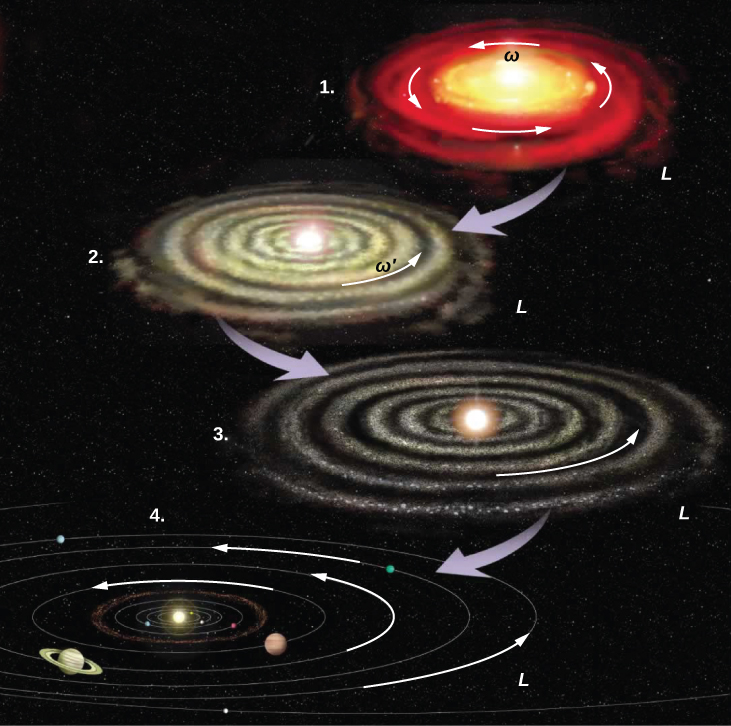
The solar system is another example of how conservation of angular momentum works in our universe. Our solar system was born from a huge cloud of gas and dust that initially had rotational energy. Gravitational forces caused the cloud to contract, and the rotation rate increased as a result of conservation of angular momentum (Figure 11.15).
英語のヒント
太陽系も、宇宙で角運動量保存が働く例である。太陽系は、もともと回転エネルギーを持つ巨大なガスと塵の雲から生まれた。重力が雲を収縮させると、角運動量保存によって回転の速さが増した(図11.15)。
(credit: modification of work by NASA) NASA imagery used for educational publication; no NASA endorsement is implied. · NASA media use permission; OpenStax additions CC BY 4.0 · Source出典

Figure 11.15図 11.15
The solar system coalesced from a cloud of gas and dust that was originally rotating. The orbital motions and spins of the planets are in the same direction as the original spin and conserve the angular momentum of the parent cloud. (credit: modification of work by NASA)
英語のヒント
太陽系は、もともと回転していたガスと塵の雲が集まってできた。惑星の公転と自転は元の回転と同じ向きで、母体となった雲の角運動量を保存する。(NASAの作品を改変)
We continue our discussion with an example that has applications to engineering.
英語のヒント
次に、工学へ応用できる例を考えよう。
Example 11.7例題 11.7
Coupled Flywheels結合するはずみ車
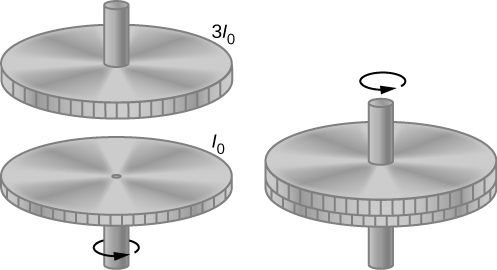
A flywheel rotates without friction at an angular velocity on a frictionless, vertical shaft of negligible rotational inertia. A second flywheel, which is at rest and has a moment of inertia three times that of the rotating flywheel, is dropped onto it (Figure 11.16). Because friction exists between the surfaces, the flywheels very quickly reach the same rotational velocity, after which they spin together. (a) Use the law of conservation of angular momentum to determine the angular velocity of the combination. (b) What fraction of the initial kinetic energy is lost in the coupling of the flywheels?
英語のヒント
回転慣性を無視できる摩擦のない鉛直軸で、はずみ車が角速度で摩擦なく回転している。静止している2個目のはずみ車をその上に落とす。2個目の慣性モーメントは、回転しているものの3倍である(図11.16)。接触面に摩擦があるので、二つのはずみ車はすぐに同じ回転速度となり、その後は一緒に回る。(a) 角運動量保存の法則を使い、結合後の角速度を求めよ。(b) 結合によって失われる運動エネルギーは、初めの何割か。
OpenStax / Rice University, University Physics Volume 1, CC BY 4.0. Source-book artwork retained. · CC BY 4.0 · Source出典

Figure 11.16図 11.16
Two flywheels are coupled and rotate together.
英語のヒント
2個のはずみ車が結合し、一緒に回転する。
Strategy方針
Part (a) is straightforward to solve for the angular velocity of the coupled system. We use the result of (a) to compare the initial and final kinetic energies of the system in part (b).
英語のヒント
(a)では、結合した系の角速度を直接求められる。(b)では(a)の結果を使い、系の初めと最後の運動エネルギーを比較する。
Solution解答
a. No external torques act on the system. The force due to friction produces an internal torque, which does not affect the angular momentum of the system. Therefore conservation of angular momentum gives
英語のヒント
(a) 系には外力によるトルクが働かない。摩擦力は内力によるトルクを生じるが、系の角運動量には影響しない。したがって、角運動量保存より次式を得る。
b. Before contact, only one flywheel is rotating. The rotational kinetic energy of this flywheel is the initial rotational kinetic energy of the system, . The final kinetic energy is
英語のヒント
(b) 接触前は、はずみ車が一つだけ回転している。その回転の運動エネルギーが、系の初めの回転の運動エネルギーである。最後の運動エネルギーはとなる。
Therefore, the ratio of the final kinetic energy to the initial kinetic energy is
英語のヒント
したがって、初めの運動エネルギーに対する最後の運動エネルギーの比は、次のようになる。
Thus, 3/4 of the initial kinetic energy is lost to the coupling of the two flywheels.
英語のヒント
よって、二つのはずみ車の結合によって、初めの運動エネルギーの3/4が失われる。
Significance考察
Since the rotational inertia of the system increased, the angular velocity decreased, as expected from the law of conservation of angular momentum. In this example, we see that the final kinetic energy of the system has decreased, as energy is lost to the coupling of the flywheels. Compare this to the example of the skater in Figure 11.14 doing work to bring her arms inward and adding rotational kinetic energy.
英語のヒント
系の回転慣性が増えたので、角運動量保存の法則から予想されるとおり、角速度は小さくなった。この例では、はずみ車の結合によってエネルギーが失われるため、系の最後の運動エネルギーが減っている。腕を内側に引き寄せる仕事をし、回転の運動エネルギーを増やす図11.14のスケート選手の例と比較しよう。
Example 11.8例題 11.8
Dismount from a High Bar鉄棒からの降り技
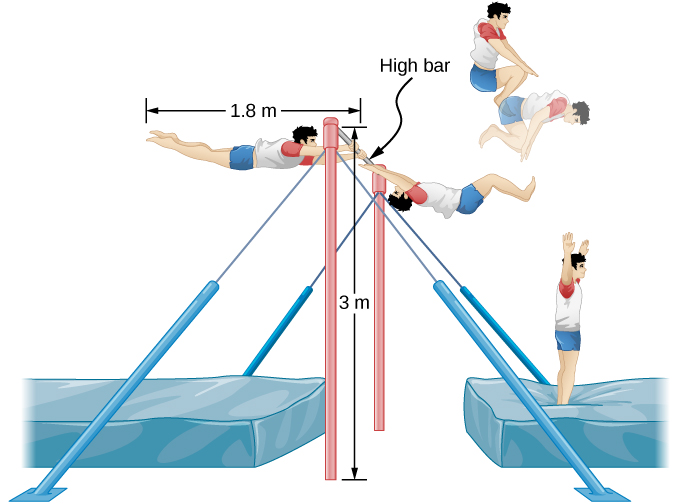
An 80.0-kg gymnast dismounts from a high bar. He starts the dismount at full extension, then tucks to complete a number of revolutions before landing. His moment of inertia when fully extended can be approximated as a rod of length 1.8 m and when in the tuck a rod of half that length. If his rotation rate at full extension is 1.0 rev/s and he enters the tuck when his center of mass is at 3.0 m height moving horizontally to the floor, how many revolutions can he execute if he comes out of the tuck at 1.8 m height? See Figure 11.17.
英語のヒント
質量80.0 kgの体操選手が鉄棒から降りる。初めは体を伸ばし、その後、抱え込み姿勢になって数回転してから着地する。伸身姿勢での慣性モーメントは長さ1.8 mの棒、抱え込み姿勢ではその半分の長さの棒で近似できる。伸身姿勢での回転数は1.0 rev/sであり、質量中心が高さ3.0 mで床に水平に動くとき、抱え込み姿勢に入る。高さ1.8 mで抱え込みを解くなら、それまでに何回転できるか。図11.17を参照しよう。
OpenStax / Rice University, University Physics Volume 1, CC BY 4.0. Source-book artwork retained. · CC BY 4.0 · Source出典

Figure 11.17図 11.17
A gymnast dismounts from a high bar and executes a number of revolutions in the tucked position before landing upright.
英語のヒント
体操選手が鉄棒から降り、抱え込み姿勢で数回転した後、体を直立させて着地する。
Strategy方針
Using conservation of angular momentum, we can find his rotation rate when in the tuck. Using the equations of kinematics, we can find the time interval from a height of 3.0 m to 1.8 m. Since he is moving horizontally with respect to the ground, the equations of free fall simplify. This will allow the number of revolutions that can be executed to be calculated. Since we are using a ratio, we can keep the units as rev/s and don’t need to convert to radians/s.
英語のヒント
角運動量保存から、抱え込み姿勢での回転数を求められる。運動学の式から、高さ3.0 mから1.8 mまで落ちる時間を求められる。初めに地面に水平に動いているので、自由落下の式は簡単になる。これで、その間にできる回転数を計算できる。比を使うので、単位はrev/sのままでよく、rad/sへの換算は不要である。
Solution解答
The moment of inertia at full extension is .
英語のヒント
伸身姿勢での慣性モーメントはである。
The moment of inertia in the tuck is .
英語のヒント
抱え込み姿勢での慣性モーメントはである。
Conservation of angular momentum: .
英語のヒント
角運動量保存より、となる。
Time interval in the tuck: .
英語のヒント
抱え込み姿勢でいる時間はである。
In 0.5 s, he will be able to execute two revolutions at 4.0 rev/s.
英語のヒント
4.0 rev/sなら、0.5 sの間に2回転できる。
Significance考察
Note that the number of revolutions he can complete will depend on how long he is in the air. In the problem, he is exiting the high bar horizontally to the ground. He could also exit at an angle with respect to the ground, giving him more or less time in the air depending on the angle, positive or negative, with respect to the ground. Gymnasts must take this into account when they are executing their dismounts.
英語のヒント
できる回転数は、空中にいる時間の長さに依存する。この問題では、鉄棒を離れるときに地面に水平に進む。地面となす角度を付けて離れることもでき、その角が正か負かによって、空中にいる時間は長くも短くもなる。体操選手は、降り技を行う際にこれを考慮しなければならない。
Example 11.9例題 11.9
Conservation of Angular Momentum of a Collision衝突での角運動量保存
A bullet of mass is moving horizontally with a speed of The bullet strikes and becomes embedded in the edge of a solid disk of mass and radius The cylinder is free to rotate around its axis and is initially at rest (Figure 11.18). What is the angular velocity of the disk immediately after the bullet is embedded?
英語のヒント
質量の弾丸が、速さで水平に進む。弾丸は、質量、半径の中実円盤の縁に当たり、埋め込まれる。円盤は軸の周りに自由に回転でき、初めは静止している(図11.18)。弾丸が埋め込まれた直後の円盤の角速度はいくらか。
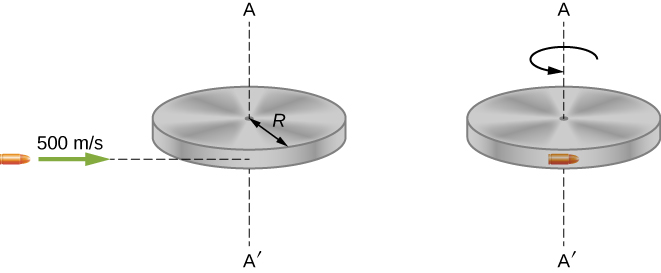
OpenStax / Rice University, University Physics Volume 1, CC BY 4.0. Source-book artwork retained. · CC BY 4.0 · Source出典

Figure 11.18図 11.18
A bullet is fired horizontally and becomes embedded in the edge of a disk that is free to rotate about its vertical axis.
英語のヒント
水平に発射された弾丸が、鉛直軸の周りに自由に回転できる円盤の縁に埋め込まれる。
Strategy方針
For the system of the bullet and the cylinder, no external torque acts along the vertical axis through the center of the disk. Thus, the angular momentum along this axis is conserved. The initial angular momentum of the bullet is , which is taken about the rotational axis of the disk the moment before the collision. The initial angular momentum of the cylinder is zero. Thus, the net angular momentum of the system is . Since angular momentum is conserved, the initial angular momentum of the system is equal to the angular momentum of the bullet embedded in the disk immediately after impact.
英語のヒント
弾丸と円盤からなる系では、円盤の中心を通る鉛直軸に沿う外力のトルクがない。したがって、この軸方向の角運動量は保存される。弾丸の初めの角運動量はで、衝突直前に円盤の回転軸に関して測る。円盤の初めの角運動量はゼロなので、系の合計の角運動量はである。角運動量が保存されるため、系の初めの角運動量は、衝突直後に弾丸が円盤へ埋め込まれた状態の角運動量に等しい。
Solution解答
The initial angular momentum of the system is
英語のヒント
系の初めの角運動量は、次の値である。
The moment of inertia of the system with the bullet embedded in the disk is
英語のヒント
弾丸が円盤に埋め込まれた系の慣性モーメントは、次のようになる。
The final angular momentum of the system is
英語のヒント
系の最後の角運動量は、次式である。
Thus, by conservation of angular momentum, and
英語のヒント
したがって、角運動量保存よりであり、次式が成り立つ。
Solving for
英語のヒント
について解くと、
Significance考察
The system is composed of both a point particle and a rigid body. Care must be taken when formulating the angular momentum before and after the collision. Just before impact the angular momentum of the bullet is taken about the rotational axis of the disk.
英語のヒント
この系は、質点と剛体の両方からなる。衝突前後の角運動量を式で表す際は、注意が必要である。衝突直前の弾丸の角運動量は、円盤の回転軸に関して測る。