第11章角運動量
11.1 Rolling Motion11.1 転がり運動
Learning Objectives学習目標
Learning Objectives学習目標
By the end of this section, you will be able to:
英語のヒント
この節を終えると、次のことができるようになる。
- Describe the physics of rolling motion without slipping
英語のヒント
滑らない転がり運動の物理を説明する。 - Explain how linear variables are related to angular variables for the case of rolling motion without slipping
英語のヒント
滑らない転がり運動で、直線運動の量と角運動の量がどのように結び付くかを説明する。 - Find the linear and angular accelerations in rolling motion with and without slipping
英語のヒント
滑りのある場合とない場合について、転がり運動の直線加速度と角加速度を求める。 - Calculate the static friction force associated with rolling motion without slipping
英語のヒント
滑らない転がり運動に伴う静止摩擦力を計算する。 - Use energy conservation to analyze rolling motion
英語のヒント
エネルギー保存を使って転がり運動を解析する。
Rolling motion is that common combination of rotational and translational motion that we see everywhere, every day. Think about the different situations of wheels moving on a car along a highway, or wheels on a plane landing on a runway, or wheels on a robotic explorer on another planet. Understanding the forces and torques involved in rolling motion is a crucial factor in many different types of situations.
英語のヒント
転がり運動は、回転運動と並進運動が組み合わさった、日常のどこでも見られる運動である。高速道路を進む自動車、滑走路に着陸する飛行機、別の惑星を走るロボット探査車の車輪を考えてみよう。さまざまな状況で、転がりに関わる力とトルクの理解が極めて重要になる。
For analyzing rolling motion in this chapter, refer to Figure 10.20 in Fixed-Axis Rotation to find moments of inertia of some common geometrical objects. You may also find it useful in other calculations involving rotation.
英語のヒント
Rolling Motion without Slipping滑らない転がり運動
People have observed rolling motion without slipping ever since the invention of the wheel. For example, we can look at the interaction of a car’s tires and the surface of the road. If the driver depresses the accelerator to the floor, such that the tires spin without the car moving forward, there must be kinetic friction between the wheels and the surface of the road. If the driver depresses the accelerator slowly, causing the car to move forward, then the tires roll without slipping. It is surprising to most people that, in fact, the bottom of the wheel is at rest with respect to the ground, indicating there must be static friction between the tires and the road surface. In Figure 11.2, the bicycle is in motion with the rider staying upright. The tires have contact with the road surface, and, even though they are rolling, the bottoms of the tires deform slightly, do not slip, and are at rest with respect to the road surface for a measurable amount of time. There must be static friction between the tire and the road surface for this to be so.
英語のヒント
車輪が発明されて以来、人々は滑らない転がり運動を見てきた。例えば、自動車のタイヤと路面の相互作用を考えよう。アクセルを床まで踏み込んでタイヤが空転し、車が前へ進まないなら、車輪と路面の間には動摩擦が働く。ゆっくり踏み込んで車が前へ進むなら、タイヤは滑らずに転がる。多くの人には意外かもしれないが、実際には車輪の最下点は地面に対して静止している。このことは、タイヤと路面の間に静止摩擦が働いていることを示す。図11.2では、乗り手が姿勢を保ったまま自転車が動いている。タイヤは路面に接触し、転がっていても、底の部分は少し変形して滑らず、測定できる長さの時間にわたって路面に対して静止する。そうなるには、タイヤと路面の間に静止摩擦が必要である。
Image omitted because its reuse rights could not be verified.権利の確認ができないため画像を割愛。
Figure 11.2図 11.2
(a) The bicycle moves forward, and its tires do not slip. The bottom of the slightly deformed tire is at rest with respect to the road surface for a measurable amount of time. (b) This image shows that the top of a rolling wheel appears blurred by its motion, but the bottom of the wheel is instantaneously at rest. (credit a: modification of work by Nelson Lourenço; credit b: modification of work by Colin Rose)
英語のヒント
(a) 自転車は前へ進み、タイヤは滑らない。少し変形したタイヤの底は、測定できる長さの時間にわたって路面に対して静止している。(b) 転がる車輪の上部は運動でぼけて見えるが、最下点は瞬間的に静止していることを示す写真。(a:Nelson Lourençoの作品を改変。b:Colin Roseの作品を改変。)
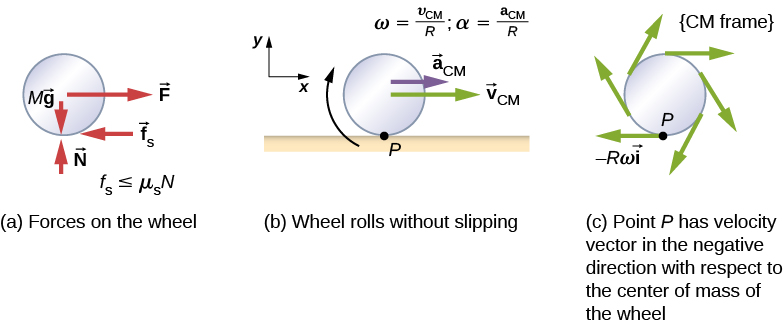
To analyze rolling without slipping, we first derive the linear variables of velocity and acceleration of the center of mass of the wheel in terms of the angular variables that describe the wheel’s motion. The situation is shown in Figure 11.3.
英語のヒント
滑らない転がりを解析するため、まず車輪の運動を表す角度に関する量から、質量中心の速度と加速度という直線運動の量を導く。状況を図11.3に示す。
OpenStax / Rice University, University Physics Volume 1, CC BY 4.0. Source-book artwork retained. · CC BY 4.0 · Source出典

Figure 11.3図 11.3
(a) A wheel is pulled across a horizontal surface by a force . The force of static friction is large enough to keep it from slipping. (b) The linear velocity and acceleration vectors of the center of mass and the relevant expressions for . Point P is at rest relative to the surface. (c) Relative to the center of mass (CM) frame, point P has linear velocity .
英語のヒント
(a) 力が水平面上で車輪を引く。静止摩擦力は、滑りを防ぐのに十分大きい。(b) 質量中心の速度・加速度ベクトルと、の関係式。P点は面に対して静止している。(c) 質量中心(CM)の座標系に対して、P点は直線速度を持つ。
From Figure 11.3(a), we see the force vectors involved in preventing the wheel from slipping. In (b), point P that touches the surface is at rest relative to the surface. Relative to the center of mass, point P has velocity , where R is the radius of the wheel and is the wheel’s angular velocity about its axis. Since the wheel is rolling, the velocity of P with respect to the surface is its velocity with respect to the center of mass plus the velocity of the center of mass with respect to the surface:
英語のヒント
図11.3(a)では、車輪の滑りを防ぐ力のベクトルが分かる。(b)では、面に接するP点はその面に対して静止している。質量中心に対するP点の速度はで、Rは車輪の半径、は軸の周りの角速度である。車輪が転がっているので、面に対するP点の速度は、質量中心に対するP点の速度と、面に対する質量中心の速度の和となる。
Since the velocity of P relative to the surface is zero, , this says that
英語のヒント
面に対するP点の速度はゼロ、すなわちなので、次式を得る。
Thus, the velocity of the wheel’s center of mass is its radius times the angular velocity about its axis. We show the correspondence of the linear variable on the left side of the equation with the angular variable on the right side of the equation. This is done below for the linear acceleration.
英語のヒント
つまり、車輪の質量中心の速度は、半径と軸の周りの角速度の積である。式の左辺に直線運動の量、右辺に角運動の量を置き、両者の対応を示している。加速度についても、以下で同様にする。
If we differentiate Equation 11.1 on the left side of the equation, we obtain an expression for the linear acceleration of the center of mass. On the right side of the equation, R is a constant and since we have
英語のヒント
速度と角速度の関係の左辺を微分すると、質量中心の直線加速度の式が得られる。右辺ではRが定数で、なので、次式となる。
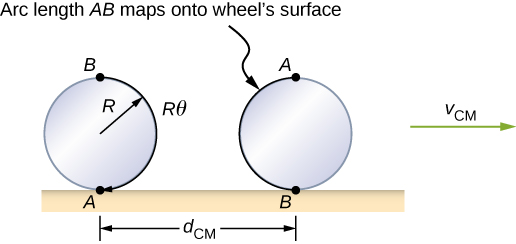
Furthermore, we can find the distance the wheel travels in terms of angular variables by referring to Figure 11.4. As the wheel rolls from point A to point B, its outer surface maps onto the ground by exactly the distance travelled, which is We see from Figure 11.4 that the length of the outer surface that maps onto the ground is the arc length . Equating the two distances, we obtain
英語のヒント
OpenStax / Rice University, University Physics Volume 1, CC BY 4.0. Source-book artwork retained. · CC BY 4.0 · Source出典

Figure 11.4図 11.4
As the wheel rolls on the surface, the arc length from A to B maps onto the surface, corresponding to the distance that the center of mass has moved.
英語のヒント
車輪が面上を転がると、AからBまでの弧長が面上に対応し、質量中心の移動距離に等しくなる。
Example 11.1例題 11.1
Rolling Down an Inclined Plane斜面を転がり下りる
A solid cylinder rolls down an inclined plane without slipping, starting from rest. It has mass m and radius r. (a) What is its acceleration? (b) What condition must the coefficient of static friction satisfy so the cylinder does not slip?
英語のヒント
中実の円柱が、静止状態から滑らずに斜面を転がり下りる。質量はm、半径はrである。(a) 加速度はいくらか。(b) 円柱が滑らないために、静止摩擦係数はどのような条件を満たす必要があるか。
Strategy方針
Draw a sketch and free-body diagram, and choose a coordinate system. We put x in the direction down the plane and y upward perpendicular to the plane. Identify the forces involved. These are the normal force, the force of gravity, and the force due to friction. Write down Newton’s laws in the x- and y-directions, and Newton’s law for rotation, and then solve for the acceleration and force due to friction.
英語のヒント
略図と自由物体図を描き、座標系を選ぶ。xを斜面に沿って下向き、yを斜面に垂直で外向きに取る。働く力は垂直抗力、重力、摩擦力である。x方向とy方向のニュートンの法則、および回転についてのニュートンの法則を書き、加速度と摩擦力について解く。
Solution解答
- The free-body diagram and sketch are shown in Figure 11.5, including the normal force, components of the weight, and the static friction force. There is barely enough friction to keep the cylinder rolling without slipping. Since there is no slipping, the magnitude of the friction force is less than or equal to . Writing down Newton’s laws in the x- and y-directions, we have
英語のヒント
図11.5に、垂直抗力、重さの成分、静止摩擦力を含む自由物体図と略図を示す。摩擦は、円柱が滑らず転がるのを保つのにかろうじて十分である。滑らないので、摩擦力の大きさは以下である。x方向とy方向のニュートンの法則を書くと、次式を得る。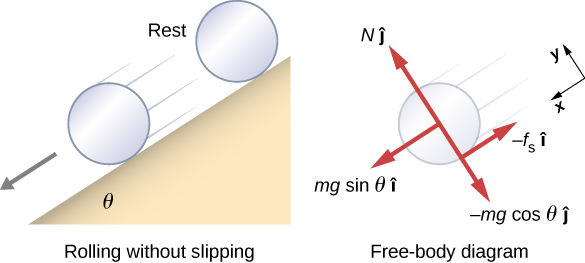
OpenStax / Rice University, University Physics Volume 1, CC BY 4.0. Source-book artwork retained. · CC BY 4.0 · Source出典
Figure 11.5図 11.5A solid cylinder rolls down an inclined plane without slipping from rest. The coordinate system has x in the direction down the inclined plane and y perpendicular to the plane. The free-body diagram is shown with the normal force, the static friction force, and the components of the weight . Friction makes the cylinder roll down the plane rather than slip.英語のヒント
中実の円柱が、静止状態から滑らず斜面を転がり下りる。座標系は、xを斜面に沿う下向き、yを斜面に垂直に取る。自由物体図に垂直抗力、静止摩擦力、重さの成分を示す。摩擦によって、円柱は滑るのでなく転がり下りる。
Substituting in from the free-body diagram,英語のヒント
自由物体図から各力を代入すると、we can then solve for the linear acceleration of the center of mass from these equations:英語のヒント
これらの式から、質量中心の直線加速度について解ける。
However, it is useful to express the linear acceleration in terms of the moment of inertia. For this, we write down Newton’s second law for rotation,英語のヒント
ただし、直線加速度を慣性モーメントで表すと便利である。そのために、回転についてのニュートンの第二法則を書く。
The torques are calculated about the axis through the center of mass of the cylinder. The only nonzero torque is provided by the friction force. We have英語のヒント
トルクは、円柱の質量中心を通る軸の周りで計算する。ゼロでないトルクを与えるのは摩擦力だけなので、次のようになる。
Finally, the linear acceleration is related to the angular acceleration by英語のヒント
最後に、直線加速度と角加速度の間には、次の関係がある。
These equations can be used to solve for in terms of the moment of inertia, where we have dropped the x-subscript. We rewrite in terms of the vertical component of gravity and the friction force, and make the following substitutions.英語のヒント
これらの式から、を慣性モーメントで表せる。ここでは添字xを省いた。を重力の鉛直成分と摩擦力で書き直し、次のように代入する。From this we obtain英語のヒント
ここから、
Note that this result is independent of the coefficient of static friction, .
Since we have a solid cylinder, from Figure 10.20, we have and英語のヒント
この結果は、静止摩擦係数に依存しないことに注意しよう。中実の円柱なので、図10.20からであり、次式を得る。
Therefore, we have英語のヒント
したがって、 - Because slipping does not occur, . Solving for the friction force,
英語のヒント
滑らないので、である。摩擦力について解くと、
Substituting this expression into the condition for no slipping, and noting that , we have英語のヒント
この式を滑らない条件へ代入し、を用いると、
or英語のヒント
すなわち、
For the solid cylinder, this becomes英語のヒント
中実の円柱では、これは次のようになる。

Significance考察
- The linear acceleration is linearly proportional to Thus, the greater the angle of the incline, the greater the linear acceleration, as would be expected. The angular acceleration, however, is linearly proportional to and inversely proportional to the radius of the cylinder. Thus, the larger the radius, the smaller the angular acceleration.
英語のヒント
直線加速度はに比例する。したがって、予想されるとおり、斜面の角度が大きいほど直線加速度も大きい。角加速度はに比例し、円柱の半径に反比例する。つまり、半径が大きいほど角加速度は小さい。 - For no slipping to occur, the coefficient of static friction must be greater than or equal to . Thus, the greater the angle of incline, the greater the coefficient of static friction must be to prevent the cylinder from slipping.
英語のヒント
滑らないためには、静止摩擦係数が以上でなければならない。したがって、斜面の角度が大きいほど、円柱の滑りを防ぐために必要な静止摩擦係数も大きくなる。