第11章角運動量
It is worthwhile to repeat the equation derived in this example for the acceleration of an object rolling without slipping:
英語のヒント
この例題で導いた、滑らず転がる物体の加速度の式を、もう一度記しておこう。
This is a very useful equation for solving problems involving rolling without slipping. Note that the acceleration is less than that of an object sliding down a frictionless plane with no rotation. The acceleration will also be different for two rotating objects with different rotational inertias.
英語のヒント
この式は、滑らない転がりの問題を解くのに非常に便利である。この加速度は、回転せずに摩擦のない斜面を滑り下りる物体の加速度より小さい。また、慣性モーメントが異なる二つの回転する物体では、加速度も異なる。
Rolling Motion with Slipping滑りを伴う転がり運動
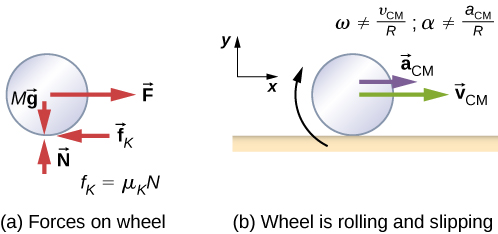
In the case of rolling motion with slipping, we must use the coefficient of kinetic friction, which gives rise to the kinetic friction force since static friction is not present. The situation is shown in Figure 11.6. In the case of slipping, , because point P on the wheel is not at rest on the surface, and . Thus, .
英語のヒント
滑りを伴う転がりでは、静止摩擦は働かず動摩擦力が働くので、動摩擦係数を使わなければならない。状況を図11.6に示す。滑る場合、車輪のP点は面上で静止していないので、、となる。したがって、である。
OpenStax / Rice University, University Physics Volume 1, CC BY 4.0. Source-book artwork retained. · CC BY 4.0 · Source出典

Figure 11.6図 11.6
(a) Kinetic friction arises between the wheel and the surface because the wheel is slipping. (b) The simple relationships between the linear and angular variables are no longer valid.
英語のヒント
(a) 車輪が滑るため、車輪と面の間に動摩擦が生じる。(b) 直線運動と角運動の量の間の単純な関係は、もはや成り立たない。
Example 11.2例題 11.2
Rolling Down an Inclined Plane with Slipping滑りを伴って斜面を転がり下りる
A solid cylinder rolls down an inclined plane from rest and undergoes slipping (Figure 11.7). It has mass m and radius r. (a) What is its linear acceleration? (b) What is its angular acceleration about an axis through the center of mass?
英語のヒント
中実の円柱が静止状態から斜面を転がり下り、滑りも生じる(図11.7)。質量はm、半径はrである。(a) 直線加速度はいくらか。(b) 質量中心を通る軸の周りの角加速度はいくらか。
Strategy方針
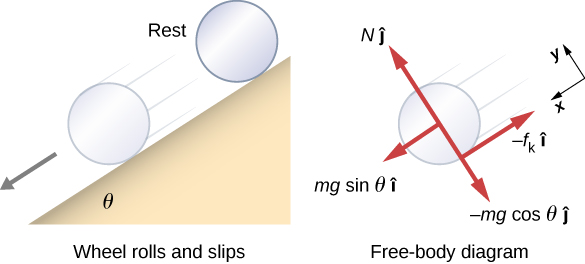
Draw a sketch and free-body diagram showing the forces involved. The free-body diagram is similar to the no-slipping case except for the friction force, which is kinetic instead of static. Use Newton’s second law to solve for the acceleration in the x-direction. Use Newton’s second law of rotation to solve for the angular acceleration.
英語のヒント
働く力を示す略図と自由物体図を描く。摩擦力が静止摩擦ではなく動摩擦である点を除けば、自由物体図は滑らない場合と同じである。ニュートンの第二法則からx方向の加速度を求め、回転についての第二法則から角加速度を求める。
Solution解答
OpenStax / Rice University, University Physics Volume 1, CC BY 4.0. Source-book artwork retained. · CC BY 4.0 · Source出典

Figure 11.7図 11.7
A solid cylinder rolls down an inclined plane from rest and undergoes slipping. The coordinate system has x in the direction down the inclined plane and y upward perpendicular to the plane. The free-body diagram shows the normal force, kinetic friction force, and the components of the weight
英語のヒント
中実の円柱が静止状態から斜面を転がり下り、滑りも生じる。座標系はxを斜面に沿う下向き、yを斜面に垂直な外向きに取る。自由物体図は、垂直抗力、動摩擦力、重さの成分を示す。
The sum of the forces in the y-direction is zero, so the friction force is now
英語のヒント
y方向の力の和はゼロなので、摩擦力はとなる。
Newton’s second law in the x-direction becomes
英語のヒント
x方向のニュートンの第二法則は、
or
英語のヒント
すなわち、
The friction force provides the only torque about the axis through the center of mass, so Newton’s second law of rotation becomes
英語のヒント
質量中心を通る軸の周りでは、摩擦力だけがトルクを与えるので、回転についてのニュートンの第二法則は次のようになる。
Solving for , we have
英語のヒント
について解くと、
Significance考察
We write the linear and angular accelerations in terms of the coefficient of kinetic friction. The linear acceleration is the same as that found for an object sliding down an inclined plane with kinetic friction. The angular acceleration about the axis of rotation is linearly proportional to the normal force, which depends on the cosine of the angle of inclination. As , this force goes to zero, and, thus, the angular acceleration goes to zero.
英語のヒント
直線加速度と角加速度を、動摩擦係数を使って表した。直線加速度は、動摩擦のある斜面を滑り下りる物体のものと同じである。回転軸の周りの角加速度は垂直抗力に比例し、その力は斜面の角度の余弦に依存する。となると、垂直抗力はゼロに近づき、角加速度もゼロに近づく。
Conservation of Mechanical Energy in Rolling Motion転がり運動での力学的エネルギー保存
In the preceding chapter, we introduced rotational kinetic energy. Any rolling object carries rotational kinetic energy, as well as translational kinetic energy and potential energy if the system requires. Including the gravitational potential energy, the total mechanical energy of an object rolling is
英語のヒント
前章では回転の運動エネルギーを導入した。転がる物体はどれも、並進の運動エネルギーに加えて、回転の運動エネルギーを持つ。系に応じて位置エネルギーも持つ。重力による位置エネルギーを含めると、転がる物体の全力学的エネルギーは次式で表される。
In the absence of any nonconservative forces that would take energy out of the system in the form of heat, the total energy of a rolling object without slipping is conserved and is constant throughout the motion. Examples where energy is not conserved are a rolling object that is slipping, production of heat as a result of kinetic friction, and a rolling object encountering air resistance.
英語のヒント
系から熱としてエネルギーを取り去る非保存力がなければ、滑らずに転がる物体の全エネルギーは保存され、運動中ずっと一定である。エネルギーが保存されない例には、滑りを伴う転がりで動摩擦により熱が生じる場合や、転がる物体が空気抵抗を受ける場合がある。
You may ask why a rolling object that is not slipping conserves energy, since the static friction force is nonconservative. The answer can be found by referring back to Figure 11.3. Point P in contact with the surface is at rest with respect to the surface. Therefore, its infinitesimal displacement with respect to the surface is zero, and the incremental work done by the static friction force is zero. We can apply energy conservation to our study of rolling motion to bring out some interesting results.
英語のヒント
静止摩擦力は非保存力なのに、滑らず転がる物体でエネルギーが保存されるのはなぜか、と疑問に思うかもしれない。答えは図11.3に戻ると分かる。面と接触するP点は、その面に対して静止している。したがって、面に対する微小変位はゼロで、静止摩擦力がする微小な仕事もゼロである。転がり運動にエネルギー保存を適用すると、興味深い結果を得られる。
Example 11.3例題 11.3
Curiosity Rover探査車キュリオシティ
The Curiosity rover, shown in Figure 11.8, was deployed on Mars on August 6, 2012. The wheels of the rover have a radius of 25 cm. Suppose astronauts arrive on Mars in the year 2050 and find the now-inoperative Curiosity on the side of a basin. While they are dismantling the rover, an astronaut accidentally loses a grip on one of the wheels, which rolls without slipping down into the bottom of the basin 25 meters below. If the wheel has a mass of 5 kg, what is its velocity at the bottom of the basin?
英語のヒント
図11.8の探査車キュリオシティは、2012年8月6日に火星へ配備された。車輪の半径は25 cmである。2050年に宇宙飛行士が火星へ到着し、くぼ地の斜面で、すでに作動しなくなったキュリオシティを見つけたとしよう。分解作業中、宇宙飛行士が誤って車輪を一つ取り落とし、車輪は滑らずに25 m下のくぼ地の底へ転がり落ちた。車輪の質量が5 kgなら、底での速度はいくらか。
(credit: NASA/JPL-Caltech) Courtesy NASA/JPL-Caltech. No endorsement is implied. · NASA/JPL image use permission; OpenStax additions CC BY 4.0 · Source出典

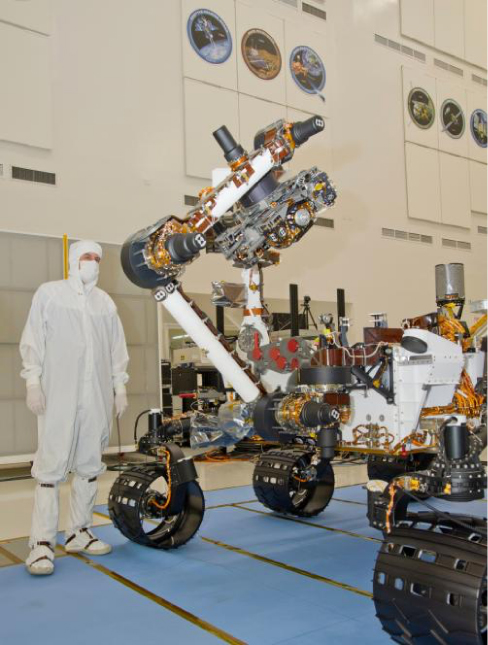
Figure 11.8図 11.8
The NASA Mars Science Laboratory rover Curiosity during testing on June 3, 2011. The location is inside the Spacecraft Assembly Facility at NASA’s Jet Propulsion Laboratory in Pasadena, California. (credit: NASA/JPL-Caltech)
英語のヒント
2011年6月3日、試験中のNASAの火星科学実験室探査車キュリオシティ。場所はカリフォルニア州パサデナにあるNASAジェット推進研究所の宇宙機組立施設内。(NASA/JPL-Caltech)
Strategy方針
We use mechanical energy conservation to analyze the problem. At the top of the hill, the wheel is at rest and has only potential energy. At the bottom of the basin, the wheel has rotational and translational kinetic energy, which must be equal to the initial potential energy by energy conservation. Since the wheel is rolling without slipping, we use the relation to relate the translational variables to the rotational variables in the energy conservation equation. We then solve for the velocity. From Figure 11.8, we see that a hollow cylinder is a good approximation for the wheel, so we can use this moment of inertia to simplify the calculation.
英語のヒント
力学的エネルギー保存で解析する。坂の上で車輪は静止し、位置エネルギーだけを持つ。底では回転と並進の運動エネルギーを持ち、その和は、エネルギー保存により初めの位置エネルギーと等しくなる。滑らずに転がるので、を使って保存式の並進の量と回転の量を結び付け、速度について解く。図11.8より、車輪は中空円柱でよく近似できる。その慣性モーメントを使えば、計算を簡単にできる。
Solution解答
Energy at the top of the basin equals energy at the bottom:
英語のヒント
くぼ地の上端のエネルギーは、底でのエネルギーに等しい。
The known quantities are .
英語のヒント
既知の量はである。
We rewrite the energy conservation equation eliminating by using We have
英語のヒント
を使ってを消去し、エネルギー保存の式を書き直す。すると、
or
英語のヒント
すなわち、
On Mars, the acceleration of gravity is which gives the magnitude of the velocity at the bottom of the basin as
英語のヒント
火星の重力加速度はなので、くぼ地の底での速度の大きさは次のようになる。
Significance考察
This is a fairly accurate result considering that Mars has very little atmosphere, and the loss of energy due to air resistance would be minimal. The result also assumes that the terrain is smooth, such that the wheel wouldn’t encounter rocks and bumps along the way.
英語のヒント
火星の大気は非常に薄く、空気抵抗によるエネルギー損失はごく小さいと考えられるので、これはかなり正確な結果である。また、地形は滑らかで、車輪が途中で岩や凹凸にぶつからないと仮定している。
Also, in this example, the kinetic energy, or energy of motion, is equally shared between linear and rotational motion. If we look at the moments of inertia in Figure 10.20, we see that the hollow cylinder has the largest moment of inertia for a given radius and mass. If the wheels of the rover were solid and approximated by solid cylinders, for example, there would be more kinetic energy in linear motion than in rotational motion. This would give the wheel a larger linear velocity than the hollow cylinder approximation. Thus, the solid cylinder would reach the bottom of the basin faster than the hollow cylinder.
英語のヒント
この例題では、運動エネルギーが直線運動と回転運動に等しく分配されている。図10.20の慣性モーメントを比べると、半径と質量が同じ場合、中空円柱の慣性モーメントが最も大きい。例えば、探査車の車輪が中実で、中実円柱と近似できるなら、直線運動の運動エネルギーが回転のものより大きくなる。そのため、中空円柱として近似した場合より直線速度が大きくなる。したがって、中実円柱の方が中空円柱より早くくぼ地の底へ到達する。