第11章角運動量
Angular Momentum of a System of Particles粒子の系の角運動量
The angular momentum of a system of particles is important in many scientific disciplines, one being astronomy. Consider a spiral galaxy, a rotating island of stars like our own Milky Way. The individual stars can be treated as point particles, each of which has its own angular momentum. The vector sum of the individual angular momenta give the total angular momentum of the galaxy. In this section, we develop the tools with which we can calculate the total angular momentum of a system of particles.
英語のヒント
粒子の系の角運動量は、多くの科学分野で重要であり、天文学もその一つである。天の川銀河のような、恒星が集まって回転する島、渦巻銀河を考えよう。各恒星を質点とみなすと、それぞれが独自の角運動量を持つ。そのベクトル和が銀河全体の角運動量となる。この節では、粒子の系の全角運動量を計算するための手段を整える。
In the preceding section, we introduced the angular momentum of a single particle about a designated origin. The expression for this angular momentum is where the vector is from the origin to the particle, and is the particle’s linear momentum. If we have a system of N particles, each with position vector from the origin given by and each having momentum then the total angular momentum of the system of particles about the origin is the vector sum of the individual angular momenta about the origin. That is,
英語のヒント
前節では、指定した原点に関する一つの粒子の角運動量を導入した。その式はであり、ベクトルは原点から粒子へ向かい、は粒子の運動量である。N個の粒子からなる系で、各粒子の原点からの位置ベクトルが、運動量がなら、系の原点に関する全角運動量は、各粒子の原点に関する角運動量のベクトル和となる。すなわち、
Similarly, if particle i is subject to a net torque about the origin, then we can find the net torque about the origin due to the system of particles by differentiating Equation 11.7:
英語のヒント
同様に、粒子iが原点の周りの合トルクを受けるなら、角運動量の和の式を微分して、粒子の系による原点の周りの合トルクを求められる。
The sum of the individual torques produces a net external torque on the system, which we designate Thus,
英語のヒント
各トルクの和は、系に働く外力による合トルクとなる。これをで表す。よって、
Equation 11.8 states that the rate of change of the total angular momentum of a system is equal to the net external torque acting on the system when both quantities are measured with respect to a given origin. Equation 11.8 can be applied to any system that has net angular momentum, including rigid bodies, as discussed in the next section.
英語のヒント
角運動量の変化率とトルクの式は、系の全角運動量の変化率が、系に働く外力による合トルクに等しいことを示す。どちらの量も、同じ原点を基準に測る。この式は、合計の角運動量を持つ任意の系に適用でき、次節で扱う剛体もその一つである。
Example 11.5例題 11.5
Angular Momentum of Three Particles3個の粒子の角運動量
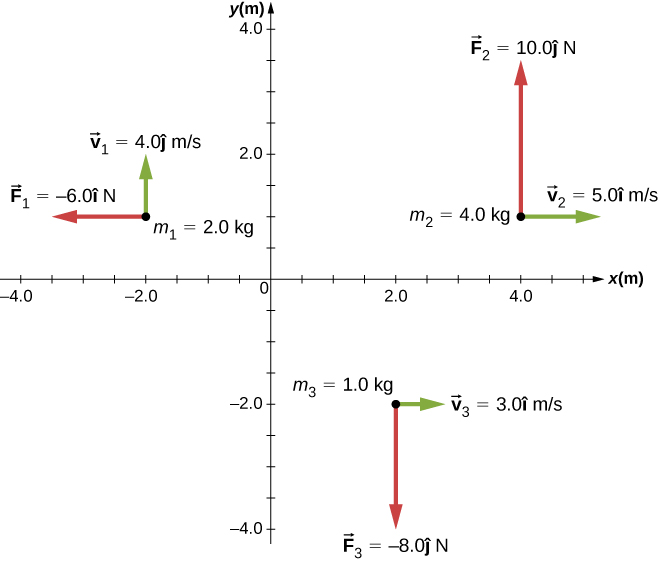
Referring to Figure 11.11(a), determine the total angular momentum due to the three particles about the origin. (b) What is the rate of change of the angular momentum?
英語のヒント
(a) 図11.11を参照し、3個の粒子による原点に関する全角運動量を求めよ。(b) 角運動量の変化率はいくらか。
OpenStax / Rice University, University Physics Volume 1, CC BY 4.0. Source-book artwork retained. · CC BY 4.0 · Source出典

Figure 11.11図 11.11
Three particles in the xy-plane with different position and momentum vectors.
英語のヒント
異なる位置ベクトルと運動量ベクトルを持つ、xy平面上の3個の粒子。
Strategy方針
Write down the position and momentum vectors for the three particles. Calculate the individual angular momenta and add them as vectors to find the total angular momentum. Then do the same for the torques.
英語のヒント
3個の粒子の位置ベクトルと運動量ベクトルを書き出す。それぞれの角運動量を計算し、ベクトルとして足して全角運動量を求める。その後、トルクについても同じことを行う。
Solution解答
- Particle 1:粒子1:Particle 2: ,粒子2:Particle 3: ,粒子3:We add the individual angular momenta to find the total about the origin:
英語のヒント
各角運動量を足し合わせて、原点に関する全角運動量を求める。 - The individual forces and lever arms are
英語のヒント
それぞれの力と腕の長さは、次のようになる。Therefore:英語のヒント
したがって、
Significance考察
This example illustrates the superposition principle for angular momentum and torque of a system of particles. Care must be taken when evaluating the radius vectors of the particles to calculate the angular momenta, and the lever arms, to calculate the torques, as they are completely different quantities.
英語のヒント
この例題は、粒子の系の角運動量とトルクに対する重ね合わせの原理を示している。角運動量の計算に用いる粒子の位置ベクトルと、トルクの計算に用いる腕の長さを求める際は、注意が必要である。これらはまったく異なる量だからである。
Angular Momentum of a Rigid Body剛体の角運動量
We have investigated the angular momentum of a single particle, which we generalized to a system of particles. Now we can use the principles discussed in the previous section to develop the concept of the angular momentum of a rigid body. Celestial objects such as planets have angular momentum due to their spin and orbits around stars. In engineering, anything that rotates about an axis carries angular momentum, such as flywheels, propellers, and rotating parts in engines. Knowledge of the angular momenta of these objects is crucial to the design of the system in which they are a part.
英語のヒント
これまで、一つの粒子の角運動量を調べ、その考え方を粒子の系へ一般化した。今度は、前節で扱った原理を使い、剛体の角運動量を考えよう。惑星などの天体は、自転と恒星の周りの公転による角運動量を持つ。工学では、はずみ車、プロペラ、エンジンの回転部品など、軸の周りを回転するものはすべて角運動量を持つ。それらの角運動量を知ることは、それらを構成要素に持つ系を設計する上で不可欠である。
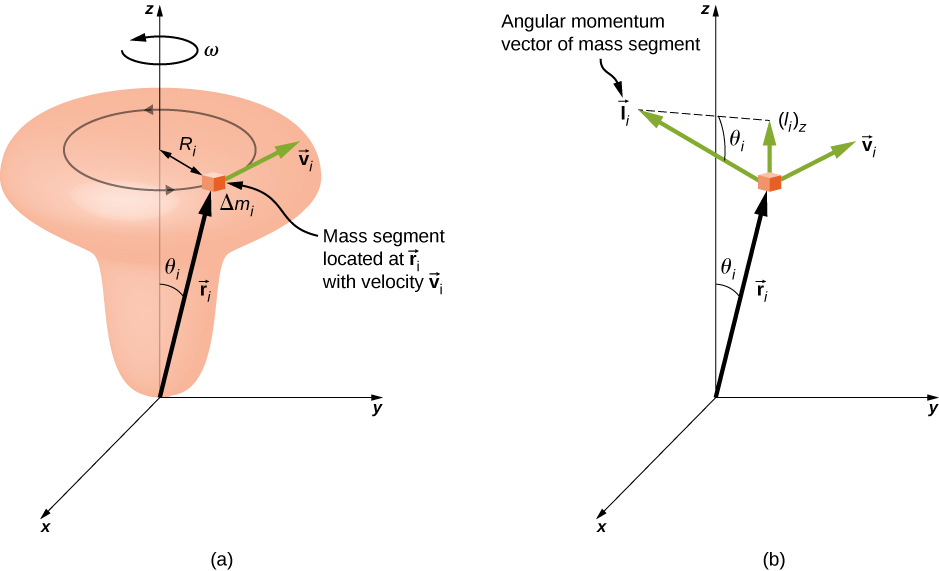
To develop the angular momentum of a rigid body, we model a rigid body as being made up of small mass segments, In Figure 11.12, a rigid body is constrained to rotate about the z-axis with angular velocity . All mass segments that make up the rigid body undergo circular motion about the z-axis with the same angular velocity. Part (a) of the figure shows mass segment with position vector from the origin and radius to the z-axis. The magnitude of its tangential velocity is . Because the vectors are perpendicular to each other, the magnitude of the angular momentum of this mass segment is
英語のヒント
剛体の角運動量を考えるため、剛体を小さな質量要素からなるものとみなす。図11.12では、剛体は角速度でz軸の周りを回転するように拘束されている。剛体を構成するすべての質量要素は、同じ角速度でz軸の周りを円運動する。図(a)の質量要素は、原点からの位置ベクトルがで、z軸からの半径がである。接線速度の大きさはとなる。ベクトルは互いに垂直なので、この質量要素の角運動量の大きさは次式で与えられる。
OpenStax / Rice University, University Physics Volume 1, CC BY 4.0. Source-book artwork retained. · CC BY 4.0 · Source出典

Figure 11.12図 11.12
(a) A rigid body is constrained to rotate around the z-axis. The rigid body is symmetrical about the z-axis. A mass segment is located at position which makes angle with respect to the z-axis. The circular motion of an infinitesimal mass segment is shown. (b) is the angular momentum of the mass segment and has a component along the z-axis .
英語のヒント
(a) z軸に関して対称な剛体が、z軸の周りを回転するように拘束されている。質量要素の位置ベクトルは、z軸となす角がである。微小な質量要素の円運動を示す。(b) は質量要素の角運動量であり、z軸方向の成分を持つ。
Using the right-hand rule, the angular momentum vector points in the direction shown in part (b). The sum of the angular momenta of all the mass segments contains components both along and perpendicular to the axis of rotation. Every mass segment has a perpendicular component of the angular momentum that will be cancelled by the perpendicular component of an identical mass segment on the opposite side of the rigid body, because it is cylindrically symmetric. Thus, the component along the axis of rotation is the only component that gives a nonzero value when summed over all the mass segments. From part (b), the component of along the axis of rotation is
英語のヒント
右手の規則より、角運動量ベクトルは図(b)の方向を向く。すべての質量要素の角運動量の和には、回転軸に沿う成分と、軸に垂直な成分がある。剛体は円筒対称なので、各質量要素の角運動量の垂直成分は、剛体の反対側にある同一の質量要素の垂直成分によって打ち消される。したがって、全質量要素について足し合わせたときにゼロでない値を持つのは、回転軸に沿う成分だけである。図(b)より、の回転軸に沿う成分は次のようになる。
The net angular momentum of the rigid body along the axis of rotation is
英語のヒント
回転軸方向の剛体の合計の角運動量は、次式で与えられる。
The summation is simply the moment of inertia I of the rigid body about the axis of rotation. For a thin hoop rotating about an axis perpendicular to the plane of the hoop, all of the ’s are equal to R so the summation reduces to which is the moment of inertia for a thin hoop found in Figure 10.20. Thus, the magnitude of the angular momentum along the axis of rotation of a rigid body rotating with angular velocity about the axis is
英語のヒント
和は、回転軸に関する剛体の慣性モーメントIにほかならない。薄い輪が、その面に垂直な軸の周りを回転する場合、はすべてRに等しい。したがって、この和はとなる。これは図10.20で示した薄い輪の慣性モーメントである。よって、軸の周りを角速度で回転する剛体の、回転軸方向の角運動量の大きさは、次のようになる。
This equation is analogous to the magnitude of the linear momentum . The direction of the angular momentum vector is directed along the axis of rotation given by the right-hand rule.
英語のヒント
この式は、運動量の大きさに対応する。角運動量ベクトルは、右手の規則で定まる回転軸の向きを向く。
Example 11.6例題 11.6
Angular Momentum of a Robot Armロボットアームの角運動量
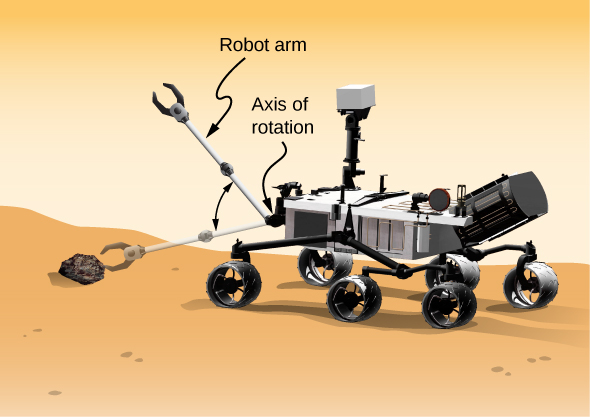
A robot arm on a Mars rover like Curiosity shown in Figure 11.8 is 1.0 m long and has forceps at the free end to pick up rocks. The mass of the arm is 2.0 kg and the mass of the forceps is 1.0 kg. See Figure 11.13. The robot arm and forceps move from rest to in 0.1 s. It rotates down and picks up a Mars rock that has mass 1.5 kg. The axis of rotation is the point where the robot arm connects to the rover. (a) What is the angular momentum of the robot arm by itself about the axis of rotation after 0.1 s when the arm has stopped accelerating? (b) What is the angular momentum of the robot arm when it has the Mars rock in its forceps and is rotating upwards? (c) When the arm does not have a rock in the forceps, what is the torque about the point where the arm connects to the rover when it is accelerating from rest to its final angular velocity?
英語のヒント
図11.8のキュリオシティのような火星探査車に付いたロボットアームは、長さ1.0 mで、自由端に岩をつかむための鉗子が付いている。アームの質量は2.0 kg、鉗子の質量は1.0 kgである。図11.13を参照しよう。アームと鉗子は、静止状態から0.1 sでまで加速する。下向きに回転し、質量1.5 kgの火星の岩をつかむ。回転軸は、アームと探査車の接続点である。(a) アームが加速を終える0.1 s後、アーム自身の回転軸に関する角運動量はいくらか。(b) 火星の岩を鉗子でつかみ、上向きに回転しているときの角運動量はいくらか。(c) 鉗子で岩をつかんでいない状態で、静止から最終角速度まで加速するとき、アームと探査車の接続点に関するトルクはいくらか。
(credit: modification of work by NASA/JPL-Caltech) Courtesy NASA/JPL-Caltech. No endorsement is implied. · NASA/JPL image use permission; OpenStax additions CC BY 4.0 · Source出典

Figure 11.13図 11.13
A robot arm on a Mars rover swings down and picks up a Mars rock. (credit: modification of work by NASA/JPL-Caltech)
英語のヒント
火星探査車のロボットアームが下向きに振れ、火星の岩を拾う。(NASA/JPL-Caltechの作品を改変)
Strategy方針
We use Equation 11.9 to find angular momentum in the various configurations. When the arm is rotating downward, the right-hand rule gives the angular momentum vector directed out of the page, which we will call the positive z-direction. When the arm is rotating upward, the right-hand rule gives the direction of the angular momentum vector into the page or in the negative z-direction. The moment of inertia is the sum of the individual moments of inertia. The arm can be approximated with a solid rod, and the forceps and Mars rock can be approximated as point masses located at a distance of 1 m from the origin. For part (c), we use Newton’s second law of motion for rotation to find the torque on the robot arm.
英語のヒント
角運動量と慣性モーメントの式を使い、各状態の角運動量を求める。アームが下向きに回転するとき、角運動量ベクトルは右手の規則で紙面の手前向きとなる。これをzの正方向とする。上向きに回転するときは紙面の奥向き、すなわちzの負方向となる。慣性モーメントは各部分の慣性モーメントの和である。アームは中実の棒、鉗子と火星の岩は原点から1 m離れた質点で近似できる。(c)では、回転に対するニュートンの第2法則を使って、アームに働くトルクを求める。
Solution解答
- Writing down the individual moments of inertia, we have
Robot arm:
Forceps:
Mars rock:
Therefore, without the Mars rock, the total moment of inertia is英語のヒント
各部分の慣性モーメントを書き出すと、ロボットアームは、鉗子は、火星の岩はとなる。したがって、火星の岩を持たないときの全慣性モーメントは次の値である。and the magnitude of the angular momentum is英語のヒント
角運動量の大きさは、次のようになる。The angular momentum vector is directed out of the page in the direction since the robot arm is rotating counterclockwise.英語のヒント
アームは反時計回りに回転するので、角運動量ベクトルは紙面の手前向き、すなわちの向きとなる。 - We must include the Mars rock in the calculation of the moment of inertia, so we have
英語のヒント
慣性モーメントの計算に火星の岩も含める必要があるので、次のようになる。and英語のヒント
また、Now the angular momentum vector is directed into the page in the direction, by the right-hand rule, since the robot arm is now rotating clockwise.英語のヒント
今度はアームが時計回りに回転するので、右手の規則より、角運動量ベクトルは紙面の奥向き、すなわちの向きになる。 - We find the torque when the arm does not have the rock by taking the derivative of the angular momentum using Equation 11.8 But since , and understanding that the direction of the angular momentum and torque vectors are along the axis of rotation, we can suppress the vector notation and find
英語のヒント
アームが岩を持たないときのトルクは、角運動量の変化率とトルクの式を使い、角運動量を微分して求める。である。ここでであり、角運動量ベクトルもトルクベクトルも回転軸の方向を向く。このことを踏まえ、ベクトル表記を省くと次のようになる。which is Newton’s second law for rotation. Since , we can calculate the net torque:英語のヒント
これは回転に対するニュートンの第2法則である。なので、合トルクは次のように計算できる。
Significance考察
The angular momentum in (a) is less than that of (b) due to the fact that the moment of inertia in (b) is greater than (a), while the angular velocity is the same.
英語のヒント
(a)の角運動量は(b)より小さい。角速度は同じだが、(b)の慣性モーメントの方が(a)より大きいからである。