第2章ベクトル
2.4 Products of Vectors2.4 ベクトルの積
Learning Objectives学習目標
Learning Objectives学習目標
By the end of this section, you will be able to:
英語のヒント
本節を学ぶと、次のことができるようになる。
- Explain the difference between the scalar product and the vector product of two vectors.
英語のヒント
二つのベクトルのスカラー積とベクトル積の違いを説明する。 - Determine the scalar product of two vectors.
英語のヒント
二つのベクトルのスカラー積を求める。 - Determine the vector product of two vectors.
英語のヒント
二つのベクトルのベクトル積を求める。 - Describe how the products of vectors are used in physics.
英語のヒント
物理学でベクトルの積がどう使われるかを説明する。
A vector can be multiplied by another vector but may not be divided by another vector. There are two kinds of products of vectors used broadly in physics and engineering. One kind of multiplication is a scalar multiplication of two vectors. Taking a scalar product of two vectors results in a number (a scalar), as its name indicates. Scalar products are used to define work and energy relations. For example, the work that a force (a vector) performs on an object while causing its displacement (a vector) is defined as a scalar product of the force vector with the displacement vector. A quite different kind of multiplication is a vector multiplication of vectors. Taking a vector product of two vectors returns as a result a vector, as its name suggests. Vector products are used to define other derived vector quantities. For example, in describing rotations, a vector quantity called torque is defined as a vector product of an applied force (a vector) and its distance from pivot to force (a vector). It is important to distinguish between these two kinds of vector multiplications because the scalar product is a scalar quantity and a vector product is a vector quantity.
英語のヒント
ベクトルに別のベクトルを掛けることはできるが、別のベクトルで割ることはできない。物理学と工学で広く使われるベクトルの積には、二種類ある。一つは、二つのベクトルのスカラー乗算である。その名のとおり、スカラー積の結果は数(スカラー)となる。スカラー積は、仕事やエネルギーの関係を定義するために使う。例えば、力(ベクトル)が物体に変位(ベクトル)を生じさせるとき、その力のする仕事は、力ベクトルと変位ベクトルのスカラー積として定義される。それとは大きく異なるもう一つの乗算が、ベクトルどうしのベクトル乗算である。その名のとおり、ベクトル積の結果はベクトルとなる。ベクトル積は、別の組立ベクトル量を定義するために使う。例えば回転を記述するとき、トルクというベクトル量を、加えた力(ベクトル)と、支点から力の作用点までの距離(ベクトル)のベクトル積で定義する。スカラー積はスカラー量、ベクトル積はベクトル量なので、この二種類のベクトルの乗算を区別することが重要である。
The Scalar Product of Two Vectors (the Dot Product)二つのベクトルのスカラー積(内積)
Scalar multiplication of two vectors yields a scalar product.
英語のヒント
二つのベクトルのスカラー乗算から、スカラー積が得られる。
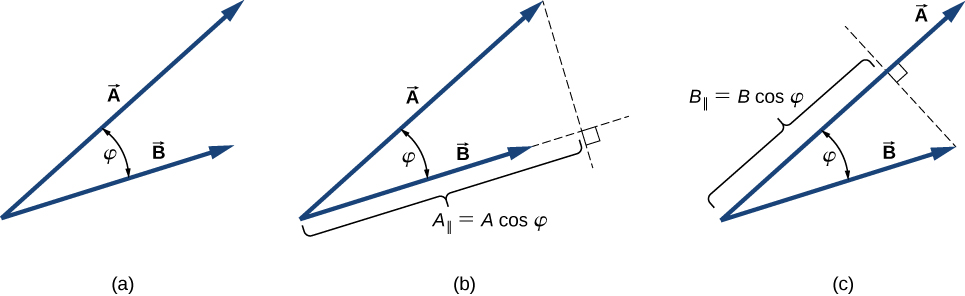
In the definition of the dot product, the direction of angle does not matter, and can be measured from either of the two vectors to the other because . The dot product is a negative number when and is a positive number when . Moreover, the dot product of two parallel vectors is , and the dot product of two antiparallel vectors is . The scalar product of two orthogonal vectors vanishes: . The scalar product of a vector with itself is the square of its magnitude:
英語のヒント
内積の定義では、角の向きは関係なく、はどちらのベクトルから他方へ測ってもよい。だからである。内積はで負、で正となる。さらに、平行な二つのベクトルの内積は、反平行な二つのベクトルの内積はである。直交する二つのベクトルのスカラー積は0となり、である。ベクトル自身とのスカラー積は、その大きさの2乗となる。
(2.28)
OpenStax / Rice University, University Physics Volume 1, CC BY 4.0. Source-book artwork retained. · CC BY 4.0 · Source出典

Figure 2.29図 2.29
The scalar product of two vectors. (a) The angle between the two vectors. (b) The orthogonal projection of vector onto the direction of vector . (c) The orthogonal projection of vector onto the direction of vector .
英語のヒント
二つのベクトルのスカラー積。(a)二つのベクトルのなす角。(b)ベクトルをベクトルの方向へ正射影した。(c)ベクトルをベクトルの方向へ正射影した。
Example 2.15例題 2.15
The Scalar Productスカラー積
Strategy方針
From Figure 2.13, the magnitudes of vectors and are A = 10.0 and F = 20.0. Angle , between them, is the difference: . Substituting these values into Equation 2.27 gives the scalar product.
英語のヒント
Solution解答
A straightforward calculation gives us
英語のヒント
単純な計算から、次を得る。
In the Cartesian coordinate system, scalar products of the unit vector of an axis with other unit vectors of axes always vanish because these unit vectors are orthogonal:
英語のヒント
デカルト座標系では、ある軸の単位ベクトルと別の軸の単位ベクトルのスカラー積は、常に0となる。これらの単位ベクトルは直交するからである。
(2.29)
In these equations, we use the fact that the magnitudes of all unit vectors are one: . For unit vectors of the axes, Equation 2.28 gives the following identities:
英語のヒント
これらの式では、すべての単位ベクトルの大きさが1であること、すなわちを使っている。軸の単位ベクトルについて、式2.28から次の恒等式を得る。
(2.30)
The scalar product can also be interpreted as either the product of B with the projection of vector onto the direction of vector (Figure 2.29(b)) or the product of A with the projection of vector onto the direction of vector (Figure 2.29(c)):
英語のヒント
For example, in the rectangular coordinate system in a plane, the scalar x-component of a vector is its dot product with the unit vector , and the scalar y-component of a vector is its dot product with the unit vector :
英語のヒント
例えば、平面内の直交座標系では、ベクトルのスカラーx成分は、そのベクトルと単位ベクトルの内積であり、スカラーy成分は、単位ベクトルとの内積である。
Scalar multiplication of vectors is commutative,
英語のヒント
ベクトルのスカラー乗算には交換法則が成り立ち、
and obeys the distributive law:
英語のヒント
分配法則にも従う。
We can use the commutative and distributive laws to derive various relations for vectors, such as expressing the dot product of two vectors in terms of their scalar components.
英語のヒント
交換法則と分配法則を使えば、ベクトルについてのさまざまな関係を導ける。例えば、二つのベクトルの内積を、スカラー成分で表せる。
When the vectors in Equation 2.27 are given in their vector component forms,
英語のヒント
式2.27のベクトルが、次の成分表示で与えられる場合、
we can compute their scalar product as follows:
英語のヒント
スカラー積を次のように計算できる。
Since scalar products of two different unit vectors of axes give zero, and scalar products of unit vectors with themselves give one (see Equation 2.29 and Equation 2.30), there are only three nonzero terms in this expression. Thus, the scalar product simplifies to
英語のヒント
We can use Equation 2.33 for the scalar product in terms of scalar components of vectors to find the angle between two vectors. When we divide Equation 2.27 by AB, we obtain the equation for , into which we substitute Equation 2.33:
英語のヒント
Angle between vectors and is obtained by taking the inverse cosine of the expression in Equation 2.34.
英語のヒント
ベクトルとのなす角は、式2.34の式の逆余弦を取れば得られる。
Example 2.16例題 2.16
Angle between Two Forces二つの力のなす角
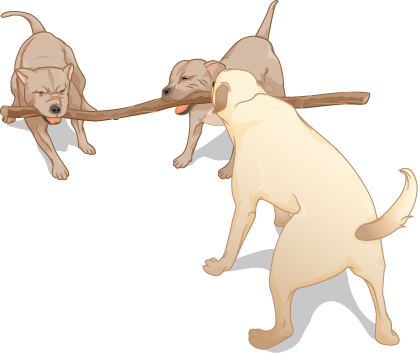
Three dogs are pulling on a stick in different directions, as shown in Figure 2.30. The first dog pulls with force , the second dog pulls with force , and the third dog pulls with force . What is the angle between forces and ?
英語のヒント
図2.30のように、3匹の犬が棒を異なる方向へ引いている。1匹目の力は、2匹目は、3匹目はである。力とのなす角はいくらか。
OpenStax / Rice University, University Physics Volume 1, CC BY 4.0. Source-book artwork retained. · CC BY 4.0 · Source出典

Figure 2.30図 2.30
Three dogs are playing with a stick.
英語のヒント
3匹の犬が棒で遊んでいる。
Strategy方針
The components of force vector are , , and , whereas those of force vector are , , and . Computing the scalar product of these vectors and their magnitudes, and substituting into Equation 2.34 gives the angle of interest.
英語のヒント
力ベクトルの成分は、、で、力ベクトルの成分は、、である。両ベクトルのスカラー積とそれぞれの大きさを計算し、式2.34へ代入すると、求める角が得られる。
Solution解答
The magnitudes of forces and are
英語のヒント
力との大きさは、次のようになる。
and
英語のヒント
および
Substituting the scalar components into Equation 2.33 yields the scalar product
英語のヒント
スカラー成分を式2.33へ代入すると、次のスカラー積が得られる。
Finally, substituting everything into Equation 2.34 gives the angle
英語のヒント
最後に、すべてを式2.34へ代入すると、角が得られる。
Significance意味の検討
Notice that when vectors are given in terms of the unit vectors of axes, we can find the angle between them without knowing the specifics about the geographic directions the unit vectors represent. Here, for example, the +x-direction might be to the east and the +y-direction might be to the north. But, the angle between the forces in the problem is the same if the +x-direction is to the west and the +y-direction is to the south.
英語のヒント
ベクトルが軸の単位ベクトルで与えられていれば、それらの単位ベクトルが具体的にどの方角を表すかを知らなくても、ベクトルどうしのなす角を求められることに注意しよう。例えば、ここでは+x方向が東、+y方向が北かもしれない。しかし、+x方向が西、+y方向が南であっても、問題中の力どうしのなす角は同じである。
Example 2.17例題 2.17
The Work of a Force力のする仕事
When force pulls on an object and when it causes its displacement , we say the force performs work. The amount of work the force does is the scalar product . If the stick in Example 2.16 moves momentarily and gets displaced by vector , how much work is done by the third dog in Example 2.16?
英語のヒント
Strategy方針
We compute the scalar product of displacement vector with force vector , which is the pull from the third dog. Let’s use to denote the work done by force on displacement .
英語のヒント
変位ベクトルと、3匹目の犬の引く力ベクトルのスカラー積を計算する。力が変位に対してする仕事を、で表そう。
Solution解答
Calculating the work is a straightforward application of the dot product:
英語のヒント
仕事の計算は、内積をそのまま適用すればよい。
Significance意味の検討
The SI unit of work is called the joule , where 1 J = 1 . The unit can be written as , so the answer can be expressed as .
英語のヒント
仕事のSI単位はジュールで、1 J = 1 である。単位はと書けるので、答えはと表せる。