第10章固定軸まわりの回転
10.4 Moment of Inertia and Rotational Kinetic Energy10.4 慣性モーメントと回転の運動エネルギー
Learning Objectives学習目標
Learning Objectives学習目標
By the end of this section, you will be able to:
英語のヒント
この節を終えると、次のことができるようになる。
- Describe the differences between rotational and translational kinetic energy
英語のヒント
回転の運動エネルギーと並進の運動エネルギーの違いを述べる。 - Define the physical concept of moment of inertia in terms of the mass distribution from the rotational axis
英語のヒント
回転軸から見た質量分布に基づいて、慣性モーメントの物理的概念を定義する。 - Explain how the moment of inertia of rigid bodies affects their rotational kinetic energy
英語のヒント
剛体の慣性モーメントが回転の運動エネルギーにどう影響するか説明する。 - Use conservation of mechanical energy to analyze systems undergoing both rotation and translation
英語のヒント
力学的エネルギーの保存を使い、回転と並進を同時に行う系を分析する。 - Calculate the angular velocity of a rotating system when there are energy losses due to nonconservative forces
英語のヒント
非保存力によるエネルギー損失がある場合の、回転する系の角速度を計算する。
So far in this chapter, we have been working with rotational kinematics: the description of motion for a rotating rigid body with a fixed axis of rotation. In this section, we define two new quantities that are helpful for analyzing properties of rotating objects: moment of inertia and rotational kinetic energy. With these properties defined, we will have two important tools we need for analyzing rotational dynamics.
英語のヒント
本章ではここまで、回転軸が固定された剛体の運動を記述する、回転の運動学を扱ってきた。本節では、回転する物体の性質を分析するのに役立つ二つの量、慣性モーメントと回転の運動エネルギーを定義する。これらを定めれば、回転の力学を分析するための重要な道具が二つそろう。
Rotational Kinetic Energy回転の運動エネルギー
Any moving object has kinetic energy. We know how to calculate this for a body undergoing translational motion, but how about for a rigid body undergoing rotation? This might seem complicated because each point on the rigid body has a different velocity. However, we can make use of angular velocity—which is the same for the entire rigid body—to express the kinetic energy for a rotating object. Figure 10.17 shows an example of a very energetic rotating body: an electric grindstone propelled by a motor. Sparks are flying, and noise and vibration are generated as the grindstone does its work. This system has considerable energy, some of it in the form of heat, light, sound, and vibration. However, most of this energy is in the form of rotational kinetic energy.
英語のヒント
動く物体はどれも運動エネルギーを持つ。並進運動する物体ではその計算法を学んだが、回転する剛体ではどうだろうか。剛体上の点ごとに速度が異なるので、複雑に思えるかもしれない。しかし、剛体全体で共通する角速度を使えば、回転物体の運動エネルギーを表せる。図10.17は大きなエネルギーを持つ回転物体の例、モーターで動かす電動砥石である。作業中には火花が飛び、音と振動が生じる。この系はかなりのエネルギーを持ち、その一部は熱、光、音、振動となる。しかし大半は、回転の運動エネルギーとして存在する。

(credit: Zachary David Bell, US Navy) The appearance of U.S. Department of Defense visual information does not imply or constitute DoD endorsement. · US government public-domain visual information; OpenStax additions CC BY 4.0 · Source出典

Figure 10.17図 10.17
The rotational kinetic energy of the grindstone is converted to heat, light, sound, and vibration. (credit: Zachary David Bell, US Navy)
英語のヒント
砥石の回転の運動エネルギーは、熱、光、音、振動へ変わる。(出典:Zachary David Bell、米国海軍)
Energy in rotational motion is not a new form of energy; rather, it is the energy associated with rotational motion, the same as kinetic energy in translational motion. However, because kinetic energy is given by , and velocity is a quantity that is different for every point on a rotating body about an axis, it makes sense to find a way to write kinetic energy in terms of the variable , which is the same for all points on a rigid rotating body. For a single particle rotating around a fixed axis, this is straightforward to calculate. We can relate the angular velocity to the magnitude of the translational velocity using the relation , where r is the distance of the particle from the axis of rotation and is its tangential speed. Substituting into the equation for kinetic energy, we find
英語のヒント
回転運動のエネルギーは、まったく新しい種類のエネルギーではない。並進運動の運動エネルギーと同じく、回転運動に伴うエネルギーである。ただし運動エネルギーはで与えられ、軸の周りに回転する物体では各点の速度が異なる。そのため、回転剛体のすべての点で同じ値を取る変数で、運動エネルギーを書けると都合がよい。固定軸の周りを回る一つの粒子なら、計算は簡単である。関係を使い、角速度を並進速度の大きさへ関係づける。rは粒子から回転軸までの距離、は接線方向の速さである。運動エネルギーの式へ代入すると、次を得る。
In the case of a rigid rotating body, we can divide up any body into a large number of smaller masses, each with a mass and distance to the axis of rotation , such that the total mass of the body is equal to the sum of the individual masses: . Each smaller mass has tangential speed , where we have dropped the subscript t for the moment. The total kinetic energy of the rigid rotating body is
英語のヒント
回転する剛体なら、物体を多数の小さな質量へ分割できる。それぞれの質量を、回転軸までの距離をとすると、物体の総質量は個々の質量の和に等しい。各小質量の接線方向の速さをとする。ここでは一時的に添字tを省いている。回転剛体の全運動エネルギーは、次のようになる。
and since for all masses,
英語のヒント
また、すべての質量でなので、
The units of Equation 10.16 are joules (J). The equation in this form is complete, but awkward; we need to find a way to generalize it.
英語のヒント
式10.16の単位はジュール(J)である。この形でも式は完全だが、扱いづらい。一般化する方法が必要となる。
Moment of Inertia慣性モーメント
If we compare Equation 10.16 to the way we wrote kinetic energy in Work and Kinetic Energy, , this suggests we have a new rotational variable to add to our list of our relations between rotational and translational variables. The quantity is the counterpart for mass in the equation for rotational kinetic energy. This is an important new term for rotational motion. This quantity is called the moment of inertia I, with units of :
英語のヒント
式10.16を、「仕事と運動エネルギー」で運動エネルギーを書いた形と比べると、回転と並進の量の対応表へ追加する、新たな回転の量があると気づく。は、回転の運動エネルギーの式で質量に対応する量である。これは回転運動の重要な新しい量となる。この量を慣性モーメントIといい、単位はである。
For now, we leave the expression in summation form, representing the moment of inertia of a system of point particles rotating about a fixed axis. We note that the moment of inertia of a single point particle about a fixed axis is simply , with r being the distance from the point particle to the axis of rotation. In the next section, we explore the integral form of this equation, which can be used to calculate the moment of inertia of some regular-shaped rigid bodies.
英語のヒント
今は式を総和の形のままにしておく。この式は、固定軸の周りを回転する質点系の慣性モーメントを表す。一つの質点の固定軸に対する慣性モーメントは、単にである。rは質点から回転軸までの距離である。次節ではこの式の積分形を調べ、いくつかの規則的な形をした剛体の慣性モーメントを計算する。
The moment of inertia is the quantitative measure of rotational inertia, just as in translational motion, and mass is the quantitative measure of linear inertia—that is, the more massive an object is, the more inertia it has, and the greater is its resistance to change in linear velocity. Similarly, the greater the moment of inertia of a rigid body or system of particles, the greater is its resistance to change in angular velocity about a fixed axis of rotation. It is interesting to see how the moment of inertia varies with r, the distance to the axis of rotation of the mass particles in Equation 10.17. Rigid bodies and systems of particles with more mass concentrated at a greater distance from the axis of rotation have greater moments of inertia than bodies and systems of the same mass, but concentrated near the axis of rotation. In this way, we can see that a hollow cylinder has more rotational inertia than a solid cylinder of the same mass when rotating about an axis through the center. Substituting Equation 10.17 into Equation 10.16, the expression for the kinetic energy of a rotating rigid body becomes
英語のヒント
慣性モーメントは、回転の慣性の大きさを定量的に表す。並進運動では、質量が直線運動の慣性を定量的に表す。つまり、物体の質量が大きいほど慣性が大きく、並進速度の変化への抵抗も大きい。同様に、剛体や粒子系の慣性モーメントが大きいほど、固定回転軸の周りの角速度を変えることへの抵抗は大きい。式10.17で、質点から回転軸までの距離rによって慣性モーメントがどう変わるかを見ると興味深い。質量が軸から遠くへより多く集まる剛体や粒子系は、同じ質量が軸の近くへ集まるものより、大きな慣性モーメントを持つ。このことから、中心を通る軸の周りに回る場合、同じ質量の中空円筒は中実円柱より回転の慣性が大きいと分かる。式10.17を式10.16へ代入すると、回転剛体の運動エネルギーの式は次のようになる。
We see from this equation that the kinetic energy of a rotating rigid body is directly proportional to the moment of inertia and the square of the angular velocity. This is exploited in flywheel energy-storage devices, which are designed to store large amounts of rotational kinetic energy. Many carmakers are now testing flywheel energy storage devices in their automobiles, such as the flywheel, or kinetic energy recovery system, shown in Figure 10.18.
英語のヒント
この式から、回転剛体の運動エネルギーは、慣性モーメントと角速度の2乗に正比例する。これは、大量の回転運動エネルギーを蓄えるよう設計された、はずみ車蓄エネルギー装置で利用されている。図10.18のはずみ車、つまり運動エネルギー回生システムのように、多くの自動車メーカーが自動車用のはずみ車蓄エネルギー装置を試験している。
Image omitted because its reuse rights could not be verified.権利の確認ができないため画像を割愛。
Figure 10.18図 10.18
A KERS (kinetic energy recovery system) flywheel used in cars. (credit: “cmonville”/Flickr)
英語のヒント
自動車に使うKERS(運動エネルギー回生システム)のはずみ車。(出典:「cmonville」/Flickr)
The rotational and translational quantities for kinetic energy and inertia are summarized in Table 10.4. The relationship column is not included because a constant doesn’t exist by which we could multiply the rotational quantity to get the translational quantity, as can be done for the variables in Table 10.3.
英語のヒント
Rotational 回転 |
Translational 並進 |
|---|---|
Example 10.8例題 10.8
Moment of Inertia of a System of Particles粒子系の慣性モーメント
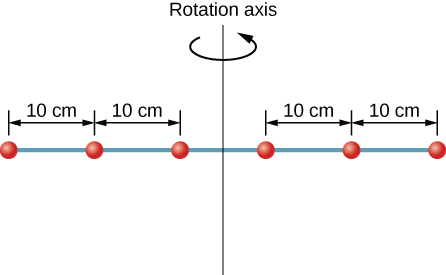
Six small washers are spaced 10 cm apart on a rod of negligible mass and 0.5 m in length. The mass of each washer is 20 g. The rod rotates about an axis located at 25 cm, as shown in Figure 10.19. (a) What is the moment of inertia of the system? (b) If the two washers closest to the axis are removed, what is the moment of inertia of the remaining four washers? (c) If the system with six washers rotates at 5 rev/s, what is its rotational kinetic energy?
英語のヒント
質量を無視できる長さ0.5 mの棒に、6個の小さな座金を10 cm間隔で置く。各座金の質量は20 gである。図10.19のように、棒は25 cmの位置にある軸の周りに回る。(a)系の慣性モーメントは何か。(b)軸に最も近い二つの座金を除くと、残る4個の慣性モーメントは何か。(c)6個の座金を持つ系が5 rev/sで回ると、回転の運動エネルギーは何か。
OpenStax / Rice University, University Physics Volume 1, CC BY 4.0. Source-book artwork retained. · CC BY 4.0 · Source出典

Figure 10.19図 10.19
Six washers are spaced 10 cm apart on a rod of negligible mass and rotating about a vertical axis.
英語のヒント
質量を無視できる棒に6個の座金を10 cm間隔で置き、鉛直軸の周りに回転させる。
Strategy方針
- We use the definition for moment of inertia for a system of particles and perform the summation to evaluate this quantity. The masses are all the same so we can pull that quantity in front of the summation symbol.
英語のヒント
粒子系の慣性モーメントの定義を使い、総和を計算する。質量はすべて同じなので、その量を総和記号の前へ出せる。 - We do a similar calculation.
英語のヒント
同様の計算を行う。 - We insert the result from (a) into the expression for rotational kinetic energy.
英語のヒント
(a)の結果を回転の運動エネルギーの式へ代入する。
Solution解答
- .
- .
- .
Significance考察
We can see the individual contributions to the moment of inertia. The masses close to the axis of rotation have a very small contribution. When we removed them, it had a very small effect on the moment of inertia.
英語のヒント
慣性モーメントへの個々の寄与が分かる。回転軸に近い質量の寄与は非常に小さい。それらを除いても、慣性モーメントへの影響はごくわずかだった。
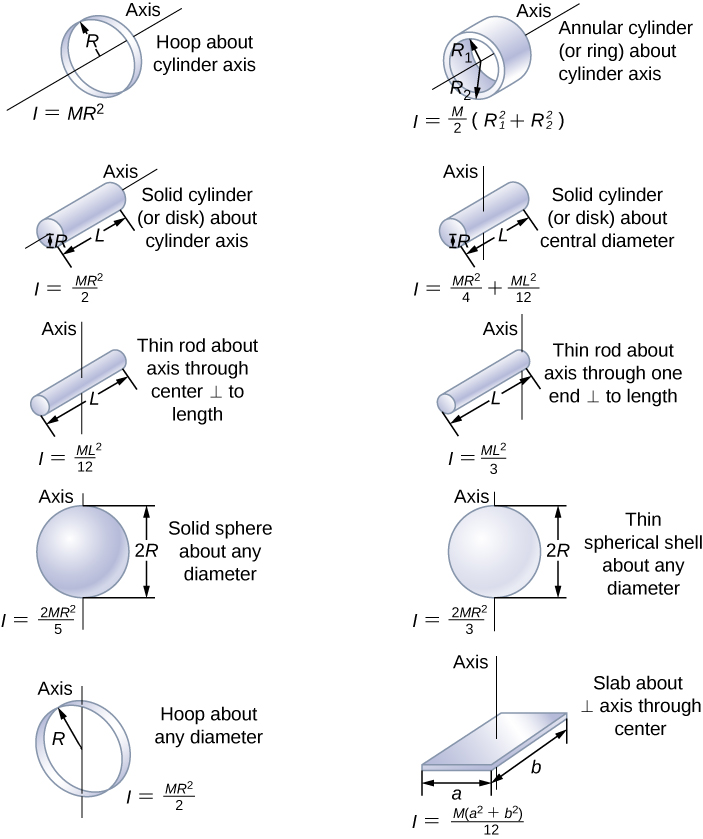
In the next section, we generalize the summation equation for point particles and develop a method to calculate moments of inertia for rigid bodies. For now, though, Figure 10.20 gives values of moment of inertia for common object shapes around specified axes.
英語のヒント
次節では質点についての総和の式を一般化し、剛体の慣性モーメントを求める方法を導く。ここでは先に、図10.20に、よくある物体の形と指定した軸についての慣性モーメントを示す。
OpenStax / Rice University, University Physics Volume 1, CC BY 4.0. Source-book artwork retained. · CC BY 4.0 · Source出典

Figure 10.20図 10.20
Moment of inertia for common shapes of objects.
英語のヒント
よくある形の物体の慣性モーメント。