第12章静的つり合いと弾性
A special case of static equilibrium occurs when all external forces on an object act at or along the axis of rotation or when the spatial extension of the object can be disregarded. In such a case, the object can be effectively treated like a point mass. In this special case, we need not worry about the second equilibrium condition, Equation 12.9, because all torques are identically zero and the first equilibrium condition (for forces) is the only condition to be satisfied. The free-body diagram and problem-solving strategy for this special case were outlined in Newton’s Laws of Motion and Applications of Newton’s Laws. You will see a typical equilibrium situation involving only the first equilibrium condition in the next example.
英語のヒント
物体に働くすべての外力が回転軸上、または軸に沿って働く場合や、物体の空間的な広がりを無視できる場合は、静的つり合いの特別な場合となる。この場合、物体を実質的に質点として扱える。すべてのトルクがゼロなので、第2条件の式12.9は考えなくてよく、力に関する第1条件だけを満たせばよい。この場合の力の図と問題解決の手順は、「ニュートンの運動の法則」と「ニュートンの法則の応用」で説明した。次の例題で、第1条件だけを使う典型的なつり合いを見よう。
Additional Resources追加教材
Example 12.2例題 12.2
A Breaking Tension糸が切れる張力
A small pan of mass 42.0 g is supported by two strings, as shown in Figure 12.7. The maximum tension that the string can support is 2.80 N. Mass is added gradually to the pan until one of the strings snaps. Which string is it? How much mass must be added for this to occur?
英語のヒント
質量42.0 gの小さな皿を、図12.7のように2本の糸で支える。糸が耐えられる最大張力は2.80 Nである。皿に少しずつおもりを加え、どちらかの糸が切れるまで続ける。切れるのはどちらの糸か。そのために加える質量はいくらか。
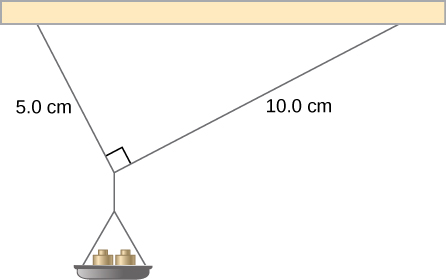
OpenStax / Rice University, University Physics Volume 1, CC BY 4.0. Source-book artwork retained. · CC BY 4.0 · Source出典

Figure 12.7図 12.7
Mass is added gradually to the pan until one of the strings snaps.
英語のヒント
どちらかの糸が切れるまで、皿に少しずつおもりを加える。
Strategy方針
This mechanical system consisting of strings, masses, and the pan is in static equilibrium. Specifically, the knot that ties the strings to the pan is in static equilibrium. The knot can be treated as a point; therefore, we need only the first equilibrium condition. The three forces pulling at the knot are the tension in the 5.0-cm string, the tension in the 10.0-cm string, and the weight of the pan holding the masses. We adopt a rectangular coordinate system with the y-axis pointing opposite to the direction of gravity and draw the free-body diagram for the knot (see Figure 12.8). To find the tension components, we must identify the direction angles and that the strings make with the horizontal direction that is the x-axis. As you can see in Figure 12.7, the strings make two sides of a right triangle. We can use the Pythagorean theorem to solve this triangle, shown in Figure 12.8, and find the sine and cosine of the angles and Then we can resolve the tensions into their rectangular components, substitute in the first condition for equilibrium (Equation 12.7 and Equation 12.8), and solve for the tensions in the strings. The string with a greater tension will break first.
英語のヒント
糸、おもり、皿からなる力学系は静的つり合いにある。特に、糸を皿につなぐ結び目が静的につり合う。結び目を点として扱えるので、第1条件だけを用いればよい。結び目を引く三つの力は、5.0 cmの糸の張力、10.0 cmの糸の張力、おもりを載せた皿の重力である。y軸を重力と反対向きに取る直交座標系を選び、結び目の力の図を描く(図12.8)。張力の成分を求めるには、各糸が水平なx軸となす角、を定める。図12.7のように、糸は直角三角形の二辺となる。ピタゴラスの定理を使って図12.8の三角形を解き、角、の正弦と余弦を求める。次に、張力を直交成分へ分解して第1条件の式12.7と式12.8へ代入し、各糸の張力を解く。張力が大きい方の糸が先に切れる。
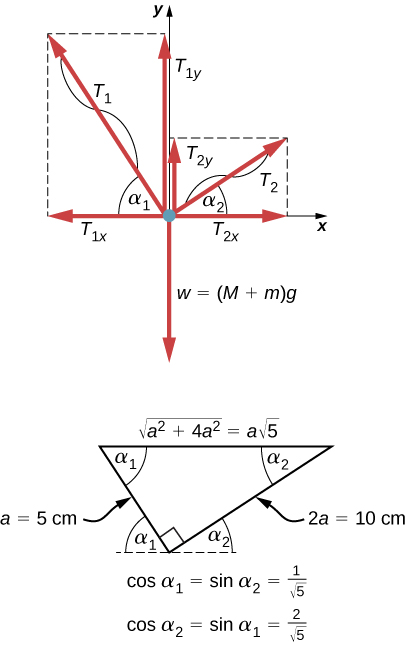
OpenStax / Rice University, University Physics Volume 1, CC BY 4.0. Source-book artwork retained. · CC BY 4.0 · Source出典

Figure 12.8図 12.8
Solution解答
The weight w pulling on the knot is due to the mass M of the pan and mass m added to the pan, or With the help of the free-body diagram in Figure 12.8, we can set up the equilibrium conditions for the knot:
英語のヒント
結び目を引く重力wは、皿の質量Mと加えたおもりの質量mによるので、である。図12.8の力の図を使い、結び目のつり合いの条件を立てる。
From the free-body diagram, the magnitudes of components in these equations are
英語のヒント
力の図から、これらの式に入る成分の大きさは、次のようになる。
We substitute these components into the equilibrium conditions and simplify. We then obtain two equilibrium equations for the tensions:
英語のヒント
これらの成分をつり合いの条件へ代入して整理すると、張力に関する二つのつり合いの式を得る。
The equilibrium equation for the x-direction tells us that the tension in the 5.0-cm string is twice the tension in the 10.0-cm string. Therefore, the shorter string will snap. When we use the first equation to eliminate from the second equation, we obtain the relation between the mass on the pan and the tension in the shorter string:
英語のヒント
x方向のつり合いの式より、5.0 cmの糸の張力は、10.0 cmの糸の張力の2倍である。したがって、短い方の糸が切れる。一つ目の式を使い、二つ目の式からを消去すると、皿に載せた質量と、短い糸の張力の関係を得る。
The string breaks when the tension reaches the critical value of The preceding equation can be solved for the critical mass m that breaks the string:
英語のヒント
張力が限界値に達すると、糸は切れる。前の式を解けば、糸を切る限界の質量mを求められる。
Significance考察
Suppose that the mechanical system considered in this example is attached to a ceiling inside an elevator going up. As long as the elevator moves up at a constant speed, the result stays the same because the weight does not change. If the elevator moves up with acceleration, the critical mass is smaller because the weight of becomes larger by an apparent weight due to the acceleration of the elevator. Still, in all cases the shorter string breaks first.
英語のヒント
この例題の力学系を、上昇するエレベーターの天井に取り付けたとしよう。一定の速さで上昇する限り、重力は変わらず、結果も同じである。上向きに加速している場合は、エレベーターの加速度による見かけの重さが加わり、の重さが増すので、限界の質量は小さくなる。いずれの場合も、短い方の糸が先に切れる。