第12章静的つり合いと弾性
Summaryまとめ
- An object or material is elastic if it comes back to its original shape and size when the stress vanishes. In elastic deformations with stress values lower than the proportionality limit, stress is proportional to strain. When stress goes beyond the proportionality limit, the deformation is still elastic but nonlinear up to the elasticity limit.
英語のヒント
応力がなくなると元の形と大きさに戻る物体や材料は、弾性を持つ。比例限界より応力が小さい弾性変形では、応力はひずみに比例する。比例限界を超えても弾性限界までは弾性変形だが、その関係は非線形になる。 - An object or material has plastic behavior when stress is larger than the elastic limit. In the plastic region, the object or material does not come back to its original size or shape when stress vanishes but acquires a permanent deformation. Plastic behavior ends at the breaking point.
英語のヒント
応力が弾性限界より大きいと、物体や材料は塑性的に振る舞う。塑性の範囲では、応力がなくなっても元の形や大きさに戻らず、永久変形が残る。塑性的な振る舞いは破断点で終わる。
Key Equations重要な式
First Equilibrium Condition つり合いの第1条件 |
|
Second Equilibrium Condition つり合いの第2条件 |
|
Linear relation between stress and strain 応力とひずみの線形関係 |
|
Young’s modulus ヤング率 |
|
Bulk modulus 体積弾性率 |
|
Shear modulus 剛性率 |
Conceptual Questions概念に関する問題
Exercises 64–65練習問題 64–65
Note: Unless stated otherwise, the weights of the wires, rods, and other elements are assumed to be negligible. Elastic moduli of selected materials are given in Table 12.1.
英語のヒント
注意:特に断らない限り、針金、棒、その他の部材の重さは無視できるものとする。いくつかの材料の弾性率は表12.1に示されている。
Exercise 64問題 64
What is meant when a fishing line is designated as “a 10-lb test?”
英語のヒント
釣り糸に「10 lbテスト」と表示されているとき、何を意味するか。
Exercise 65問題 65
Steel rods are commonly placed in concrete before it sets. What is the purpose of these rods?
英語のヒント
コンクリートが固まる前に、鋼の棒を中に入れることがよくある。この棒の目的は何か。
Solution解き方
It acts as “reinforcement,” increasing a range of strain values before the structure reaches its breaking point.
英語のヒント
「補強材」として働き、構造が破断点に達するまでの、ひずみの範囲を広げる。
Problems問題
Exercises 66–68練習問題 66–68
Exercise 66問題 66
A uniform rope of cross-sectional area breaks when the tensile stress in it reaches (a) What is the maximum load that can be lifted slowly at a constant speed by the rope? (b) What is the maximum load that can be lifted by the rope with an acceleration of
英語のヒント
断面積の一様なロープは、引張応力がに達すると切れる。(a) このロープで、低い一定速度で持ち上げられる荷物の最大の重さはいくらか。(b) 加速度で持ち上げられる荷物の最大の重さはいくらか。
Exercise 67問題 67
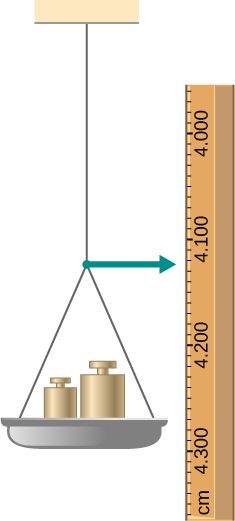
One end of a vertical metallic wire of length 2.0 m and diameter 1.0 mm is attached to a ceiling, and the other end is attached to a 5.0-N weight pan, as shown below. The position of the pointer before the pan is 4.000 cm. Different weights are then added to the pan area, and the position of the pointer is recorded in the table shown. Plot stress versus strain for this wire, then use the resulting curve to determine Young’s modulus and the proportionality limit of the metal. What metal is this most likely to be?
英語のヒント
長さ2.0 m、直径1.0 mmの鉛直な金属線の一端を天井に、もう一端を重さ5.0 Nのおもり皿に取り付ける。下図のように、皿に荷重を加える前の指針の位置は4.000 cmである。皿にさまざまなおもりを加え、そのときの指針の位置を表に記録した。この線の応力–ひずみ線図を描き、その曲線から金属のヤング率と比例限界を求めよ。どの金属である可能性が最も高いか。
Added load (including pan) (N) 英語のヒント加えた荷重(皿を含む)(N) |
Scale reading (cm) 英語のヒント目盛りの読み(cm) |
|---|---|
0 |
4.000 |
15 |
4.036 |
25 |
4.073 |
35 |
4.109 |
45 |
4.146 |
55 |
4.181 |
65 |
4.221 |
75 |
4.266 |
85 |
4.316 |
Exercise 68問題 68
An aluminum wire is suspended from the ceiling and hangs vertically. How long must the wire be before the stress at its upper end reaches the proportionality limit, which is
英語のヒント
アルミニウムの針金を天井から鉛直につるす。上端での応力が、比例限界に達するのは、針金の長さがいくらのときか。
Additional Problems追加問題
Exercises 69–74練習問題 69–74
Exercise 69問題 69
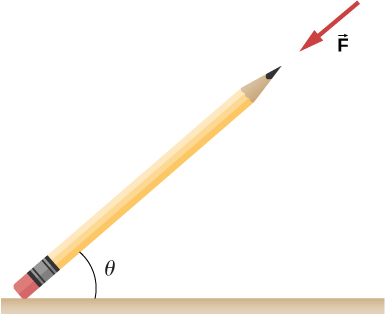
The coefficient of static friction between the rubber eraser of the pencil and the tabletop is If the force is applied along the axis of the pencil, as shown below, what is the minimum angle at which the pencil can stand without slipping? Ignore the weight of the pencil.
英語のヒント
鉛筆の消しゴムとテーブル面との静止摩擦係数はである。下図のように、鉛筆の軸に沿って力を加えるとき、滑らずに立てておける最小の角度はいくらか。鉛筆の重さは無視せよ。
Solution解き方
Exercise 70問題 70
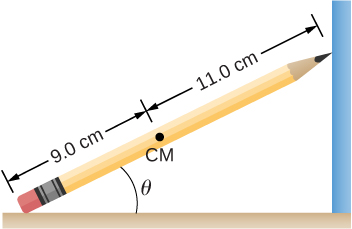
A pencil rests against a corner, as shown below. The sharpened end of the pencil touches a smooth vertical surface and the eraser end touches a rough horizontal floor. The coefficient of static friction between the eraser and the floor is The center of mass of the pencil is located 9.0 cm from the tip of the eraser and 11.0 cm from the tip of the pencil lead. Find the minimum angle for which the pencil does not slip.
英語のヒント
下図のように鉛筆を隅に立て掛ける。削った先端は滑らかな鉛直面に、消しゴム側の端は粗い水平な床に接している。消しゴムと床との静止摩擦係数はである。鉛筆の重心は、消しゴム側の先端から9.0 cm、芯の先端から11.0 cmの位置にある。鉛筆が滑らないための最小の角度を求めよ。
Exercise 71問題 71
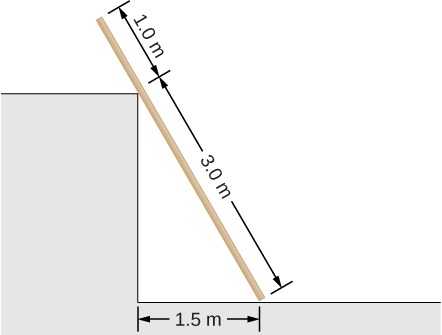
A uniform 4.0-m plank weighing 200.0 N rests against the corner of a wall, as shown below. There is no friction at the point where the plank meets the corner. (a) Find the forces that the corner and the floor exert on the plank. (b) What is the minimum coefficient of static friction between the floor and the plank to prevent the plank from slipping?
英語のヒント
下図のように、長さ4.0 m、重さ200.0 Nの一様な板を、壁の角に立て掛ける。板が壁の角に接する点には摩擦がない。(a) 壁の角と床が板に及ぼす力を求めよ。(b) 板が滑るのを防ぐために必要な、床と板との静止摩擦係数の最小値はいくらか。


Solution解き方
a. at corner 66.7 N at with the horizontal; at floor 177 N at with the horizontal; b.
英語のヒント
a. 壁の角では、水平となす角で66.7 N。床では、水平となす角で177 N。b.
Exercise 72問題 72
A 40-kg boy jumps from a height of 3.0 m, lands on one foot and comes to rest in 0.10 s after he hits the ground. Assume that he comes to rest with a constant acceleration opposite to the motion. If the total cross-sectional area of the bones in his legs just above his ankles is what is the compression stress in these bones? Leg bones can be fractured when they are subjected to stress greater than Is the boy in danger of breaking his leg?
英語のヒント
質量40 kgの少年が高さ3.0 mから飛び降り、片足で着地し、地面に接してから0.10 sで止まる。運動と逆向きの一定加速度で止まるとする。足首のすぐ上での脚の骨の断面積の合計がなら、骨の圧縮応力はいくらか。脚の骨は、応力がを超えると折れることがある。この少年に骨折の危険はあるか。
Exercise 73問題 73
Two thin rods, one made of steel and the other of aluminum, are joined end to end. Each rod is 2.0 m long and has cross-sectional area If a 10,000-N tensile force is applied at each end of the combination, find: (a) stress in each rod; (b) strain in each rod; and, (c) elongation of each rod.
英語のヒント
鋼とアルミニウムでできた2本の細い棒を、端と端でつなぐ。どちらも長さ2.0 m、断面積である。つないだ棒の両端に10,000 Nの引張力を加えるとき、各棒の(a) 応力、(b) ひずみ、(c) 伸びを求めよ。
Solution解き方
a. b. c. 11.0 mm, 31.4 mm
a. b. c. 11.0 mm、31.4 mm
Exercise 74問題 74
Two rods, one made of copper and the other of steel, have the same dimensions. If the copper rod stretches by 0.15 mm under some stress, how much does the steel rod stretch under the same stress?
英語のヒント
銅と鋼でできた2本の棒は、寸法が同じである。ある応力の下で銅の棒が0.15 mm伸びるとき、同じ応力の下で鋼の棒はどれだけ伸びるか。