第12章静的つり合いと弾性
Tensile or Compressive Stress, Strain, and Young’s Modulus引張り・圧縮の応力とひずみ、ヤング率
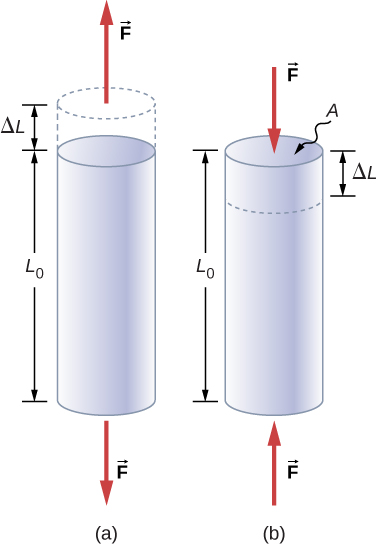
Tension or compression occurs when two antiparallel forces of equal magnitude act on an object along only one of its dimensions, in such a way that the object does not move. One way to envision such a situation is illustrated in Figure 12.18. A rod segment is either stretched or squeezed by a pair of forces acting along its length and perpendicular to its cross-section. The net effect of such forces is that the rod changes its length from the original length that it had before the forces appeared, to a new length L that it has under the action of the forces. This change in length may be either elongation (when L is larger than the original length or contraction (when L is smaller than the original length Tensile stress and strain occur when the forces are stretching an object, causing its elongation, and the length change is positive. Compressive stress and strain occur when the forces are contracting an object, causing its shortening, and the length change is negative.
英語のヒント
大きさの等しい、互いに反平行な二つの力が、物体の一方向に沿って働き、物体自体は動かないとき、引張りや圧縮が生じる。図12.18の棒がその例である。長さの方向に沿い、断面に垂直な一対の力によって、棒が伸ばされるか押し縮められる。結果として、力が働く前の長さから、働いているときの新しい長さLへ変化する。この変化は、伸び (L > 、または縮み (L < となる。引き伸ばす力が働くと、引張応力と引張ひずみが生じ、長さの変化は正になる。押し縮める力が働くと、圧縮応力と圧縮ひずみが生じ、長さの変化は負になる。
In either of these situations, we define stress as the ratio of the deforming force to the cross-sectional area A of the object being deformed. The symbol that we reserve for the deforming force means that this force acts perpendicularly to the cross-section of the object. Forces that act parallel to the cross-section do not change the length of an object. The definition of the tensile stress is
英語のヒント
どちらの場合も、応力を、変形させる力と変形を受ける物体の断面積Aの比として定義する。力を表す記号は、この力が物体の断面に垂直に働くことを示す。断面に平行な力では物体の長さは変わらない。引張応力の定義は次のとおりである。
Tensile strain is the measure of the deformation of an object under tensile stress and is defined as the fractional change of the object’s length when the object experiences tensile stress
英語のヒント
引張ひずみは、引張応力を受けた物体の変形の尺度であり、そのときの長さの変化の割合として定義する。
Compressive stress and strain are defined by the same formulas, Equation 12.34 and Equation 12.35, respectively. The only difference from the tensile situation is that for compressive stress and strain, we take absolute values of the right-hand sides in Equation 12.34 and Equation 12.35.
英語のヒント
OpenStax / Rice University, University Physics Volume 1, CC BY 4.0. Source-book artwork retained. · CC BY 4.0 · Source出典

Figure 12.18図 12.18
When an object is in either tension or compression, the net force on it is zero, but the object deforms by changing its original length (a) Tension: The rod is elongated by (b) Compression: The rod is contracted by In both cases, the deforming force acts along the length of the rod and perpendicular to its cross-section. In the linear range of low stress, the cross-sectional area of the rod does not change.
英語のヒント
物体が引張りまたは圧縮を受けるとき、合力はゼロだが、元の長さが変わる。(a) 引張りでは棒がだけ伸びる。(b) 圧縮ではだけ縮む。どちらも、変形させる力は棒の長さ方向、断面に垂直に働く。応力が小さい線形範囲では、棒の断面積は変わらない。
Young’s modulus Y is the elastic modulus when deformation is caused by either tensile or compressive stress, and is defined by Equation 12.33. Dividing this equation by tensile strain, we obtain the expression for Young’s modulus:
英語のヒント
ヤング率Yは、引張応力または圧縮応力で変形するときの弾性率であり、式12.33で定義される。この式を引張ひずみで割ると、次の式を得る。
Example 12.7例題 12.7
Compressive Stress in a Pillar柱の圧縮応力
A sculpture weighing 10,000 N rests on a horizontal surface at the top of a 6.0-m-tall vertical pillar Figure 12.19. The pillar’s cross-sectional area is and it is made of granite with a mass density of Find the compressive stress at the cross-section located 3.0 m below the top of the pillar and the value of the compressive strain of the top 3.0-m segment of the pillar.
英語のヒント
高さ6.0 mの鉛直な柱の、水平な上面に、重さ10,000 Nの彫像が載っている(図12.19)。柱の断面積はで、密度の花崗岩でできている。柱の上端から3.0 m下の断面での圧縮応力と、柱の上側3.0 mの部分の圧縮ひずみを求めよ。
Image omitted because its reuse rights could not be verified.権利の確認ができないため画像を割愛。
Figure 12.19図 12.19
Nelson’s Column in Trafalgar Square, London, England. (credit: modification of work by Cristian Bortes)
英国ロンドン、トラファルガー広場のネルソン記念柱。(クリスティアン・ボルテスの作品を改変)
Strategy方針
First we find the weight of the 3.0-m-long top section of the pillar. The normal force that acts on the cross-section located 3.0 m down from the top is the sum of the pillar’s weight and the sculpture’s weight. Once we have the normal force, we use Equation 12.34 to find the stress. To find the compressive strain, we find the value of Young’s modulus for granite in Table 12.1 and invert Equation 12.36.
英語のヒント
Solution解答
The volume of the pillar segment with height and cross-sectional area is
英語のヒント
高さ、断面積の柱の部分の体積は、次のようになる。
With the density of granite the mass of the pillar segment is
英語のヒント
花崗岩の密度より、この柱の部分の質量は次のようになる。
The weight of the pillar segment is
英語のヒント
柱の部分の重さは、次の値である。
The weight of the sculpture is so the normal force on the cross-sectional surface located 3.0 m below the sculpture is
英語のヒント
彫像の重さはなので、その3.0 m下の断面に働く垂直な力は次のようになる。
Therefore, the stress is
英語のヒント
したがって、応力は次のようになる。
Young’s modulus for granite is Therefore, the compressive strain at this position is
英語のヒント
花崗岩のヤング率はである。したがって、この位置での圧縮ひずみは次のようになる。
Significance考察
Notice that the normal force acting on the cross-sectional area of the pillar is not constant along its length, but varies from its smallest value at the top to its largest value at the bottom of the pillar. Thus, if the pillar has a uniform cross-sectional area along its length, the stress is largest at its base.
英語のヒント
柱の断面に働く垂直な力は、長さに沿って一定ではない。上端で最小、下端で最大となる。したがって、断面積がどこでも同じなら、応力は柱の根元で最大となる。
Example 12.8例題 12.8
Stretching a Rod棒の伸び
A 2.0-m-long steel rod has a cross-sectional area of The rod is a part of a vertical support that holds a heavy 550-kg platform that hangs attached to the rod’s lower end. Ignoring the weight of the rod, what is the tensile stress in the rod and the elongation of the rod under the stress?
英語のヒント
長さ2.0 mの鋼の棒の断面積はである。棒は鉛直な支持部の一部をなし、下端につるした質量550 kgの重い台を支える。棒自身の重さを無視すると、棒の引張応力と、その応力による伸びはいくらか。
Strategy方針
First we compute the tensile stress in the rod under the weight of the platform in accordance with Equation 12.34. Then we invert Equation 12.36 to find the rod’s elongation, using From Table 12.1, Young’s modulus for steel is
英語のヒント
Solution解答
Substituting numerical values into the equations gives us
英語のヒント
式に数値を代入すると、次の結果を得る。
Significance考察
Similarly as in the example with the column, the tensile stress in this example is not uniform along the length of the rod. Unlike in the previous example, however, if the weight of the rod is taken into consideration, the stress in the rod is largest at the top and smallest at the bottom of the rod where the equipment is attached.
英語のヒント
柱の例と同様、この例の棒でも、引張応力は長さに沿って一様ではない。ただし前の例と異なり、棒の重さを考慮すると、応力は上端で最大となり、装置を取り付けた下端で最小となる。
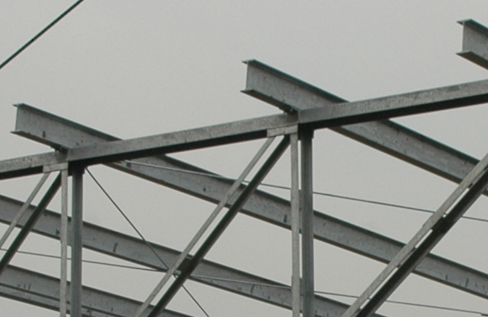
Objects can often experience both compressive stress and tensile stress simultaneously Figure 12.20. One example is a long shelf loaded with heavy books that sags between the end supports under the weight of the books. The top surface of the shelf is in compressive stress and the bottom surface of the shelf is in tensile stress. Similarly, long and heavy beams sag under their own weight. In modern building construction, such bending strains can be almost eliminated with the use of I-beams Figure 12.21.
英語のヒント
Image omitted because its reuse rights could not be verified.権利の確認ができないため画像を割愛。
Figure 12.20図 12.20
(a) An object bending downward experiences tensile stress (stretching) in the upper section and compressive stress (compressing) in the lower section. (b) Elite weightlifters often bend iron bars temporarily during lifting, as in the 2012 Olympics competition. (credit b: modification of work by Oleksandr Kocherzhenko)
英語のヒント
(a) 下向きに曲がる物体では、上側の部分に引張応力(伸び)、下側の部分に圧縮応力(縮み)が生じる。(b) 一流の重量挙げ選手が持ち上げるとき、鉄の棒は一時的に曲がることが多い。写真は2012年オリンピックでの競技の様子である。(b:オレクサンドル・コチェルジェンコの作品を改変)
(credit: modification of work by “US Army Corps of Engineers Europe District”/Flickr) The appearance of U.S. Department of Defense visual information does not imply or constitute DoD endorsement. · US government public-domain visual information; OpenStax additions CC BY 4.0 · Source出典

Figure 12.21図 12.21
Steel I-beams are used in construction to reduce bending strains. (credit: modification of work by “US Army Corps of Engineers Europe District”/Flickr)
英語のヒント
建設では、曲げによるひずみを小さくするためにI形鋼を使う。(「US Army Corps of Engineers Europe District」/Flickrの作品を改変)