第12章静的つり合いと弾性
Shear Stress, Strain, and Modulusせん断応力・せん断ひずみ・剛性率
The concepts of shear stress and strain concern only solid objects or materials. Buildings and tectonic plates are examples of objects that may be subjected to shear stresses. In general, these concepts do not apply to fluids.
英語のヒント
せん断応力とせん断ひずみの概念は、固体だけに適用される。建物や地殻のプレートは、せん断応力を受ける物体の例である。一般に、これらの概念は流体には適用しない。
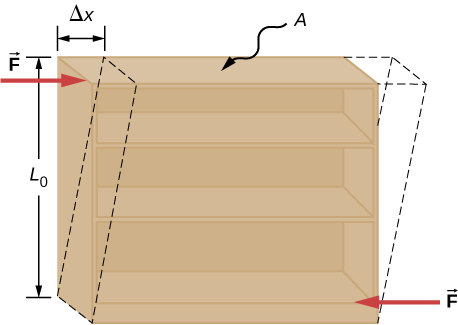
Shear deformation occurs when two antiparallel forces of equal magnitude are applied tangentially to opposite surfaces of a solid object, causing no deformation in the transverse direction to the line of force, as in the typical example of shear stress illustrated in Figure 12.24. Shear deformation is characterized by a gradual shift of layers in the direction tangent to the acting forces. This gradation in occurs in the transverse direction along some distance Shear strain is defined by the ratio of the largest displacement to the transverse distance
英語のヒント
せん断変形は、固体の向かい合う面に、大きさが等しく互いに反平行な二つの力を、面に沿って加えたときに生じる。図12.24の典型例のように、力の作用線に垂直な方向の変形は生じない。せん断変形では、物体の各層が、力に沿う方向へずれる。このずれは、力と直交する方向に、距離にわたって徐々に変わる。せん断ひずみを、最大変位と、それに直交する方向の距離との比として定義する。
Shear strain is caused by shear stress. Shear stress is due to forces that act parallel to the surface. We use the symbol for such forces. The magnitude per surface area A where shearing force is applied is the measure of shear stress
英語のヒント
せん断ひずみは、せん断応力によって生じる。せん断応力を生じさせる力は、表面に平行に働く。この力をで表す。力の大きさを、それが加わる面の面積Aで割った量が、せん断応力である。
The shear modulus is the proportionality constant in Equation 12.33 and is defined by the ratio of stress to strain. Shear modulus is commonly denoted by S:
英語のヒント
剛性率は式12.33の比例定数であり、せん断応力とせん断ひずみの比で定義される。通常はSで表す。
OpenStax / Rice University, University Physics Volume 1, CC BY 4.0. Source-book artwork retained. · CC BY 4.0 · Source出典

Figure 12.24図 12.24
An object under shear stress: Two antiparallel forces of equal magnitude are applied tangentially to opposite parallel surfaces of the object. The dashed-line contour depicts the resulting deformation. There is no change in the direction transverse to the acting forces and the transverse length is unaffected. Shear deformation is characterized by a gradual shift of layers in the direction tangent to the forces.
英語のヒント
せん断応力を受ける物体。向かい合う平行な面に、大きさが等しく互いに反平行な二つの力が、面に沿って働く。破線の輪郭が変形後の形を示す。力に垂直な方向には変化がなく、その方向の長さは変わらない。せん断変形では、各層が力に沿う方向へ徐々にずれる。
Example 12.10例題 12.10
An Old Bookshelf古い本棚
A cleaning person tries to move a heavy, old bookcase on a carpeted floor by pushing tangentially on the surface of the very top shelf. However, the only noticeable effect of this effort is similar to that seen in Figure 12.24, and it disappears when the person stops pushing. The bookcase is 180.0 cm tall and 90.0 cm wide with four 30.0-cm-deep shelves, all partially loaded with books. The total weight of the bookcase and books is 600.0 N. If the person gives the top shelf a 50.0-N push that displaces the top shelf horizontally by 15.0 cm relative to the motionless bottom shelf, find the shear modulus of the bookcase.
英語のヒント
清掃中の人が、カーペット敷きの床に置いた重く古い本棚を、最上段の棚板に沿って押して動かそうとする。しかし目に見える変化は、図12.24に似た変形だけであり、押すのをやめると消える。本棚は高さ180.0 cm、幅90.0 cmで、奥行き30.0 cmの棚板が4枚ある。どの段にも一部に本が載っており、本棚と本の重さの合計は600.0 Nである。最上段の棚を50.0 Nの力で押すと、動かない最下段の棚に対して、最上段が水平方向に15.0 cmずれる。この本棚の剛性率を求めよ。
Strategy方針
The only pieces of relevant information are the physical dimensions of the bookcase, the value of the tangential force, and the displacement this force causes. We identify and and we use Equation 12.43 to compute the shear modulus.
英語のヒント
必要な情報は、本棚の寸法、棚板に沿って加えた力の値、その力によって生じる変位だけである。、、を確認し、式12.43で剛性率を計算する。
Solution解答
Substituting numbers into the equations, we obtain for the shear modulus
英語のヒント
式に数値を代入すると、剛性率は次のようになる。
We can also find shear stress and strain, respectively:
英語のヒント
せん断応力とせん断ひずみも、それぞれ次のように求められる。
Significance考察
If the person in this example gave the shelf a healthy push, it might happen that the induced shear would collapse it to a pile of rubbish. Much the same shear mechanism is responsible for failures of earth-filled dams and levees; and, in general, for landslides.
英語のヒント
この例で棚を思い切り押したら、生じたせん断変形によって本棚が崩れ、がれきの山になるかもしれない。土を盛って作ったダムや堤防の決壊、さらに一般には地滑りも、ほぼ同じせん断の仕組みによって生じる。
Summaryまとめ
- External forces on an object (or medium) cause its deformation, which is a change in its size and shape. The strength of the forces that cause deformation is expressed by stress, which in SI units is measured in the unit of pressure (pascal). The extent of deformation under stress is expressed by strain, which is dimensionless.
英語のヒント
物体(または媒質)に外力が働くと、その大きさと形が変わる。この変化が変形である。変形を起こす力の強さを応力で表す。SIでは、圧力の単位であるパスカルで測る。応力による変形の程度をひずみで表し、これは無次元量である。 - For a small stress, the relation between stress and strain is linear. The elastic modulus is the proportionality constant in this linear relation.
英語のヒント
応力が小さい範囲では、応力とひずみは線形関係にある。この比例定数が弾性率である。 - Tensile (or compressive) strain is the response of an object or medium to tensile (or compressive) stress. Here, the elastic modulus is called Young’s modulus. Tensile (or compressive) stress causes elongation (or shortening) of the object or medium and is due to an external forces acting along only one direction perpendicular to the cross-section.
英語のヒント
引張ひずみ(または圧縮ひずみ)は、引張応力(または圧縮応力)に対する物体や媒質の応答である。この場合の弾性率をヤング率と呼ぶ。引張応力(または圧縮応力)は、断面に垂直な一方向に沿って働く外力から生じ、物体や媒質を伸ばす(または縮める)。 - Bulk strain is the response of an object or medium to bulk stress. Here, the elastic modulus is called the bulk modulus. Bulk stress causes a change in the volume of the object or medium and is caused by forces acting on the body from all directions, perpendicular to its surface. Compressibility of an object or medium is the reciprocal of its bulk modulus.
英語のヒント
体積ひずみは、体積応力に対する物体や媒質の応答である。この場合の弾性率を体積弾性率と呼ぶ。体積応力は、物体の表面に垂直に、あらゆる方向から働く力によって生じ、物体や媒質の体積を変える。物体や媒質の圧縮率は、体積弾性率の逆数である。 - Shear strain is the deformation of an object or medium under shear stress. The shear modulus is the elastic modulus in this case. Shear stress is caused by forces acting along the object’s two parallel surfaces.
英語のヒント
せん断ひずみは、せん断応力を受けた物体や媒質の変形である。この場合の弾性率が剛性率である。せん断応力は、物体の二つの平行な面に沿って働く力から生じる。