第12章静的つり合いと弾性
12.2 Examples of Static Equilibrium12.2 静的つり合いの例
Learning Objectives学習目標
Learning Objectives学習目標
By the end of this section, you will be able to:
英語のヒント
この節を終えると、次のことができるようになる。
- Identify and analyze static equilibrium situations
英語のヒント
静的つり合いの状況を特定し、解析する。 - Set up a free-body diagram for an extended object in static equilibrium
英語のヒント
静的つり合いにある、広がりを持つ物体の力の図を作る。 - Set up and solve static equilibrium conditions for objects in equilibrium in various physical situations
英語のヒント
さまざまな物理的状況でつり合う物体について、静的つり合いの条件を立てて解く。
All examples in this chapter are planar problems. Accordingly, we use equilibrium conditions in the component form of Equation 12.7 to Equation 12.9. We introduced a problem-solving strategy in Example 12.1 to illustrate the physical meaning of the equilibrium conditions. Now we generalize this strategy in a list of steps to follow when solving static equilibrium problems for extended rigid bodies. We proceed in five practical steps.
英語のヒント
Note that setting up a free-body diagram for a rigid-body equilibrium problem is the most important component in the solution process. Without the correct setup and a correct diagram, you will not be able to write down correct conditions for equilibrium. Also note that a free-body diagram for an extended rigid body that may undergo rotational motion is different from a free-body diagram for a body that experiences only translational motion (as you saw in the chapters on Newton’s laws of motion). In translational dynamics, a body is represented as its CM, where all forces on the body are attached and no torques appear. This does not hold true in rotational dynamics, where an extended rigid body cannot be represented by one point alone. The reason for this is that in analyzing rotation, we must identify torques acting on the body, and torque depends both on the acting force and on its lever arm. Here, the free-body diagram for an extended rigid body helps us identify external torques.
英語のヒント
剛体のつり合いを解く過程で最も重要なのは、力の図を正しく作ることである。設定と図が正しくなければ、正しいつり合いの条件を書けない。回転しうる、広がりを持つ剛体の力の図は、ニュートンの運動の法則の章で見た、並進運動だけをする物体の図とは異なる。並進の動力学では、物体をCMで代表させ、すべての力をそこに置く。トルクは現れない。回転の動力学では、広がりを持つ剛体を一点だけで表せない。回転を解析するには、物体に働くトルクを定める必要があり、トルクは力とその腕の長さの両方に依存するからである。剛体全体を示す力の図は、外力によるトルクを特定する助けとなる。
Example 12.3例題 12.3
The Torque Balanceてこのつり合い
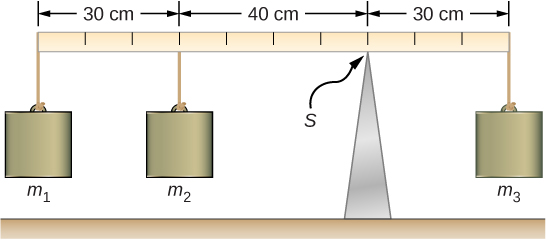
Three masses are attached to a uniform meter stick, as shown in Figure 12.9. The mass of the meter stick is 150.0 g and the masses to the left of the fulcrum are and Find the mass that balances the system when it is attached at the right end of the stick, and the normal reaction force at the fulcrum when the system is balanced.
英語のヒント
図12.9のように、一様な1 mの物差しに三つのおもりを取り付ける。物差しの質量は150.0 g、支点の左側のおもりの質量はとである。物差しの右端に付けたときに系をつり合わせる質量と、つり合ったときの支点の垂直抗力を求めよ。
OpenStax / Rice University, University Physics Volume 1, CC BY 4.0. Source-book artwork retained. · CC BY 4.0 · Source出典

Figure 12.9図 12.9
In a torque balance, a horizontal beam is supported at a fulcrum (indicated by S) and masses are attached to both sides of the fulcrum. The system is in static equilibrium when the beam does not rotate. It is balanced when the beam remains level.
英語のヒント
てこでは、水平な棒を支点Sで支え、両側におもりを付ける。棒が回転しなければ、系は静的つり合いにある。棒が水平を保つとき、つり合っている。
Strategy方針
For the arrangement shown in the figure, we identify the following five forces acting on the meter stick:
英語のヒント
図の配置で、物差しに働く次の五つの力を特定する。
is the weight of mass is the weight of mass
英語のヒント
は質量の重力、は質量の重力である。
is the weight of the entire meter stick; is the weight of unknown mass
英語のヒント
は物差し全体の重力、は未知の質量の重力である。
is the normal reaction force at the support point S.
英語のヒント
は、支持点Sでの垂直抗力である。
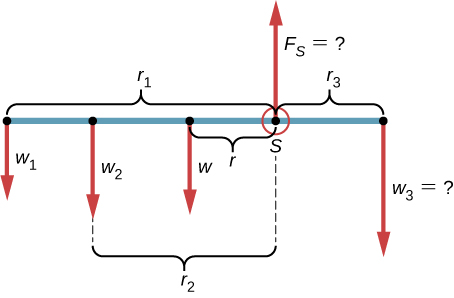
We choose a frame of reference where the direction of the y-axis is the direction of gravity, the direction of the x-axis is along the meter stick, and the axis of rotation (the z-axis) is perpendicular to the x-axis and passes through the support point S. In other words, we choose the pivot at the point where the meter stick touches the support. This is a natural choice for the pivot because this point does not move as the stick rotates. Now we are ready to set up the free-body diagram for the meter stick. We indicate the pivot and attach five vectors representing the five forces along the line representing the meter stick, locating the forces with respect to the pivot Figure 12.10. At this stage, we can identify the lever arms of the five forces given the information provided in the problem. For the three hanging masses, the problem is explicit about their locations along the stick, but the information about the location of the weight w is given implicitly. The key word here is “uniform.” We know from our previous studies that the CM of a uniform stick is located at its midpoint, so this is where we attach the weight w, at the 50-cm mark.
英語のヒント
y軸を重力の向き、x軸を物差しに沿う向きに取り、回転軸であるz軸はx軸に垂直で支持点Sを通るようにする。つまり、物差しが支えに接する点を支点に選ぶ。この点は物差しが回転しても動かないので、自然な選び方である。力の図に支点を示し、物差しを表す線上に五つの力のベクトルを配置する。支点との位置関係も示す(図12.10)。これで、問題の情報から五つの力の腕の長さを求められる。三つのおもりの位置は明示されているが、重力wの作用点は暗黙に与えられている。鍵となる語は「一様な」である。一様な棒のCMは中点にあるので、重力wを50 cmの目盛の位置に置く。
OpenStax / Rice University, University Physics Volume 1, CC BY 4.0. Source-book artwork retained. · CC BY 4.0 · Source出典

Figure 12.10図 12.10
Free-body diagram for the meter stick. The pivot is chosen at the support point S.
英語のヒント
物差しの力の図。支点は支持点Sに選ぶ。
Solution解答
With Figure 12.9 and Figure 12.10 for reference, we begin by finding the lever arms of the five forces acting on the stick:
英語のヒント
Now we can find the five torques with respect to the chosen pivot:
英語のヒント
選んだ支点に関して、五つのトルクを求める。
The second equilibrium condition (equation for the torques) for the meter stick is
英語のヒント
物差しについての第2条件、トルクのつり合いの式は、次のとおりである。
When substituting torque values into this equation, we can omit the torques giving zero contributions. In this way the second equilibrium condition is
英語のヒント
この式にトルクを代入するとき、ゼロとなる項は省ける。すると、第2条件は次のようになる。
(12.17)
Selecting the -direction to be parallel to the first equilibrium condition for the stick is
英語のヒント
方向をと平行に選ぶと、物差しの第1条件は次のようになる。
Substituting the forces, the first equilibrium condition becomes
英語のヒント
力を代入すると、第1条件は次のようになる。
(12.18)
We solve these equations simultaneously for the unknown values and In Equation 12.17, we cancel the g factor and rearrange the terms to obtain
英語のヒント
これらの式を連立して解き、未知のとを求める。式12.17で共通因子gを約分し、項を整理すると、次式を得る。
To obtain we divide both sides by so we have
英語のヒント
を求めるため、両辺をで割ると、次のようになる。
(12.19)
To find the normal reaction force, we rearrange the terms in Equation 12.18, converting grams to kilograms:
英語のヒント
垂直抗力を求めるため、式12.18の項を整理し、グラムをキログラムへ換算する。
(12.20)
Significance考察
Notice that Equation 12.17 is independent of the value of g. The torque balance may therefore be used to measure mass, since variations in g-values on Earth’s surface do not affect these measurements. This is not the case for a spring balance because it measures the force.
英語のヒント
式12.17はgの値に依存しない。このため、てこを用いるはかりは質量を測定でき、地表でgが変化しても測定に影響しない。力を測定するばねばかりでは、そうはいかない。