第12章静的つり合いと弾性
Bulk Stress, Strain, and Modulus体積応力・体積ひずみ・体積弾性率
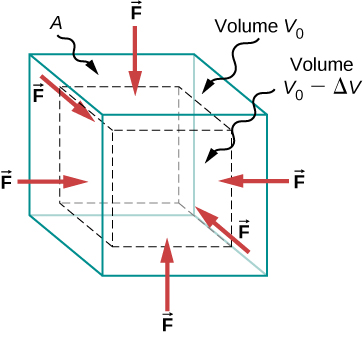
When you dive into water, you feel a force pressing on every part of your body from all directions. What you are experiencing then is bulk stress, or in other words, pressure. Bulk stress always tends to decrease the volume enclosed by the surface of a submerged object. The forces of this “squeezing” are always perpendicular to the submerged surface Figure 12.22. The effect of these forces is to decrease the volume of the submerged object by an amount compared with the volume of the object in the absence of bulk stress. This kind of deformation is called bulk strain and is described by a change in volume relative to the original volume:
英語のヒント
水中に潜ると、体のあらゆる部分を、あらゆる方向から押す力を感じる。このとき受けているのが体積応力、言い換えれば圧力である。体積応力は、水中に沈めた物体の表面に囲まれた体積を、常に小さくしようとする。この「押し縮める」力は、図12.22のように、水中の表面に常に垂直に働く。これらの力によって、水中の物体の体積は、体積応力がないときの体積と比べてだけ小さくなる。この種の変形を体積ひずみと呼ぶ。元の体積に対する体積変化の比で表す。
OpenStax / Rice University, University Physics Volume 1, CC BY 4.0. Source-book artwork retained. · CC BY 4.0 · Source出典

Figure 12.22図 12.22
An object under increasing bulk stress always undergoes a decrease in its volume. Equal forces perpendicular to the surface act from all directions. The effect of these forces is to decrease the volume by the amount compared to the original volume,
英語のヒント
体積応力が増加すると、物体の体積は必ず小さくなる。表面に垂直な等しい力が、あらゆる方向から働く。これらの力により、元の体積からだけ体積が減る。
The bulk strain results from the bulk stress, which is a force normal to a surface that presses on the unit surface area A of a submerged object. This kind of physical quantity, or pressure p, is defined as
英語のヒント
体積ひずみは、体積応力によって生じる。体積応力は、水中に沈めた物体の表面に垂直な力を、力が働く面の面積Aで割った量である。この物理量、すなわち圧力pは、次のように定義される。
We will study pressure in fluids in greater detail in Fluid Mechanics. An important characteristic of pressure is that it is a scalar quantity and does not have any particular direction; that is, pressure acts equally in all possible directions. When you submerge your hand in water, you sense the same amount of pressure acting on the top surface of your hand as on the bottom surface, or on the side surface, or on the surface of the skin between your fingers. What you are perceiving in this case is an increase in pressure over what you are used to feeling when your hand is not submerged in water. What you feel when your hand is not submerged in the water is the normal pressure of one atmosphere, which serves as a reference point. The bulk stress is this increase in pressure, or over the normal level,
英語のヒント
流体中の圧力は「流体力学」で詳しく学ぶ。圧力の重要な性質は、スカラー量であり、特定の方向を持たないことである。つまり、圧力はあらゆる方向に等しく働く。手を水に沈めると、手の甲にも、手のひらにも、側面にも、指の間の皮膚にも、同じ大きさの圧力を感じる。この場合に感じるのは、水に手を沈めていないときに普段感じている圧力からの増加分である。手を水に沈めていないときの圧力は、基準となる1気圧の通常の圧力である。体積応力は、この通常の圧力からの増加分を指す。
When the bulk stress increases, the bulk strain increases in response, in accordance with Equation 12.33. The proportionality constant in this relation is called the bulk modulus, B, or
英語のヒント
体積応力が増すと、式12.33に従って体積ひずみも増す。この関係の比例定数を体積弾性率Bと呼ぶ。すなわち、
The minus sign that appears in Equation 12.39 is for consistency, to ensure that B is a positive quantity. Note that the minus sign is necessary because an increase in pressure (a positive quantity) always causes a decrease in volume, and decrease in volume is a negative quantity. The reciprocal of the bulk modulus is called compressibility or
英語のヒント
式12.39の負号は、Bを正の量にするために付いている。圧力の増加は正の量だが、それによって必ず体積の減少、つまり負の量が生じるため、負号が必要となる。体積弾性率の逆数を圧縮率と呼ぶ。すなわち、
(12.40)
The term ‘compressibility’ is used in relation to fluids (gases and liquids). Compressibility describes the change in the volume of a fluid per unit increase in pressure. Fluids characterized by a large compressibility are relatively easy to compress. For example, the compressibility of water is and the compressibility of acetone is This means that under a 1.0-atm increase in pressure, the relative decrease in volume is approximately three times as large for acetone as it is for water.
英語のヒント
「圧縮率」は、流体(気体と液体)について使う用語である。圧力が単位量だけ増したときの、流体の体積の変化を表す。圧縮率が大きい流体は、比較的圧縮しやすい。例えば、水の圧縮率は、アセトンの圧縮率はである。圧力を1.0 atm増したとき、体積が減少する割合は、アセトンでは水のおよそ3倍になる。
Example 12.9例題 12.9
Hydraulic Press油圧プレス
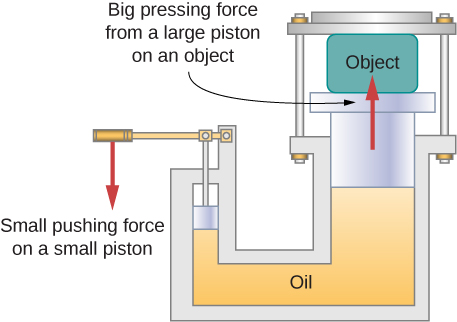
In a hydraulic press Figure 12.23, a 250-liter volume of oil is subjected to a 2300-psi pressure increase. If the compressibility of oil is find the bulk strain and the absolute decrease in the volume of oil when the press is operating.
英語のヒント
油圧プレス(図12.23)内の250 Lの油に加わる圧力が、2300 psi増加する。油の圧縮率がのとき、プレスの作動中の体積ひずみと、油の体積減少量の絶対値を求めよ。
OpenStax / Rice University, University Physics Volume 1, CC BY 4.0. Source-book artwork retained. · CC BY 4.0 · Source出典

Figure 12.23図 12.23
In a hydraulic press, when a small piston is displaced downward, the pressure in the oil is transmitted throughout the oil to the large piston, causing the large piston to move upward. A small force applied to a small piston causes a large pressing force, which the large piston exerts on an object that is either lifted or squeezed. The device acts as a mechanical lever.
英語のヒント
油圧プレスでは、小さいピストンを押し下げると、油の圧力が油全体を通じて大きいピストンへ伝わり、それを押し上げる。小さいピストンに加えた小さな力が、大きいピストンに大きな押す力を生じさせる。その力で物体を持ち上げたり、押し縮めたりできる。この装置は、てこの働きをする。
Strategy方針
We must invert Equation 12.40 to find the bulk strain. First, we convert the pressure increase from psi to atm, and identify
英語のヒント
体積ひずみを求めるために、式12.40を変形する。まず圧力の増加をpsiからatmへ換算すると、となる。また、である。
Solution解答
Substituting values into the equation, we have
英語のヒント
式に数値を代入すると、次のようになる。
Significance考察
Notice that since the compressibility of water is 2.32 times larger than that of oil, if the working substance in the hydraulic press of this problem were changed to water, the bulk strain as well as the volume change would be 2.32 times larger.
英語のヒント
水の圧縮率は油の2.32倍なので、この問題の油圧プレスの作動流体を水に替えると、体積ひずみも体積変化も2.32倍になる。