第12章静的つり合いと弾性
Summaryまとめ
- A body is in equilibrium when it remains either in uniform motion (both translational and rotational) or at rest. When a body in a selected inertial frame of reference neither rotates nor moves in translational motion, we say the body is in static equilibrium in this frame of reference.
英語のヒント
物体が並進・回転ともに等速運動を続けるか、静止を保つとき、つり合いにある。選んだ慣性基準系で、回転も並進運動もしない物体は、その基準系で静的つり合いにあるという。 - Conditions for equilibrium require that the sum of all external forces acting on the body is zero (first condition of equilibrium), and the sum of all external torques from external forces is zero (second condition of equilibrium). These two conditions must be simultaneously satisfied in equilibrium. If one of them is not satisfied, the body is not in equilibrium.
英語のヒント
つり合いには、物体に働くすべての外力の和がゼロであること(第1条件)と、外力によるすべてのトルクの和がゼロであること(第2条件)が必要である。二つは同時に満たさなければならない。どちらかが満たされなければ、物体はつり合いにない。 - The free-body diagram for a body is a useful tool that allows us to count correctly all contributions from all external forces and torques acting on the body. Free-body diagrams for the equilibrium of an extended rigid body must indicate a pivot point and lever arms of acting forces with respect to the pivot.
英語のヒント
力の図は、物体に働くすべての外力とトルクの寄与を、漏れなく正しく数えるために役立つ。広がりを持つ剛体のつり合いの図には、支点と、支点に関する各力の腕の長さを示さなければならない。
Conceptual Questions概念に関する問題
Exercises 1–4練習問題 1–4
Exercise 1問題 1
What can you say about the velocity of a moving body that is in dynamic equilibrium?
英語のヒント
動的つり合いにある、運動する物体の速度について何が言えるか。
Solution解き方
constant
英語のヒント
一定である。
Exercise 2問題 2
Under what conditions can a rotating body be in equilibrium? Give an example.
英語のヒント
回転する物体がつり合うのは、どのような条件の下か。例を挙げよ。
Exercise 3問題 3
What three factors affect the torque created by a force relative to a specific pivot point?
英語のヒント
ある支点に関して、力が生むトルクに影響する三つの要素は何か。
Solution解き方
magnitude and direction of the force, and its lever arm
英語のヒント
力の大きさと向き、および力の腕。
Exercise 4問題 4
Mechanics sometimes put a length of pipe over the handle of a wrench when trying to remove a very tight bolt. How does this help?
英語のヒント
整備士は、固く締まったボルトを外す際、レンチの柄にパイプをかぶせることがある。これはどう役立つか。
Exercises 5–9練習問題 5–9
For the next four problems, evaluate the statement as either true or false and explain your answer.
英語のヒント
次の四つの問題では、記述が正しいか誤りかを判定し、理由を説明せよ。
Exercise 5問題 5
If there is only one external force (or torque) acting on an object, it cannot be in equilibrium.
英語のヒント
物体に働く外力(またはトルク)が一つだけなら、その物体はつり合いにありえない。
Solution解き方
True, as the sum of forces cannot be zero in this case unless the force itself is zero.
英語のヒント
正しい。この場合、その力自体がゼロでなければ、力の和はゼロにならない。
Exercise 6問題 6
If an object is in equilibrium there must be an even number of forces acting on it.
英語のヒント
物体がつり合っているなら、働く力の個数は偶数でなければならない。
Exercise 7問題 7
If an odd number of forces act on an object, the object cannot be in equilibrium.
英語のヒント
奇数個の力が物体に働くなら、物体はつり合いにありえない。
Solution解き方
False, provided forces add to zero as vectors then equilibrium can be achieved.
英語のヒント
誤り。力のベクトル和がゼロなら、つり合いは成立する。
Exercise 8問題 8
A body moving in a circle with a constant speed is in rotational equilibrium.
英語のヒント
一定の速さで円を描いて動く物体は、回転のつり合いにある。
Exercise 9問題 9
What purpose is served by a long and flexible pole carried by wire-walkers?
英語のヒント
綱渡りをする人が持つ、長くしなやかな棒は、どのような役割を果たすか。
Solution解き方
It helps a wire-walker to maintain equilibrium.
英語のヒント
綱渡りをする人がつり合いを保つのに役立つ。
Problems問題
Exercises 10–17練習問題 10–17
Exercise 10問題 10
When tightening a bolt, you push perpendicularly on a wrench with a force of 165 N at a distance of 0.140 m from the center of the bolt. How much torque are you exerting relative to the center of the bolt?
英語のヒント
ボルトを締める際、中心から0.140 mの位置で、レンチに垂直に165 Nの力を加える。ボルトの中心に関して加えるトルクはいくらか。
Exercise 11問題 11
When opening a door, you push on it perpendicularly with a force of 55.0 N at a distance of 0.850 m from the hinges. What torque are you exerting relative to the hinges?
英語のヒント
ドアを開ける際、ちょうつがいから0.850 mの位置で、ドアに垂直に55.0 Nの力を加える。ちょうつがいに関するトルクはいくらか。
Solution解き方
Exercise 12問題 12
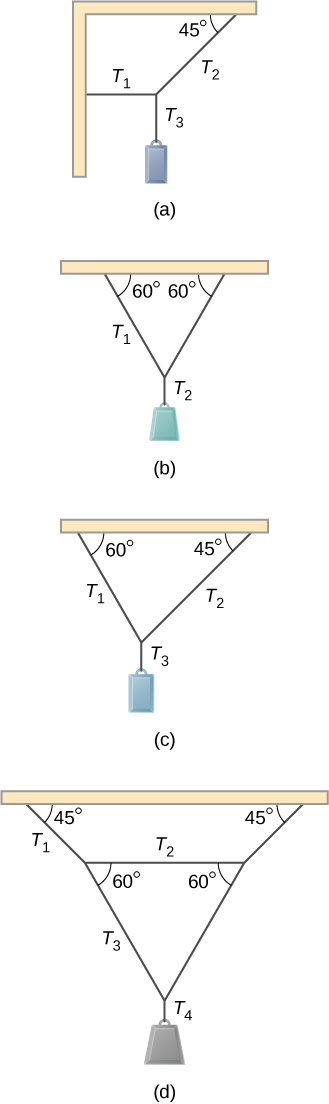
Find the magnitude of the tension in each supporting cable shown below. In each case, the weight of the suspended body is 100.0 N and the masses of the cables are negligible.
英語のヒント
下図の各ケーブルの張力の大きさを求めよ。どの場合も、つり下げた物体の重さは100.0 Nで、ケーブルの質量は無視できる。
Exercise 13問題 13
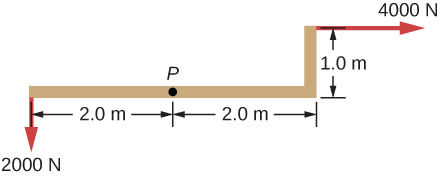
What force must be applied at point P to keep the structure shown in equilibrium? The weight of the structure is negligible.
英語のヒント
図の構造物をつり合わせるには、P点にどのような力を加えればよいか。構造物の重さは無視できる。
Solution解き方
4,472 N, 153.4°
4,472 N、153.4°。
Exercise 14問題 14
Exercise 15問題 15
Two children push on opposite sides of a door during play. Both push horizontally and perpendicular to the door. One child pushes with a force of 17.5 N at a distance of 0.600 m from the hinges, and the second child pushes at a distance of 0.450 m. What force must the second child exert to keep the door from moving? Assume friction is negligible.
英語のヒント
子ども2人が遊びでドアの両側から押し合う。どちらもドアに垂直な水平方向へ押す。一人はちょうつがいから0.600 mの位置で17.5 Nの力を加え、もう一人は0.450 mの位置で押す。ドアを動かさないために、二人目が加える力はいくらか。摩擦は無視できるとする。
Solution解き方
23.3 N
23.3 N。
Exercise 16問題 16
A small 1000-kg SUV has a wheel base of 3.0 m. If 60% if its weight rests on the front wheels, how far behind the front wheels is the wagon’s center of mass?
英語のヒント
質量1000 kgの小型SUVのホイールベースは3.0 mである。重さの60%を前輪が支えるなら、質量中心は前輪からどれだけ後ろにあるか。
Exercise 17問題 17
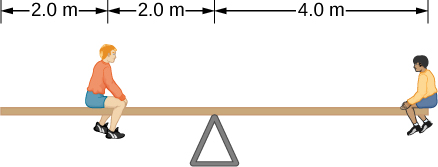
The uniform seesaw is balanced at its center of mass, as seen below. The smaller boy on the right has a mass of 40.0 kg. What is the mass of his friend?
英語のヒント
下図の一様なシーソーは、質量中心で支えられてつり合っている。右の小さい少年の質量は40.0 kgである。もう一人の質量はいくらか。


Solution解き方
80.0 kg
80.0 kg。
center of gravity
重心
point where the weight vector is attached
英語のヒント
重力ベクトルの作用点。
equilibrium
つり合い
body is in equilibrium when its linear and angular accelerations are both zero relative to an inertial frame of reference
英語のヒント
慣性基準系に対して、物体の直線加速度と角加速度がともにゼロである状態。
first equilibrium condition
つり合いの第1条件
expresses translational equilibrium; all external forces acting on the body balance out and their vector sum is zero
英語のヒント
並進のつり合いを表す。物体に働くすべての外力がつり合い、そのベクトル和がゼロとなる。
gravitational torque
重力トルク
torque on the body caused by its weight; it occurs when the center of gravity of the body is not located on the axis of rotation
英語のヒント
物体の重力によるトルク。重心が回転軸上にないときに生じる。
second equilibrium condition
つり合いの第2条件
expresses rotational equilibrium; all torques due to external forces acting on the body balance out and their vector sum is zero
英語のヒント
回転のつり合いを表す。物体に働く外力によるトルクがすべてつり合い、そのベクトル和がゼロとなる。
static equilibrium
静的つり合い
body is in static equilibrium when it is at rest in our selected inertial frame of reference
英語のヒント
選んだ慣性基準系で物体が静止している、つり合いの状態。