第2章ベクトル
Algebra of Vectors in One Dimension1次元でのベクトル代数
Vectors can be multiplied by scalars, added to other vectors, or subtracted from other vectors. We can illustrate these vector concepts using an example of the fishing trip seen in Figure 2.6.
英語のヒント
ベクトルにはスカラーを掛けられ、ほかのベクトルを加えたり引いたりできる。これらのベクトルの考え方を、図2.6に示す釣りへの移動の例で説明できる。
OpenStax / Rice University, University Physics Volume 1, CC BY 4.0. Source-book artwork retained. · CC BY 4.0 · Source出典

Figure 2.6図 2.6
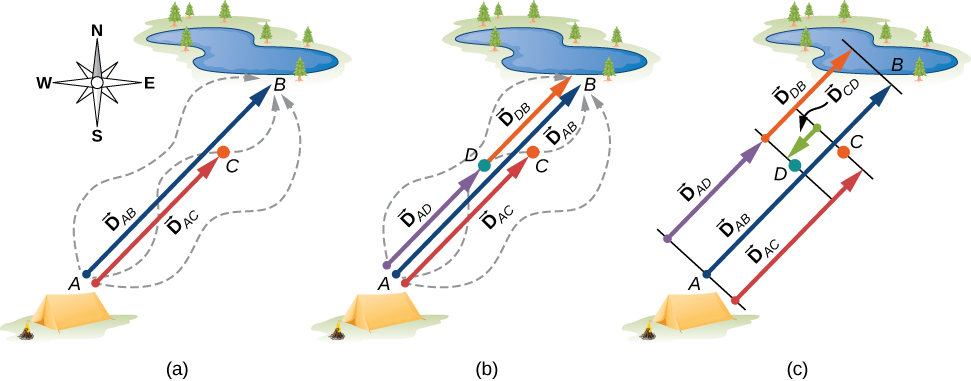
Displacement vectors for a fishing trip. (a) Stopping to rest at point C while walking from camp (point A) to the pond (point B). (b) Going back for the dropped tackle box (point D). (c) Finishing up at the fishing pond.
英語のヒント
釣りに出かけるときの変位ベクトル。(a)キャンプ地点(点A)から池(点B)へ歩く途中、点Cで休む。(b)落とした釣り道具箱を取りに、点Dへ戻る。(c)最後に釣り池へ着く。
Suppose your friend departs from point A (the campsite) and walks in the direction to point B (the fishing pond), but, along the way, stops to rest at some point C located three-quarters of the distance between A and B, beginning from point A (Figure 2.6(a)). What is his displacement vector when he reaches point C? We know that if he walks all the way to B, his displacement vector relative to A is , which has magnitude and a direction of northeast. If he walks only a 0.75 fraction of the total distance, maintaining the northeasterly direction, at point C he must be away from the campsite at A. So, his displacement vector at the rest point C has magnitude and is parallel to the displacement vector . All of this can be stated succinctly in the form of the following vector equation:
英語のヒント
友人が点A(キャンプ地点)から点B(釣り池)へ向けて出発し、途中、AからBまでの距離の4分の3進んだ点Cで休んだとしよう(図2.6(a))。点Cに着いたときの変位ベクトルは何だろうか。Bまで歩けば、Aに対する変位ベクトルはで、大きさが、方向が北東であることはわかっている。北東への方向を保って全距離の0.75倍だけ歩くなら、点CではAのキャンプ地点から離れているはずである。したがって、休憩地点Cでの変位ベクトルの大きさはで、変位ベクトルと平行である。これらをまとめて、次のベクトル方程式で簡潔に表せる。
In a vector equation, both sides of the equation are vectors. The previous equation is an example of a vector multiplied by a positive scalar (number) . The result, , of such a multiplication is a new vector with a direction parallel to the direction of the original vector .
英語のヒント
ベクトル方程式では、等式の両辺がベクトルである。直前の式は、ベクトルに正のスカラー(数)を掛けた例である。この乗算の結果は、元のベクトルの方向と平行な方向を持つ、新しいベクトルである。
In general, when a vector is multiplied by a positive scalar , the result is a new vector that is parallel to :
英語のヒント
一般に、ベクトルに正のスカラーを掛けると、と平行な新しいベクトルが得られる。
The magnitude of this new vector is obtained by multiplying the magnitude of the original vector, as expressed by the scalar equation:
英語のヒント
この新しいベクトルの大きさは、次のスカラー方程式のように、元のベクトルの大きさを掛けることで得られる。
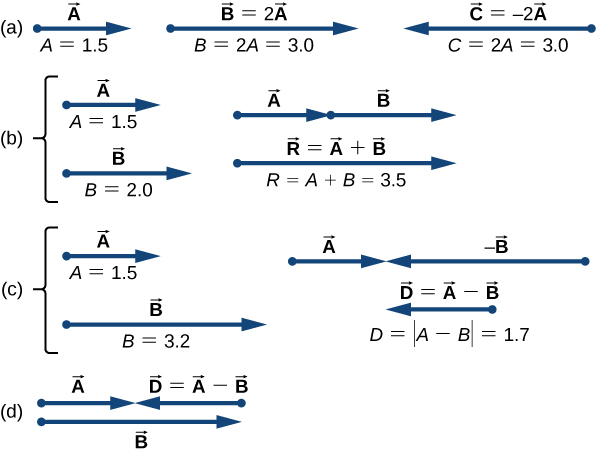
In a scalar equation, both sides of the equation are numbers. Equation 2.2 is a scalar equation because the magnitudes of vectors are scalar quantities (and positive numbers). If the scalar is negative in the vector equation Equation 2.1, then the magnitude of the new vector is still given by Equation 2.2, but the direction of the new vector is antiparallel to the direction of . These principles are illustrated in Figure 2.7(a) by two examples where the length of vector is 1.5 units. When , the new vector has length (twice as long as the original vector) and is parallel to the original vector. When , the new vector has length (twice as long as the original vector) and is antiparallel to the original vector.
英語のヒント
OpenStax / Rice University, University Physics Volume 1, CC BY 4.0. Source-book artwork retained. · CC BY 4.0 · Source出典

Figure 2.7図 2.7
Algebra of vectors in one dimension. (a) Multiplication by a scalar. (b) Addition of two vectors is called the resultant of vectors and . (c) Subtraction of two vectors is the difference of vectors and . (d) The difference between A and B can also be drawn in tail-to-tail fashion, with the vectors slightly offset. The difference connects the head of the second (subtracted) vector to the head of the first.
英語のヒント
1次元でのベクトル代数。(a)スカラーによる乗算。(b)二つのベクトルの加算は合ベクトルと呼ばれ、元のベクトルはと。(c)二つのベクトルの減算は差のベクトルであり、元のベクトルはと。(d)AとBの差は、二つのベクトルを少しずらし、尾どうしをそろえた配置でも描ける。差のベクトルは、第2の(引く側の)ベクトルの頭から、第1のベクトルの頭へ向かう。
Now suppose your fishing buddy departs from point A (the campsite), walking in the direction to point B (the fishing hole), but he realizes he lost his tackle box when he stopped to rest at point C (located three-quarters of the distance between A and B, beginning from point A). So, he turns back and retraces his steps in the direction toward the campsite and finds the box lying on the path at some point D only 1.2 km away from point C (see Figure 2.6(b)). What is his displacement vector when he finds the box at point D? What is his displacement vector from point D to the hole? We have already established that at rest point C his displacement vector is . Starting at point C, he walks southwest (toward the campsite), which means his new displacement vector from point C to point D is antiparallel to . Its magnitude is , so his second displacement vector is . His total displacement relative to the campsite is the vector sum of the two displacement vectors: vector (from the campsite to the rest point) and vector (from the rest point to the point where he finds his box):
英語のヒント
今度は、釣り仲間が点A(キャンプ地点)から点B(釣り場)へ向けて歩き、AからBまでの距離の4分の3進んだ点Cで休んだとき、釣り道具箱をなくしたことに気づいたとしよう。そこでキャンプ地点の方向へ引き返して足取りをたどり、点Cからわずか1.2 kmの点Dで、道に落ちている箱を見つけた(図2.6(b))。点Dで箱を見つけたときの変位ベクトルは何か。また、点Dから釣り場への変位ベクトルは何か。休憩地点Cでの変位ベクトルがであることは、すでに求めた。点Cから南西(キャンプ地点の方向)へ歩くので、点Cから点Dへの新しい変位ベクトルは、と反平行である。その大きさはなので、第2の変位ベクトルはとなる。キャンプ地点に対する全変位は、二つの変位ベクトル、(キャンプ地点から休憩地点へ)と(休憩地点から箱を見つけた地点へ)のベクトル和である。
The vector sum of two (or more) vectors is called the resultant vector or, for short, the resultant. When the vectors on the right-hand-side of Equation 2.3 are known, we can find the resultant as follows:
英語のヒント
二つ(以上)のベクトルのベクトル和を、合ベクトルという。式2.3の右辺のベクトルがわかっていれば、合ベクトルは次のように求められる。
(2.4)
When your friend finally reaches the pond at B, his displacement vector from point A is the vector sum of his displacement vector from point A to point D and his displacement vector from point D to the fishing hole: (see Figure 2.6(c)). This means his displacement vector is the difference of two vectors:
英語のヒント
友人が最後にBの池へ着くと、点Aからの変位ベクトルは、点Aから点Dへの変位ベクトルと、点Dから釣り場への変位ベクトルとの和になる。すなわち、である(図2.6(c))。したがって、変位ベクトルは、二つのベクトルの差である。
(2.5)
Notice that a difference of two vectors is nothing more than a vector sum of two vectors because the second term in Equation 2.5 is vector (which is antiparallel to . When we substitute Equation 2.4 into Equation 2.5, we obtain the second displacement vector:
英語のヒント
(2.6)
This result means your friend walked from the point where he finds his tackle box to the fishing hole.
英語のヒント
この結果は、友人が釣り道具箱を見つけた地点から釣り場まで、歩いたことを意味する。
When vectors and lie along a line (that is, in one dimension), such as in the camping example, their resultant and their difference both lie along the same direction. We can illustrate the addition or subtraction of vectors by drawing the corresponding vectors to scale in one dimension, as shown in Figure 2.7.
英語のヒント
キャンプの例のように、ベクトルとが一本の直線に沿う(1次元にある)場合、合ベクトルも差も、その直線に沿う。図2.7のように、対応するベクトルを1次元で縮尺に従って描けば、ベクトルの加算や減算を図示できる。
To illustrate the resultant when and are two parallel vectors, we draw them along one line by placing the origin of one vector at the end of the other vector in head-to-tail fashion (see Figure 2.7(b)). The magnitude of this resultant is the sum of their magnitudes: R = A + B. The direction of the resultant is parallel to both vectors. When vector is antiparallel to vector , we can draw them along one line in head-to-head fashion (Figure 2.7(c)), tail-to-tail fashion, or head-to-tail fashion. The magnitude of the vector difference, then, is the absolute value of the difference of their magnitudes. The direction of the difference vector is parallel to the direction of the longer vector.
英語のヒント
In general, in one dimension—as well as in higher dimensions, such as in a plane or in space—we can add any number of vectors and we can do so in any order because the addition of vectors is commutative,
英語のヒント
一般に、1次元でも、平面や空間のような高次元でも、任意の個数のベクトルを任意の順序で加えられる。ベクトルの加算には交換法則が成り立ち、
and associative,
英語のヒント
結合法則も成り立つからである。
Moreover, multiplication by a scalar is distributive:
英語のヒント
さらに、スカラーによる乗算には分配法則が成り立つ。
When adding many vectors in one dimension, it is convenient to use the concept of a unit vector. A unit vector, which is denoted by a letter symbol with a hat, such as , has a magnitude of one and does not have any physical unit so that . The only role of a unit vector is to specify direction. For example, instead of saying vector has a magnitude of 6.0 km and a direction of northeast, we can introduce a unit vector that points to the northeast and say succinctly that . Then the southwesterly direction is simply given by the unit vector . In this way, the displacement of 6.0 km in the southwesterly direction is expressed by the vector
英語のヒント
1次元で多数のベクトルを加えるときには、単位ベクトルの概念を用いると便利である。単位ベクトルはのように、文字の上にハットを付けて表す。大きさは1で、物理的な単位を持たないため、である。単位ベクトルの唯一の役割は、方向を指定することである。例えば、ベクトルの大きさが6.0 kmで方向が北東であるという代わりに、北東を向く単位ベクトルを導入して、と簡潔に表せる。このとき、南西という方向は、単に単位ベクトルで与えられる。こうして、南西方向への6.0 kmの変位は、次のベクトルで表される。
Example 2.1例題 2.1
A Ladybug Walker歩くテントウムシ
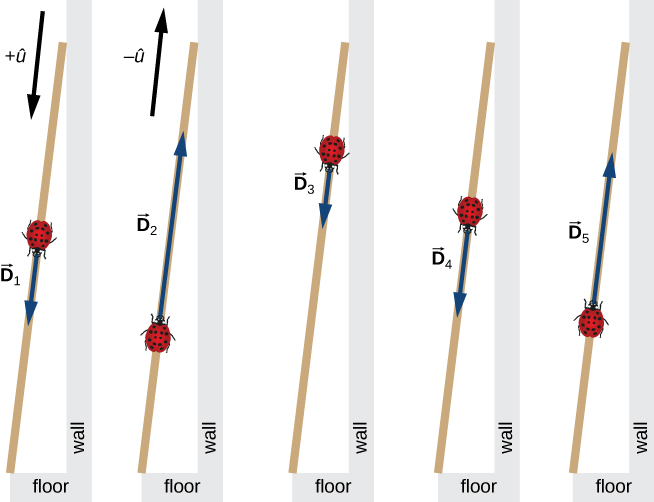
A long measuring stick rests against a wall in a physics laboratory with its 200-cm end at the floor. A ladybug lands on the 100-cm mark and crawls randomly along the stick. It first walks 15 cm toward the floor, then it walks 56 cm toward the wall, then it walks 3 cm toward the floor again. Then, after a brief stop, it continues for 25 cm toward the floor and then, again, it crawls up 19 cm toward the wall before coming to a complete rest (Figure 2.8). Find the vector of its total displacement and its final resting position on the stick.
英語のヒント
物理実験室で、長い物差しが200 cm側の端を床につけ、壁に立てかけられている。テントウムシが100 cmの目盛りに止まり、物差しに沿ってでたらめに歩き始める。まず床へ向かって15 cm、次に壁へ向かって56 cm、次に再び床へ向かって3 cm進む。少し止まった後、床へ向かってさらに25 cm進み、再び壁へ向かって19 cm登ってから完全に止まる(図2.8)。全変位のベクトルと、物差し上で最後に止まった位置を求めよ。
Strategy方針
If we choose the direction along the stick toward the floor as the direction of unit vector , then the direction toward the floor is and the direction toward the wall is . The ladybug makes a total of five displacements:
英語のヒント
物差しに沿って床へ向かう方向を単位ベクトルの方向に選べば、床へ向かう方向は、壁へ向かう方向はとなる。テントウムシは、合わせて5回の変位をする。
The total displacement is the resultant of all its displacement vectors.
英語のヒント
全変位は、すべての変位ベクトルの合ベクトルである。
Persian Poet Gal, Coccinellidae (Ladybug) Anatomy. Modified in OpenStax University Physics Volume 1. CC BY 3.0 component; OpenStax composition CC BY 4.0. · CC BY 3.0 component; OpenStax composition CC BY 4.0 · Source出典

Figure 2.8図 2.8
Five displacements of the ladybug. Note that in this schematic drawing, magnitudes of displacements are not drawn to scale. (credit "ladybug": modification of work by “Persian Poet Gal”/Wikimedia Commons)
英語のヒント
テントウムシの5回の変位。この模式図では、変位の大きさは縮尺どおりに描かれていない。(テントウムシの出典:「Persian Poet Gal」/Wikimedia Commonsによる作品を改変)
Solution解答
The resultant of all the displacement vectors is
英語のヒント
すべての変位ベクトルの合ベクトルは、次のようになる。
In this calculation, we use the distributive law given by Equation 2.9. The result reads that the total displacement vector points away from the 100-cm mark (initial landing site) toward the end of the meter stick that touches the wall. The end that touches the wall is marked 0 cm, so the final position of the ladybug is at the (100 – 32)cm = 68-cm mark.
英語のヒント
この計算では、式2.9で与えられる分配法則を用いる。結果は、全変位ベクトルが100 cmの目盛り(最初に止まった地点)から、壁に接する物差しの端へ向くことを示す。壁に接する端は0 cmなので、テントウムシの最終位置は、(100 − 32) cm = 68 cmの目盛りである。