第2章ベクトル
2.1 Scalars and Vectors2.1 スカラーとベクトル
Learning Objectives学習目標
Learning Objectives学習目標
By the end of this section, you will be able to:
英語のヒント
本節を学ぶと、次のことができるようになる。
- Describe the difference between vector and scalar quantities.
英語のヒント
ベクトル量とスカラー量の違いを説明する。 - Identify the magnitude and direction of a vector.
英語のヒント
ベクトルの大きさと方向を特定する。 - Explain the effect of multiplying a vector quantity by a scalar.
英語のヒント
ベクトル量にスカラーを掛けたときの効果を説明する。 - Describe how one-dimensional vector quantities are added or subtracted.
英語のヒント
1次元のベクトル量を加減する方法を説明する。 - Explain the geometric construction for the addition or subtraction of vectors in a plane.
英語のヒント
平面内のベクトルの加減算を作図で説明する。 - Distinguish between a vector equation and a scalar equation.
英語のヒント
ベクトル方程式とスカラー方程式を区別する。
Many familiar physical quantities can be specified completely by giving a single number and the appropriate unit. For example, “a class period lasts 50 min” or “the gas tank in my car holds 65 L” or “the distance between two posts is 100 m.” A physical quantity that can be specified completely in this manner is called a scalar quantity. Scalar is a synonym of “number.” Time, mass, distance, length, volume, temperature, and energy are examples of scalar quantities.
英語のヒント
なじみのある物理量の多くは、一つの数値と適切な単位を与えることで、完全に指定できる。例えば、「授業の1時限は50 minである」「車の燃料タンクには65 L入る」「2本の柱の間の距離は100 mである」といった具合である。このように完全に指定できる物理量を、スカラー量という。スカラーは「数」の同義語である。時間、質量、距離、長さ、体積、温度、エネルギーは、スカラー量の例である。
Scalar quantities that have the same physical units can be added or subtracted according to the usual rules of algebra for numbers. For example, a class ending 10 min earlier than 50 min lasts . Similarly, a 60-cal serving of corn followed by a 200-cal serving of donuts gives of energy. When we multiply a scalar quantity by a number, we obtain the same scalar quantity but with a larger (or smaller) value. For example, if yesterday’s breakfast had 200 cal of energy and today’s breakfast has four times as much energy as it had yesterday, then today’s breakfast has of energy. Two scalar quantities can also be multiplied or divided by each other to form a derived scalar quantity. For example, if a train covers a distance of 100 km in 1.0 h, its speed is 100.0 km/1.0 h = 27.8 m/s, where the speed is a derived scalar quantity obtained by dividing distance by time.
英語のヒント
同じ物理単位を持つスカラー量どうしは、数の代数で用いる通常の規則に従って、加えたり引いたりできる。例えば、50 minより10 min早く終わる授業の長さは、である。同様に、60 cal分のトウモロコシの後に200 cal分のドーナツを食べれば、のエネルギーが得られる。スカラー量に数を掛けると、同じ種類のスカラー量で、値がより大きい(または小さい)ものが得られる。例えば、昨日の朝食が200 calで、今日の朝食のエネルギーが昨日の4倍なら、今日の朝食のエネルギーはである。二つのスカラー量を掛けたり、一方を他方で割ったりして、組立スカラー量を作ることもできる。例えば、列車が1.0 hで100 km進むなら、速さは100.0 km/1.0 h = 27.8 m/sである。ここで速さは、距離を時間で割って得られる組立スカラー量である。
Many physical quantities, however, cannot be described completely by just a single number of physical units. For example, when the U.S. Coast Guard dispatches a ship or a helicopter for a rescue mission, the rescue team must know not only the distance to the distress signal, but also the direction from which the signal is coming so they can get to its origin as quickly as possible. Physical quantities specified completely by giving a number of units (magnitude) and a direction are called vector quantities. Examples of vector quantities include displacement, velocity, position, force, and torque. In the language of mathematics, physical vector quantities are represented by mathematical objects called vectors (Figure 2.2). We can add or subtract two vectors, and we can multiply a vector by a scalar or by another vector, but we cannot divide by a vector. The operation of division by a vector is not defined.
英語のヒント
しかし、多くの物理量は、単位を伴う一つの数値だけでは完全に表せない。例えば、米国沿岸警備隊が救助のために船やヘリコプターを派遣するとき、救助隊は遭難信号までの距離だけでなく、その信号が来る方向も知らなければならない。発信地点へできるだけ早く到達するためである。単位を伴う数値(大きさ)と方向を与えることで完全に指定できる物理量を、ベクトル量という。変位、速度、位置、力、トルクなどが、ベクトル量の例である。数学の言葉では、物理的なベクトル量を、ベクトルという数学的対象で表す(図2.2)。二つのベクトルを加えたり引いたりできる。また、ベクトルにスカラーや別のベクトルを掛けることもできるが、ベクトルで割ることはできない。ベクトルによる除算という演算は、定義されていない。
Image omitted because its reuse rights could not be verified.権利の確認ができないため画像を割愛。
Figure 2.2図 2.2
We draw a vector from the initial point or origin (called the “tail” of a vector) to the end or terminal point (called the “head” of a vector), marked by an arrowhead. Magnitude is the length of a vector and is always a positive scalar quantity. (credit "photo": modification of work by Cate Sevilla)
英語のヒント
ベクトルは、始点または起点(ベクトルの「尾」)から、矢じりで示す終点(ベクトルの「頭」)へ向けて描く。大きさはベクトルの長さであり、常に正のスカラー量である。(写真の出典:Cate Sevillaによる作品を改変)
Let’s examine vector algebra using a graphical method to be aware of basic terms and to develop a qualitative understanding. In practice, however, when it comes to solving physics problems, we use analytical methods, which we’ll see in the next section. Analytical methods are more simple computationally and more accurate than graphical methods. From now on, to distinguish between a vector and a scalar quantity, we adopt the common convention that a letter in bold type with an arrow above it denotes a vector, and a letter without an arrow denotes a scalar. For example, a distance of 2.0 km, which is a scalar quantity, is denoted by d = 2.0 km, whereas a displacement of 2.0 km in some direction, which is a vector quantity, is denoted by .
英語のヒント
基本的な用語を知り、定性的な理解を深めるために、図を用いてベクトル代数を調べよう。ただし、実際に物理の問題を解くときには、次節で扱う解析的方法を用いる。解析的方法は、図を用いる方法より計算が簡単で、精度も高い。ここからは、ベクトル量とスカラー量を区別するため、文字を太字にして上に矢印を付ければベクトル、矢印を付けなければスカラーを表すという、一般的な約束を用いる。例えば、スカラー量である2.0 kmの距離はd = 2.0 kmと表し、ある方向への2.0 kmの変位というベクトル量はと表す。
Suppose you tell a friend on a camping trip that you have discovered a terrific fishing hole 6 km from your tent. It is unlikely your friend would be able to find the hole easily unless you also communicate the direction in which it can be found with respect to your campsite. You may say, for example, “Walk about 6 km northeast from my tent.” The key concept here is that you have to give not one but two pieces of information—namely, the distance or magnitude (6 km) and the direction (northeast).
英語のヒント
キャンプ中、テントから6 kmのところに、すばらしい釣り場を見つけたと友人に話したとしよう。キャンプ地点に対してどちらの方向にあるかも伝えなければ、友人がその釣り場を簡単に見つけられるとは考えにくい。例えば、「テントから北東へ約6 km歩く」と伝えられる。重要なのは、一つではなく二つの情報、すなわち距離つまり大きさ(6 km)と方向(北東)を与える必要があるという点である。
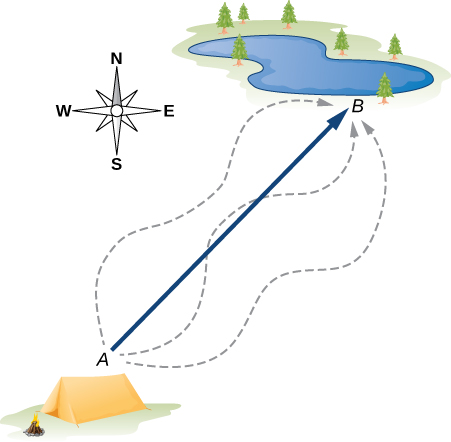
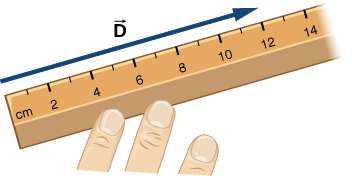
Displacement is a general term used to describe a change in position, such as during a trip from the tent to the fishing hole. Displacement is an example of a vector quantity. If you walk from the tent (location A) to the hole (location B), as shown in Figure 2.3, the vector , representing your displacement, is drawn as the arrow that originates at point A and ends at point B. The arrowhead marks the end of the vector. The direction of the displacement vector is the direction of the arrow. The length of the arrow represents the magnitude D of vector . Here, D = 6 km. Since the magnitude of a vector is its length, which is a positive number, the magnitude is also indicated by placing the absolute value notation around the symbol that denotes the vector; so, we can write equivalently that . To solve a vector problem graphically, we need to draw the vector to scale. For example, if we assume 1 unit of distance (1 km) is represented in the drawing by a line segment of length u = 2 cm, then the total displacement in this example is represented by a vector of length , as shown in Figure 2.4. Notice that here, to avoid confusion, we used to denote the magnitude of the actual displacement and d = 12 cm to denote the length of its representation in the drawing.
英語のヒント
変位は、テントから釣り場へ向かうときのような、位置の変化を表す一般的な用語であり、ベクトル量の一例である。図2.3のように、テント(地点A)から釣り場(地点B)へ歩くなら、変位を表すベクトルは、点Aから始まって点Bで終わる矢印として描く。矢じりはベクトルの終点を示す。変位ベクトルの方向は矢印の方向であり、矢印の長さはベクトルの大きさDを表す。ここではD = 6 kmである。ベクトルの大きさはその長さ、つまり正の数なので、ベクトルを表す記号を絶対値記号で囲んでも大きさを表せる。したがって、と同じ意味で書ける。図を用いてベクトルの問題を解くには、ベクトルを縮尺に合わせて描く必要がある。例えば、距離の1単位(1 km)を、図では長さu = 2 cmの線分で表すなら、この例の全変位は、図2.4のように長さのベクトルで表される。ここでは混乱を避けるため、実際の変位の大きさを、図に描いた長さをd = 12 cmで表したことに注意しよう。
OpenStax / Rice University, University Physics Volume 1, CC BY 4.0. Source-book artwork retained. · CC BY 4.0 · Source出典

Figure 2.3図 2.3
The displacement vector from point A (the initial position at the campsite) to point B (the final position at the fishing hole) is indicated by an arrow with origin at point A and end at point B. The displacement is the same for any of the actual paths (dashed curves) that may be taken between points A and B.
英語のヒント
点A(キャンプ地点での最初の位置)から点B(釣り場での最後の位置)への変位ベクトルは、点Aを起点、点Bを終点とする矢印で示す。AとBの間を実際にどの経路(破線の曲線)で進んでも、変位は同じである。
OpenStax / Rice University, University Physics Volume 1, CC BY 4.0. Source-book artwork retained. · CC BY 4.0 · Source出典

Figure 2.4図 2.4
A displacement of magnitude 6 km is drawn to scale as a vector of length 12 cm when the length of 2 cm represents 1 unit of displacement (which in this case is 1 km).
英語のヒント
長さ2 cmで変位の1単位(この場合は1 km)を表すと、大きさ6 kmの変位は、縮尺に従って長さ12 cmのベクトルとして描かれる。
Suppose your friend walks from the campsite at A to the fishing pond at B and then walks back: from the fishing pond at B to the campsite at A. The magnitude of the displacement vector from A to B is the same as the magnitude of the displacement vector from B to A (it equals 6 km in both cases), so we can write . However, vector is not equal to vector because these two vectors have different directions: . In Figure 2.3, vector would be represented by a vector with an origin at point B and an end at point A, indicating vector points to the southwest, which is exactly opposite to the direction of vector . We say that vector is antiparallel to vector and write , where the minus sign indicates the antiparallel direction.
英語のヒント
友人がAのキャンプ地点からBの釣り池へ歩き、その後、Bの釣り池からAのキャンプ地点へ戻ったとしよう。AからBへの変位ベクトルの大きさと、BからAへの変位ベクトルの大きさは等しく、いずれも6 kmなので、と書ける。しかし、二つのベクトルは方向が異なるので、ベクトルとベクトルは等しくない。すなわち、である。図2.3では、ベクトルは点Bを起点、点Aを終点とするベクトルとして表される。つまり、ベクトルは南西を向き、ベクトルの方向とはちょうど逆である。ベクトルはベクトルと反平行であるといい、と書く。負号は反平行の方向を示す。
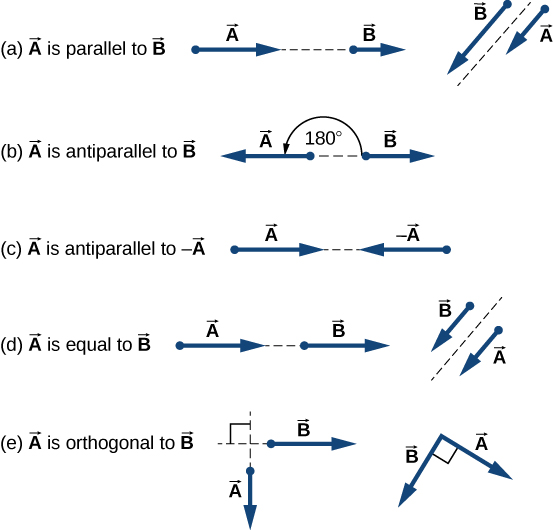
Two vectors that have identical directions are said to be parallel vectors—meaning, they are parallel to each other. Two parallel vectors and are equal, denoted by , if and only if they have equal magnitudes . Two vectors with directions perpendicular to each other are said to be orthogonal vectors. These relations between vectors are illustrated in Figure 2.5.
英語のヒント
方向が同一の二つのベクトルは、平行なベクトル、つまり互いに平行であるという。平行な二つのベクトルとは、大きさがのように等しいとき、かつそのときに限って等しく、と表す。方向が互いに垂直な二つのベクトルは、直交するベクトルという。これらのベクトルの関係を図2.5に示す。
OpenStax / Rice University, University Physics Volume 1, CC BY 4.0. Source-book artwork retained. · CC BY 4.0 · Source出典

Figure 2.5図 2.5
Various relations between two vectors and . (a) because . (b) because they are not parallel and . (c) because they have different directions (even though . (d) because they are parallel and have identical magnitudes A = B. (e) because they have different directions (are not parallel); here, their directions differ by —meaning, they are orthogonal.
英語のヒント
二つのベクトルとのさまざまな関係。(a)なので。(b)平行でなく、でもあるので。(c)大きさが同じでも(、方向が異なるので。(d)平行で、大きさもA = Bと同一なので。(e)方向が異なる(平行でない)ので。ここでは方向が異なり、直交している。