第2章ベクトル
2.3 Algebra of Vectors2.3 ベクトルの代数
Learning Objectives学習目標
Learning Objectives学習目標
By the end of this section, you will be able to:
英語のヒント
本節を学ぶと、次のことができるようになる。
- Apply analytical methods of vector algebra to find resultant vectors and to solve vector equations for unknown vectors.
英語のヒント
ベクトル代数の解析的方法を適用し、合ベクトルを求め、未知のベクトルについてベクトル方程式を解く。 - Interpret physical situations in terms of vector expressions.
英語のヒント
物理的な状況を、ベクトルの式で解釈する。
Vectors can be added together and multiplied by scalars. Vector addition is associative (Equation 2.8) and commutative (Equation 2.7), and vector multiplication by a sum of scalars is distributive (Equation 2.9). Also, scalar multiplication by a sum of vectors is distributive:
英語のヒント
In this equation, is any number (a scalar). For example, a vector antiparallel to vector can be expressed simply by multiplying by the scalar :
英語のヒント
この式で、は任意の数(スカラー)である。例えば、ベクトルと反平行なベクトルは、にスカラーを掛けるだけで表せる。
Example 2.8例題 2.8
Direction of Motion運動の方向
In a Cartesian coordinate system where denotes geographic east, denotes geographic north, and denotes altitude above sea level, a military convoy advances its position through unknown territory with velocity . If the convoy had to retreat, in what geographic direction would it be moving?
英語のヒント
が東、が北、が海抜高度を表すデカルト座標系で、軍の車列が未知の地域を速度で進む。この車列が撤退しなければならない場合、どの方角へ動くことになるか。
Solution解答
The velocity vector has the third component , which says the convoy is climbing at a rate of 100 m/h through mountainous terrain. At the same time, its velocity is 4.0 km/h to the east and 3.0 km/h to the north, so it moves on the ground in direction north of east. If the convoy had to retreat, its new velocity vector would have to be antiparallel to and be in the form , where is a positive number. Thus, the velocity of the retreat would be . The negative sign of the third component indicates the convoy would be descending. The direction angle of the retreat velocity is south of west. Therefore, the convoy would be moving on the ground in direction south of west while descending on its way back.
英語のヒント
速度ベクトルの第3成分はであり、車列が山地を100 m/hの割合で登っていることを示す。同時に、東向きの速度は4.0 km/h、北向きは3.0 km/hなので、地上では東から北への方向に動く。撤退するなら、新しい速度ベクトルはに反平行で、の形でなければならない。ここでは正の数である。したがって、撤退時の速度はとなる。第3成分の負号は、車列が下ることを示す。撤退速度の方向角は、西から南へである。したがって、車列は戻り道を下りながら、地上では西から南への方向に動くことになる。
The generalization of the number zero to vector algebra is called the null vector, denoted by . All components of the null vector are zero, , so the null vector has no length and no direction.
英語のヒント
数の0をベクトル代数へ一般化したものを零ベクトルといい、で表す。零ベクトルはすべての成分が0で、であるため、長さも方向も持たない。
Two vectors and are equal vectors if and only if their difference is the null vector:
英語のヒント
二つのベクトルとは、その差が零ベクトルであるとき、かつそのときに限り等しい。
This vector equation means we must have simultaneously , , and . Hence, we can write if and only if the corresponding components of vectors and are equal:
英語のヒント
このベクトル方程式は、、、が同時に成り立たなければならないことを意味する。したがって、ベクトルとの対応する成分が等しいとき、かつそのときに限り、と書ける。
Two vectors are equal when their corresponding scalar components are equal.
英語のヒント
二つのベクトルは、対応するスカラー成分が等しいとき、等しい。
Resolving vectors into their scalar components (i.e., finding their scalar components) and expressing them analytically in vector component form (given by Equation 2.19) allows us to use vector algebra to find sums or differences of many vectors analytically (i.e., without using graphical methods). For example, to find the resultant of two vectors and , we simply add them component by component, as follows:
英語のヒント
ベクトルをスカラー成分へ分解し(つまりスカラー成分を求め)、式2.19のベクトル成分表示で解析的に表せば、ベクトル代数を使って、多数のベクトルの和や差を解析的に、すなわち図を用いずに求められる。例えば、二つのベクトルとの合ベクトルを求めるには、次のように成分ごとに加えるだけでよい。
In this way, using Equation 2.24, scalar components of the resultant vector are the sums of corresponding scalar components of vectors and :
英語のヒント
こうして、式2.24を使うと、合ベクトルのスカラー成分は、ベクトルとの対応するスカラー成分の和となる。
Analytical methods can be used to find components of a resultant of many vectors. For example, if we are to sum up vectors , where each vector is , the resultant vector is
英語のヒント
解析的方法は、多数のベクトルの合ベクトルの成分を求めるのにも使える。例えば、個のベクトルを加えるとし、各ベクトルがなら、合ベクトルは次のようになる。
Therefore, scalar components of the resultant vector are
英語のヒント
したがって、合ベクトルのスカラー成分は次のようになる。
Having found the scalar components, we can write the resultant in vector component form:
英語のヒント
スカラー成分が求まれば、合ベクトルを成分表示で次のように書ける。
Analytical methods for finding the resultant and, in general, for solving vector equations are very important in physics because many physical quantities are vectors. For example, we use this method in kinematics to find resultant displacement vectors and resultant velocity vectors, in mechanics to find resultant force vectors and the resultants of many derived vector quantities, and in electricity and magnetism to find resultant electric or magnetic vector fields.
英語のヒント
合ベクトルを求め、さらに一般にはベクトル方程式を解く解析的方法は、物理学で非常に重要である。多くの物理量がベクトルだからだ。例えば、運動学では合成変位ベクトルや合成速度ベクトルを求めるために、力学では合力ベクトルや、多くの組立ベクトル量の合ベクトルを求めるために用いる。また、電気と磁気では、電場や磁場の合成ベクトル場を求めるために用いる。
Example 2.9例題 2.9
Analytical Computation of a Resultant合ベクトルの解析的な計算
Three displacement vectors , , and in a plane (Figure 2.13) are specified by their magnitudes A = 10.0, B = 7.0, and C = 8.0, respectively, and by their respective direction angles with the horizontal direction , and . The physical units of the magnitudes are centimeters. Resolve the vectors to their scalar components and find the following vector sums: (a) , (b) , and (c) .
英語のヒント
平面内の三つの変位ベクトル、、(図2.13)は、大きさがそれぞれA = 10.0、B = 7.0、C = 8.0で、水平方向となす方向角がそれぞれ、、として指定される。大きさの物理単位はセンチメートルである。各ベクトルをスカラー成分へ分解し、次のベクトル和を求めよ。(a)、(b)、(c)。
Strategy方針
First, we use Equation 2.17 to find the scalar components of each vector and then we express each vector in its vector component form given by Equation 2.12. Then, we use analytical methods of vector algebra to find the resultants.
英語のヒント
Solution解答
We resolve the given vectors to their scalar components:
英語のヒント
与えられたベクトルを、スカラー成分へ分解する。
For (a) we may substitute directly into Equation 2.25 to find the scalar components of the resultant:
英語のヒント
(a)では、式2.25へ直接代入し、合ベクトルのスカラー成分を求められる。
Therefore, the resultant vector is .
英語のヒント
したがって、合ベクトルはである。
For (b), we may want to write the vector difference as
英語のヒント
(b)では、ベクトルの差を次のように書くとよい。
Then, the scalar components of the vector difference are
英語のヒント
すると、差のベクトルのスカラー成分は次のようになる。
Hence, the difference vector is .
英語のヒント
したがって、差のベクトルはである。
For (c), we can write vector in the following explicit form:
英語のヒント
(c)では、ベクトルを、次のように具体的な形で書ける。
Then, the scalar components of are
英語のヒント
すると、のスカラー成分は次のようになる。
The vector is .
英語のヒント
ベクトルはである。
Significance意味の検討
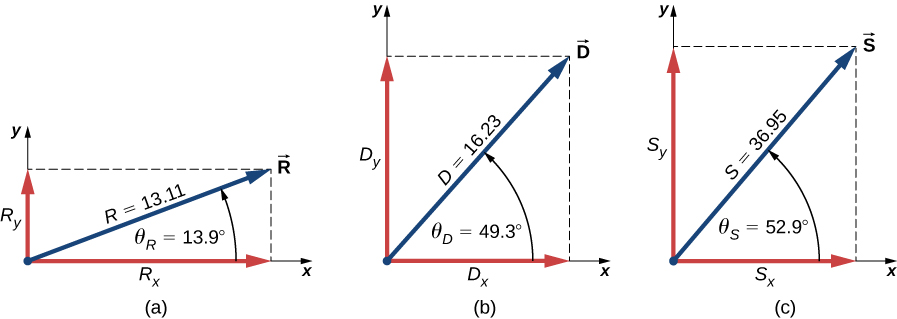
Having found the vector components, we can illustrate the vectors by graphing or we can compute magnitudes and direction angles, as shown in Figure 2.24. Results for the magnitudes in (b) and (c) can be compared with results for the same problems obtained with the graphical method, shown in Figure 2.14 and Figure 2.15. Notice that the analytical method produces exact results and its accuracy is not limited by the resolution of a ruler or a protractor, as it was with the graphical method used in Example 2.2 for finding this same resultant.
英語のヒント
OpenStax / Rice University, University Physics Volume 1, CC BY 4.0. Source-book artwork retained. · CC BY 4.0 · Source出典

Figure 2.24図 2.24
Graphical illustration of the solutions obtained analytically in Example 2.9.
英語のヒント
例題2.9で解析的に得た解の図示。
Example 2.10例題 2.10
The Tug-of-War Game綱引き遊び
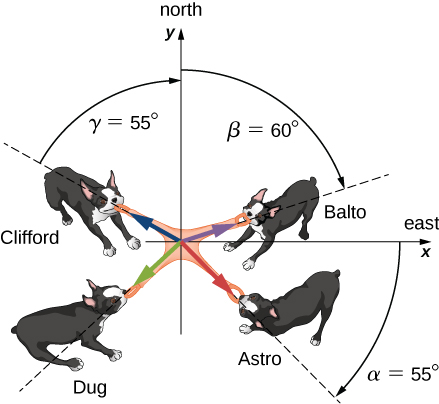
Four dogs named Astro, Balto, Clifford, and Dug play a tug-of-war game with a toy (Figure 2.25). Astro pulls on the toy in direction south of east, Balto pulls in direction east of north, and Clifford pulls in direction west of north. Astro pulls strongly with 160.0 units of force (N), which we abbreviate as A = 160.0 N. Balto pulls even stronger than Astro with a force of magnitude B = 200.0 N, and Clifford pulls with a force of magnitude C = 140.0 N. When Dug pulls on the toy in such a way that his force balances out the resultant of the other three forces, the toy does not move in any direction. With how big a force and in what direction must Dug pull on the toy for this to happen?
英語のヒント
アストロ、バルト、クリフォード、ダグという4匹の犬が、おもちゃを引っ張り合って遊んでいる(図2.25)。アストロは東から南へ、バルトは北から東へ、クリフォードは北から西への方向へ引く。アストロは160.0単位の力(N)で強く引き、これをA = 160.0 Nと略記する。バルトはそれより強く、大きさB = 200.0 Nで引き、クリフォードは大きさC = 140.0 Nで引く。ダグの力がほかの三つの力の合力と釣り合うように引くと、おもちゃはどの方向にも動かない。そうするために、ダグはどれだけの大きさの力で、どの方向へ引く必要があるか。
OpenStax / Rice University, University Physics Volume 1, CC BY 4.0. Source-book artwork retained. · CC BY 4.0 · Source出典

Figure 2.25図 2.25
Four dogs play a tug-of-war game with a toy.
英語のヒント
4匹の犬が、おもちゃを綱引きのように引っ張り合っている。
Strategy方針
We assume that east is the direction of the positive x-axis and north is the direction of the positive y-axis. As in Example 2.9, we have to resolve the three given forces— (the pull from Astro), (the pull from Balto), and (the pull from Clifford)—into their scalar components and then find the scalar components of the resultant vector . When the pulling force from Dug balances out this resultant, the sum of and must give the null vector . This means that , so the pull from Dug must be antiparallel to .
英語のヒント
x軸の正方向を東、y軸の正方向を北とする。例題2.9と同様に、与えられた三つの力、(アストロの力)、(バルトの力)、(クリフォードの力)をスカラー成分へ分解し、合ベクトルのスカラー成分を求める。ダグの引く力がこの合力と釣り合うなら、との和は零ベクトル、すなわちでなければならない。これはを意味するので、ダグの力はと反平行でなければならない。
Solution解答
The direction angles are , , and , and substituting them into Equation 2.17 gives the scalar components of the three given forces:
英語のヒント
方向角は、、である。これらを式2.17へ代入すると、三つの力のスカラー成分が得られる。
Now we compute scalar components of the resultant vector :
英語のヒント
次に、合ベクトルのスカラー成分を計算する。
The antiparallel vector to the resultant is
英語のヒント
合ベクトルと反平行なベクトルは、次のようになる。
The magnitude of Dug’s pulling force is
英語のヒント
ダグの引く力の大きさは、次のようになる。
The direction of Dug’s pulling force is
英語のヒント
ダグの引く力の方向は、次のようになる。
Dug pulls in the direction south of west because both components are negative, which means the pull vector lies in the third quadrant (Figure 2.19).
英語のヒント
両成分が負なので、ダグは西から南への方向へ引く。両成分が負であることは、力のベクトルが第3象限にあることを意味する(図2.19)。
Example 2.11例題 2.11
Vector Algebraベクトル代数
Find the magnitude of the vector that satisfies the equation , where and .
英語のヒント
、のとき、方程式を満たすベクトルの大きさを求めよ。
Strategy方針
We first solve the given equation for the unknown vector . Then we substitute and ; group the terms along each of the three directions , , and ; and identify the scalar components , , and . Finally, we substitute into Equation 2.21 to find magnitude C.
英語のヒント
まず、与えられた方程式を未知のベクトルについて解く。次にとを代入し、三つの方向、、ごとに項をまとめ、スカラー成分、、を特定する。最後に式2.21へ代入し、大きさCを求める。
Solution解答
The components are , , and , and substituting into Equation 2.21 gives
英語のヒント
成分は、、であり、式2.21へ代入すると、次を得る。
Example 2.12例題 2.12
Displacement of a Skierスキーヤーの変位
Starting at a ski lodge, a cross-country skier goes 5.0 km north, then 3.0 km west, and finally 4.0 km southwest before taking a rest. Find their total displacement vector relative to the lodge when they are at the rest point. How far and in what direction must they ski from the rest point to return directly to the lodge?
英語のヒント
クロスカントリースキーをする人が山小屋を出発し、北へ5.0 km、西へ3.0 km、最後に南西へ4.0 km進んで休む。休憩地点での、小屋を基準とする全変位ベクトルを求めよ。休憩地点から小屋へ直接戻るには、どれだけの距離を、どの方向へ滑ればよいか。
Strategy方針
We assume a rectangular coordinate system with the origin at the ski lodge and with the unit vector pointing east and the unit vector pointing north. There are three displacements: , , and . We identify their magnitudes as , , and . We identify their directions are the angles , , and . We resolve each displacement vector to its scalar components and substitute the components into Equation 2.25 to obtain the scalar components of the resultant displacement from the lodge to the rest point. On the way back from the rest point to the lodge, the displacement is . Finally, we find the magnitude and direction of .
英語のヒント
小屋を原点とし、単位ベクトルが東、が北を向く直交座標系を選ぶ。変位は、、の三つである。大きさは、、、方向角は、、と特定できる。各変位ベクトルをスカラー成分へ分解し、その成分を式2.25へ代入して、小屋から休憩地点への合成変位のスカラー成分を得る。休憩地点から小屋へ戻る際の変位はである。最後に、の大きさと方向を求める。
Solution解答
Scalar components of the displacement vectors are
英語のヒント
各変位ベクトルのスカラー成分は、次のとおりである。
Scalar components of the net displacement vector are
英語のヒント
正味の変位ベクトルのスカラー成分は、次のとおりである。
Hence, the skier’s net displacement vector is . On the way back to the lodge, their displacement is . Its magnitude is and its direction angle is . Therefore, to return to the lodge, they must go 6.2 km in a direction about south of east.
英語のヒント
したがって、スキーヤーの正味の変位ベクトルはである。小屋へ戻る際の変位はとなる。その大きさは、方向角はである。したがって、小屋へ戻るには、東から南へ約の方向に6.2 km進む必要がある。
Significance意味の検討
Notice that no figure is needed to solve this problem by the analytical method. Figures are required when using a graphical method; however, we can check if our solution makes sense by sketching it, which is a useful final step in solving any vector problem.
英語のヒント
解析的方法でこの問題を解くには、図が不要であることに注意しよう。図を用いる方法では作図が必要になる。それでも、解を簡単な図にすれば、意味の通る結果かどうかを確かめられる。これは、どのベクトル問題でも最後に行うと役立つ。
Example 2.13例題 2.13
Displacement of a Joggerジョギングをする人の変位
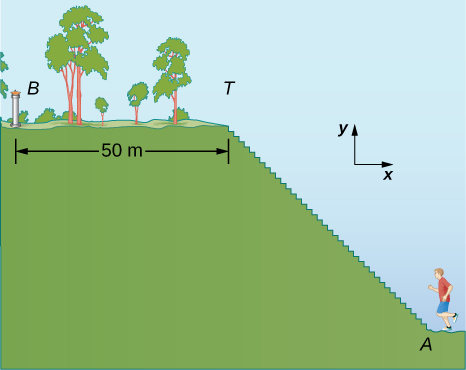
A jogger runs up a flight of 200 identical steps to the top of a hill and then runs along the top of the hill 50.0 m before he stops at a drinking fountain (Figure 2.26). His displacement vector from point A at the bottom of the steps to point B at the fountain is . What is the height and width of each step in the flight? What is the actual distance the jogger covers? If he makes a loop and returns to point A, what is his net displacement vector?
英語のヒント
ジョギングをする人が、同じ形の段が200段ある階段を丘の頂上まで駆け上がり、頂上を50.0 m走って水飲み場で止まる(図2.26)。階段下の点Aから水飲み場の点Bへの変位ベクトルはである。階段の各段の高さと幅はいくらか。実際に走った距離はいくらか。一周して点Aへ戻った場合、正味の変位ベクトルはいくらか。
OpenStax / Rice University, University Physics Volume 1, CC BY 4.0. Source-book artwork retained. · CC BY 4.0 · Source出典

Figure 2.26図 2.26
A jogger runs up a flight of steps.
英語のヒント
ジョギングをする人が、一続きの階段を駆け上がる。
Strategy方針
The displacement vector is the vector sum of the jogger’s displacement vector along the stairs (from point A at the bottom of the stairs to point T at the top of the stairs) and his displacement vector on the top of the hill (from point T at the top of the stairs to the fountain at point B). We must find the horizontal and the vertical components of . If each step has width w and height h, the horizontal component of must have a length of 200w and the vertical component must have a length of 200h. The actual distance the jogger covers is the sum of the distance he runs up the stairs and the distance of 50.0 m that he runs along the top of the hill.
英語のヒント
変位ベクトルは、階段に沿う変位ベクトル(階段下のAから階段上のTまで)と、丘の頂上での変位ベクトル(階段上のTから水飲み場のBまで)の和である。の水平成分と鉛直成分を求める必要がある。各段の幅をw、高さをhとすれば、の水平成分の長さは200w、鉛直成分の長さは200hでなければならない。実際に走る距離は、階段を駆け上がる距離と、丘の頂上を走る50.0 mとの和である。
Solution解答
In the coordinate system indicated in Figure 2.26, the jogger’s displacement vector on the top of the hill is . His net displacement vector is
英語のヒント
図2.26の座標系では、丘の頂上での走者の変位ベクトルはである。正味の変位ベクトルは、次のようになる。
Therefore, his displacement vector along the stairs is
英語のヒント
したがって、階段に沿う変位ベクトルは、次のようになる。
Its scalar components are and . Therefore, we must have
英語のヒント
スカラー成分はとである。したがって、次の関係が成り立たなければならない。
Hence, the step width is w = 40.0 m/200 = 0.2 m = 20 cm, and the step height is h = 30.0 m/200 = 0.15 m = 15 cm. The distance that the jogger covers along the stairs is
英語のヒント
したがって、段の幅はw = 40.0 m/200 = 0.2 m = 20 cm、高さはh = 30.0 m/200 = 0.15 m = 15 cmである。走者が階段に沿って進む距離は、次のようになる。
Thus, the actual distance he runs is . When he makes a loop and comes back from the fountain to his initial position at point A, the total distance he covers is twice this distance, or 200.0 m. However, his net displacement vector is zero, because when his final position is the same as his initial position, the scalar components of his net displacement vector are zero (Equation 2.13).
英語のヒント
したがって、実際に走る距離はである。一周して水飲み場から最初の位置Aへ戻るなら、全移動距離はこの2倍の200.0 mとなる。しかし、正味の変位ベクトルは0である。最終位置と最初の位置が同じなら、正味の変位ベクトルのスカラー成分が0になるからである(式2.13)。
In many physical situations, we often need to know the direction of a vector. For example, we may want to know the direction of a magnetic field vector at some point or the direction of motion of an object. We have already said direction is given by a unit vector, which is a dimensionless entity—that is, it has no physical units associated with it. When the vector in question lies along one of the axes in a Cartesian system of coordinates, the answer is simple, because then its unit vector of direction is either parallel or antiparallel to the direction of the unit vector of an axis. For example, the direction of vector is unit vector . The general rule of finding the unit vector of direction for any vector is to divide it by its magnitude V:
英語のヒント
物理学の多くの状況では、ベクトルの方向を知る必要がある。例えば、ある点での磁場ベクトルの方向や、物体の運動方向を知りたい場合である。すでに述べたように、方向は単位ベクトルで与えられる。単位ベクトルは無次元の対象であり、物理単位を伴わない。問題のベクトルがデカルト座標系のいずれかの軸に沿っていれば、答えは簡単である。その方向の単位ベクトルは、軸の単位ベクトルの方向と平行か反平行になるからだ。例えば、ベクトルの方向は単位ベクトルである。任意のベクトルの方向を表す単位ベクトルを求める一般的な規則は、そのベクトルを大きさVで割ることである。