第2章ベクトル
Summaryまとめ
- Vectors are described in terms of their components in a coordinate system. In two dimensions (in a plane), vectors have two components. In three dimensions (in space), vectors have three components.
英語のヒント
ベクトルは、座標系での成分を用いて表す。2次元(平面内)では二つ、3次元(空間内)では三つの成分を持つ。 - A vector component of a vector is its part in an axis direction. The vector component is the product of the unit vector of an axis with its scalar component along this axis. A vector is the resultant of its vector components.
英語のヒント
ベクトル成分は、ベクトルの軸方向の部分である。軸の単位ベクトルと、その軸に沿うスカラー成分との積に等しい。ベクトルは、そのベクトル成分の合ベクトルである。 - Scalar components of a vector are differences of coordinates, where coordinates of the origin are subtracted from end point coordinates of a vector. In a rectangular system, the magnitude of a vector is the square root of the sum of the squares of its components.
英語のヒント
ベクトルのスカラー成分は、終点の座標から起点の座標を引いた、座標の差である。直交座標系でのベクトルの大きさは、各成分の2乗の和の平方根である。 - In a plane, the direction of a vector is given by an angle the vector has with the positive x-axis. This direction angle is measured counterclockwise. The scalar x-component of a vector can be expressed as the product of its magnitude with the cosine of its direction angle, and the scalar y-component can be expressed as the product of its magnitude with the sine of its direction angle.
英語のヒント
平面内のベクトルの方向は、x軸の正方向となす角で与える。この方向角は反時計回りに測る。スカラーx成分は、大きさと方向角の余弦との積で表され、スカラーy成分は、大きさと方向角の正弦との積で表される。 - In a plane, there are two equivalent coordinate systems. The Cartesian coordinate system is defined by unit vectors and along the x-axis and the y-axis, respectively. The polar coordinate system is defined by the radial unit vector , which gives the direction from the origin, and a unit vector , which is perpendicular (orthogonal) to the radial direction.
英語のヒント
平面内には、二つの等価な座標系がある。デカルト座標系は、x軸とy軸にそれぞれ沿う単位ベクトルとで定義する。極座標系は、原点からの方向を与える動径単位ベクトルと、動径方向に垂直(直交)な単位ベクトルで定義する。
Conceptual Questions概念を確かめる問題
Exercises 27–32練習問題 27–32
Exercise 27問題 27
Give an example of a nonzero vector that has a component of zero.
英語のヒント
0でないベクトルで、成分の一つが0になる例を挙げよ。
Solution解き方
a unit vector of the x-axis
英語のヒント
x軸の単位ベクトル。
Exercise 28問題 28
Explain why a vector cannot have a component greater than its own magnitude.
英語のヒント
ベクトルが、それ自身の大きさより大きい成分を持てない理由を説明せよ。
Exercise 29問題 29
If two vectors are equal, what can you say about their components?
英語のヒント
二つのベクトルが等しいなら、その成分について何がいえるか。
Solution解き方
They are equal.
英語のヒント
成分も等しい。
Exercise 30問題 30
If vectors and are orthogonal, what is the component of along the direction of ? What is the component of along the direction of ?
英語のヒント
ベクトルとが直交するなら、の方向に沿うの成分はいくらか。また、の方向に沿うの成分はいくらか。
Exercise 31問題 31
If one of the two components of a vector is not zero, can the magnitude of the other vector component of this vector be zero?
英語のヒント
ベクトルの二つの成分の一方が0でないとき、他方のベクトル成分の大きさが0になることはあるか。
Solution解き方
yes
ある。
Exercise 32問題 32
If two vectors have the same magnitude, do their components have to be the same?
英語のヒント
二つのベクトルの大きさが同じなら、成分も同じでなければならないか。
Problems問題
Exercises 33–42練習問題 33–42
Exercise 33問題 33
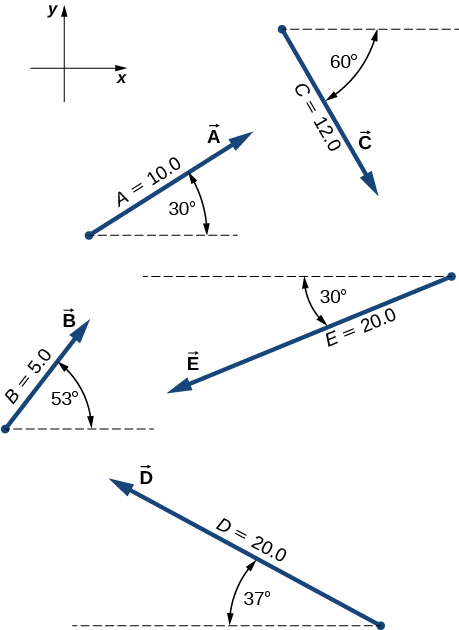
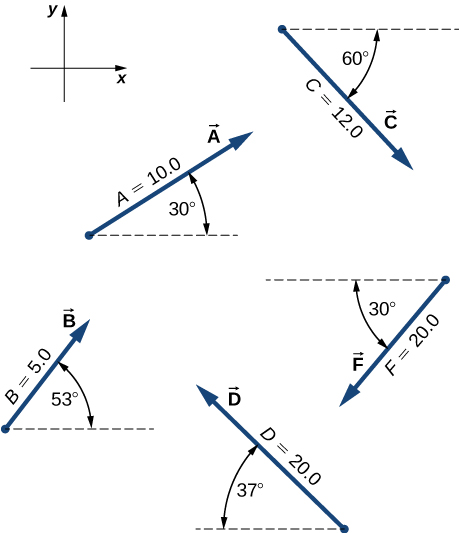
Assuming the +x-axis is horizontal and points to the right, resolve the vectors given in the following figure to their scalar components and express them in vector component form.
英語のヒント
+x軸を水平右向きとする。次の図のベクトルをスカラー成分へ分解し、ベクトル成分表示で表せ。
Exercise 34問題 34
Suppose you walk 18.0 m straight west and then 25.0 m straight north. How far are you from your starting point? What is your displacement vector? What is the direction of your displacement? Assume the +x-axis is to the east.
英語のヒント
真西へ18.0 m歩き、次に真北へ25.0 m歩いたとする。出発点からどれだけ離れているか。変位ベクトルはいくらか。変位の方向はどちらか。+x軸を東向きとする。
Exercise 35問題 35
You drive 7.50 km in a straight line in a direction east of north. (a) Find the distances you would have to drive straight east and then straight north to arrive at the same point. (b) Show that you still arrive at the same point if the east and north legs are reversed in order. Assume the +x-axis is to the east.
英語のヒント
北から東への方向に、直線で7.50 km運転する。(a)同じ地点へ着くため、まず真東へ、次に真北へ、それぞれどれだけ走ればよいか求めよ。(b)東と北の区間の順序を逆にしても、同じ地点へ着くことを示せ。+x軸を東向きとする。
Solution解き方
a. 1.94 km, 7.24 km; b. proof
英語のヒント
(a)1.94 km、7.24 km。(b)証明。
Exercise 36問題 36
A sledge is being pulled by two horses on a flat terrain. The net force on the sledge can be expressed in the Cartesian coordinate system as vector , where and denote directions to the east and north, respectively. Find the magnitude and direction of the pull.
英語のヒント
平らな地面で、2頭の馬がそりを引いている。そりに働く合力は、デカルト座標系でベクトルと表せる。とは、それぞれ東と北の方向を示す。この引く力の大きさと方向を求めよ。
Exercise 37問題 37
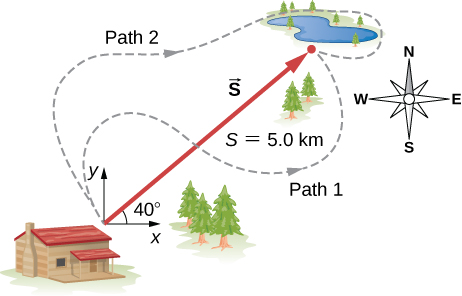
A trapper walks a 5.0-km straight-line distance from her cabin to the lake, as shown in the following figure. Determine the east and north components of her displacement vector. How many more kilometers would she have to walk if she walked along the component displacements? What is her displacement vector?
英語のヒント
わな猟師が、小屋から湖まで、次の図のように直線距離5.0 kmを歩く。変位ベクトルの東向きと北向きの成分を求めよ。成分に沿って移動するなら、何km余分に歩く必要があるか。変位ベクトルはいくらか。


Solution解き方
3.8 km east, 3.2 km north, 2.0 km,
英語のヒント
東へ3.8 km、北へ3.2 km、2.0 km、。
Exercise 38問題 38
The polar coordinates of a point are and 5.50 m. What are its Cartesian coordinates?
英語のヒント
ある点の極座標はと5.50 mである。デカルト座標はいくらか。
Exercise 39問題 39
Two points in a plane have polar coordinates and . Determine their Cartesian coordinates and the distance between them in the Cartesian coordinate system. Round the distance to a nearest centimeter.
英語のヒント
平面内の二点の極座標はとである。デカルト座標と、デカルト座標系での二点間の距離を求めよ。距離は最も近い1 cmの位に丸めよ。
Solution解き方
, , 4.55 m
、、4.55 m。
Exercise 40問題 40
A chameleon is resting quietly on a lanai screen, waiting for an insect to come by. Assume the origin of a Cartesian coordinate system at the lower left-hand corner of the screen and the horizontal direction to the right as the +x-direction. If its coordinates are (2.000 m, 1.000 m), (a) how far is it from the corner of the screen? (b) What is its location in polar coordinates?
英語のヒント
カメレオンがベランダの網戸で静かに休み、虫が近づくのを待っている。網戸の左下の隅をデカルト座標系の原点とし、水平右向きを+x方向とする。座標が(2.000 m, 1.000 m)なら、(a)網戸の隅からどれだけ離れているか。(b)極座標での位置はいくらか。
Exercise 41問題 41
Two points in the Cartesian plane are A(2.00 m, −4.00 m) and B(−3.00 m, 3.00 m). Find the distance between them and their polar coordinates.
英語のヒント
デカルト平面内の二点はA(2.00 m, −4.00 m)とB(−3.00 m, 3.00 m)である。二点間の距離と、それぞれの極座標を求めよ。
Solution解き方
8.60 m, ,
8.60 m、、。
Exercise 42問題 42
A fly enters through an open window and zooms around the room. In a Cartesian coordinate system with three axes along three edges of the room, the fly changes its position from point b(4.0 m, 1.5 m, 2.5 m) to point e(1.0 m, 4.5 m, 0.5 m). Find the scalar components of the fly’s displacement vector and express its displacement vector in vector component form. What is its magnitude?
英語のヒント
開いた窓からハエが入り、室内を飛び回る。部屋の三つの辺に沿って3軸を取るデカルト座標系で、ハエの位置がb(4.0 m, 1.5 m, 2.5 m)からe(1.0 m, 4.5 m, 0.5 m)へ変わる。変位ベクトルのスカラー成分を求め、ベクトル成分表示で表せ。その大きさはいくらか。
component form of a vector
ベクトルの成分表示
a vector written as the vector sum of its components in terms of unit vectors
英語のヒント
単位ベクトルを使い、成分のベクトル和として書いたベクトル。
direction angle
方向角
in a plane, an angle between the positive direction of the x-axis and the vector, measured counterclockwise from the axis to the vector
英語のヒント
平面内で、x軸の正方向からベクトルまで反時計回りに測る、両者のなす角。
polar coordinate system
極座標系
an orthogonal coordinate system where location in a plane is given by polar coordinates
英語のヒント
平面内の位置を極座標で与える直交座標系。
polar coordinates
極座標
a radial coordinate and an angle
英語のヒント
動径座標と角度。
radial coordinate
動径座標
distance to the origin in a polar coordinate system
英語のヒント
極座標系における原点までの距離。
scalar component
スカラー成分
a number that multiplies a unit vector in a vector component of a vector
英語のヒント
ベクトル成分の中で、単位ベクトルに掛かる数。
unit vectors of the axes
軸の単位ベクトル
unit vectors that define orthogonal directions in a plane or in space
英語のヒント
平面または空間内の直交する方向を定める単位ベクトル。
vector components
ベクトル成分
orthogonal components of a vector; a vector is the vector sum of its vector components.
英語のヒント
ベクトルの互いに直交する成分。ベクトルは、そのベクトル成分の和である。