第2章ベクトル
Polar Coordinates極座標
To describe locations of points or vectors in a plane, we need two orthogonal directions. In the Cartesian coordinate system these directions are given by unit vectors and along the x-axis and the y-axis, respectively. The Cartesian coordinate system is very convenient to use in describing displacements and velocities of objects and the forces acting on them. However, it becomes cumbersome when we need to describe the rotation of objects. When describing rotation, we usually work in the polar coordinate system.
英語のヒント
平面内の点やベクトルの位置を表すには、直交する二つの方向が必要である。デカルト座標系では、それらをx軸とy軸に沿う単位ベクトルとで与える。デカルト座標系は、物体の変位や速度、物体に働く力を表すのに非常に便利である。しかし、物体の回転を表す必要があると、扱いにくくなる。回転を表すときは、通常、極座標系を使う。
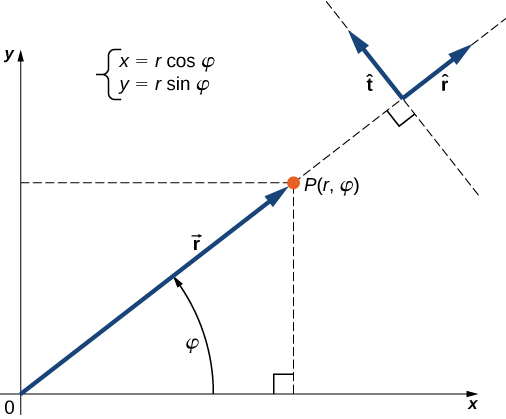
In the polar coordinate system, the location of point P in a plane is given by two polar coordinates (Figure 2.20). The first polar coordinate is the radial coordinate r, which is the distance of point P from the origin. The second polar coordinate is an angle that the radial vector makes with some chosen direction, usually the positive x-direction. In polar coordinates, angles are measured in radians, or rads. The radial vector is attached at the origin and points away from the origin to point P. This radial direction is described by a unit radial vector . The second unit vector is a vector orthogonal to the radial direction . The positive direction indicates how the angle changes in the counterclockwise direction. In this way, a point P that has coordinates (x, y) in the rectangular system can be described equivalently in the polar coordinate system by the two polar coordinates . Equation 2.17 is valid for any vector, so we can use it to express the x- and y-coordinates of vector . In this way, we obtain the connection between the polar coordinates and rectangular coordinates of point P:
英語のヒント
極座標系では、平面内の点Pの位置を二つの極座標で与える(図2.20)。第1の極座標は動径座標rで、原点から点Pまでの距離である。第2の極座標は角で、動径ベクトルと、選んだ方向(通常はxの正方向)のなす角である。極座標では、角をラジアン(rad)で測る。動径ベクトルは原点に付けられ、原点から離れて点Pへ向かう。この動径方向を単位動径ベクトルで表す。第2の単位ベクトルは、動径方向に直交するベクトルである。正方向は、角が反時計回りに変わる向きを示す。こうして、直交座標系で座標(x, y)を持つ点Pを、極座標系では二つの極座標で同じように表せる。式2.17はどのベクトルにも成り立つため、ベクトルのx座標とy座標を表すのにも使える。このように、点Pの極座標と直交座標の関係が得られる。
OpenStax / Rice University, University Physics Volume 1, CC BY 4.0. Source-book artwork retained. · CC BY 4.0 · Source出典

Figure 2.20図 2.20
Using polar coordinates, the unit vector defines the positive direction along the radius r (radial direction) and, orthogonal to it, the unit vector defines the positive direction of rotation by the angle .
英語のヒント
極座標では、単位ベクトルが半径rに沿う正方向(動径方向)を定める。それと直交する単位ベクトルは、角による回転の正方向を定める。
Example 2.6例題 2.6
Polar Coordinates極座標
A treasure hunter finds one silver coin at a location 20.0 m away from a dry well in the direction north of east and finds one gold coin at a location 10.0 m away from the well in the direction north of west. What are the polar and rectangular coordinates of these findings with respect to the well?
英語のヒント
宝探しをする人が、干上がった井戸から、東から北への方向に20.0 m離れた場所で銀貨を1枚、西から北への方向に10.0 m離れた場所で金貨を1枚見つける。井戸を基準とした、これらの発見場所の極座標と直交座標はいくらか。
Strategy方針
The well marks the origin of the coordinate system and east is the +x-direction. We identify radial distances from the locations to the origin, which are (for the silver coin) and (for the gold coin). To find the angular coordinates, we convert to radians: . We use Equation 2.18 to find the x- and y-coordinates of the coins.
英語のヒント
井戸を座標系の原点とし、東を+x方向とする。各場所から原点までの動径方向の距離は、銀貨が、金貨がである。角座標を求めるため、をラジアンへ換算すると、となる。式2.18を使い、硬貨のx座標とy座標を求める。
Solution解答
The angular coordinate of the silver coin is , whereas the angular coordinate of the gold coin is . Hence, the polar coordinates of the silver coin are and those of the gold coin are . We substitute these coordinates into Equation 2.18 to obtain rectangular coordinates. For the gold coin, the coordinates are
英語のヒント
銀貨の角座標は、金貨の角座標はである。したがって、銀貨の極座標は、金貨はとなる。これらを式2.18へ代入して直交座標を得る。金貨の座標は次のとおりである。
For the silver coin, the coordinates are
英語のヒント
銀貨の座標は、次のとおりである。
Vectors in Three Dimensions3次元のベクトル
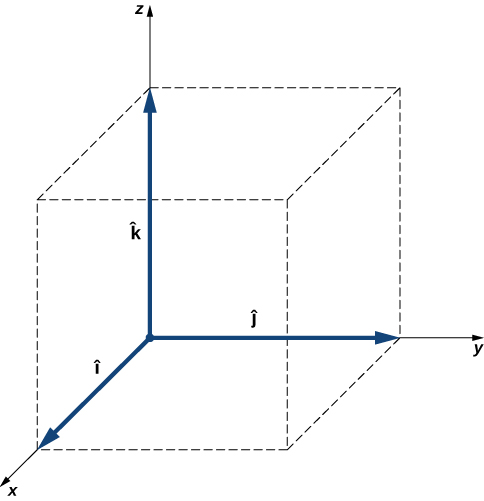
To specify the location of a point in space, we need three coordinates (x, y, z), where coordinates x and y specify locations in a plane, and coordinate z gives a vertical position above or below the plane. Three-dimensional space has three orthogonal directions, so we need not two but three unit vectors to define a three-dimensional coordinate system. In the Cartesian coordinate system, the first two unit vectors are the unit vector of the x-axis and the unit vector of the y-axis . The third unit vector is the direction of the z-axis (Figure 2.21). The order in which the axes are labeled, which is the order in which the three unit vectors appear, is important because it defines the orientation of the coordinate system. The order x-y-z, which is equivalent to the order - - , defines the standard right-handed coordinate system (positive orientation). Notice that while previously the y-axis was used for the upward direction, in three dimensions we usually choose z to represent the vertical. A right-handed coordinate system with z up and with one of the remaining axes pointing to the right and the other out of the page must have the y-axis pointing right and x out of the page, as illustrated here.
英語のヒント
空間内の点の位置を指定するには、三つの座標(x, y, z)が必要である。xとyは平面内の位置を指定し、zはその平面より上または下の鉛直位置を与える。3次元空間には直交する三つの方向があるため、3次元座標系を定めるには、単位ベクトルも二つではなく三つ必要となる。デカルト座標系では、最初の二つはx軸の単位ベクトルとy軸の単位ベクトルである。第3の単位ベクトルはz軸の方向である(図2.21)。軸に名前を付ける順番、つまり三つの単位ベクトルが並ぶ順番は重要である。座標系の向きを定めるからだ。x−y−zという順番は、−−の順番に等しく、標準的な右手座標系(正の向き)を定める。以前は上向きにy軸を使っていたが、3次元では通常、鉛直方向をzで表すことに注意しよう。zを上向きとし、残りの軸の一方を右、他方を紙面の手前へ向ける右手座標系では、ここに示すようにy軸が右、x軸が手前を向かなければならない。
OpenStax / Rice University, University Physics Volume 1, CC BY 4.0. Source-book artwork retained. · CC BY 4.0 · Source出典

Figure 2.21図 2.21
Three unit vectors define a Cartesian system in three-dimensional space. The order in which these unit vectors appear defines the orientation of the coordinate system. The order shown here defines the right-handed orientation.
英語のヒント
三つの単位ベクトルが、3次元空間のデカルト座標系を定める。これらが並ぶ順番によって、座標系の向きが定まる。ここでの順番は、右手系の向きを定める。
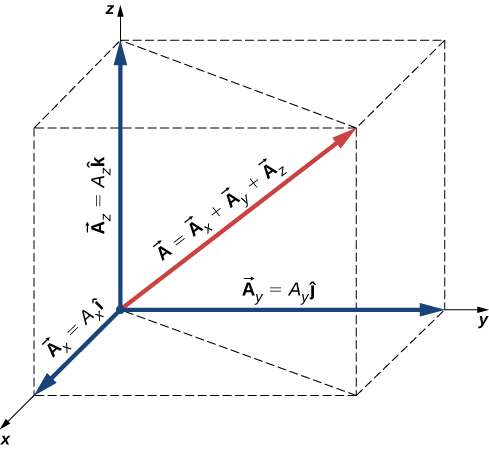
In three-dimensional space, vector has three vector components: the x-component , which is the part of vector along the x-axis; the y-component , which is the part of along the y-axis; and the z-component , which is the part of the vector along the z-axis. A vector in three-dimensional space is the vector sum of its three vector components (Figure 2.22):
英語のヒント
3次元空間のベクトルには、三つのベクトル成分がある。x成分はベクトルのx軸に沿う部分、y成分はのy軸に沿う部分、z成分はz軸に沿う部分である。3次元空間のベクトルは、三つのベクトル成分の和である(図2.22)。
If we know the coordinates of its origin and of its end , its scalar components are obtained by taking their differences: and are given by Equation 2.13 and the z-component is given by
英語のヒント
起点と終点の座標がわかれば、その差を取ることでスカラー成分が得られる。とは式2.13で与えられ、z成分は次で与えられる。
Magnitude A is obtained by generalizing Equation 2.15 to three dimensions:
英語のヒント
大きさAは、式2.15を3次元へ一般化することで得られる。
This expression for the vector magnitude comes from applying the Pythagorean theorem twice. As seen in Figure 2.22, the diagonal in the xy-plane has length and its square adds to the square to give . Note that when the z-component is zero, the vector lies entirely in the xy-plane and its description is reduced to two dimensions.
英語のヒント
このベクトルの大きさの式は、ピタゴラスの定理を2回適用することで得られる。図2.22のように、xy平面内の対角線の長さはである。その2乗との和がとなる。z成分が0なら、ベクトル全体がxy平面内にあり、2次元での記述に帰着することに注意しよう。
OpenStax / Rice University, University Physics Volume 1, CC BY 4.0. Source-book artwork retained. · CC BY 4.0 · Source出典

Figure 2.22図 2.22
A vector in three-dimensional space is the vector sum of its three vector components.
英語のヒント
3次元空間のベクトルは、三つのベクトル成分の和である。
Example 2.7例題 2.7
Takeoff of a Drone無人航空機の離陸
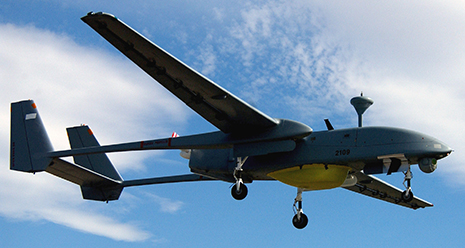
During a takeoff of IAI Heron (Figure 2.23), its position with respect to a control tower is 100 m above the ground, 300 m to the east, and 200 m to the north. One minute later, its position is 250 m above the ground, 1200 m to the east, and 2100 m to the north. What is the drone’s displacement vector with respect to the control tower? What is the magnitude of its displacement vector?
英語のヒント
IAIヘロン(図2.23)の離陸中、管制塔を基準とした位置が、地上100 m、東へ300 m、北へ200 mである。1分後、位置は地上250 m、東へ1200 m、北へ2100 mとなる。管制塔を基準とした無人航空機の変位ベクトルはいくらか。その大きさはいくらか。
(credit: SSgt Reynaldo Ramon, USAF) The appearance of U.S. Department of Defense visual information does not imply or constitute DoD endorsement. · US government public-domain visual information; OpenStax additions CC BY 4.0 · Source出典

Figure 2.23図 2.23
The drone IAI Heron in flight. (credit: SSgt Reynaldo Ramon, USAF)
英語のヒント
飛行中の無人航空機IAIヘロン。(出典:米空軍Reynaldo Ramon軍曹)
Strategy方針
We take the origin of the Cartesian coordinate system as the control tower. The direction of the +x-axis is given by unit vector to the east, the direction of the +y-axis is given by unit vector to the north, and the direction of the +z-axis is given by unit vector , which points up from the ground. The drone’s first position is the origin (or, equivalently, the beginning) of the displacement vector and its second position is the end of the displacement vector.
英語のヒント
デカルト座標系の原点を管制塔とする。+x軸の方向を東向きの単位ベクトル、+y軸の方向を北向きの単位ベクトル、+z軸の方向を地面から上へ向く単位ベクトルで与える。無人航空機の最初の位置が変位ベクトルの起点(始点)であり、2番目の位置が終点である。
Solution解答
We identify b(300.0 m, 200.0 m, 100.0 m) and e(1200 m, 2100 m, 250 m), and use Equation 2.13 and Equation 2.20 to find the scalar components of the drone’s displacement vector:
英語のヒント
We substitute these components into Equation 2.19 to find the displacement vector:
英語のヒント
これらの成分を式2.19へ代入し、変位ベクトルを求める。
We substitute into Equation 2.21 to find the magnitude of the displacement:
英語のヒント
式2.21へ代入して、変位の大きさを求める。