第2章ベクトル
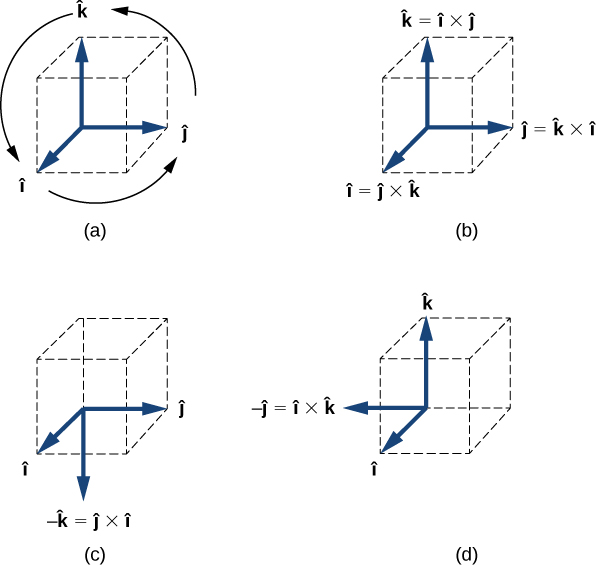
Notice that in Equation 2.39, the three unit vectors , , and appear in the cyclic order shown in a diagram in Figure 2.34(a). The cyclic order means that in the product formula, follows and comes before , or follows and comes before , or follows and comes before . The cross product of two different unit vectors is always a third unit vector. When two unit vectors in the cross product appear in the cyclic order, the result of such a multiplication is the remaining unit vector, as illustrated in Figure 2.34(b). When unit vectors in the cross product appear in a different order, the result is a unit vector that is antiparallel to the remaining unit vector (i.e., the result is with the minus sign, as shown by the examples in Figure 2.34(c) and Figure 2.34(d). In practice, when the task is to find cross products of vectors that are given in vector component form, this rule for the cross-multiplication of unit vectors is very useful.
英語のヒント
OpenStax / Rice University, University Physics Volume 1, CC BY 4.0. Source-book artwork retained. · CC BY 4.0 · Source出典

Figure 2.34図 2.34
(a) The diagram of the cyclic order of the unit vectors of the axes. (b) The only cross products where the unit vectors appear in the cyclic order. These products have the positive sign. (c, d) Two examples of cross products where the unit vectors do not appear in the cyclic order. These products have the negative sign.
英語のヒント
(a)軸の単位ベクトルの循環順序を示す図。(b)単位ベクトルが循環順序に並ぶ外積の全例。これらの積は正符号を持つ。(c、d)循環順序に並ばない外積の二例。これらの積は負符号を持つ。
Suppose we want to find the cross product for vectors and . We can use the distributive property (Equation 2.37), the anticommutative property (Equation 2.36), and the results in Equation 2.38 and Equation 2.39 for unit vectors to perform the following algebra:
英語のヒント
When performing algebraic operations involving the cross product, be very careful about keeping the correct order of multiplication because the cross product is anticommutative. The last two steps that we still have to do to complete our task are, first, grouping the terms that contain a common unit vector and, second, factoring. In this way we obtain the following very useful expression for the computation of the cross product:
英語のヒント
外積を含む代数演算では、乗算の正しい順序を保つことに十分注意する。外積は反可換だからである。計算を完成させるために残る最後の二段階は、第1に共通の単位ベクトルを含む項をまとめ、第2に因数でくくることである。こうして、外積の計算に非常に便利な次の式を得る。
In this expression, the scalar components of the cross-product vector are
英語のヒント
この式で、外積ベクトルのスカラー成分は次のとおりである。
(2.41)
When finding the cross product, in practice, we can use either Equation 2.35 or Equation 2.40, depending on which one of them seems to be less complex computationally. They both lead to the same final result. One way to make sure if the final result is correct is to use them both.
英語のヒント
Example 2.19例題 2.19
A Particle in a Magnetic Field磁場中の粒子
When moving in a magnetic field, some particles may experience a magnetic force. Without going into details—a detailed study of magnetic phenomena comes in later chapters—let’s acknowledge that the magnetic field is a vector, the magnetic force is a vector, and the velocity of the particle is a vector. The magnetic force vector is proportional to the vector product of the velocity vector with the magnetic field vector, which we express as . In this equation, a constant takes care of the consistency in physical units, so we can omit physical units on vectors and . In this example, let’s assume the constant is positive.
英語のヒント
磁場の中を動くと、磁気力を受ける粒子がある。磁気現象は後の章で詳しく学ぶので、ここでは詳細に立ち入らず、磁場、磁気力、粒子の速度が、いずれもベクトルであることを確認しておこう。磁気力ベクトルは、速度ベクトルと磁場ベクトルのベクトル積に比例し、と表す。この式の定数が物理単位の整合性を担うため、ベクトルとの物理単位を省略できる。この例では、定数を正とする。
A particle moving in space with velocity vector enters a region with a magnetic field and experiences a magnetic force. Find the magnetic force on this particle at the entry point to the region where the magnetic field vector is (a) and (b) . In each case, find magnitude F of the magnetic force and angle the force vector makes with the given magnetic field vector .
英語のヒント
速度ベクトルで空間を動く粒子が、磁場のある領域へ入り、磁気力を受ける。磁場ベクトルが(a)、(b)の場合について、領域へ入った地点で粒子に働く磁気力を求めよ。それぞれの場合に、磁気力の大きさFと、力ベクトルが磁場ベクトルとなす角を求めよ。
Strategy方針
First, we want to find the vector product , because then we can determine the magnetic force using . Magnitude F can be found either by using components, , or by computing the magnitude directly using Equation 2.35. In the latter approach, we would have to find the angle between vectors and . When we have , the general method for finding the direction angle involves the computation of the scalar product and substitution into Equation 2.34. To compute the vector product we can either use Equation 2.40 or compute the product directly, whichever way is simpler.
英語のヒント
Solution解答
The components of the velocity vector are , , and .
英語のヒント
速度ベクトルの成分は、、、である。
(a) The components of the magnetic field vector are , , and . Substituting them into Equation 2.41 gives the scalar components of vector :
英語のヒント
(a)磁場ベクトルの成分は、、である。式2.41へ代入すると、ベクトルのスカラー成分が得られる。
Thus, the magnetic force is and its magnitude is
英語のヒント
したがって、磁気力はで、その大きさは次のようになる。
To compute angle , we may need to find the magnitude of the magnetic field vector,
英語のヒント
角を計算するには、磁場ベクトルの大きさと、
and the scalar product :
英語のヒント
スカラー積を求める必要がある。
Hence, the magnetic force vector is perpendicular to the magnetic field vector. (We could have saved some time if we had computed the scalar product earlier.)
英語のヒント
したがって、磁気力ベクトルは磁場ベクトルに垂直である。(先にスカラー積を計算していれば、少し時間を節約できた。)
(b) Because vector has only one component, we can perform the algebra quickly and find the vector product directly:
英語のヒント
(b)ベクトルは成分を一つしか持たないので、代数計算を手早く行い、ベクトル積を直接求められる。
The magnitude of the magnetic force is
英語のヒント
磁気力の大きさは、次のとおりである。
Because the scalar product is
英語のヒント
スカラー積が次のようになるので、
the magnetic force vector is perpendicular to the magnetic field vector .
英語のヒント
磁気力ベクトルは、磁場ベクトルに垂直である。
Significance意味の検討
Even without actually computing the scalar product, we can predict that the magnetic force vector must always be perpendicular to the magnetic field vector because of the way this vector is constructed. Namely, the magnetic force vector is the vector product and, by the definition of the vector product (see Figure 2.31), vector must be perpendicular to both vectors and .
英語のヒント
スカラー積を実際に計算しなくても、磁気力ベクトルの作り方から、それが常に磁場ベクトルに垂直でなければならないと予測できる。すなわち、磁気力ベクトルはベクトル積であり、ベクトル積の定義(図2.31)によれば、はとの両方に垂直でなければならない。
In conclusion to this section, we want to stress that “dot product” and “cross product” are entirely different mathematical objects that have different meanings. The dot product is a scalar; the cross product is a vector. Later chapters use the terms dot product and scalar product interchangeably. Similarly, the terms cross product and vector product are used interchangeably.
英語のヒント
本節の最後に、「内積」と「外積」はまったく異なる数学的対象であり、意味も異なることを強調しておく。内積はスカラー、外積はベクトルである。後の章では、内積とスカラー積という用語を同じ意味で使う。同様に、外積とベクトル積も同じ意味で使う。