第2章ベクトル
2.2 Coordinate Systems and Components of a Vector2.2 座標系とベクトルの成分
Learning Objectives学習目標
Learning Objectives学習目標
By the end of this section, you will be able to:
英語のヒント
本節を学ぶと、次のことができるようになる。
- Describe vectors in two and three dimensions in terms of their components, using unit vectors along the axes.
英語のヒント
軸に沿う単位ベクトルを使い、2次元と3次元のベクトルを成分で表す。 - Distinguish between the vector components of a vector and the scalar components of a vector.
英語のヒント
ベクトル成分とスカラー成分を区別する。 - Explain how the magnitude of a vector is defined in terms of the components of a vector.
英語のヒント
ベクトルの大きさが成分によってどのように定義されるか説明する。 - Identify the direction angle of a vector in a plane.
英語のヒント
平面内のベクトルの方向角を特定する。 - Explain the connection between polar coordinates and Cartesian coordinates in a plane.
英語のヒント
平面内の極座標とデカルト座標の関係を説明する。
Vectors are usually described in terms of their components in a coordinate system. Even in everyday life we naturally invoke the concept of vector components in a rectangular coordinate system. For example, if you ask someone for directions to a particular location, you will more likely be told to go 40 km east and 30 km north than 50 km in the direction north of east.
英語のヒント
ベクトルは通常、座標系での成分を用いて表される。日常生活でも、直交座標系におけるベクトルの成分という考え方を、自然に用いている。例えば、ある場所への道順を人に尋ねると、東から北への方向へ50 km進むというより、東へ40 km、北へ30 km進むと教えられることが多い。
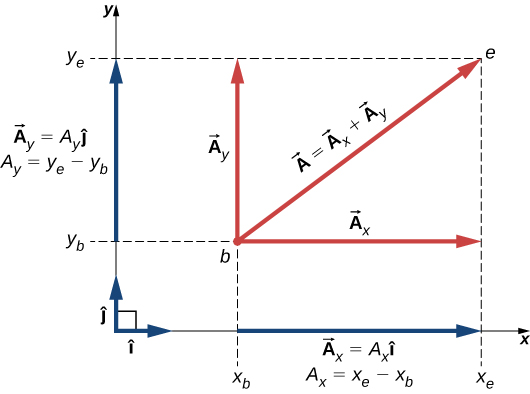
In a rectangular (Cartesian) xy-coordinate system in a plane, a point in a plane is described by a pair of coordinates (x, y). In a similar fashion, a vector in a plane is described by a pair of its vector coordinates. The x-coordinate of vector is called its x-component and the y-coordinate of vector is called its y-component. The vector x-component is a vector denoted by . The vector y-component is a vector denoted by . In the Cartesian system, the x and y vector components of a vector are the orthogonal projections, as illustrated in Figure 2.16, of this vector onto the x- and y-axes, respectively. In this way, following the parallelogram rule for vector addition, each vector on a Cartesian plane can be expressed as the vector sum of its vector components:
英語のヒント
平面内の直交(デカルト)xy座標系では、平面上の点を一組の座標(x, y)で表す。同様に、平面内のベクトルも、一組のベクトル座標で表される。ベクトルのx座標をx成分、ベクトルのy座標をy成分という。ベクトルとしてのx成分を、y成分をと表す。デカルト座標系では、図2.16のように、ベクトルのx方向とy方向のベクトル成分は、それぞれ元のベクトルをx軸とy軸へ正射影したものである。こうして、ベクトルの加算に関する平行四辺形の法則に従い、デカルト平面上の各ベクトルを、ベクトル成分の和として表せる。
(2.10)
As illustrated in Figure 2.16, vector is the diagonal of the rectangle where the x-component is the side parallel to the x-axis and the y-component is the side parallel to the y-axis. Vector component is orthogonal to vector component .
英語のヒント
図2.16のように、ベクトルは長方形の対角線である。x成分はx軸に平行な辺、y成分はy軸に平行な辺に当たる。ベクトル成分はベクトル成分に直交する。
OpenStax / Rice University, University Physics Volume 1, CC BY 4.0. Source-book artwork retained. · CC BY 4.0 · Source出典

Figure 2.16図 2.16
Vector in a plane in the Cartesian coordinate system is the vector sum of its vector x- and y-components. The x-vector component is the orthogonal projection of vector onto the x-axis. The y-vector component is the orthogonal projection of vector onto the y-axis. The numbers and that multiply the unit vectors are the scalar components of the vector.
英語のヒント
デカルト座標系の平面内のベクトルは、x方向とy方向のベクトル成分の和である。x方向のベクトル成分は、をx軸へ正射影したもの。y方向のベクトル成分は、をy軸へ正射影したものである。単位ベクトルに掛かる数とは、このベクトルのスカラー成分である。
It is customary to denote the positive direction on the x-axis by the unit vector and the positive direction on the y-axis by the unit vector . Unit vectors of the axes, and , define two orthogonal directions in the plane. As shown in Figure 2.16, the x- and y- components of a vector can now be written in terms of the unit vectors of the axes:
英語のヒント
通常、x軸の正方向を単位ベクトル、y軸の正方向を単位ベクトルで表す。軸の単位ベクトルとは、平面内の直交する二つの方向を定める。図2.16のように、ベクトルのx成分とy成分を、軸の単位ベクトルを使って次のように書ける。
(2.11)
The vectors and defined by Equation 2.11 are the vector components of vector . The numbers and that define the vector components in Equation 2.11 are the scalar components of vector . Combining Equation 2.10 with Equation 2.11, we obtain the component form of a vector:
英語のヒント
If we know the coordinates of the origin point of a vector (where b stands for “beginning”) and the coordinates of the end point of a vector (where e stands for “end”), we can obtain the scalar components of a vector simply by subtracting the origin point coordinates from the end point coordinates:
英語のヒント
ベクトルの起点の座標(bは「始まり」を表すbeginningの略)と、終点の座標(eは「終わり」を表すendの略)がわかれば、終点の座標から起点の座標を引くだけで、ベクトルのスカラー成分が得られる。
Example 2.3例題 2.3
Displacement of a Mouse Pointerマウスポインターの変位
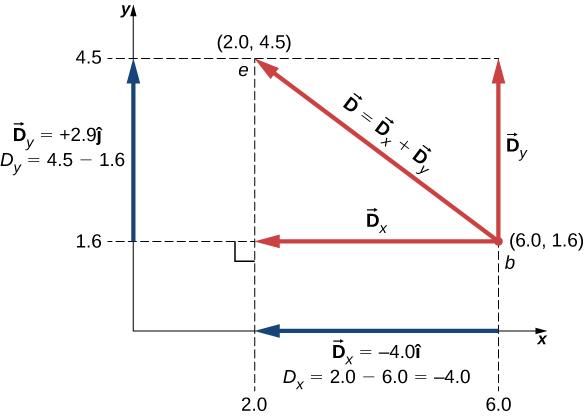
A mouse pointer on the display monitor of a computer at its initial position is at point (6.0 cm, 1.6 cm) with respect to the lower left-side corner. If you move the pointer to an icon located at point (2.0 cm, 4.5 cm), what is the displacement vector of the pointer?
英語のヒント
コンピューターの画面で、マウスポインターの最初の位置が、画面左下の隅を基準として(6.0 cm, 1.6 cm)にある。ポインターを(2.0 cm, 4.5 cm)にあるアイコンへ動かしたとき、ポインターの変位ベクトルはいくらか。
Strategy方針
The origin of the xy-coordinate system is the lower left-side corner of the computer monitor. Therefore, the unit vector on the x-axis points horizontally to the right and the unit vector on the y-axis points vertically upward. The origin of the displacement vector is located at point b(6.0, 1.6) and the end of the displacement vector is located at point e(2.0, 4.5). Substitute the coordinates of these points into Equation 2.13 to find the scalar components and of the displacement vector . Finally, substitute the coordinates into Equation 2.12 to write the displacement vector in the vector component form.
英語のヒント
Solution解答
We identify , , , and , where the physical unit is 1 cm. The scalar x- and y-components of the displacement vector are
英語のヒント
、、、と特定でき、物理単位は1 cmである。変位ベクトルのスカラーx成分とy成分は、次のようになる。
The vector component form of the displacement vector is
英語のヒント
変位ベクトルのベクトル成分表示は、次のようになる。
(2.14)
OpenStax / Rice University, University Physics Volume 1, CC BY 4.0. Source-book artwork retained. · CC BY 4.0 · Source出典

Figure 2.17図 2.17
The graph of the displacement vector. The vector points from the origin point at b to the end point at e.
英語のヒント
変位ベクトルの図。ベクトルは、起点bから終点eへ向かう。
Significance意味の検討
Notice that the physical unit—here, 1 cm—can be placed either with each component immediately before the unit vector or globally for both components, as in Equation 2.14. Often, the latter way is more convenient because it is simpler.
英語のヒント
物理単位(ここでは1 cm)は、各成分の単位ベクトルの直前に付けても、式2.14のように両成分にまとめて付けてもよい。後者のほうが単純なので、便利な場合が多い。
The vector x-component of the displacement vector has the magnitude because the magnitude of the unit vector is . Notice, too, that the direction of the x-component is , which is antiparallel to the direction of the +x-axis; hence, the x-component vector points to the left, as shown in Figure 2.17. The scalar x-component of vector is .
英語のヒント
変位ベクトルのベクトルx成分の大きさはである。単位ベクトルの大きさがだからである。また、x成分の方向はであり、+x軸の方向と反平行であることに注意しよう。したがって、図2.17のように、ベクトルx成分は左を向く。ベクトルのスカラーx成分はである。
Similarly, the vector y-component of the displacement vector has magnitude because the magnitude of the unit vector is . The direction of the y-component is , which is parallel to the direction of the +y-axis. Therefore, the y-component vector points up, as seen in Figure 2.17. The scalar y-component of vector is . The displacement vector is the resultant of its two vector components.
英語のヒント
同様に、変位ベクトルのベクトルy成分の大きさはである。単位ベクトルの大きさがだからである。y成分の方向はで、+y軸の方向と平行である。したがって、図2.17のように、ベクトルy成分は上を向く。ベクトルのスカラーy成分はである。変位ベクトルは、二つのベクトル成分の合ベクトルである。
The vector component form of the displacement vector Equation 2.14 tells us that the mouse pointer has been moved on the monitor 4.0 cm to the left and 2.9 cm upward from its initial position.
英語のヒント
変位ベクトルの成分表示である式2.14は、マウスポインターが画面上で、最初の位置から左へ4.0 cm、上へ2.9 cm動いたことを示す。
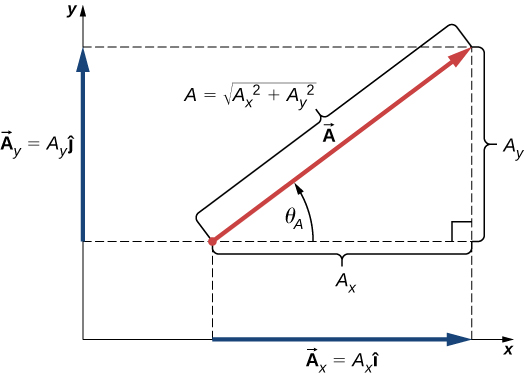
When we know the scalar components and of a vector , we can find its magnitude A and its direction angle . The direction angle—or direction, for short—is the angle the vector forms with the positive direction on the x-axis. The angle is measured in the counterclockwise direction from the +x-axis to the vector (Figure 2.18). Because the lengths A, , and form a right triangle, they are related by the Pythagorean theorem:
英語のヒント
ベクトルのスカラー成分とがわかれば、大きさAと方向角を求められる。方向角、あるいは単に方向とは、ベクトルがx軸の正方向となす角である。角は、+x軸からベクトルまで反時計回りに測る(図2.18)。長さA、、は直角三角形を作るので、ピタゴラスの定理によって次の関係が成り立つ。
This equation works even if the scalar components of a vector are negative. The direction angle of a vector is defined via the tangent function of angle in the triangle shown in Figure 2.18:
英語のヒント
この式は、ベクトルのスカラー成分が負の場合にも成り立つ。ベクトルの方向角は、図2.18の三角形の角の正接関数によって定義される。
OpenStax / Rice University, University Physics Volume 1, CC BY 4.0. Source-book artwork retained. · CC BY 4.0 · Source出典

Figure 2.18図 2.18
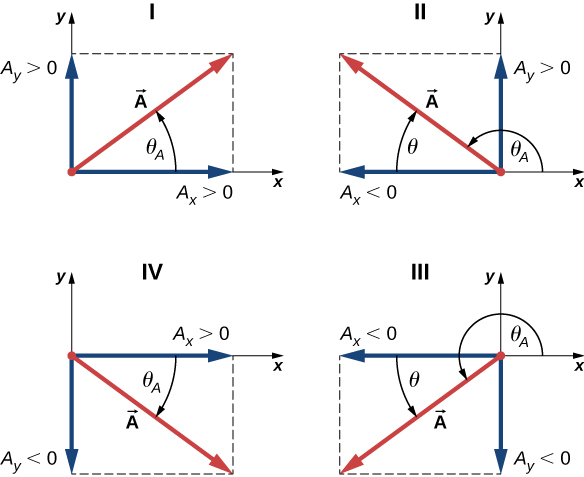
When the vector lies either in the first quadrant or in the fourth quadrant, where component is positive (Figure 2.19), the direction angle in Equation 2.16) is identical to the angle .
英語のヒント
ベクトルが、成分の正となる第1象限または第4象限にある場合(図2.19)、式2.16の方向角は角と同一である。
When the vector lies either in the first quadrant or in the fourth quadrant, where component is positive (Figure 2.19), the angle in Equation 2.16 is identical to the direction angle . For vectors in the fourth quadrant, angle is negative, which means that for these vectors, direction angle is measured clockwise from the positive x-axis. Similarly, for vectors in the second quadrant, angle is negative. When the vector lies in either the second or third quadrant, where component is negative, the direction angle is (Figure 2.19).
英語のヒント
OpenStax / Rice University, University Physics Volume 1, CC BY 4.0. Source-book artwork retained. · CC BY 4.0 · Source出典

Figure 2.19図 2.19
Scalar components of a vector may be positive or negative. Vectors in the first quadrant (I) have both scalar components positive and vectors in the third quadrant have both scalar components negative. For vectors in quadrants II and III, the direction angle of a vector is .
英語のヒント
ベクトルのスカラー成分は、正にも負にもなりうる。第1象限(I)のベクトルは両成分が正で、第3象限のベクトルは両成分が負である。第2象限と第3象限のベクトルでは、方向角はとなる。
Example 2.4例題 2.4
Magnitude and Direction of the Displacement Vector変位ベクトルの大きさと方向
You move a mouse pointer on the display monitor from its initial position at point (6.0 cm, 1.6 cm) to an icon located at point (2.0 cm, 4.5 cm). What are the magnitude and direction of the displacement vector of the pointer?
英語のヒント
画面上のマウスポインターを、最初の位置(6.0 cm, 1.6 cm)から、(2.0 cm, 4.5 cm)にあるアイコンへ移動する。ポインターの変位ベクトルの大きさと方向はいくらか。
Strategy方針
In Example 2.3, we found the displacement vector of the mouse pointer (see Equation 2.14). We identify its scalar components and and substitute into Equation 2.15 and Equation 2.16 to find the magnitude D and direction , respectively.
英語のヒント
Solution解答
The magnitude of vector is
英語のヒント
ベクトルの大きさは、次のようになる。
The direction angle is
英語のヒント
方向角は、次のようになる。
Vector lies in the second quadrant, so its direction angle is
英語のヒント
ベクトルは第2象限にあるので、その方向角は次のようになる。