第2章ベクトル
Summaryまとめ
- There are two kinds of multiplication for vectors. One kind of multiplication is the scalar product, also known as the dot product. The other kind of multiplication is the vector product, also known as the cross product. The scalar product of vectors is a number (scalar). The vector product of vectors is a vector.
英語のヒント
ベクトルの乗算には二種類ある。一つはスカラー積、別名内積であり、もう一つはベクトル積、別名外積である。スカラー積は数(スカラー)であり、ベクトル積はベクトルである。 - Both kinds of multiplication have the distributive property, but only the scalar product has the commutative property. The vector product has the anticommutative property, which means that when we change the order in which two vectors are multiplied, the result acquires a minus sign.
英語のヒント
どちらの乗算にも分配法則が成り立つが、交換法則が成り立つのはスカラー積だけである。ベクトル積は反可換であり、二つのベクトルを掛ける順序を変えると、結果に負号が付く。 - The scalar product of two vectors is obtained by multiplying their magnitudes with the cosine of the angle between them. The scalar product of orthogonal vectors vanishes; the scalar product of antiparallel vectors is negative.
英語のヒント
二つのベクトルのスカラー積は、両者の大きさと、なす角の余弦を掛けて得る。直交するベクトルのスカラー積は0であり、反平行なベクトルのスカラー積は負である。 - The vector product of two vectors is a vector perpendicular to both of them. Its magnitude is obtained by multiplying their magnitudes by the sine of the angle between them. The direction of the vector product can be determined by the corkscrew right-hand rule. The vector product of two either parallel or antiparallel vectors vanishes. The magnitude of the vector product is largest for orthogonal vectors.
英語のヒント
二つのベクトルのベクトル積は、両者に垂直なベクトルである。大きさは、両者の大きさと、なす角の正弦を掛けて得る。方向は右ねじの法則で決められる。二つのベクトルが平行または反平行なら、ベクトル積は0となる。大きさは、両者が直交するときに最大になる。 - The scalar product of vectors is used to find angles between vectors and in the definitions of derived scalar physical quantities such as work or energy.
英語のヒント
スカラー積は、ベクトルのなす角を求めたり、仕事やエネルギーなどの組立スカラー物理量を定義したりするために用いる。 - The cross product of vectors is used in definitions of derived vector physical quantities such as torque or magnetic force, and in describing rotations.
英語のヒント
外積は、トルクや磁気力などの組立ベクトル物理量の定義と、回転の記述に用いる。
Key Equations重要な式
Multiplication by a scalar (vector equation) スカラーによる乗算(ベクトル方程式) |
|
Multiplication by a scalar (scalar equation for magnitudes) スカラーによる乗算(大きさについてのスカラー方程式) |
|
Resultant of two vectors 二つのベクトルの合ベクトル |
|
Commutative law 交換法則 |
|
Associative law 結合法則 |
|
Distributive law 分配法則 |
|
The component form of a vector in two dimensions 2次元ベクトルの成分表示 |
|
Scalar components of a vector in two dimensions 2次元ベクトルのスカラー成分 |
|
Magnitude of a vector in a plane 平面内のベクトルの大きさ |
|
The direction angle of a vector in a plane 平面内のベクトルの方向角 |
|
Scalar components of a vector in a plane 平面内のベクトルのスカラー成分 |
|
Polar coordinates in a plane 平面内の極座標 |
|
The component form of a vector in three dimensions 3次元ベクトルの成分表示 |
|
The scalar z-component of a vector in three dimensions 3次元ベクトルのスカラーz成分 |
|
Magnitude of a vector in three dimensions 3次元ベクトルの大きさ |
|
Distributive property 分配法則 |
|
Antiparallel vector to と反平行なベクトル |
|
Equal vectors 等しいベクトル |
|
Components of the resultant of N vectors N個のベクトルの合ベクトルの成分 |
|
General unit vector 一般の単位ベクトル |
|
Definition of the scalar product スカラー積の定義 |
|
Commutative property of the scalar product スカラー積の交換法則 |
|
Distributive property of the scalar product スカラー積の分配法則 |
|
Scalar product in terms of scalar components of vectors ベクトルのスカラー成分によるスカラー積 |
|
Cosine of the angle between two vectors 二つのベクトルのなす角の余弦 |
|
Dot products of unit vectors 単位ベクトルの内積 |
|
Magnitude of the vector product (definition) ベクトル積の大きさ(定義) |
|
Anticommutative property of the vector product ベクトル積の反可換性 |
|
Distributive property of the vector product ベクトル積の分配法則 |
|
Cross products of unit vectors 単位ベクトルの外積 |
|
The cross product in terms of scalar components of vectors ベクトルのスカラー成分による外積 |
Conceptual Questions概念を確かめる問題
Exercises 58–61練習問題 58–61
Exercise 58問題 58
What is wrong with the following expressions? How can you correct them? (a) , (b) , (c) , (d) , (e) , (f) , (g) , (h) , (i) , and (j) .
英語のヒント
次の式の何が誤っているか。どう直せるか。(a)、(b)、(c)、(d)、(e)、(f)、(g)、(h)、(i)、(j)。
Solution解き方
a. , b. or , c. , d. , e. , f. , g. left side is a scalar and right side is a vector, h. , i. , j.
英語のヒント
(a)、(b)または、(c)、(d)、(e)、(f)、(g)左辺はスカラー、右辺はベクトル、(h)、(i)、(j)。
Exercise 59問題 59
If the cross product of two vectors vanishes, what can you say about their directions?
英語のヒント
二つのベクトルの外積が0なら、両者の方向について何がいえるか。
Exercise 60問題 60
If the dot product of two vectors vanishes, what can you say about their directions?
英語のヒント
二つのベクトルの内積が0なら、両者の方向について何がいえるか。
Solution解き方
They are orthogonal.
英語のヒント
両者は直交する。
Exercise 61問題 61
What is the dot product of a vector with the cross product that this vector has with another vector?
英語のヒント
あるベクトルと、そのベクトルが別のベクトルとなす外積との内積は、いくらか。
Problems問題
Exercises 62–70練習問題 62–70
Exercise 62問題 62
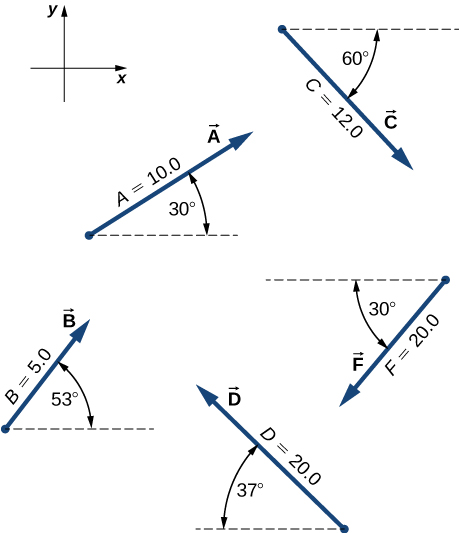
Assuming the +x-axis is horizontal to the right for the vectors in the following figure, find the following scalar products: (a) , (b) , (c) , (d) , (e) , (f) , (g) , and (h) .
英語のヒント
次の図のベクトルについて、+x軸を水平右向きとする。次のスカラー積を求めよ。(a)、(b)、(c)、(d)、(e)、(f)、(g)、(h)。

Exercise 63問題 63
Assuming the +x-axis is horizontal to the right for the vectors in the preceding figure, find (a) the component of vector along vector , (b) the component of vector along vector , (c) the component of vector along vector , and (d) the component of vector along vector .
英語のヒント
前の図のベクトルについて、+x軸を水平右向きとする。(a)に沿うの成分、(b)に沿うの成分、(c)に沿うの成分、(d)に沿うの成分を求めよ。
Solution解き方
a. 0, b. 0, c. –0.866, d. –17.32
(a)0、(b)0、(c)−0.866、(d)−17.32。
Exercise 64問題 64
Find the angle between vectors for (a) and and (b) and .
英語のヒント
(a)と、(b)とについて、ベクトルどうしのなす角を求めよ。
Exercise 65問題 65
Find the angles that vector makes with the x-, y-, and z- axes.
英語のヒント
ベクトルがx軸、y軸、z軸となす角を求めよ。
Solution解き方
Exercise 66問題 66
Show that the force vector is orthogonal to the force vector .
英語のヒント
力ベクトルが、力ベクトルと直交することを示せ。
Exercise 67問題 67
Assuming the +x-axis is horizontal to the right for the vectors in the previous figure, find the following vector products: (a) , (b) , (c) , (d) , (e) , (f) , (g) , and (h) .
英語のヒント
前の図のベクトルについて、+x軸を水平右向きとする。次のベクトル積を求めよ。(a)、(b)、(c)、(d)、(e)、(f)、(g)、(h)。
Solution解き方
a. , b. , c. , d. , e. , f. , g. , h. 0
(a)、(b)、(c)、(d)、(e)、(f)、(g)、(h)0。
Exercise 68問題 68
Find the cross product for (a) and , (b) and , (c) and , and (d) and .
英語のヒント
次の組について外積を求めよ。(a)と、(b)と、(c)と、(d)と。
Exercise 69問題 69
For the vectors in the earlier figure, find (a) , (b) , and (c) .
英語のヒント
先の図のベクトルについて、(a)、(b)、(c)を求めよ。
Solution解き方
a. 0, b. 0, c.
(a)0、(b)0、(c)。
Exercise 70問題 70
(a) If , can we conclude ? (b) If , can we conclude ? (c) If , can we conclude ? Why or why not?
英語のヒント
(a)なら、と結論できるか。(b)なら、と結論できるか。(c)なら、と結論できるか。それぞれ理由を説明せよ。