第2章ベクトル
Summaryまとめ
- A vector quantity is any quantity that has magnitude and direction, such as displacement or velocity. Vector quantities are represented by mathematical objects called vectors.
英語のヒント
ベクトル量とは、変位や速度など、大きさと方向を持つ量である。ベクトル量は、ベクトルという数学的対象で表される。 - Geometrically, vectors are represented by arrows, with the end marked by an arrowhead. The length of the vector is its magnitude, which is a positive scalar. On a plane, the direction of a vector is given by the angle the vector makes with a reference direction, often an angle with the horizontal. The direction angle of a vector is a scalar.
英語のヒント
幾何学的には、ベクトルは終点に矢じりを付けた矢印で表す。ベクトルの長さが大きさであり、正のスカラーである。平面内のベクトルの方向は、基準方向となす角、しばしば水平方向となす角で与える。ベクトルの方向角はスカラーである。 - Two vectors are equal if and only if they have the same magnitudes and directions. Parallel vectors have the same direction angles but may have different magnitudes. Antiparallel vectors have direction angles that differ by . Orthogonal vectors have direction angles that differ by .
英語のヒント
二つのベクトルは、大きさと方向がともに同じとき、かつそのときに限って等しい。平行なベクトルは方向角が同じだが、大きさは異なる場合がある。反平行なベクトルの方向角は異なる。直交するベクトルの方向角は異なる。 - When a vector is multiplied by a scalar, the result is another vector of a different length than the length of the original vector. Multiplication by a positive scalar does not change the original direction; only the magnitude is affected. Multiplication by a negative scalar reverses the original direction. The resulting vector is antiparallel to the original vector. Multiplication by a scalar is distributive. Vectors can be divided by nonzero scalars but cannot be divided by vectors.
英語のヒント
ベクトルにスカラーを掛けると、元のベクトルとは長さの異なる別のベクトルが得られる。正のスカラーによる乗算では、元の方向は変わらず、大きさだけが影響を受ける。負のスカラーによる乗算では、元の方向が逆転する。得られるベクトルは、元のベクトルと反平行である。スカラーによる乗算には分配法則が成り立つ。ベクトルは0でないスカラーで割れるが、ベクトルでは割れない。 - Two or more vectors can be added to form another vector. The vector sum is called the resultant vector. We can add vectors to vectors or scalars to scalars, but we cannot add scalars to vectors. Vector addition is commutative and associative.
英語のヒント
二つ以上のベクトルを加え、別のベクトルを作れる。そのベクトル和を合ベクトルという。ベクトルどうし、スカラーどうしは加えられるが、スカラーとベクトルは加えられない。ベクトルの加算には交換法則と結合法則が成り立つ。 - To construct a resultant vector of two vectors in a plane geometrically, we use the parallelogram rule. To construct a resultant vector of many vectors in a plane geometrically, we use the tail-to-head method.
英語のヒント
平面内の二つのベクトルの合ベクトルを幾何学的に作図するには、平行四辺形の法則を用いる。平面内の多数のベクトルの合ベクトルを幾何学的に作図するには、尾と頭をつなぐ方法を用いる。
Conceptual Questions概念を確かめる問題
Exercises 1–14練習問題 1–14
Exercise 1問題 1
A weather forecast states the temperature is predicted to be the following day. Is this temperature a vector or a scalar quantity? Explain.
英語のヒント
天気予報で、翌日の気温はになると予測されている。この気温はベクトル量か、スカラー量か。説明せよ。
Solution解き方
scalar
英語のヒント
スカラー。
Exercise 2問題 2
Which of the following is a vector: a person’s height, the altitude on Mt. Everest, the velocity of a fly, the age of Earth, the boiling point of water, the cost of a book, Earth’s population, or the acceleration of gravity?
英語のヒント
次のうちベクトルはどれか。人の身長、エベレスト山での標高、ハエの速度、地球の年齢、水の沸点、本の値段、地球の人口、重力加速度。
Exercise 3問題 3
Give a specific example of a vector, stating its magnitude, units, and direction.
英語のヒント
ベクトルの具体例を一つ挙げ、大きさ、単位、方向を示せ。
Solution解き方
answers may vary
英語のヒント
解答は一通りではない。
Exercise 4問題 4
What do vectors and scalars have in common? How do they differ?
英語のヒント
ベクトルとスカラーには何が共通しているか。どう異なるか。
Exercise 5問題 5
Suppose you add two vectors and . What relative direction between them produces the resultant with the greatest magnitude? What is the maximum magnitude? What relative direction between them produces the resultant with the smallest magnitude? What is the minimum magnitude?
英語のヒント
二つのベクトルとを加えるとする。両者がどのような方向関係にあると、合ベクトルの大きさが最大になるか。その最大値はいくらか。どのような方向関係にあると最小になるか。その最小値はいくらか。
Solution解き方
parallel, sum of magnitudes, antiparallel, zero
英語のヒント
平行、大きさの和、反平行、0。
Exercise 6問題 6
Is it possible to add a scalar quantity to a vector quantity?
英語のヒント
スカラー量をベクトル量に加えることは可能か。
Exercise 7問題 7
Is it possible for two vectors of different magnitudes to add to zero? Is it possible for three vectors of different magnitudes to add to zero? Explain.
英語のヒント
大きさの異なる二つのベクトルを加えて0にできるか。大きさの異なる三つのベクトルを加えて0にできるか。説明せよ。
Solution解き方
no, yes
二つではできない。三つではできる。
Exercise 8問題 8
Does the odometer in an automobile indicate a scalar or a vector quantity?
英語のヒント
自動車の走行距離計は、スカラー量とベクトル量のどちらを示すか。
Exercise 9問題 9
When a 10,000-m runner competing on a 400-m track crosses the finish line, what is the runner’s net displacement? Can this displacement be zero? Explain.
英語のヒント
400 mトラックで競う10,000 m走の選手がフィニッシュラインを通過するとき、正味の変位はいくらか。この変位は0になりうるか。説明せよ。
Solution解き方
zero, yes
0。なりうる。
Exercise 10問題 10
A vector has zero magnitude. Is it necessary to specify its direction? Explain.
英語のヒント
あるベクトルの大きさが0である。その方向を指定する必要はあるか。説明せよ。
Exercise 11問題 11
Can a magnitude of a vector be negative?
英語のヒント
ベクトルの大きさは負になりうるか。
Solution解き方
no
ならない。
Exercise 12問題 12
Can the magnitude of a particle’s displacement be greater than the distance traveled?
英語のヒント
粒子の変位の大きさは、移動距離より大きくなりうるか。
Exercise 13問題 13
If two vectors are equal, what can you say about their components? What can you say about their magnitudes? What can you say about their directions?
英語のヒント
二つのベクトルが等しいなら、その成分について何がいえるか。大きさについてはどうか。方向についてはどうか。
Solution解き方
equal, equal, the same
英語のヒント
成分は等しく、大きさも等しく、方向は同じである。
Exercise 14問題 14
If three vectors sum up to zero, what geometric condition do they satisfy?
英語のヒント
三つのベクトルの和が0なら、それらはどのような幾何学的条件を満たすか。
Problems問題
Exercises 15–26練習問題 15–26
Exercise 15問題 15
A scuba diver makes a slow descent into the depths of the ocean. His vertical position with respect to a boat on the surface changes several times. He makes the first stop 9.0 m from the boat but has a problem with equalizing the pressure, so he ascends 3.0 m and then continues descending for another 12.0 m to the second stop. From there, he ascends 4 m and then descends for 18.0 m, ascends again for 7 m and descends again for 24.0 m, where he makes a stop, waiting for his buddy. Assuming the positive direction up to the surface, express his net vertical displacement vector in terms of the unit vector. What is his distance to the boat?
英語のヒント
スキューバダイバーが、海の深部へゆっくり潜る。水面の船を基準とする鉛直位置が何度か変わる。まず船から9.0 mのところで止まるが、圧力を釣り合わせるのに問題があり、3.0 m浮上してから、さらに12.0 m潜って2回目の停止をする。そこから4 m浮上し、18.0 m潜り、再び7 m浮上し、再び24.0 m潜ったところで止まって仲間を待つ。水面へ向かう方向を正とし、正味の鉛直変位ベクトルを単位ベクトルで表せ。船からの距離はいくらか。
Solution解き方
, 49 m
、49 m。
Exercise 16問題 16
In a tug-of-war game on one campus, 15 students pull on a rope at both ends in an effort to displace the central knot to one side or the other. Two students pull with force 196 N each to the right, four students pull with force 98 N each to the left, five students pull with force 62 N each to the left, three students pull with force 150 N each to the right, and one student pulls with force 250 N to the left. Assuming the positive direction to the right, express the net pull on the knot in terms of the unit vector. How big is the net pull on the knot? In what direction?
英語のヒント
ある大学の綱引きで、15人の学生が中央の結び目をどちらかへ動かそうと、ロープの両端を引く。2人はそれぞれ196 Nで右へ、4人はそれぞれ98 Nで左へ、5人はそれぞれ62 Nで左へ、3人はそれぞれ150 Nで右へ、1人は250 Nで左へ引く。右向きを正とし、結び目に働く合力を単位ベクトルで表せ。合力の大きさはいくらか。方向はどちらか。
Exercise 17問題 17
Suppose you walk 18.0 m straight west and then 25.0 m straight north. How far are you from your starting point and what is the compass direction of a line connecting your starting point to your final position? Use a graphical method.
英語のヒント
真西へ18.0 m歩いてから、真北へ25.0 m歩いたとする。出発点からどれだけ離れているか。また、出発点と最終位置を結ぶ直線の方位はどうなるか。図を用いて求めよ。
Solution解き方
30.8 m, west of north (equivalently, north of west or from east)
英語のヒント
30.8 m、北から西へ(西から北へ、または東からと同じ)。
Exercise 18問題 18
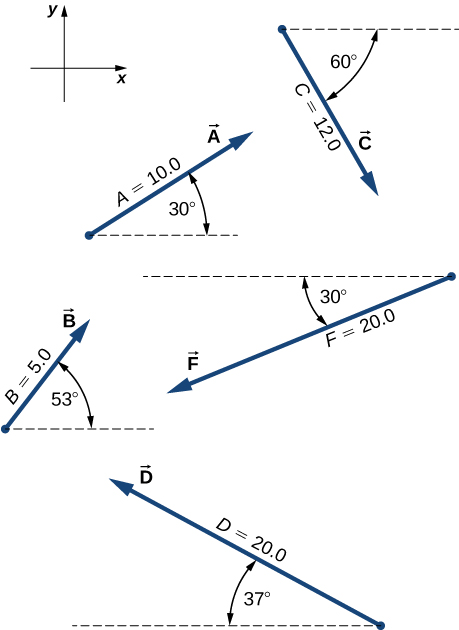
For the vectors given in the following figure, use a graphical method to find the following resultants: (a) , (b) , (c) , (d) , (e) , (f) , (g); and (h) .
英語のヒント
次の図のベクトルについて、図を用いて次の合ベクトルを求めよ。(a)、(b)、(c)、(d)、(e)、(f)、(g)、(h)。
Exercise 19問題 19
A delivery driver starts at the post office, drives 40 km north, then 20 km west, then 60 km northeast, and finally 50 km north to stop for lunch. Use a graphical method to find their net displacement vector.
英語のヒント
配達の運転手が郵便局を出発し、北へ40 km、西へ20 km、北東へ60 km、最後に北へ50 km走って、昼食のために止まる。図を用いて正味の変位ベクトルを求めよ。
Solution解き方
134 km,
134 km、。
Exercise 20問題 20
An adventurous dog strays from home, runs three blocks east, two blocks north, one block east, one block north, and two blocks west. Assuming that each block is about 100 m, how far from home and in what direction is the dog? Use a graphical method.
英語のヒント
冒険好きな犬が家を離れ、東へ3区画、北へ2区画、東へ1区画、北へ1区画、西へ2区画走る。各区画は約100 mとする。犬は家からどれだけ離れ、どの方向にいるか。図を用いて求めよ。
Exercise 21問題 21
In an attempt to escape a desert island, a castaway builds a raft and sets out to sea. The wind shifts a great deal during the day and he is blown along the following directions: 2.50 km and north of west, then 4.70 km and south of east, then 1.30 km and south of west, then 5.10 km straight east, then 1.70 km and east of north, then 7.20 km and south of west, and finally 2.80 km and north of east. Use a graphical method to find the castaway’s final position relative to the island.
英語のヒント
無人島から脱出しようと、漂流者がいかだを作って海へ出る。一日の間に風向きが大きく変わり、次の方向へ流される。西から北への方向に2.50 km、東から南への方向に4.70 km、西から南への方向に1.30 km、真東へ5.10 km、北から東への方向に1.70 km、西から南への方向に7.20 km、最後に東から北への方向に2.80 km。図を用いて、島に対する漂流者の最終位置を求めよ。
Solution解き方
7.34 km, south of east
英語のヒント
7.34 km、東から南へ。
Exercise 22問題 22
A small plane flies 40.0 km in a direction north of east and then flies 30.0 km in a direction north of east. Use a graphical method to find the total distance the plane covers from the starting point and the direction of the path to the final position.
英語のヒント
小型飛行機が東から北への方向に40.0 km飛び、次に東から北への方向に30.0 km飛ぶ。図を用いて、出発点から飛行機までの全距離と、最終位置への方向を求めよ。
Exercise 23問題 23
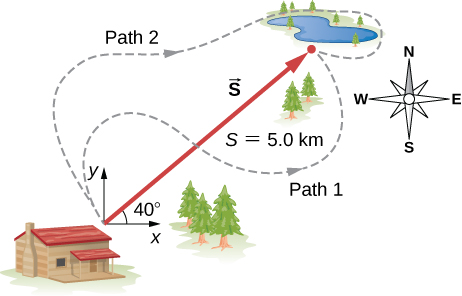
A trapper walks a 5.0-km straight-line distance from his cabin to the lake, as shown in the following figure. Use a graphical method (the parallelogram rule) to determine the trapper’s displacement directly to the east and displacement directly to the north that sum up to his resultant displacement vector. If the trapper walked only in directions east and north, zigzagging his way to the lake, how many kilometers would he have to walk to get to the lake?
英語のヒント
わな猟師が、小屋から湖まで、次の図のように直線距離5.0 kmを歩く。図による方法(平行四辺形の法則)を使い、合成するとこの変位ベクトルになる真東への変位と真北への変位を求めよ。東と北だけへ向かい、ジグザグに湖へ進むなら、湖まで何km歩かなければならないか。


Solution解き方
3.8 km east, 3.2 km north, 7.0 km
英語のヒント
東へ3.8 km、北へ3.2 km、7.0 km。
Exercise 24問題 24
A surveyor measures the distance across a river that flows straight north by the following method. Starting directly across from a tree on the opposite bank, the surveyor walks 100 m along the river to establish a baseline. She then sights across to the tree and reads that the angle from the baseline to the tree is . How wide is the river?
英語のヒント
測量士が、真北に流れる川の幅を次の方法で測る。対岸の木の真向かいから川に沿って100 m歩き、基線を定める。そこから対岸の木を見通し、基線から木への角度がであると読み取る。川幅はいくらか。
Exercise 25問題 25
A pedestrian walks 6.0 km east and then 13.0 km north. Use a graphical method to find the pedestrian’s resultant displacement and geographic direction.
英語のヒント
歩行者が東へ6.0 km、次に北へ13.0 km歩く。図を用いて、合成変位と方位を求めよ。
Solution解き方
14.3 km,
14.3 km、。
Exercise 26問題 26
The magnitudes of two displacement vectors are A = 20 m and B = 6 m. What are the largest and the smallest values of the magnitude of the resultant
英語のヒント
二つの変位ベクトルの大きさはA = 20 m、B = 6 mである。合ベクトルの大きさの最大値と最小値はいくらか。
antiparallel vectors
反平行なベクトル
two vectors with directions that differ by
英語のヒント
方向が異なる二つのベクトル。
associative
結合法則が成り立つ
terms can be grouped in any fashion
英語のヒント
各項をどのようにまとめてもよいこと。
commutative
交換法則が成り立つ
operations can be performed in any order
英語のヒント
任意の順序で演算を行えること。
difference of two vectors
二つのベクトルの差
vector sum of the first vector with the vector antiparallel to the second
英語のヒント
第1のベクトルと、第2のベクトルに反平行なベクトルとの和。
displacement
変位
change in position
英語のヒント
位置の変化。
distributive
分配法則が成り立つ
multiplication can be distributed over terms in summation
英語のヒント
和を構成する各項に、乗算を分配できること。
magnitude
大きさ
length of a vector
英語のヒント
ベクトルの長さ。
orthogonal vectors
直交するベクトル
two vectors with directions that differ by exactly , synonymous with perpendicular vectors
英語のヒント
方向がちょうど異なる二つのベクトル。垂直なベクトルと同じ意味。
parallelogram rule
平行四辺形の法則
geometric construction of the vector sum in a plane
英語のヒント
平面内のベクトル和の作図法。
parallel vectors
平行なベクトル
two vectors with exactly the same direction angles
英語のヒント
方向角がまったく同じ二つのベクトル。
resultant vector
合ベクトル
vector sum of two (or more) vectors
英語のヒント
二つ(以上)のベクトルのベクトル和。
scalar
スカラー
a number, synonymous with a scalar quantity in physics
英語のヒント
数。物理学ではスカラー量と同義。
scalar equation
スカラー方程式
equation in which the left-hand and right-hand sides are numbers
英語のヒント
左辺と右辺が数である方程式。
scalar quantity
スカラー量
quantity that can be specified completely by a single number with an appropriate physical unit
英語のヒント
適切な物理単位を伴う一つの数値で、完全に指定できる量。
tail-to-head geometric construction
尾と頭をつなぐ作図法
geometric construction for drawing the resultant vector of many vectors
英語のヒント
多数のベクトルの合ベクトルを描く作図法。
unit vector
単位ベクトル
vector of a unit magnitude that specifies direction; has no physical unit
英語のヒント
方向を指定する大きさ1のベクトル。物理的な単位を持たない。
vector
ベクトル
mathematical object with magnitude and direction
英語のヒント
大きさと方向を持つ数学的対象。
vector equation
ベクトル方程式
equation in which the left-hand and right-hand sides are vectors
英語のヒント
左辺と右辺がベクトルである方程式。
vector quantity
ベクトル量
physical quantity described by a mathematical vector—that is, by specifying both its magnitude and its direction; synonymous with a vector in physics
英語のヒント
大きさと方向の両方を指定する、数学的なベクトルによって表される物理量。物理学ではベクトルと同義。
vector sum
ベクトル和
resultant of the combination of two (or more) vectors
英語のヒント
二つ(以上)のベクトルを組み合わせた合ベクトル。