第2章ベクトル
The Vector Product of Two Vectors (the Cross Product)二つのベクトルのベクトル積(外積)
Vector multiplication of two vectors yields a vector product.
英語のヒント
二つのベクトルのベクトル乗算から、ベクトル積が得られる。
According to Equation 2.35, the vector product vanishes for pairs of vectors that are either parallel or antiparallel because .
英語のヒント
式2.35によれば、二つのベクトルが平行または反平行の場合、なので、ベクトル積は0となる。
OpenStax / Rice University, University Physics Volume 1, CC BY 4.0. Source-book artwork retained. · CC BY 4.0 · Source出典

Figure 2.31図 2.31
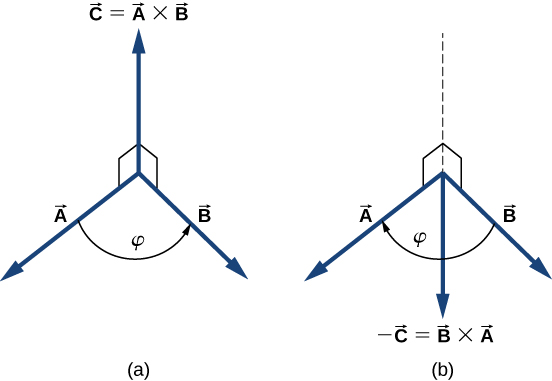
The vector product of two vectors is drawn in three-dimensional space. (a) The vector product is a vector perpendicular to the plane that contains vectors and . Small squares drawn in perspective mark right angles between and , and between and so that if and lie on the floor, vector points vertically upward to the ceiling. (b) The vector product is a vector antiparallel to vector .
英語のヒント
3次元空間に描いた二つのベクトルのベクトル積。(a)は、とを含む平面に垂直なベクトルである。透視図で描く小さな四角は、と、およびとの間の直角を示す。とが床上にあれば、は天井へ向かって鉛直上向きになる。(b)は、に反平行なベクトルである。
On the line perpendicular to the plane that contains vectors and there are two alternative directions—either up or down, as shown in Figure 2.31—and the direction of the vector product may be either one of them. In the standard right-handed orientation, where the angle between vectors is measured counterclockwise from the first vector, vector points upward, as seen in Figure 2.31(a). If we reverse the order of multiplication, so that now comes first in the product, then vector must point downward, as seen in Figure 2.31(b). This means that vectors and are antiparallel to each other and that vector multiplication is not commutative but anticommutative. The anticommutative property means the vector product reverses the sign when the order of multiplication is reversed:
英語のヒント
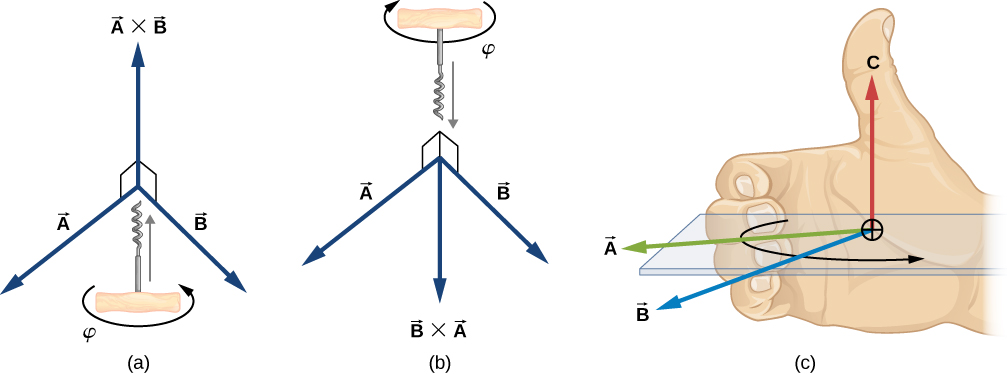
The corkscrew right-hand rule is a common mnemonic used to determine the direction of the vector product. As shown in Figure 2.32, a corkscrew is placed in a direction perpendicular to the plane that contains vectors and , and its handle is turned in the direction from the first to the second vector in the product. The direction of the cross product is given by the progression of the corkscrew.
英語のヒント
右ねじの法則は、ベクトル積の方向を決めるためによく使う覚え方である。図2.32のように、ベクトルとを含む平面に垂直な方向へコルク抜きを置き、積の第1のベクトルから第2のベクトルへ向かって柄を回す。コルク抜きが進む向きが、外積の方向になる。
You can also use your right hand, without the use of a corkscrew, by positioning your right hand so that your fingers point in the direction of A and they curl toward B. The cross product must be perpendicular to both A and B, and so you are choosing from only two possible directions. Your thumb now points toward the correct choice.
英語のヒント
コルク抜きを使わず、右手でも方向を決められる。指をAの方向へ伸ばし、Bへ向かって曲げるように右手を置く。外積はAとBの両方に垂直でなければならないので、候補は二つの方向だけである。このとき、親指が正しい方向を示す。
OpenStax / Rice University, University Physics Volume 1, CC BY 4.0. Source-book artwork retained. · CC BY 4.0 · Source出典

Figure 2.32図 2.32
The corkscrew right-hand rule can be used to determine the direction of the cross product . Place a corkscrew in the direction perpendicular to the plane that contains vectors and , and turn it in the direction from the first to the second vector in the product. The direction of the cross product is given by the progression of the corkscrew. (a) Upward movement means the cross-product vector points up. (b) Downward movement means the cross-product vector points downward. (c) To find the direction of C = A × B using your right hand (be careful not to use your left hand or you will get the opposite direction!), with A and B placed tail-to-tail, position your right hand so that your fingers point in the direction of A and curl them toward B. Your extended thumb will point in the direction of the cross product. Make sure your thumb is perpendicular to the plan defined by the two crossed vectors, A and B.
英語のヒント
右ねじの法則で、外積の方向を決められる。ベクトルとを含む平面に垂直にコルク抜きを置き、積の第1のベクトルから第2のベクトルへ向けて回す。コルク抜きが進む向きが外積の方向である。(a)上へ進む場合、外積は上向き。(b)下へ進む場合、外積は下向き。(c)右手でC = A × Bの方向を求めるには、AとBの尾をそろえ、指をAの方向へ伸ばしてBへ向けて曲げる。左手を使うと逆方向になるので注意する。伸ばした親指が外積の方向を示す。親指が、外積を取る二つのベクトルAとBの定める平面に垂直であることを確かめる。
Example 2.18例題 2.18
The Torque of a Force力のトルク
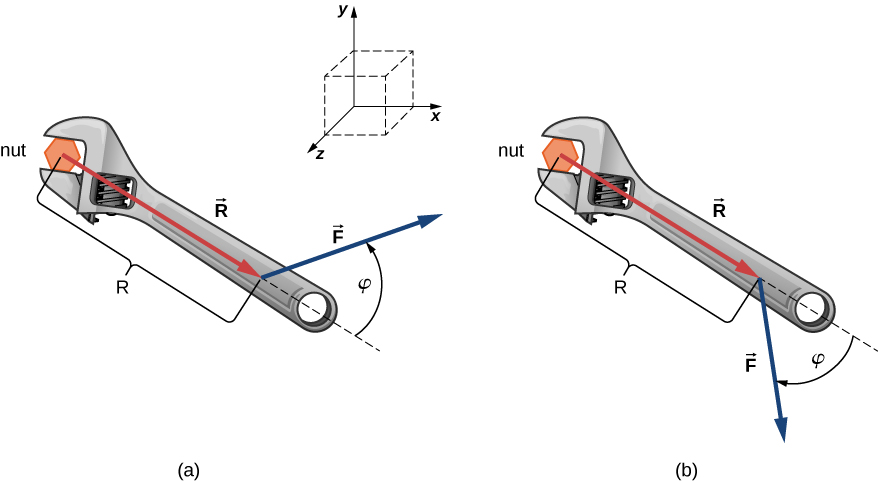
The mechanical advantage that a familiar tool called a wrench provides (Figure 2.33) depends on magnitude F of the applied force, on its direction with respect to the wrench handle, and on how far from the nut this force is applied. The distance R from the nut to the point where force vector is attached is represented by the radial vector . The physical vector quantity that makes the nut turn is called torque (denoted by , and it is the vector product of the distance between the pivot to force with the force: .
英語のヒント
レンチという身近な道具(図2.33)が与える力学的な利点は、加える力の大きさF、柄に対する力の方向、ナットからどれだけ離れた場所に力を加えるかに依存する。ナットから力ベクトルの作用点までの距離Rを、動径ベクトルで表す。ナットを回すベクトルの物理量をトルク(記号といい、支点から力の作用点までの距離と力とのベクトル積である。
To loosen a rusty nut, a 20.00-N force is applied to the wrench handle at angle and at a distance of 0.25 m from the nut, as shown in Figure 2.33(a). Find the magnitude and direction of the torque applied to the nut. What would the magnitude and direction of the torque be if the force were applied at angle , as shown in Figure 2.33(b)? For what value of angle does the torque have the largest magnitude?
英語のヒント
OpenStax / Rice University, University Physics Volume 1, CC BY 4.0. Source-book artwork retained. · CC BY 4.0 · Source出典

Figure 2.33図 2.33
A wrench provides grip and mechanical advantage in applying torque to turn a nut. (a) Turn counterclockwise to loosen the nut. (b) Turn clockwise to tighten the nut.
英語のヒント
レンチはナットをつかみ、回すためのトルクを加える際に力学的な利点を与える。(a)反時計回りに回して緩める。(b)時計回りに回して締める。
Strategy方針
We adopt the frame of reference shown in Figure 2.33, where vectors and lie in the xy-plane and the origin is at the position of the nut. The radial direction along vector (pointing away from the origin) is the reference direction for measuring the angle because is the first vector in the vector product . Vector must lie along the z-axis because this is the axis that is perpendicular to the xy-plane, where both and lie. To compute the magnitude , we use Equation 2.35. To find the direction of , we use the corkscrew right-hand rule (Figure 2.32).
英語のヒント
Solution解答
For the situation in (a), the corkscrew rule gives the direction of in the positive direction of the z-axis. Physically, it means the torque vector points out of the page, perpendicular to the wrench handle. We identify F = 20.00 N and R = 0.25 m, and compute the magnitude using Equation 2.35:
英語のヒント
(a)の場合、右ねじの法則より、の方向はz軸の正方向となる。物理的には、トルクベクトルが、レンチの柄に垂直に、紙面の手前を向くことを意味する。F = 20.00 N、R = 0.25 mと特定し、式2.35で大きさを計算する。
For the situation in (b), the corkscrew rule gives the direction of in the negative direction of the z-axis. Physically, it means the vector points into the page, perpendicular to the wrench handle. The magnitude of this torque is
英語のヒント
(b)の場合、右ねじの法則より、の方向はz軸の負方向となる。物理的には、ベクトルがレンチの柄に垂直に、紙面の奥を向くことを意味する。このトルクの大きさは、次のようになる。
The torque has the largest value when , which happens when . Physically, it means the wrench is most effective—giving us the best mechanical advantage—when we apply the force perpendicular to the wrench handle. For the situation in this example, this best-torque value is .
英語のヒント
トルクが最大になるのはのとき、すなわちのときである。物理的には、レンチの柄に垂直な力を加えたとき、レンチが最も効果的に働き、力学的な利点が最大になることを意味する。この例での最大トルクはである。
Significance意味の検討
When solving mechanics problems, we often do not need to use the corkscrew rule at all, as we’ll see now in the following equivalent solution. Notice that once we have identified that vector lies along the z-axis, we can write this vector in terms of the unit vector of the z-axis:
英語のヒント
力学の問題を解く際には、右ねじの法則をまったく使わずに済むことも多い。次の同等な解法で、それを見てみよう。ベクトルがz軸に沿うと特定できれば、z軸の単位ベクトルを使って、このベクトルを次のように書ける。
In this equation, the number that multiplies is the scalar z-component of the vector . In the computation of this component, care must be taken that the angle is measured counterclockwise from (first vector) to (second vector). Following this principle for the angles, we obtain for the situation in (a), and we obtain for the situation in (b). In the latter case, the angle is negative because the graph in Figure 2.33 indicates the angle is measured clockwise; but, the same result is obtained when this angle is measured counterclockwise because and . In this way, we obtain the solution without reference to the corkscrew rule. For the situation in (a), the solution is ; for the situation in (b), the solution is .
英語のヒント
この式で、に掛かる数が、ベクトルのスカラーz成分である。この成分を計算する際には、角を(第1のベクトル)から(第2のベクトル)へ反時計回りに測ることに注意しなければならない。この角度の規則に従うと、(a)では、(b)ではを得る。後者の角が負なのは、図2.33で時計回りに測っているからである。しかし、反時計回りに測っても、かつなので同じ結果になる。このように、右ねじの法則を使わずに解を得られる。(a)の解は、(b)の解はである。
Similar to the dot product (Equation 2.32), the cross product has the following distributive property:
英語のヒント
内積(式2.32)と同様に、外積にも次の分配法則が成り立つ。
The distributive property is applied frequently when vectors are expressed in their component forms, in terms of unit vectors of Cartesian axes.
英語のヒント
ベクトルをデカルト座標軸の単位ベクトルによる成分表示で表すとき、分配法則をよく使う。
When we apply the definition of the cross product, Equation 2.35, to unit vectors , , and that define the positive x-, y-, and z-directions in space, we find that
英語のヒント
外積の定義である式2.35を、空間のx、y、zの正方向を定める単位ベクトル、、へ適用すると、次を得る。
(2.38)
All other cross products of these three unit vectors must be vectors of unit magnitudes because , , and are orthogonal. For example, for the pair and , the magnitude is . The direction of the vector product must be orthogonal to the xy-plane, which means it must be along the z-axis. The only unit vectors along the z-axis are or . By the corkscrew rule, the direction of vector must be parallel to the positive z-axis. Therefore, the result of the multiplication is identical to . We can repeat similar reasoning for the remaining pairs of unit vectors. The results of these multiplications are
英語のヒント
この三つの単位ベクトルどうしの、それ以外の外積は、すべて大きさ1のベクトルでなければならない。、、が直交するからである。例えば、との組では、大きさはとなる。ベクトル積の方向はxy平面に直交し、したがってz軸に沿う必要がある。z軸に沿う単位ベクトルはとだけである。右ねじの法則より、ベクトルの方向はz軸の正方向と平行でなければならない。したがって、積の結果はと同一になる。残りの単位ベクトルの組にも、同様の推論を繰り返せる。これらの積の結果は、次のとおりである。