第8章位置エネルギーとエネルギー保存
In these examples, we were able to use conservation of energy to calculate the speed of a particle just at particular points in its motion. But the method of analyzing particle motion, starting from energy conservation, is more powerful than that. More advanced treatments of the theory of mechanics allow you to calculate the full time dependence of a particle’s motion, for a given potential energy. In fact, it is often the case that a better model for particle motion is provided by the form of its kinetic and potential energies, rather than an equation for force acting on it. (This is especially true for the quantum mechanical description of particles like electrons or atoms.)
英語のヒント
これまでの例では、エネルギー保存を使い、粒子の運動の特定の点での速さを求めた。しかし、エネルギー保存から粒子運動を解析する方法には、さらに大きな力がある。力学のより高度な理論では、位置エネルギーが与えられれば、粒子の運動の時間依存性を全体にわたって計算できる。実際、粒子に働く力の式よりも、運動エネルギーと位置エネルギーの形のほうが、運動のよりよいモデルを与えることも多い。電子や原子などを量子力学で記述するときは、とくにそうである。
We can illustrate some of the simplest features of this energy-based approach by considering a particle in one-dimensional motion, with potential energy U(x) and no non-conservative interactions present. Equation 8.12 and the definition of velocity require
英語のヒント
位置エネルギーU(x)をもち、非保存的な相互作用のない1次元運動の粒子を考えると、エネルギーを出発点にする方法の基本的な特徴を示せる。式8.12と速度の定義から、
Separate the variables x and t and integrate, from an initial time to an arbitrary time, to get
英語のヒント
変数xとtを分離し、初期時刻から任意の時刻まで積分すると、
(8.14)
If you can do the integral in Equation 8.14, then you can solve for x as a function of t.
英語のヒント
式8.14の積分を計算できれば、xをtの関数として求められる。
Example 8.9例題 8.9
Constant Acceleration一定の加速度
Use the potential energy for in Equation 8.14 to find the position x of a particle as a function of time t.
英語のヒント
式8.14のに位置エネルギーを使い、粒子の位置xを時間tの関数として求めよ。
Strategy方針
Since we know how the potential energy changes as a function of x, we can substitute for in Equation 8.14, integrate, and then solve for x. This results in an expression of x as a function of time with constants of energy E, mass m, and the initial position
英語のヒント
位置エネルギーがxとともにどう変わるかがわかっているので、式8.14のへ代入して積分し、xについて解ける。こうして、エネルギーE、質量m、初期位置を定数として、xを時間の関数で表す式が得られる。
Solution解答
Following the first two suggested steps in the above strategy,
英語のヒント
上の方針の最初の二段階を実行すると、
Solving for the position, we obtain .
英語のヒント
位置について解くと、を得る。
Significance考察
The position as a function of time, for this potential, represents one-dimensional motion with constant acceleration, starting at rest from position This is not so surprising, since this is a potential energy for a constant force, and
英語のヒント
この位置エネルギーから得た位置の時間関数は、位置で静止状態から始まる、一定加速度の1次元運動を表す。この位置エネルギーは一定の力に対応し、なので、この結果は意外ではない。
We will look at another more physically appropriate example of the use of Equation 8.13 after we have explored some further implications that can be drawn from the functional form of a particle’s potential energy.
英語のヒント
粒子の位置エネルギーの関数形から引き出せる、さらにいくつかの意味を調べた後に、力学的エネルギー保存の式を使う、より物理的に適切な別の例を見る。
Systems with Several Particles or Objects複数の粒子または物体からなる系
Systems generally consist of more than one particle or object. However, the conservation of mechanical energy, in one of the forms in Equation 8.12 or Equation 8.13, is a fundamental law of physics and applies to any system. You just have to include the kinetic and potential energies of all the particles, and the work done by all the non-conservative forces acting on them. Until you learn more about the dynamics of systems composed of many particles, in Linear Momentum and Collisions, Fixed-Axis Rotation, and Angular Momentum, it is better to postpone discussing the application of energy conservation to then.
英語のヒント
系は一般に複数の粒子や物体からなる。それでも、式8.12や非保存力の仕事がゼロの場合の保存式に表した力学的エネルギーの関係は、物理学の基本法則で、どんな系にも適用できる。すべての粒子の運動エネルギーと位置エネルギー、そしてすべての非保存力の仕事を含めればよい。複数粒子の系へのエネルギー保存の適用は、「運動量と衝突」「固定軸まわりの回転」「角運動量」で、そのような系の力学をさらに学んでから詳しく扱うことにする。
Summaryまとめ
- A conserved quantity is a physical property that stays constant regardless of the path taken.
英語のヒント
保存量は、通った経路によらず一定に保たれる物理的性質である。 - A form of the work-energy theorem says that the change in the mechanical energy of a particle equals the work done on it by non-conservative forces.
英語のヒント
仕事とエネルギーの定理の一つの形では、粒子の力学的エネルギーの変化は、非保存力が粒子にする仕事に等しい。 - If non-conservative forces do no work and there are no external forces, the mechanical energy of a particle stays constant. This is a statement of the conservation of mechanical energy and there is no change in the total mechanical energy.
英語のヒント
非保存力が仕事をせず、外力もなければ、粒子の力学的エネルギーは一定に保たれる。これが力学的エネルギー保存であり、力学的エネルギーの合計は変わらない。 - For one-dimensional particle motion, in which the mechanical energy is constant and the potential energy is known, the particle’s position, as a function of time, can be found by evaluating an integral that is derived from the conservation of mechanical energy.
英語のヒント
1次元の粒子運動で、力学的エネルギーが一定で位置エネルギーがわかっていれば、力学的エネルギー保存から導いた積分を計算して、粒子の位置を時間の関数として求められる。
Conceptual Questions概念に関する問題
Exercises 22–30練習問題 22–30
Exercise 22問題 22
When a body slides down an inclined plane, does the work of friction depend on the body’s initial speed? Answer the same question for a body sliding down a curved surface.
英語のヒント
物体が斜面を滑り下りるとき、摩擦の仕事は初速度に依存するか。曲面を滑り下りる物体についても同じ問いに答えよ。
Exercise 23問題 23
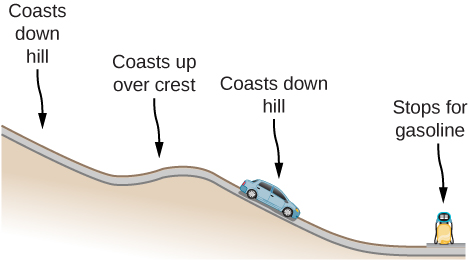
Consider the following scenario. A car for which friction is not negligible accelerates from rest down a hill, running out of gasoline after a short distance (see below). The driver lets the car coast farther down the hill, then up and over a small crest. He then coasts down that hill into a gas station, where he brakes to a stop and fills the tank with gasoline. Identify the forms of energy the car has, and how they are changed and transferred in this series of events.
英語のヒント
次の状況を考える。摩擦を無視できない車が、静止状態から坂を下りながら加速し、少し進んだところでガソリンが切れる(下図)。運転者はそのまま惰性で坂を下り、さらに小さな丘を上って越える。その後も惰性で下って給油所に入り、ブレーキで止まってタンクに給油する。この一連の出来事で、車がどの形のエネルギーをもち、それがどう変わり、移されるかを示せ。
Solution解き方
The car experiences a change in gravitational potential energy as it goes down the hills because the vertical distance is decreasing. Some of this change of gravitational potential energy will be taken away by work done by friction. The rest of the energy results in a kinetic energy increase, making the car go faster. Lastly, the car brakes and will lose its kinetic energy to the work done by braking to a stop.
英語のヒント
車が丘を下ると高さが減るため、重力による位置エネルギーが変わる。その一部は摩擦のする仕事によって失われる。残りは運動エネルギーの増加となり、車は速くなる。最後にブレーキをかけて停止すると、制動の仕事によって運動エネルギーを失う。
Exercise 24問題 24
A dropped ball bounces to one-half its original height. Discuss the energy transformations that take place.
英語のヒント
落としたボールが元の高さの半分まで跳ね返る。この間に起こるエネルギーの変換を論じよ。
Exercise 25問題 25
“ constant is a special case of the work-energy theorem.” Discuss this statement.
英語のヒント
「一定は、仕事とエネルギーの定理の特別な場合である」。この記述について論じよ。
Solution解き方
It states that total energy of the system E is conserved as long as there are no non-conservative forces acting on the object.
英語のヒント
物体に非保存力が働かない限り、系の全エネルギーEは保存される、ということである。
Exercise 26問題 26
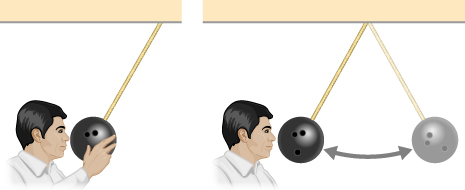
In a common physics demonstration, a bowling ball is suspended from the ceiling by a rope.
英語のヒント
物理のよくある演示実験で、天井からロープでボウリングの球をつるす。
The professor pulls the ball away from its equilibrium position and holds it adjacent to his nose, as shown below. He releases the ball so that it swings directly away from him. Does he get struck by the ball on its return swing? What is he trying to show in this demonstration?
英語のヒント
教授は球をつり合いの位置から引き、下図のように鼻のすぐ近くに置く。球を放すと、球は教授から離れる向きへ振れる。戻ってきた球は教授にぶつかるか。この実験で何を示そうとしているのか。


Exercise 27問題 27
A child jumps up and down on a bed, reaching a higher height after each bounce. Explain how the child can increase his maximum gravitational potential energy with each bounce.
英語のヒント
子どもがベッドで跳びはね、跳ねるたびに到達する高さが増していく。どうして毎回、重力による位置エネルギーの最大値を増やせるのか説明せよ。
Solution解き方
He puts energy into the system through his legs compressing and expanding.
英語のヒント
脚を縮めたり伸ばしたりして、系へエネルギーを加える。
Exercise 28問題 28
Can a non-conservative force increase the mechanical energy of the system?
英語のヒント
非保存力が系の力学的エネルギーを増やすことはあるか。
Exercise 29問題 29
Neglecting air resistance, how much would I have to raise the vertical height if I wanted to double the impact speed of a falling object?
英語のヒント
空気抵抗を無視して、落下物体の衝突時の速さを2倍にするには、落とす高さをどれだけ増やせばよいか。
Solution解き方
Four times the original height would double the impact speed.
英語のヒント
元の高さの4倍にすれば、衝突時の速さは2倍になる。
Exercise 30問題 30
A box is dropped onto a spring at its equilibrium position. The spring compresses with the box attached and comes to rest. Since the spring is in the vertical position, does the change in the gravitational potential energy of the box while the spring is compressing need to be considered in this problem?
英語のヒント
つり合いの位置にあるばねへ箱を落とす。ばねは箱が接したまま縮み、停止する。ばねが鉛直なので、縮む間の箱の重力による位置エネルギーの変化も考える必要があるか。