第8章位置エネルギーとエネルギー保存
Summaryまとめ
- Interpreting a one-dimensional potential energy diagram allows you to obtain qualitative, and some quantitative, information about the motion of a particle.
英語のヒント
1次元の位置エネルギー図を読み取ると、粒子運動について定性的な情報と、いくらかの定量的な情報が得られる。 - At a turning point, the potential energy equals the mechanical energy and the kinetic energy is zero, indicating that the direction of the velocity reverses there.
英語のヒント
折り返し点では、位置エネルギーが力学的エネルギーに等しく、運動エネルギーはゼロである。これは、その点で速度の向きが反転することを示す。 - The negative of the slope of the potential energy curve, for a particle, equals the one-dimensional component of the conservative force on the particle. At an equilibrium point, the slope is zero and is a stable (unstable) equilibrium for a potential energy minimum (maximum).
英語のヒント
粒子の位置エネルギー曲線の傾きの符号を反転したものは、粒子に働く保存力の1次元成分に等しい。つり合いの位置では傾きがゼロで、位置エネルギーが極小なら安定、極大なら不安定なつり合いである。
Problems問題
Exercises 45–51練習問題 45–51
Exercise 45問題 45
A mysterious constant force of 10 N acts horizontally on everything. The direction of the force is found to be always pointed toward a wall in a big hall. Find the potential energy of a particle due to this force when it is at a distance x from the wall, assuming the potential energy at the wall to be zero.
英語のヒント
不思議な一定の力10 Nが、あらゆるものに水平方向へ働く。力は大きなホールのある壁へ常に向く。壁での位置エネルギーをゼロとすると、壁から距離xにある粒子の、この力による位置エネルギーを求めよ。
Solution解き方
10x with x-axis pointed away from the wall and origin at the wall
英語のヒント
壁を原点とし、壁から離れる向きをx軸の正にとると、10xである。
Exercise 46問題 46
A single force (in newtons) acts on a 1.0-kg body. When the speed of the body is 4.0 m/s. What is its speed at
英語のヒント
質量1.0 kgの物体に、一つの力(N)が働く。での速さが4.0 m/sなら、での速さはいくらか。
Exercise 47問題 47
A particle of mass 4.0 kg is constrained to move along the x-axis under a single force where The particle’s speed at A, where is 6.0 m/s. What is its speed at B, where
英語のヒント
質量4.0 kgの粒子がx軸に沿って動くよう拘束され、一つの力を受ける。ここでである。であるAでの速さは6.0 m/s。であるBでの速さはいくらか。
Solution解き方
4.6 m/s
Exercise 48問題 48
The force on a particle of mass 2.0 kg varies with position according to (x in meters, F(x) in newtons). The particle’s velocity at is 5.0 m/s. Calculate the mechanical energy of the particle using (a) the origin as the reference point and (b) as the reference point. (c) Find the particle’s velocity at Do this part of the problem for each reference point.
英語のヒント
質量2.0 kgの粒子に働く力は、位置に応じてと変わる。xの単位はm、F(x)の単位はNである。での速度は5.0 m/sである。(a) 原点、(b) を基準点として、粒子の力学的エネルギーを求めよ。(c) での速度を、両方の基準点を使って求めよ。
Exercise 49問題 49
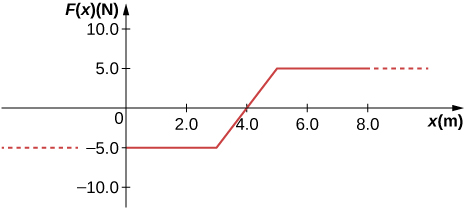
A 4.0-kg particle moving along the x-axis is acted upon by the force whose functional form appears below. The velocity of the particle at is Find the particle’s speed at Does the particle turn around at some point and head back toward the origin? (e) Repeat part (d) if
英語のヒント
x軸に沿って動く質量4.0 kgの粒子に、下図の関数形の力が働く。での速度はである。での速さを求めよ。途中のどこかで折り返し、原点へ戻るか。(e) の場合に(d)を繰り返せ。
Solution解き方
a. 5.6 m/s; b. 5.2 m/s; c. 6.4 m/s; d. no; e. yes
英語のヒント
a. 5.6 m/s、b. 5.2 m/s、c. 6.4 m/s、d. 戻らない、e. 戻る。
Exercise 50問題 50
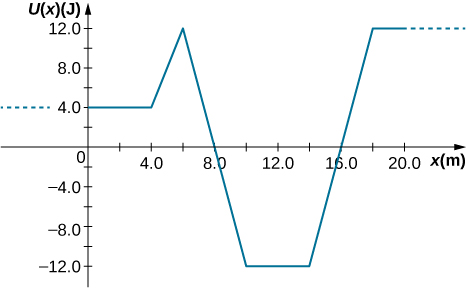
A particle of mass 0.50 kg moves along the x-axis with a potential energy whose dependence on x is shown below. (a) What is the force on the particle at 12 m? (b) If the total mechanical energy E of the particle is −6.0 J, what are the minimum and maximum positions of the particle? (c) What are these positions if (d) If , what are the speeds of the particle at the positions listed in part (a)?
英語のヒント
質量0.50 kgの粒子がx軸に沿って動き、位置エネルギーは下図のようにxに依存する。(a) 、12 mでの力はいくらか。(b) 全力学的エネルギーEが−6.0 Jなら、粒子がとる位置の最小値と最大値はいくらか。(c) ならどうか。(d) のとき、(a)の各位置での速さはいくらか。


Exercise 51問題 51
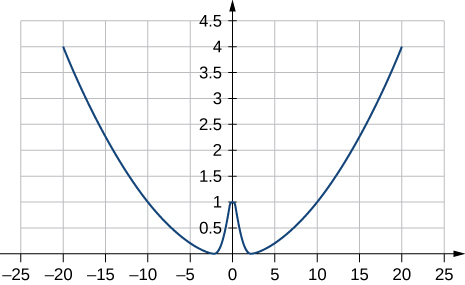
(a) Sketch a graph of the potential energy function where are constants. (b) What is the force corresponding to this potential energy? (c) Suppose a particle of mass m moving with this potential energy has a velocity when its position is . Show that the particle does not pass through the origin unless
英語のヒント
(a) 定数を含む位置エネルギー関数のグラフを描け。(b) 対応する力は何か。(c) この位置エネルギーのもとで動く質量mの粒子が、位置で速度をもつとする。次の条件が成り立たない限り、粒子が原点を通過しないことを示せ。
Solution解き方
a.
OpenStax / Rice University, University Physics Volume 1, CC BY 4.0. Source-book artwork retained. · CC BY 4.0 · Source出典

where ; b. ; c. The potential energy at must be less than the kinetic plus potential energy at or Solving this for A matches results in the problem.
英語のヒント
ここで。b. 。c. での位置エネルギーは、での運動エネルギーと位置エネルギーの和より小さい必要がある。すなわち。これをAについて解くと、問題の結果に一致する。
equilibrium point
つり合いの位置
position where the assumed conservative, net force on a particle, given by the slope of its potential energy curve, is zero
英語のヒント
粒子に働く合力を保存力としたとき、位置エネルギー曲線の傾きで与えられる合力がゼロになる位置。
potential energy diagram
位置エネルギー図
graph of a particle’s potential energy as a function of position
英語のヒント
粒子の位置エネルギーを、位置の関数として描いたグラフ。
turning point
折り返し点
position where the velocity of a particle, in one-dimensional motion, changes sign
英語のヒント
1次元運動で、粒子の速度の符号が変わる位置。