第8章位置エネルギーとエネルギー保存
8.1 Potential Energy of a System8.1 系の位置エネルギー
Learning Objectives学習目標
Learning Objectives学習目標
By the end of this section, you will be able to:
英語のヒント
この節を終えると、次のことができるようになる。
- Relate the difference of potential energy to work done on a particle for a system without friction or air drag
英語のヒント
摩擦や空気抵抗がない系で、位置エネルギーの差と、粒子にされる仕事を関係付ける。 - Explain the meaning of the zero of the potential energy function for a system
英語のヒント
系の位置エネルギー関数のゼロ点の意味を説明する。 - Calculate and apply the gravitational potential energy for an object near Earth’s surface and the elastic potential energy of a mass-spring system
英語のヒント
地表付近の物体の重力による位置エネルギーと、ばねとおもりの系の弾性位置エネルギーを計算し、適用する。
In Work, we saw that the work done on an object by the constant gravitational force, near the surface of Earth, over any displacement is a function only of the difference in the positions of the end-points of the displacement. This property allows us to define a different kind of energy for the system than its kinetic energy, which is called potential energy. We consider various properties and types of potential energy in the following subsections.
英語のヒント
「仕事」では、地表付近の一定の重力が、任意の変位にわたって物体にする仕事は、変位の始点と終点の位置の差だけの関数になるとわかった。この性質を使うと、系について運動エネルギーとは異なる種類のエネルギー、位置エネルギーを定義できる。以下では、位置エネルギーのさまざまな性質と種類を考える。
Potential Energy Basics位置エネルギーの基礎
In Motion in Two and Three Dimensions, we analyzed the motion of a projectile, like kicking a football in Figure 8.2. For this example, let’s ignore friction and air resistance and begin the analysis immediately after the kick, at the start of the projectile motion of the ball. As the football rises, the work done by the gravitational force on the football is negative, because the ball’s displacement is positive vertically and the force due to gravity is negative vertically. We also noted that the ball slowed down until it reached its highest point in the motion, thereby decreasing the ball’s kinetic energy. This loss in kinetic energy translates to a gain in gravitational potential energy of the football-Earth system.
英語のヒント
「2次元と3次元の運動」では、図8.2の蹴られたフットボールのような投射体の運動を解析した。ここでは摩擦と空気抵抗を無視し、蹴った直後、ボールの投射運動が始まる時点から解析を始める。ボールが上昇する間、重力がボールにする仕事は負である。変位は鉛直方向に正、重力は鉛直方向に負だからだ。ボールは最高点に達するまで遅くなり、運動エネルギーが減ることも見た。この運動エネルギーの減少は、ボールと地球の系の重力による位置エネルギーの増加に変わる。
As the football falls toward Earth, the work done on the football is now positive, because the displacement and the gravitational force both point vertically downward. The ball also speeds up, which indicates an increase in kinetic energy. Therefore, energy is converted from gravitational potential energy back into kinetic energy.
英語のヒント
ボールが地球へ落ちるとき、変位と重力はともに鉛直下向きなので、ボールにされる仕事は正になる。ボールは速くなり、運動エネルギーが増える。したがって、重力による位置エネルギーが運動エネルギーへ戻る。
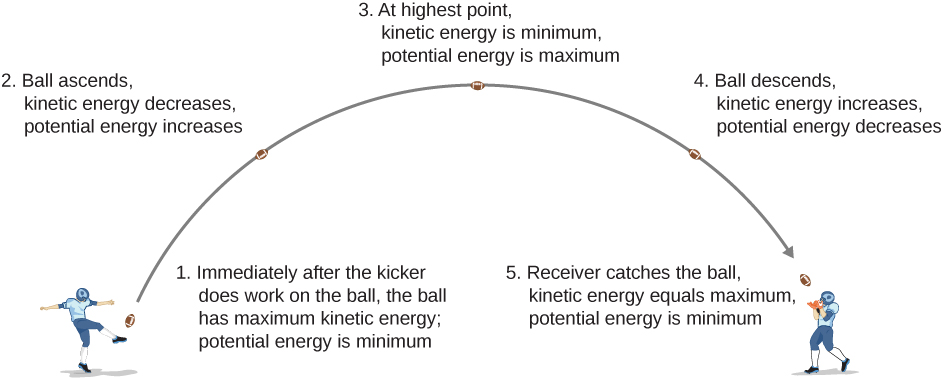
OpenStax / Rice University, University Physics Volume 1, CC BY 4.0. Source-book artwork retained. · CC BY 4.0 · Source出典

Figure 8.2図 8.2
As a football starts its descent toward the wide receiver, gravitational potential energy is converted back into kinetic energy.
英語のヒント
ボールがワイドレシーバーに向かって下降し始めると、重力による位置エネルギーが運動エネルギーへ戻る。
Based on this scenario, we can define the difference of potential energy from point A to point B as the negative of the work done:
英語のヒント
この状況に基づき、点Aから点Bへの位置エネルギーの差を、された仕事の符号を反転したものとして定義できる。
This formula explicitly states a potential energy difference, not just an absolute potential energy. Therefore, we need to define potential energy at a given position in such a way as to state standard values of potential energy on their own, rather than potential energy differences. We do this by rewriting the potential energy function in terms of an arbitrary constant,
英語のヒント
この式が明示しているのは、位置エネルギーの絶対値ではなく、その差である。したがって、差でなく位置エネルギーそのものの基準となる値を表すには、ある位置での位置エネルギーを定義しなければならない。そこで、位置エネルギーの関数を任意定数を使って書き直す。
The choice of the potential energy at a starting location of is made out of convenience in the given problem. Most importantly, whatever choice is made should be stated and kept consistent throughout the given problem. There are some well-accepted choices of initial potential energy. For example, the lowest height in a problem is usually defined as zero potential energy, or if an object is in space, the farthest point away from the system is often defined as zero potential energy. Then, the potential energy, with respect to zero at is just
英語のヒント
出発点での位置エネルギーは、問題に応じて都合よく選べる。大切なのは、どのように選んだかを明示し、問題全体を通してその選択を一貫して保つことだ。初めの位置エネルギーには、よく使われる選び方がある。たとえば、問題中の最も低い高さでゼロとすることが多い。宇宙空間の物体なら、系から最も遠い点でゼロとすることが多い。こうすると、でゼロとした位置エネルギーは、単にとなる。
As long as there is no friction or air resistance, the change in kinetic energy of the football equals negative of the change in gravitational potential energy of the football. This can be generalized to any potential energy:
英語のヒント
摩擦や空気抵抗がない限り、ボールの運動エネルギーの変化は、重力による位置エネルギーの変化の符号を反転したものに等しい。これは任意の位置エネルギーへ一般化できる。
(8.3)
Let’s look at a specific example, choosing zero potential energy for gravitational potential energy at convenient points.
英語のヒント
都合のよい点で重力による位置エネルギーをゼロとする、具体例を見よう。
Example 8.1例題 8.1
Basic Properties of Potential Energy位置エネルギーの基本的な性質
A particle moves along the x-axis under the action of a force given by , where . (a) What is the difference in its potential energy as it moves from to ? (b) What is the particle’s potential energy at with respect to a given 0.5 J of potential energy at ?
英語のヒント
粒子が力を受けてx軸に沿って動く。ここでである。(a) からへ動くときの位置エネルギーの差はいくらか。(b) での位置エネルギーが0.5 Jであることを基準とすると、での位置エネルギーはいくらか。
Strategy方針
(a) The difference in potential energy is the negative of the work done, as defined by Equation 8.1. The work is defined in the previous chapter as the dot product of the force with the distance. Since the particle is moving forward in the x-direction, the dot product simplifies to a multiplication (). To find the total work done, we need to integrate the function between the given limits. After integration, we can state the work or the change in potential energy. (b) The potential energy function, with respect to zero at , is the indefinite integral encountered in part (a), with the constant of integration determined from Equation 8.3. Then, we substitute the x-value into the function of potential energy to calculate the potential energy at
英語のヒント
(a) 位置エネルギー差の定義式のとおり、位置エネルギーの差は、された仕事の符号を反転したものである。前の章で、仕事は力と移動距離の内積として定義した。粒子はx方向へ進むので、内積は単なる掛け算になる。仕事の合計を求めるには、与えられた上下限の間で関数を積分する。積分後に、仕事または位置エネルギーの変化を求められる。(b) でゼロとした位置エネルギーの関数は、(a)で扱った不定積分であり、積分定数は式8.3から決まる。この関数にxの値を代入して、での位置エネルギーを計算する。
Solution解答
- The work done by the given force as the particle moves from coordinate x to in one dimension is
英語のヒント
粒子が1次元で座標xからへ動く間に、与えられた力がする仕事は、 - The indefinite integral for the potential energy function in part (a) is
英語のヒント
(a)の位置エネルギー関数の不定積分は、and we want the constant to be determined by英語のヒント
この定数は、次の条件から決める。Thus, the potential energy with respect to zero at is just英語のヒント
したがって、でゼロとした位置エネルギーは、Therefore, the potential energy at is英語のヒント
ゆえに、での位置エネルギーは、
Significance考察
In this one-dimensional example, any function we can integrate, independent of path, is conservative. Notice how we applied the definition of potential energy difference to determine the potential energy function with respect to zero at a chosen point. Also notice that the potential energy, as determined in part (b), at is and at is ; their difference is the result in part (a).
英語のヒント
この1次元の例では、経路によらず積分できる関数は保存的である。選んだ点でゼロとする位置エネルギー関数を決めるために、位置エネルギー差の定義をどのように使ったかに注目しよう。また、(b)で求めた位置エネルギーはで、でであり、その差は(a)の結果に一致する。