第8章位置エネルギーとエネルギー保存
Elastic potential energy弾性による位置エネルギー
In Work, we saw that the work done by a perfectly elastic spring, in one dimension, depends only on the spring constant and the squares of the displacements from the unstretched position, as given in Equation 7.5. This work involves only the properties of a Hooke’s law interaction and not the properties of real springs and whatever objects are attached to them. Therefore, we can define the difference of elastic potential energy for a spring force as the negative of the work done by the spring force in this equation, before we consider systems that embody this type of force. Thus,
英語のヒント
(8.6)
where the object travels from point A to point B. The potential energy function corresponding to this difference is
英語のヒント
ここで物体は点Aから点Bへ動く。この差に対応する位置エネルギー関数は、
If the spring force is the only force acting, it is simplest to take the zero of potential energy at , when the spring is at its unstretched length. Then, the constant in Equation 8.7 is zero. (Other choices may be more convenient if other forces are acting.)
英語のヒント
ばねの力だけが働くなら、ばねが自然長となるで位置エネルギーをゼロとするのが最も簡単である。そのとき、弾性位置エネルギー関数の定数はゼロになる。(ほかの力が働くなら、別の選択のほうが便利な場合もある。)
Example 8.3例題 8.3
Spring Potential Energyばねの位置エネルギー
A system contains a perfectly elastic spring, with an unstretched length of 20 cm and a spring constant of 4 N/cm. (a) How much elastic potential energy does the spring contribute when its length is 23 cm? (b) How much more potential energy does it contribute if its length increases to 26 cm?
英語のヒント
自然長20 cm、ばね定数4 N/cmの完全弾性ばねを含む系がある。(a) 長さが23 cmのとき、ばねはどれだけの弾性位置エネルギーをもたらすか。(b) 長さが26 cmになると、位置エネルギーはさらにいくら増えるか。
Strategy方針
When the spring is at its unstretched length, it contributes nothing to the potential energy of the system, so we can use Equation 8.7 with the constant equal to zero. The value of x is the length minus the unstretched length. When the spring is expanded, the spring’s displacement or difference between its relaxed length and stretched length should be used for the x-value in calculating the potential energy of the spring.
英語のヒント
ばねが自然長のとき、系の位置エネルギーへの寄与はゼロなので、弾性位置エネルギー関数の定数をゼロにして使える。xは、ばねの長さから自然長を引いた値である。ばねが伸びたときの位置エネルギーを計算するには、xとしてばねの変位、つまり自然長と伸びた長さの差を使う。
Solution解答
- The displacement of the spring is , so the contributed potential energy is .
英語のヒント
ばねの変位はなので、位置エネルギーへの寄与はである。 - When the spring’s displacement is , the potential energy is , which is a 0.54-J increase over the amount in part (a).
英語のヒント
ばねの変位がのとき、位置エネルギーはで、(a)より0.54 J大きい。
Significance考察
Calculating the elastic potential energy and potential energy differences from Equation 8.7 involves solving for the potential energies based on the given lengths of the spring. Since U depends on , the potential energy for a compression (negative x) is the same as for an extension of equal magnitude.
英語のヒント
弾性位置エネルギー関数から位置エネルギーやその差を計算するときは、与えられたばねの長さに基づいて値を求める。Uはに依存するため、圧縮(負のx)による位置エネルギーは、同じ大きさだけ伸ばした場合と等しい。
Gravitational and elastic potential energy重力と弾性による位置エネルギー
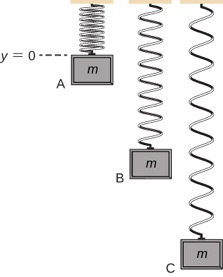
A simple system embodying both gravitational and elastic types of potential energy is a one-dimensional, vertical mass-spring system. This consists of a massive particle (or block), hung from one end of a perfectly elastic, massless spring, the other end of which is fixed, as illustrated in Figure 8.4.
英語のヒント
重力と弾性の両方の位置エネルギーをもつ単純な系は、鉛直1次元のばねとおもりの系である。図8.4のように、完全弾性で質量のないばねの一端に、質量をもつ粒子や物体をつるし、もう一端を固定する。
OpenStax / Rice University, University Physics Volume 1, CC BY 4.0. Source-book artwork retained. · CC BY 4.0 · Source出典

Figure 8.4図 8.4
A vertical mass-spring system, with the positive y-axis pointing upward. The mass is initially at an unstretched spring length, point A. Then it is released, expanding past point B to point C, where it comes to a stop.
英語のヒント
y軸の正を上向きにとった、鉛直なばねとおもりの系。最初、おもりはばねが自然長となる点Aにある。放すとばねが伸び、おもりは点Bを通過して点Cで止まる。
First, let's consider the potential energy of the system. We need to define the constant in the potential energy function of Equation 8.5. Often, the ground is a suitable choice for when the gravitational potential energy is zero; however, in this case, the highest point or when is a convenient location for zero gravitational potential energy. Note that this choice is arbitrary, and the problem can be solved correctly even if another choice is picked.
英語のヒント
まず系の位置エネルギーを考える。重力の位置エネルギー関数の定数を決める必要がある。多くの場合は地面でゼロとするのが適切だが、この場合は最も高い点、すなわちの位置でゼロとするのが便利である。この選び方は任意であり、ほかを選んでも問題は正しく解ける。
We must also define the elastic potential energy of the system and the corresponding constant, as detailed in Equation 8.7. This is where the spring is unstretched, or at the position.
英語のヒント
弾性位置エネルギー関数で詳しく述べたように、系の弾性位置エネルギーと、それに対応する定数も定義する必要がある。ゼロ点はばねが伸びていないところ、つまりの位置である。
If we consider that the total energy of the system is conserved, then the energy at point A equals point C. The block is placed just on the spring so its initial kinetic energy is zero. By the setup of the problem discussed previously, both the gravitational potential energy and elastic potential energy are equal to zero. Therefore, the initial energy of the system is zero. When the block arrives at point C, its kinetic energy is zero. However, it now has both gravitational potential energy and elastic potential energy. Therefore, we can solve for the distance y that the block travels before coming to a stop:
英語のヒント
系の全エネルギーが保存されると考えると、点Aと点Cのエネルギーは等しい。物体をばねに取り付けた直後の運動エネルギーはゼロである。先ほどの設定により、重力による位置エネルギーも弾性位置エネルギーもゼロなので、系の初期エネルギーはゼロになる。点Cに達したときも運動エネルギーはゼロだが、今度は重力と弾性の両方の位置エネルギーをもつ。したがって、止まるまでに物体が動く距離yは、次のように求められる。
OpenStax / Rice University, University Physics Volume 1, CC BY 4.0. Source-book artwork retained. · CC BY 4.0 · Source出典

Figure 8.5図 8.5
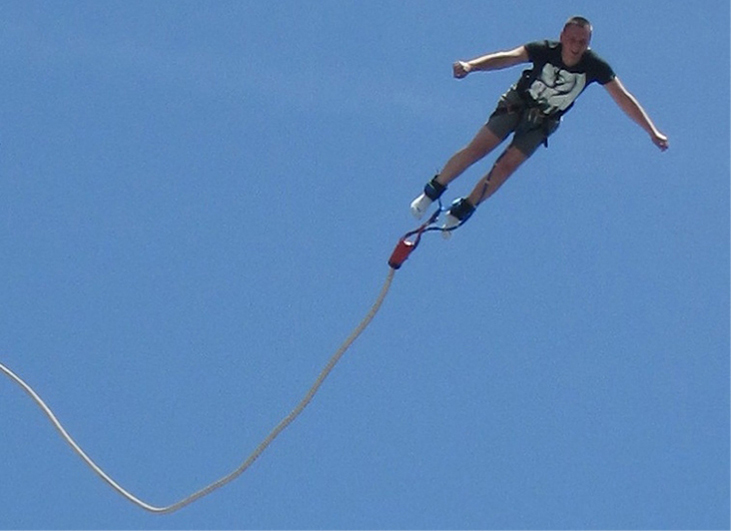
A bungee jumper transforms gravitational potential energy at the start of the jump into elastic potential energy at the bottom of the jump.
英語のヒント
バンジージャンプでは、出発点での重力による位置エネルギーが、最下点での弾性位置エネルギーへ変わる。
Example 8.4例題 8.4
Potential Energy of a Vertical Mass-Spring System鉛直なばねとおもりの系の位置エネルギー
A block weighing is hung from a spring with a spring constant of , as shown in Figure 8.4. (a) What is the maximum expansion of the spring, as seen at point C? (b) What is the total potential energy at point B, halfway between A and C? (c) What is the speed of the block at point B?
英語のヒント
図8.4のように、重さの物体を、ばね定数のばねにつるす。(a) 点Cでのばねの最大の伸びはいくらか。(b) AとCの中間の点Bで、位置エネルギーの合計はいくらか。(c) 点Bでの物体の速さはいくらか。
Strategy方針
In part (a) we calculate the distance as discussed in the previous text. Then in part (b), we use half of the y value to calculate the potential energy at point B using equations Equation 8.4 and Equation 8.6. This energy must be equal to the kinetic energy, Equation 7.6, at point B since the initial energy of the system is zero. By calculating the kinetic energy at point B, we can now calculate the speed of the block at point B.
英語のヒント
Solution解答
- Since the total energy of the system is zero at point A as discussed previously, the maximum expansion of the spring is calculated to be:
英語のヒント
すでに述べたとおり、点Aで系の全エネルギーはゼロなので、ばねの最大の伸びは次のように求まる。 - The position of is half of the position at or . The total potential energy at point B would therefore be:
英語のヒント
の位置はの位置の半分、すなわちである。したがって、点Bでの位置エネルギーの合計は、 - The mass of the block is the weight divided by gravity.
英語のヒント
物体の質量は、重さを重力加速度で割ったものである。The kinetic energy at point B therefore is 0.12 J because the total energy is zero. Therefore, the speed of the block at point B is equal to英語のヒント
全エネルギーがゼロなので、点Bでの運動エネルギーは0.12 Jである。したがって、そこでの物体の速さは、
Significance考察
Even though the potential energy due to gravity is relative to a chosen zero location, the solutions to this problem would be the same if the zero energy points were chosen at different locations.
英語のヒント
重力による位置エネルギーは選んだゼロ点に対する量だが、別の場所をゼロ点に選んでも、この問題の解は変わらない。
Additional Resources追加教材
A sample chart of a variety of energies is shown in Table 8.1 to give you an idea about typical energy values associated with certain events. Some of these are calculated using kinetic energy, whereas others are calculated by using quantities found in a form of potential energy that may not have been discussed at this point.
英語のヒント
さまざまな出来事に関わる典型的なエネルギーの値をつかむために、表8.1にいくつかの例を示す。運動エネルギーから計算したものもあれば、ここまでまだ扱っていない形の位置エネルギーに現れる量から計算したものもある。
Object/phenomenon 物体・現象 |
Energy in joules エネルギー(J) |
|---|---|
Big Bang ビッグバン |
|
Annual world energy use 世界の年間エネルギー使用量 |
|
Large fusion bomb (9 megaton) 大型の核融合爆弾(9メガトン) |
|
Hiroshima-size fission bomb (10 kiloton) 広島型の核分裂爆弾(10キロトン) |
|
1 barrel crude oil 原油1バレル |
|
1 metric ton TNT TNT 1メートルトン |
|
1 gallon of gasoline ガソリン1ガロン |
|
Daily adult food intake (recommended) 成人の1日の推奨食物摂取量 |
|
1000-kg car at 90 km/h 90 km/hで走る1000 kgの車 |
|
Tennis ball at 100 km/h 100 km/hのテニスボール |
|
Mosquito 蚊 |
|
Single electron in a TV tube beam テレビのブラウン管の電子線中の1個の電子 |
|
Energy to break one DNA strand DNAの1本の鎖を切るエネルギー |
|
1 kg hydrogen (fusion to helium) 水素1 kg(ヘリウムへの核融合) |
|
1 kg uranium (nuclear fission) ウラン1 kg(核分裂) |