第8章位置エネルギーとエネルギー保存
8.3 Conservation of Energy8.3 エネルギー保存
Learning Objectives学習目標
Learning Objectives学習目標
By the end of this section, you will be able to:
英語のヒント
この節を終えると、次のことができるようになる。
- Formulate the principle of conservation of mechanical energy, with or without the presence of non-conservative forces
英語のヒント
非保存力がある場合とない場合の、力学的エネルギー保存の原理を定式化する。 - Use the conservation of mechanical energy to calculate various properties of simple systems
英語のヒント
力学的エネルギー保存を使い、単純な系のさまざまな性質を計算する。
In this section, we elaborate and extend the result we derived in Potential Energy of a System, where we re-wrote the work-energy theorem in terms of the change in the kinetic and potential energies of a particle. This will lead us to a discussion of the important principle of the conservation of mechanical energy. As you continue to examine other topics in physics, in later chapters of this book, you will see how this conservation law is generalized to encompass other types of energy and energy transfers. The last section of this chapter provides a preview.
英語のヒント
この節では、「系の位置エネルギー」で得た結果を詳しく調べ、拡張する。そこでは、仕事とエネルギーの定理を、粒子の運動エネルギーと位置エネルギーの変化で書き直した。ここから、力学的エネルギー保存という重要な原理へ進む。本書の後の章で物理のほかの話題を調べると、この保存則が、ほかの種類のエネルギーやエネルギーの移動まで含むように一般化されることがわかる。この章の最後の節で、その概要を先に見る。
The terms ‘conserved quantity’ and ‘conservation law’ have specific, scientific meanings in physics, which are different from the everyday meanings associated with the use of these words. (The same comment is also true about the scientific and everyday uses of the word ‘work.’) In everyday usage, you could conserve water by not using it, or by using less of it, or by re-using it. Water is composed of molecules consisting of two atoms of hydrogen and one of oxygen. Bring these atoms together to form a molecule and you create water; dissociate the atoms in such a molecule and you destroy water. However, in scientific usage, a conserved quantity for a system stays constant, changes by a definite amount that is transferred to other systems, and/or is converted into other forms of that quantity. A conserved quantity, in the scientific sense, can be transformed, but not strictly created or destroyed. Thus, there is no physical law of conservation of water.
英語のヒント
物理学の「保存量」「保存則」という言葉には、日常の用法とは異なる、特定の科学的意味がある。「仕事」にも科学と日常の意味の違いがあった。日常の意味では、水を使わない、使用量を減らす、再利用することによって、水をconserve(節約・保全)できる。水は、水素原子2個と酸素原子1個からなる分子でできている。これらの原子をまとめて分子にすると水ができ、分子の原子を解離させると水はなくなる。科学的な意味での系の保存量は、一定に保たれるか、ほかの系へ移された一定量だけ変わるか、同じ量のほかの形へ変換される。科学の保存量は変換できても、厳密には作り出したり消したりできない。したがって、水の保存則という物理法則はない。
Systems with a Single Particle or Object一つの粒子または物体からなる系
We first consider a system with a single particle or object. Returning to our development of Equation 8.2, recall that we first separated all the forces acting on a particle into conservative and non-conservative types, and wrote the work done by each type of force as a separate term in the work-energy theorem. We then replaced the work done by the conservative forces by the change in the potential energy of the particle, combining it with the change in the particle’s kinetic energy to get Equation 8.2. Now, we write this equation without the middle step and define the sum of the kinetic and potential energies, to be the mechanical energy of the particle.
英語のヒント
まず一つの粒子や物体からなる系を考える。位置エネルギー差の式を導いたとき、粒子に働く力を保存力と非保存力に分け、それぞれの仕事を、仕事とエネルギーの定理の別々の項として書いた。次に、保存力のする仕事を粒子の位置エネルギーの変化に置き換え、運動エネルギーの変化と組み合わせて、位置エネルギー差の式を得た。ここでは途中の段階を省いて式を書き、運動エネルギーと位置エネルギーの和を、粒子の力学的エネルギーと定義する。
This statement expresses the concept of energy conservation for a classical particle as long as there is no non-conservative work. Recall that a classical particle is just a point mass, is nonrelativistic, and obeys Newton’s laws of motion. In Relativity, we will see that conservation of energy still applies to a non-classical particle, but for that to happen, we have to make a slight adjustment to the definition of energy.
英語のヒント
この記述は、非保存力の仕事がない限り、古典的粒子のエネルギーが保存されることを表す。古典的粒子は、非相対論的で、ニュートンの運動法則に従う質点である。「相対性理論」では、古典的でない粒子にもエネルギー保存が成り立つことを見る。そのためには、エネルギーの定義を少し調整する必要がある。
It is sometimes convenient to separate the case where the work done by non-conservative forces is zero, either because no such forces are assumed present, or, like the normal force, they do zero work when the motion is parallel to the surface. Then
英語のヒント
非保存力の仕事がゼロの場合を、別に扱うと便利なことがある。非保存力が存在しないと仮定した場合や、面に平行な運動での垂直抗力のように、存在しても仕事がゼロになる場合である。このとき、
In this case, the conservation of mechanical energy can be expressed as follows: The mechanical energy of a particle does not change if all the non-conservative forces that may act on it do no work. Understanding the concept of energy conservation is the important thing, not the particular equation you use to express it.
英語のヒント
この場合、力学的エネルギー保存は次のように述べられる。粒子に働く可能性のある非保存力がすべて仕事をしないなら、その力学的エネルギーは変わらない。大切なのはエネルギー保存の概念を理解することであり、それを表す特定の式ではない。
Example 8.7例題 8.7
Simple Pendulum単振り子
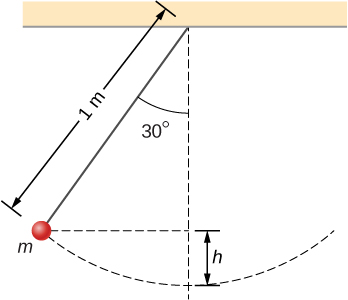
A particle of mass m is hung from the ceiling by a massless string of length 1.0 m, as shown in Figure 8.7. The particle is released from rest, when the angle between the string and the downward vertical direction is What is its speed when it reaches the lowest point of its arc?
英語のヒント
図8.7のように、長さ1.0 mで質量のない糸に、質量mの粒子をつるす。糸と鉛直下向きのなす角がのとき、粒子を静かに放す。円弧の最下点に達したときの速さはいくらか。
OpenStax / Rice University, University Physics Volume 1, CC BY 4.0. Source-book artwork retained. · CC BY 4.0 · Source出典

Figure 8.7図 8.7
A particle hung from a string constitutes a simple pendulum. It is shown when released from rest, along with some distances used in analyzing the motion.
英語のヒント
糸につるした粒子は単振り子を作る。静かに放す位置と、運動の解析に使う距離を示す。
Strategy方針
Using our problem-solving strategy, the first step is to define that we are interested in the particle-Earth system. Second, only the gravitational force is acting on the particle, which is conservative (step 3). We neglect air resistance in the problem, and no work is done by the string tension, which is perpendicular to the arc of the motion. Therefore, the mechanical energy of the system is conserved, as represented by Equation 8.13, . Because the particle starts from rest, the increase in the kinetic energy is just the kinetic energy at the lowest point. This increase in kinetic energy equals the decrease in the gravitational potential energy, which we can calculate from the geometry. In step 4, we choose a reference point for zero gravitational potential energy to be at the lowest vertical point the particle achieves, which is mid-swing. Lastly, in step 5, we set the sum of energies at the highest point (initial) of the swing to the lowest point (final) of the swing to ultimately solve for the final speed.
英語のヒント
問題を解く手順に従い、まず粒子と地球を対象の系とする。第二に、粒子に働く重力だけを考え、これは保存力である(手順3)。空気抵抗は無視し、糸の張力は円弧状の運動に垂直なので仕事をしない。したがって系の力学的エネルギーは保存され、力学的エネルギー保存の式によりとなる。粒子は静止状態から出発するため、運動エネルギーの増加は、最下点での運動エネルギーそのものである。この増加は、図形の関係から計算できる重力の位置エネルギーの減少に等しい。手順4では、振れの中央にある粒子の最下点を、重力の位置エネルギーのゼロ点にする。手順5では、最も高い出発点と最下点でのエネルギーの和を等しいと置き、最後の速さを求める。
Solution解答
We are neglecting non-conservative forces, so we write the energy conservation formula relating the particle at the highest point (initial) and the lowest point in the swing (final) as
英語のヒント
非保存力を無視するので、粒子の最高点(初め)と振れの最下点(終わり)を結ぶエネルギー保存の式は、
Since the particle is released from rest, the initial kinetic energy is zero. At the lowest point, we define the gravitational potential energy to be zero. Therefore our conservation of energy formula reduces to
英語のヒント
粒子は静かに放されるため、初期運動エネルギーはゼロである。また最下点で重力の位置エネルギーをゼロと定義した。したがって、エネルギー保存の式は次の形になる。
The vertical height of the particle is not given directly in the problem. This can be solved for by using trigonometry and two givens: the length of the pendulum and the angle through which the particle is vertically pulled up. Looking at the diagram, the vertical dashed line is the length of the pendulum string. The vertical height is labeled h. The other partial length of the vertical string can be calculated with trigonometry. That piece is solved for by
英語のヒント
粒子の鉛直の高さは直接与えられていない。しかし、振り子の長さと、粒子を上へ引いた角度の二つから、三角法で求められる。図の鉛直な破線全体は振り子の糸の長さで、高さをhと示している。鉛直線の残りの部分の長さは、三角法から次のように求まる。
Therefore, by looking at the two parts of the string, we can solve for the height h,
英語のヒント
したがって、糸の長さを二つの部分に分けて考えると、高さhは、
We substitute this height into the previous expression solved for speed to calculate our result:
英語のヒント
この高さを、先ほど速さについて解いた式に代入すると、次の結果を得る。
Significance考察
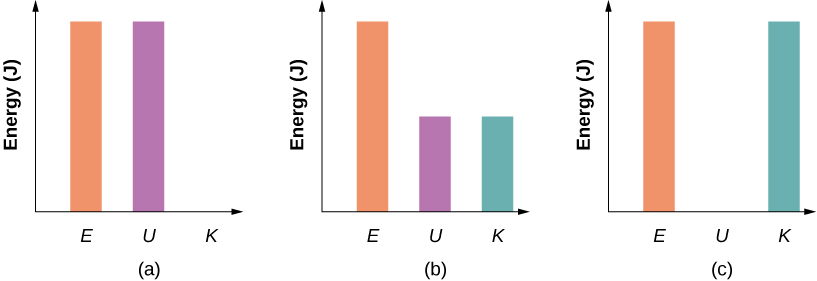
We found the speed directly from the conservation of mechanical energy, without having to solve the differential equation for the motion of a pendulum (see Oscillations). We can approach this problem in terms of bar graphs of total energy. Initially, the particle has all potential energy, being at the highest point, and no kinetic energy. When the particle crosses the lowest point at the bottom of the swing, the energy moves from the potential energy column to the kinetic energy column. Therefore, we can imagine a progression of this transfer as the particle moves between its highest point, lowest point of the swing, and back to the highest point (Figure 8.8). As the particle travels from the lowest point in the swing to the highest point on the far right hand side of the diagram, the energy bars go in reverse order from (c) to (b) to (a).
英語のヒント
OpenStax / Rice University, University Physics Volume 1, CC BY 4.0. Source-book artwork retained. · CC BY 4.0 · Source出典

Figure 8.8図 8.8
Bar graphs representing the total energy (E), potential energy (U), and kinetic energy (K) of the particle in different positions. (a) The total energy of the system equals the potential energy and the kinetic energy is zero, which is found at the highest point the particle reaches. (b) The particle is midway between the highest and lowest point, so the kinetic energy plus potential energy bar graphs equal the total energy. (c) The particle is at the lowest point of the swing, so the kinetic energy bar graph is the highest and equal to the total energy of the system.
英語のヒント
異なる位置での粒子の全エネルギーE、位置エネルギーU、運動エネルギーKの棒グラフ。(a) 最高点では全エネルギーが位置エネルギーに等しく、運動エネルギーはゼロ。(b) 最高点と最下点の途中では、運動エネルギーと位置エネルギーの棒の和が全エネルギーになる。(c) 最下点では運動エネルギーの棒が最大となり、系の全エネルギーに等しくなる。
Example 8.8例題 8.8
Air Resistance on a Falling Object落下物体に働く空気抵抗
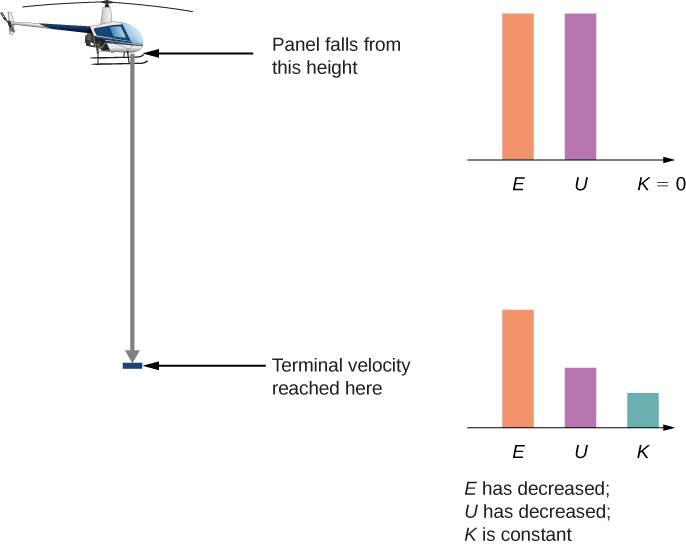
A helicopter is hovering at an altitude of when a panel from its underside breaks loose and plummets to the ground (Figure 8.9). The mass of the panel is and it hits the ground with a speed of . How much mechanical energy was dissipated by air resistance during the panel’s descent?
英語のヒント
ヘリコプターが高度でホバリングしていると、底面のパネルが外れ、地面へ落下する(図8.9)。パネルの質量はで、速さで地面にぶつかる。落下中に空気抵抗で散逸した力学的エネルギーはいくらか。
OpenStax / Rice University, University Physics Volume 1, CC BY 4.0. Source-book artwork retained. · CC BY 4.0 · Source出典

Figure 8.9図 8.9
A helicopter loses a panel that falls until it reaches terminal velocity of 45 m/s. How much did air resistance contribute to the dissipation of energy in this problem?
英語のヒント
ヘリコプターから外れたパネルが落下し、終端速度45 m/sに達する。この問題で、空気抵抗はどれだけエネルギーを散逸させたか。
Strategy方針
Step 1: Here only one body is being investigated.
英語のヒント
手順1:ここで調べる物体は一つだけである。
Step 2: Gravitational force is acting on the panel, as well as air resistance, which is stated in the problem.
英語のヒント
手順2:パネルには重力のほか、問題に示された空気抵抗が働く。
Step 3: Gravitational force is conservative; however, the non-conservative force of air resistance does negative work on the falling panel, so we can use the conservation of mechanical energy, in the form expressed by Equation 8.12, to find the energy dissipated. This energy is the magnitude of the work:
英語のヒント
手順3:重力は保存力だが、非保存力である空気抵抗は落下するパネルに負の仕事をする。そこで、式8.12の形の力学的エネルギーの関係を使い、散逸したエネルギーを求める。このエネルギーは、仕事の大きさである。
Step 4: The initial kinetic energy, at is zero. We set the gravitational potential energy to zero at ground level out of convenience.
英語のヒント
手順4:での初期運動エネルギーはゼロ。便宜上、地面で重力による位置エネルギーをゼロとする。
Step 5: The non-conservative work is set equal to the energies to solve for the work dissipated by air resistance.
英語のヒント
手順5:非保存力の仕事をエネルギーの変化に等しいと置き、空気抵抗で散逸した仕事を求める。
Solution解答
The mechanical energy dissipated by air resistance is the algebraic sum of the gain in the kinetic energy and loss in potential energy. Therefore the calculation of this energy is
英語のヒント
空気抵抗で散逸する力学的エネルギーは、運動エネルギーの増加と位置エネルギーの減少を符号付きで加えたものから求める。したがって、計算は次のようになる。
Significance考察
Most of the initial mechanical energy of the panel , 147 kJ, was lost to air resistance. Notice that we were able to calculate the energy dissipated without knowing what the force of air resistance was, only that it was dissipative.
英語のヒント
パネルの初期力学的エネルギーである147 kJの大部分が、空気抵抗によって失われた。空気抵抗の力そのものを知らなくても、散逸的だということだけで、失われたエネルギーを求められた。