第8章位置エネルギーとエネルギー保存
Systems of Several Particles複数の粒子からなる系
In general, a system of interest could consist of several particles. The difference in the potential energy of the system is the negative of the work done by gravitational or elastic forces, which, as we will see in the next section, are conservative forces. The potential energy difference depends only on the initial and final positions of the particles, and on some parameters that characterize the interaction (like mass for gravity or the spring constant for a Hooke’s law force).
英語のヒント
一般に、対象とする系は複数の粒子からなりうる。系の位置エネルギーの差は、重力や弾性力がする仕事の符号を反転したものに等しい。次の節で見るように、これらは保存力である。位置エネルギーの差は、粒子の初めと終わりの位置、および相互作用を特徴付けるいくつかの量だけに依存する。たとえば重力なら質量、フックの法則に従う力ならばね定数である。
It is important to remember that potential energy is a property of the interactions between objects in a chosen system, and not just a property of each object. This is especially true for electric forces, although in the examples of potential energy we consider below, parts of the system are either so big (like Earth, compared to an object on its surface) or so small (like a massless spring), that the changes those parts undergo are negligible when included in the system.
英語のヒント
位置エネルギーは、選んだ系の中で物体どうしが相互作用することの性質であり、各物体だけの性質ではない。この点を覚えておくことが重要だ。電気力ではとくにそうである。以下の位置エネルギーの例では、系の一部は非常に大きい(地表の物体に対する地球など)か、非常に小さい(質量のないばねなど)ため、それらを系に含めても、その部分に起こる変化は無視できる。
Types of Potential Energy位置エネルギーの種類
For each type of interaction present in a system, you can label a corresponding type of potential energy. The total potential energy of the system is the sum of the potential energies of all the types. (This follows from the additive property of the dot product in the expression for the work done.) Let’s look at some specific examples of types of potential energy discussed in Work. First, we consider each of these forces when acting separately, and then when both act together.
英語のヒント
系に存在する相互作用の種類ごとに、対応する種類の位置エネルギーを名付けられる。系の全位置エネルギーは、すべての種類の位置エネルギーの和である。これは、仕事を表す式の内積の加法性から導かれる。「仕事」で扱った位置エネルギーの具体例を見よう。まず、それぞれの力が別々に働く場合を考え、次に両方が同時に働く場合を考える。
Gravitational potential energy near Earth’s surface地表付近の重力による位置エネルギー
The system of interest consists of our planet, Earth, and one or more particles near its surface (or bodies small enough to be considered as particles, compared to Earth). The gravitational force on each particle (or body) is just its weight mg near the surface of Earth, acting vertically down. According to Newton’s third law, each particle exerts a force on Earth of equal magnitude but in the opposite direction. Newton’s second law tells us that the magnitude of the acceleration produced by each of these forces on Earth is mg divided by Earth’s mass. Since the ratio of the mass of any ordinary object to the mass of Earth is vanishingly small, the motion of Earth can be completely neglected. Therefore, we consider this system to be a group of single-particle systems, subject to the uniform gravitational force of Earth.
英語のヒント
対象とする系は、地球と、その表面近くの一つ以上の粒子からなる。地球に比べて十分小さく、粒子とみなせる物体でもよい。地表付近で各粒子や物体に働く重力は、鉛直下向きのmgである。ニュートンの第三法則によれば、各粒子は地球に同じ大きさで逆向きの力を及ぼす。第二法則によれば、この力が地球に与える加速度の大きさは、mgを地球の質量で割った値である。普通の物体の質量と地球の質量の比は、消えてしまうほど小さいため、地球の運動は完全に無視できる。そこで、この系を、地球の一様な重力を受ける一粒子系の集まりとして扱う。
In Work, the work done on a body by Earth’s uniform gravitational force, near its surface, depended on the mass of the body, the acceleration due to gravity, and the difference in height the body traversed, as given by Equation 7.4. By definition, this work is the negative of the difference in the gravitational potential energy, so that difference is
英語のヒント
You can see from this that the gravitational potential energy function, near Earth’s surface, is
英語のヒント
ここから、地表付近の重力による位置エネルギー関数は、
You can choose the value of the constant, as described in the discussion of Equation 8.2; however, for solving most problems, the most convenient constant to choose is zero for when which is the lowest vertical position in the problem.
英語のヒント
となる。基準点からの位置エネルギー差の式で説明したように、定数は選べる。ただし多くの問題では、問題中の最も低い鉛直位置でゼロとなるように、定数をゼロにするのが最も便利である。
Example 8.2例題 8.2
Gravitational Potential Energy of a Hikerハイカーの重力による位置エネルギー
The summit of Great Blue Hill in Milton, MA, is 147 m above its base and has an elevation above sea level of 195 m (Figure 8.3). (Its Native American name, Massachusett, was adopted by settlers for naming the Bay Colony and state near its location.) A 75-kg hiker ascends from the base to the summit. What is the gravitational potential energy of the hiker-Earth system with respect to zero gravitational potential energy at base height, when the hiker is (a) at the base of the hill, (b) at the summit, and (c) at sea level, afterward?
英語のヒント
マサチューセッツ州ミルトンにあるグレート・ブルー・ヒルの山頂は、ふもとより147 m高く、海抜195 mにある(図8.3)。(先住民による名称Massachusettは、入植者がこの付近の湾岸植民地や州を名付ける際に用いた。)質量75 kgのハイカーがふもとから山頂へ登る。ふもとの高さで重力による位置エネルギーをゼロとしたとき、ハイカーと地球の系の位置エネルギーは、(a) ふもと、(b) 山頂、(c) その後に海面と同じ高さへ移った場合に、それぞれいくらか。
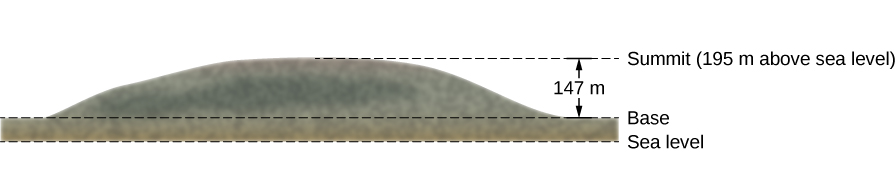
OpenStax / Rice University, University Physics Volume 1, CC BY 4.0. Source-book artwork retained. · CC BY 4.0 · Source出典

Figure 8.3図 8.3
Sketch of the profile of Great Blue Hill, Milton, MA. The altitudes of the three levels are indicated.
英語のヒント
マサチューセッツ州ミルトンのグレート・ブルー・ヒルの輪郭図。三つの高さを示す。
Strategy方針
First, we need to pick an origin for the y-axis and then determine the value of the constant that makes the potential energy zero at the height of the base. Then, we can determine the potential energies from Equation 8.5, based on the relationship between the zero potential energy height and the height at which the hiker is located.
英語のヒント
まずy軸の原点を選び、ふもとの高さで位置エネルギーがゼロになる定数を決める。その後、位置エネルギーがゼロとなる高さとハイカーの高さの関係に基づき、重力の位置エネルギー関数から値を求める。
Solution解答
- Let’s choose the origin for the y-axis at base height, where we also want the zero of potential energy to be. This choice makes the constant equal to zero and
英語のヒント
位置エネルギーをゼロにしたい、ふもとの高さをy軸の原点に選ぼう。この選択では定数がゼロになり、 - At the summit, , so
英語のヒント
山頂ではなので、 - At sea level, , so
英語のヒント
海面の高さではなので、
Significance考察
Besides illustrating the use of Equation 8.4 and Equation 8.5, the values of gravitational potential energy we found are reasonable. The gravitational potential energy is higher at the summit than at the base, and lower at sea level than at the base. Gravity does work on you on your way up, too! It does negative work and not quite as much (in magnitude), as your muscles do. But it certainly does work. Similarly, your muscles do work on your way down, as negative work. The numerical values of the potential energies depend on the choice of zero of potential energy, but the physically meaningful differences of potential energy do not. [Note that since Equation 8.2 is a difference, the numerical values do not depend on the origin of coordinates.]
英語のヒント
式8.4と重力の位置エネルギー関数の使い方がわかるだけでなく、得られた位置エネルギーの値も妥当である。山頂ではふもとより大きく、海面の高さではふもとより小さい。登っている間にも、重力はあなたに仕事をする。負の仕事で、その大きさは筋肉のする仕事よりわずかに小さいが、確かに仕事をしている。同様に、下る間には筋肉が負の仕事をする。位置エネルギーの数値はゼロ点の選び方によるが、物理的に意味のある位置エネルギーの差はよらない。基準点からの位置エネルギー差の式は差を表すので、数値は座標原点によらない。