第8章位置エネルギーとエネルギー保存
8.4 Potential Energy Diagrams and Stability8.4 位置エネルギー図と安定性
Learning Objectives学習目標
Learning Objectives学習目標
By the end of this section, you will be able to:
英語のヒント
この節を終えると、次のことができるようになる。
- Create and interpret graphs of potential energy
英語のヒント
位置エネルギーのグラフを作り、読み取る。 - Explain the connection between stability and potential energy
英語のヒント
安定性と位置エネルギーの関係を説明する。
Often, you can get a good deal of useful information about the dynamical behavior of a mechanical system just by interpreting a graph of its potential energy as a function of position, called a potential energy diagram. This is most easily accomplished for a one-dimensional system, whose potential energy can be plotted in one two-dimensional graph—for example, U(x) versus x—on a piece of paper or a computer program. For systems whose motion is in more than one dimension, the motion needs to be studied in three-dimensional space. We will simplify our procedure for one-dimensional motion only.
英語のヒント
位置を横軸にして位置エネルギーを描いた「位置エネルギー図」を読み取るだけで、力学系の振る舞いについて多くの有用な情報が得られることがある。最も扱いやすいのは1次元の系である。位置エネルギーを、たとえばxに対するU(x)として、紙やコンピューターに一つの2次元グラフで描ける。2次元以上で運動する系は、3次元空間で調べる必要がある。ここでは手順を簡単にし、1次元の運動だけを扱う。
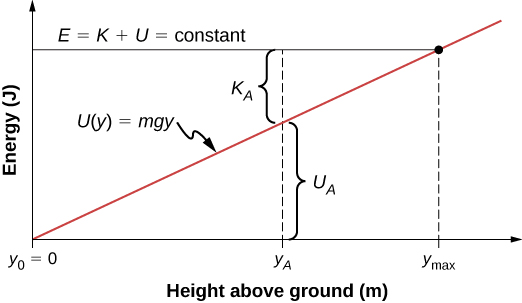
First, let’s look at an object, freely falling vertically, near the surface of Earth, in the absence of air resistance. The mechanical energy of the object is conserved, and the potential energy, with respect to zero at ground level, is which is a straight line through the origin with slope . In the graph shown in Figure 8.10, the x-axis is the height above the ground y and the y-axis is the object’s energy.
英語のヒント
まず、地表付近を空気抵抗なしで鉛直に自由落下する物体を考える。力学的エネルギーはと保存され、地面をゼロ点とした位置エネルギーはである。これは原点を通る、傾きの直線となる。図8.10では、横軸を地面からの高さy、縦軸を物体のエネルギーとしている。
OpenStax / Rice University, University Physics Volume 1, CC BY 4.0. Source-book artwork retained. · CC BY 4.0 · Source出典

Figure 8.10図 8.10
The potential energy graph for an object in vertical free fall, with various quantities indicated.
英語のヒント
鉛直に自由落下する物体の位置エネルギー図。各種の量を示す。
The line at energy E represents the constant mechanical energy of the object, whereas the kinetic and potential energies, and are indicated at a particular height You can see how the total energy is divided between kinetic and potential energy as the object’s height changes. Since kinetic energy can never be negative, there is a maximum potential energy and a maximum height, which an object with the given total energy cannot exceed:
英語のヒント
エネルギーEの水平線は、物体の一定の力学的エネルギーを表す。ある高さにおける運動エネルギーと位置エネルギーも示してある。高さが変わるにつれて、全エネルギーが両者にどう分かれるかがわかる。運動エネルギーは負にならないので、位置エネルギーと高さには最大値があり、全エネルギーが与えられた物体はこれを超えられない。
If we use the gravitational potential energy reference point of zero at we can rewrite the gravitational potential energy U as mgy. Solving for y results in
英語のヒント
で重力による位置エネルギーをゼロとすれば、Uをmgyと書き直せる。yについて解くと、
We note in this expression that the quantity of the total energy divided by the weight (mg) is located at the maximum height of the particle, or At the maximum height, the kinetic energy and the speed are zero, so if the object were initially traveling upward, its velocity would go through zero there, and would be a turning point in the motion. At ground level, , the potential energy is zero, and the kinetic energy and the speed are maximum:
英語のヒント
この式では、全エネルギーを重さmgで割った値が粒子の最大の高さに当たる。最大の高さでは運動エネルギーも速さもゼロなので、初めに上へ動いていた物体の速度はそこでゼロになり、が折り返し点になる。地面では位置エネルギーがゼロとなり、運動エネルギーと速さは最大になる。
The maximum speed gives the initial velocity necessary to reach the maximum height, and represents the final velocity, after falling from You can read all this information, and more, from the potential energy diagram we have shown.
英語のヒント
最大の速さは、最高点へ達するのに必要な初速度を与える。また、はから落ちた後の終速度を表す。位置エネルギー図から、これらをはじめ多くの情報を読み取れる。
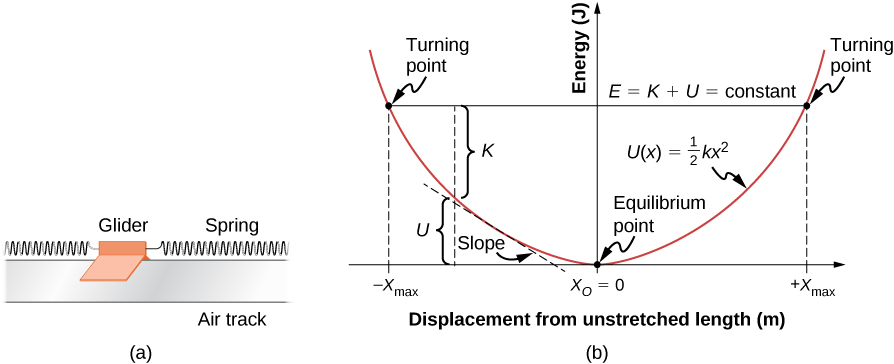
Consider a mass-spring system on a frictionless, stationary, horizontal surface, so that gravity and the normal contact force do no work and can be ignored (Figure 8.11). This is like a one-dimensional system, whose mechanical energy E is a constant and whose potential energy, with respect to zero energy at zero displacement from the spring’s unstretched length, .
英語のヒント
摩擦がなく静止した水平面上の、ばねとおもりの系を考える(図8.11)。重力と垂直抗力は仕事をしないので無視できる。これは1次元系で、力学的エネルギーEは一定、ばねが自然長で変位ゼロのときに位置エネルギーをゼロとすると、となる。
OpenStax / Rice University, University Physics Volume 1, CC BY 4.0. Source-book artwork retained. · CC BY 4.0 · Source出典

Figure 8.11図 8.11
(a) A glider between springs on an air track is an example of a horizontal mass-spring system. (b) The potential energy diagram for this system, with various quantities indicated.
英語のヒント
(a) エアトラック上で二つのばねの間にある滑走体は、水平なばねとおもりの系の例である。(b) この系の位置エネルギー図と各種の量。
You can read off the same type of information from the potential energy diagram in this case, as in the case for the body in vertical free fall, but since the spring potential energy describes a variable force, you can learn more from this graph. As for the object in vertical free fall, you can deduce the physically allowable range of motion and the maximum values of distance and speed, from the limits on the kinetic energy, Therefore, and at a turning point, of which there are two for the elastic spring potential energy,
英語のヒント
この場合も鉛直自由落下と同じ種類の情報を読み取れるが、ばねの位置エネルギーは変化する力を表すため、さらに多くのことがわかる。自由落下の場合と同様に、運動エネルギーへの制限から、可能な運動範囲や距離と速さの最大値を導ける。したがって、折り返し点ではかつとなる。弾性ばねの位置エネルギーでは、折り返し点は二つある。
The glider’s motion is confined to the region between the turning points, This is true for any (positive) value of E because the potential energy is unbounded with respect to x. For this reason, as well as the shape of the potential energy curve, U(x) is called an infinite potential well. At the bottom of the potential well, and the kinetic energy is a maximum,
英語のヒント
滑走体の運動は、二つの折り返し点の間の領域に限られる。xに対して位置エネルギーが際限なく増えるため、どんな正のEでもそうなる。この性質と曲線の形から、U(x)を無限のポテンシャル井戸と呼ぶ。井戸の底ではであり、運動エネルギーは最大になる。
However, from the slope of this potential energy curve, you can also deduce information about the force on the glider and its acceleration. We saw earlier that the negative of the slope of the potential energy is the spring force, which in this case is also the net force, and thus is proportional to the acceleration. When , the slope, the force, and the acceleration are all zero, so this is an equilibrium point. The negative of the slope, on either side of the equilibrium point, gives a force pointing back to the equilibrium point, so the equilibrium is termed stable and the force is called a restoring force. This implies that U(x) has a relative minimum there. If the force on either side of an equilibrium point has a direction that is the same as the direction of position change, pointing away from the equilibrium point, the equilibrium is termed unstable, and this implies that U(x) has a relative maximum there.
英語のヒント
位置エネルギー曲線の傾きからは、滑走体に働く力や加速度もわかる。傾きの符号を反転したものがばねの力であり、この場合は合力でもあるので、加速度に比例する。では傾き、力、加速度がすべてゼロとなるため、つり合いの位置である。つり合いの位置の両側では、傾きの符号を反転した力はその位置へ戻る向きになる。このつり合いを安定といい、力を復元力と呼ぶ。これは、U(x)がそこで極小になることを意味する。つり合いの位置の両側で、力が位置の変化と同じ向き、つまりつり合いの位置から離れる向きなら、つり合いは不安定である。そのときU(x)はそこで極大になる。
Example 8.10例題 8.10
Quartic and Quadratic Potential Energy Diagram4次項と2次項をもつ位置エネルギー図
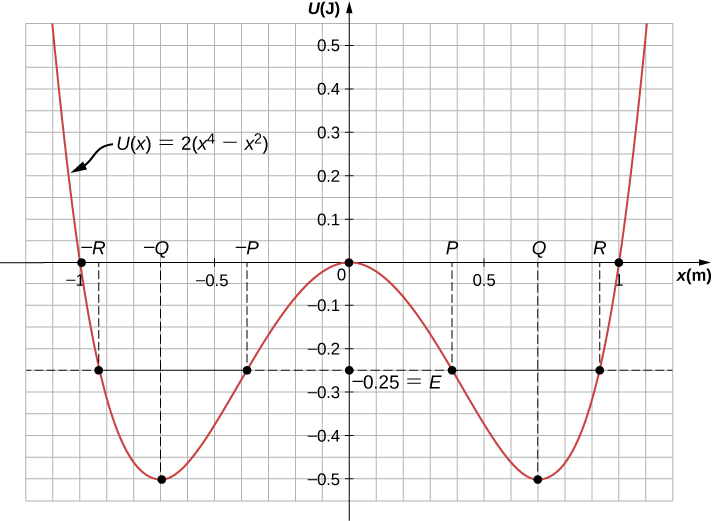
The potential energy for a particle undergoing one-dimensional motion along the x-axis is where U is in joules and x is in meters. The particle is not subject to any non-conservative forces and its mechanical energy is constant at . (a) Is the motion of the particle confined to any regions on the x-axis, and if so, what are they? (b) Are there any equilibrium points, and if so, where are they and are they stable or unstable?
英語のヒント
x軸に沿う1次元運動の粒子の位置エネルギーはで、Uの単位はJ、xの単位はmである。非保存力は働かず、力学的エネルギーはで一定である。(a) 粒子の運動は、x軸上の特定の領域に限られるか。そうならどの領域か。(b) つり合いの位置はあるか。あればどこで、安定か不安定か。
Strategy方針
First, we need to graph the potential energy as a function of x. The function is zero at the origin, becomes negative as x increases in the positive or negative directions ( is larger than for ), and then becomes positive at sufficiently large . Your graph should look like a double potential well, with the zeros determined by solving the equation , and the extremes determined by examining the first and second derivatives of U(x), as shown in Figure 8.12.
英語のヒント
まず位置エネルギーをxの関数として描く。関数は原点でゼロであり、xが正または負の方向へ離れると負になる(ではがより大きい)。そして、が十分大きくなると正になる。グラフは二重のポテンシャル井戸の形になるはずだ。ゼロ点はを解き、極値はU(x)の1階微分と2階微分を調べて求める(図8.12)。
OpenStax / Rice University, University Physics Volume 1, CC BY 4.0. Source-book artwork retained. · CC BY 4.0 · Source出典

Figure 8.12図 8.12
The potential energy graph for a one-dimensional, quartic and quadratic potential energy, with various quantities indicated.
英語のヒント
1次元の、4次項と2次項をもつ位置エネルギー図。各種の量を示す。
You can find the values of (a) the allowed regions along the x-axis, for the given value of the mechanical energy, from the condition that the kinetic energy can’t be negative, and (b) the equilibrium points and their stability from the properties of the force (stable for a relative minimum and unstable for a relative maximum of potential energy).
英語のヒント
(a) 与えられた力学的エネルギーで可能なx軸上の領域は、運動エネルギーが負にならない条件から求められる。(b) つり合いの位置と安定性は、力の性質から求められる。位置エネルギーが極小なら安定、極大なら不安定である。
You can just eyeball the graph to reach qualitative answers to the questions in this example. That, after all, is the value of potential energy diagrams. You can see that there are two allowed regions for the motion and three equilibrium points (slope of which the central one is unstable and the other two are stable
英語のヒント
グラフを目で見るだけでも、この例題の問いに定性的に答えられる。それが位置エネルギー図の価値である。運動できる領域が二つあり、つり合いの位置(傾きが三つある。中央は不安定で、残る二つは安定である。
Solution解答
- To find the allowed regions for x, we use the condition
英語のヒント
xの許される領域を求めるため、次の条件を使う。If we complete the square in , this condition simplifies to which we can solve to obtain英語のヒント
について平方完成すると、この条件はとなり、これを解くと、This represents two allowed regions, and where and (in meters).英語のヒント
となる。これは二つの領域とを表し、、である。単位はm。 - To find the equilibrium points, we solve the equation
英語のヒント
つり合いの位置を求めるには、次の方程式を解く。and find and , where (meters). The second derivative英語のヒント
すると、とが得られ、(m)である。2階微分は、is negative at , so that position is a relative maximum and the equilibrium there is unstable. The second derivative is positive at , so these positions are relative minima and represent stable equilibria.英語のヒント
で負なので、そこは極大点で、つり合いは不安定である。2階微分はで正なので、そこは極小点で、安定なつり合いを表す。
Significance考察
The particle in this example can oscillate in the allowed region about either of the two stable equilibrium points we found, but it does not have enough energy to escape from whichever potential well it happens to initially be in. The conservation of mechanical energy and the relations between kinetic energy and speed, and potential energy and force, enable you to deduce much information about the qualitative behavior of the motion of a particle, as well as some quantitative information, from a graph of its potential energy.
英語のヒント
この例の粒子は、求めた二つの安定なつり合いの位置のどちらかを中心に、許された領域内で振動できる。しかし、初めに入っていたほうのポテンシャル井戸から脱出するには、エネルギーが足りない。力学的エネルギー保存と、運動エネルギーと速さ、位置エネルギーと力の関係を使うと、位置エネルギーのグラフから、粒子運動の定性的な振る舞いについて多くの情報が得られる。定量的な情報もいくらか得られる。
Before ending this section, let’s practice applying the method based on the potential energy of a particle to find its position as a function of time, for the one-dimensional, mass-spring system considered earlier in this section.
英語のヒント
この節を終える前に、先ほどの1次元のばねとおもりの系について、位置エネルギーから粒子の位置を時間の関数として求める方法を練習しよう。
Example 8.11例題 8.11
Sinusoidal Oscillations正弦波状の振動
Find x(t) for a particle moving with a constant mechanical energy and a potential energy , when the particle starts from rest at time .
英語のヒント
一定の力学的エネルギーと位置エネルギーをもつ粒子が、時刻に静止状態から動き始める。x(t)を求めよ。
Strategy方針
We follow the same steps as we did in Example 8.9. Substitute the potential energy U into Equation 8.14 and factor out the constants, like m or k. Integrate the function and solve the resulting expression for position, which is now a function of time.
英語のヒント
Solution解答
Substitute the potential energy in Equation 8.14 and integrate using an integral solver found on a web search:
英語のヒント
位置エネルギーを式8.14へ代入し、ウェブ検索で見つかる積分計算ツールを使って積分する。
From the initial conditions at the initial kinetic energy is zero and the initial potential energy is from which you can see that and Now you can solve for x:
英語のヒント
での初期条件から、初期運動エネルギーはゼロ、初期位置エネルギーはである。これより、とわかる。xについて解くと、
Significance考察
A few paragraphs earlier, we referred to this mass-spring system as an example of a harmonic oscillator. Here, we anticipate that a harmonic oscillator executes sinusoidal oscillations with a maximum displacement of (called the amplitude) and a rate of oscillation of (called the frequency). Further discussions about oscillations can be found in Oscillations.
英語のヒント
少し前に、このばねとおもりの系を調和振動子の例として挙げた。ここで先取りしておくと、調和振動子は正弦波状の振動を行い、最大変位を振幅、振動の速さを振動数という。「振動」でさらに詳しく扱う。