第4章二次元・三次元の運動
Velocity Vector速度ベクトル
In the previous chapter we found the instantaneous velocity by calculating the derivative of the position function with respect to time. We can do the same operation in two and three dimensions, but we use vectors. The instantaneous velocity vector is now
英語のヒント
前章では、位置関数を時間で微分して瞬間速度を求めた。2次元や3次元でも同じ操作を行えるが、ここではベクトルを使う。瞬間速度ベクトルは次のようになる。
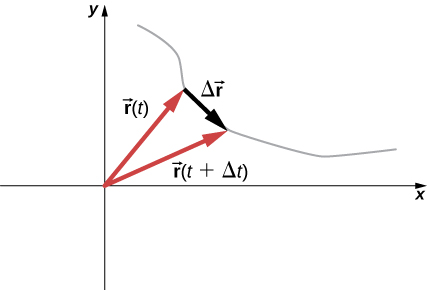
Let’s look at the relative orientation of the position vector and velocity vector graphically. In Figure 4.7 we show the vectors and which give the position of a particle moving along a path represented by the gray line. As goes to zero, the velocity vector, given by Equation 4.4, becomes tangent to the path of the particle at time t.
英語のヒント
OpenStax / Rice University, University Physics Volume 1, CC BY 4.0. Source-book artwork retained. · CC BY 4.0 · Source出典

Figure 4.7図 4.7
A particle moves along a path given by the gray line. In the limit as approaches zero, the velocity vector becomes tangent to the path of the particle.
英語のヒント
粒子が灰色の線で示す経路を進む。が0へ近づく極限で、速度ベクトルは粒子の経路に接するようになる。
Equation 4.4 can also be written in terms of the components of Since
英語のヒント
式4.4は、の成分を使っても書ける。次の関係があるので、
we can write
英語のヒント
次のように書ける。
where
英語のヒント
ここで、
If only the average velocity is of concern, we have the vector equivalent of the one-dimensional average velocity for two and three dimensions:
英語のヒント
平均速度だけに関心がある場合、1次元の平均速度に相当する、2次元や3次元でのベクトルの式は次のようになる。
Example 4.3例題 4.3
Calculating the Velocity Vector速度ベクトルを求める
The position function of a particle is (a) What is the instantaneous velocity and speed at t = 2.0 s? (b) What is the average velocity between 1.0 s and 3.0 s?
英語のヒント
粒子の位置関数はである。(a)t = 2.0 sにおける瞬間速度と速さはいくらか。(b)1.0 sから3.0 sの間の平均速度はいくらか。
Solution解答
Using Equation 4.5 and Equation 4.6, and taking the derivative of the position function with respect to time, we find
英語のヒント
(a)
Speed
英語のヒント
速さはである。
Significance意味の検討
We see the average velocity is the same as the instantaneous velocity at t = 2.0 s, as a result of the velocity function being linear. This need not be the case in general. In fact, most of the time, instantaneous and average velocities are not the same.
英語のヒント
速度関数が1次式であるため、平均速度はt = 2.0 sでの瞬間速度に等しくなる。一般には必ずしもそうならない。実際、ほとんどの場合、瞬間速度と平均速度は異なる。
The Independence of Perpendicular Motions直交する運動の独立性
When we look at the three-dimensional equations for position and velocity written in unit vector notation, Equation 4.2 and Equation 4.5, we see the components of these equations are separate and unique functions of time that do not depend on one another. Motion along the x direction has no part of its motion along the y and z directions, and similarly for the other two coordinate axes. Thus, the motion of an object in two or three dimensions can be divided into separate, independent motions along the perpendicular axes of the coordinate system in which the motion takes place.
英語のヒント
To illustrate this concept with respect to displacement, consider a woman walking from point A to point B in a city with square blocks. The woman taking the path from A to B may walk east for so many blocks and then north (two perpendicular directions) for another set of blocks to arrive at B. How far she walks east is affected only by her motion eastward. Similarly, how far she walks north is affected only by her motion northward.
英語のヒント
変位についてこの概念を説明するため、正方形の街区からなる町で、女性が点Aから点Bへ歩く場合を考えよう。AからBへ向かう女性は、東へ何街区か歩いた後、北へ別のいくつかの街区を歩いてBへ達するかもしれない。東と北は互いに垂直な方向である。東へどれだけ進むかに影響するのは東向きの運動だけであり、同様に、北へどれだけ進むかに影響するのは北向きの運動だけである。
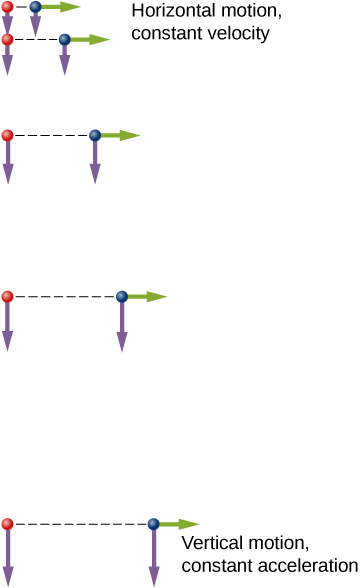
An example illustrating the independence of vertical and horizontal motions is given by two baseballs. One baseball is dropped from rest. At the same instant, another is thrown horizontally from the same height and it follows a curved path. A stroboscope captures the positions of the balls at fixed time intervals as they fall (Figure 4.8).
英語のヒント
鉛直運動と水平運動の独立性を示す例として、二つの野球のボールを使う。一つは静止状態から落とす。同じ瞬間に、もう一つを同じ高さから水平に投げると、こちらは曲がった経路を進む。ストロボによって、落下中のボールの位置を一定の時間間隔で記録する(図4.8)。
OpenStax / Rice University, University Physics Volume 1, CC BY 4.0. Source-book artwork retained. · CC BY 4.0 · Source出典

Figure 4.8図 4.8
A diagram of the motions of two identical balls: one falls from rest and the other has an initial horizontal velocity. Each subsequent position is an equal time interval. Arrows represent the horizontal and vertical velocities at each position. The ball on the right has an initial horizontal velocity whereas the ball on the left has no horizontal velocity. Despite the difference in horizontal velocities, the vertical velocities and positions are identical for both balls, which shows the vertical and horizontal motions are independent.
英語のヒント
同じ二つのボールの運動の図。一つは静止状態から落ち、もう一つは水平初速度を持つ。各位置は等しい時間間隔で示される。矢印は各位置での水平速度と鉛直速度を表す。右のボールには水平初速度があるが、左にはない。水平速度が異なっても、両方の鉛直速度と位置は等しく、水平運動と鉛直運動の独立性を示す。
It is remarkable that for each flash of the strobe, the vertical positions of the two balls are the same. This similarity implies vertical motion is independent of whether the ball is moving horizontally. (Assuming no air resistance, the vertical motion of a falling object is influenced by gravity only, not by any horizontal forces.) Careful examination of the ball thrown horizontally shows it travels the same horizontal distance between flashes. This is because there are no additional forces on the ball in the horizontal direction after it is thrown. This result means horizontal velocity is constant and is affected neither by vertical motion nor by gravity (which is vertical). Note this case is true for ideal conditions only. In the real world, air resistance affects the speed of the balls in both directions.
英語のヒント
ストロボが光るたびに、二つのボールの鉛直位置が等しいことは注目に値する。この一致は、ボールが水平に動いているかどうかに、鉛直運動が依存しないことを示す。(空気抵抗がないとすれば、落下物体の鉛直運動は重力だけに影響され、水平方向の力には影響されない。)水平に投げたボールを詳しく見ると、光るたびに同じ水平距離だけ進んでいる。投げられた後、水平方向に新たな力を受けないためである。この結果は、水平速度が一定で、鉛直運動にも重力(鉛直方向)にも影響されないことを意味する。これは理想的な条件だけで成り立つことに注意しよう。現実には、空気抵抗が両方向の速さへ影響する。
The two-dimensional curved path of the horizontally thrown ball is composed of two independent one-dimensional motions (horizontal and vertical). The key to analyzing such motion, called projectile motion, is to resolve it into motions along perpendicular directions. Resolving two-dimensional motion into perpendicular components is possible because the components are independent.
英語のヒント
水平に投げたボールの2次元の曲線軌道は、独立した二つの1次元運動(水平と鉛直)から構成される。放物運動と呼ばれるこのような運動を分析する鍵は、互いに垂直な方向の運動へ分解することである。2次元運動を直交成分へ分解できるのは、各成分が独立しているためである。