第4章二次元・三次元の運動
4.5 Relative Motion in One and Two Dimensions4.5 1次元と2次元の相対運動
Learning Objectives学習目標
Learning Objectives学習目標
By the end of this section, you will be able to:
英語のヒント
この節を終えると、次のことができるようになる。
- Explain the concept of reference frames.
英語のヒント
基準系の概念を説明する。 - Write the position and velocity vector equations for relative motion.
英語のヒント
相対運動の位置ベクトルと速度ベクトルの式を書く。 - Draw the position and velocity vectors for relative motion.
英語のヒント
相対運動の位置ベクトルと速度ベクトルを描く。 - Analyze one-dimensional and two-dimensional relative motion problems using the position and velocity vector equations.
英語のヒント
位置ベクトルと速度ベクトルの式を使い、1次元と2次元の相対運動の問題を分析する。
Motion does not happen in isolation. If you’re riding in a train moving at 10 m/s east, this velocity is measured relative to the ground on which you’re traveling. However, if another train passes you at 15 m/s east, your velocity relative to this other train is different from your velocity relative to the ground. Your velocity relative to the other train is 5 m/s west. To explore this idea further, we first need to establish some terminology.
英語のヒント
運動は、他と切り離して起こるものではない。東向き10 m/sで走る列車に乗っているとき、この速度は列車が走る地面を基準に測っている。しかし、別の列車が東向き15 m/sで追い越す場合、その列車に対する自分の速度は、地面に対する速度とは異なる。相手の列車に対する自分の速度は西向き5 m/sである。この考えをさらに調べるため、まず用語を定める。
Reference Frames基準系
To discuss relative motion in one or more dimensions, we first introduce the concept of reference frames. When we say an object has a certain velocity, we must state it has a velocity with respect to a given reference frame. In most examples we have examined so far, this reference frame has been Earth. If you say a person is sitting in a train moving at 10 m/s east, then you imply the person on the train is moving relative to the surface of Earth at this velocity, and Earth is the reference frame. We can expand our view of the motion of the person on the train and say Earth is spinning in its orbit around the Sun, in which case the motion becomes more complicated. In this case, the solar system is the reference frame. In summary, all discussion of relative motion must define the reference frames involved. We now develop a method to refer to reference frames in relative motion. This method makes an approximation that breaks down near the speed of light, where the more accurate methods or special relativity are needed, but is extremely accurate for everyday speeds (Relativity).
英語のヒント
1次元以上の相対運動を論じるため、まず基準系という概念を導入する。物体がある速度を持つと言うときには、どの基準系に対する速度かを明示しなければならない。これまでに調べた例の大半では、基準系は地球だった。東向き10 m/sで走る列車に人が座っていると言えば、列車内の人は地球の表面に対してその速度で動くという意味であり、地球が基準系となる。列車内の人の運動を見る範囲を広げ、地球が太陽を回る軌道を運動していることも考えれば、運動はより複雑になる。この場合には、太陽系が基準系となる。つまり、相対運動を論じるには、必ず関係する基準系を定めなければならない。ここから、相対運動の基準系を表す方法を作る。この方法では、光速近くで成り立たなくなる近似を用いる。その領域では、より正確な方法や特殊相対性理論が必要となるが、日常的な速さに対しては非常に正確である(「相対性理論」参照)。
Relative Motion in One Dimension1次元の相対運動
We introduce relative motion in one dimension first, because the velocity vectors simplify to having only two possible directions. Take the example of the person sitting in a train moving east. If we choose east as the positive direction and Earth as the reference frame, then we can write the velocity of the train with respect to the Earth as east, where the subscripts TE refer to train and Earth. Let’s now say the person gets up out of her seat and walks toward the back of the train at 2 m/s. This tells us she has a velocity relative to the reference frame of the train. Since the person is walking west, in the negative direction, we write her velocity with respect to the train as We can add the two velocity vectors to find the velocity of the person with respect to Earth. This relative velocity is written as
英語のヒント
まず1次元の相対運動を導入する。この場合、速度ベクトルの向きは二つだけとなり、単純になるからである。東へ走る列車に座っている人を例に取ろう。東を正方向、地球を基準系に選ぶと、地球に対する列車の速度は東向きのと書ける。添字TEは列車と地球を表す。その人が席を立ち、列車の後方へ2 m/sで歩くとする。これは列車の基準系に対して速度を持つということである。西、つまり負方向へ歩くので、列車に対する速度はと書く。二つの速度ベクトルを足せば、地球に対する人の速度を求められる。この相対速度は次のように表す。
(4.33)
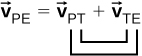
Note the ordering of the subscripts for the various reference frames in Equation 4.33. The subscripts for the coupling reference frame, which is the train, appear consecutively in the right-hand side of the equation. Figure 4.24 shows the correct order of subscripts when forming the vector equation.
英語のヒント
OpenStax / Rice University, University Physics Volume 1, CC BY 4.0. Source-book artwork retained. · CC BY 4.0 · Source出典

Figure 4.24図 4.24
When constructing the vector equation, the subscripts for the coupling reference frame appear consecutively on the inside. The subscripts on the left-hand side of the equation are the same as the two outside subscripts on the right-hand side of the equation.
英語のヒント
ベクトルの式を作るとき、両者をつなぐ基準系の添字は内側に続けて現れる。式の左辺の添字は、右辺の外側にある二つの添字と同じである。
Adding the vectors, we find so the person is moving 8 m/s east with respect to Earth. Graphically, this is shown in Figure 4.25.
英語のヒント
ベクトルを足すとを得る。したがって、この人は地球に対して東向き8 m/sで動いている。図4.25に図示する。

OpenStax / Rice University, University Physics Volume 1, CC BY 4.0. Source-book artwork retained. · CC BY 4.0 · Source出典

Figure 4.25図 4.25
Velocity vectors of the train with respect to Earth, person with respect to the train, and person with respect to Earth.
英語のヒント
地球に対する列車、列車に対する人、地球に対する人の速度ベクトル。
Relative Velocity in Two Dimensions2次元の相対速度
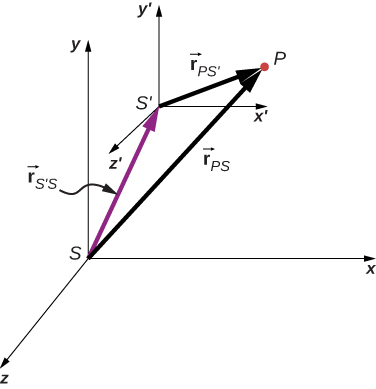
We can now apply these concepts to describing motion in two dimensions. Consider a particle P and reference frames S and as shown in Figure 4.26. The position of the origin of as measured in S is the position of P as measured in is and the position of P as measured in S is
英語のヒント
これらの概念を、2次元の運動の記述へ適用しよう。図4.26の粒子Pと基準系S、を考える。Sで測ったの原点の位置は、で測ったPの位置は、Sで測ったPの位置はである。
OpenStax / Rice University, University Physics Volume 1, CC BY 4.0. Source-book artwork retained. · CC BY 4.0 · Source出典

Figure 4.26図 4.26
The positions of particle P relative to frames S and are and respectively.
英語のヒント
基準系Sとに対する粒子Pの位置は、それぞれとである。
The relative velocities are the time derivatives of the position vectors. Therefore,
英語のヒント
相対速度は位置ベクトルの時間微分である。したがって、
The velocity of a particle relative to S is equal to its velocity relative to plus the velocity of relative to S.
英語のヒント
Sに対する粒子の速度は、に対する粒子の速度と、Sに対するの速度の和に等しい。
We can extend Equation 4.35 to any number of reference frames. For particle P with velocities in frames A, B, and C,
英語のヒント
式4.35は、任意の数の基準系へ拡張できる。基準系A、B、Cで速度を持つ粒子Pについて、
We can also see how the accelerations are related as observed in two reference frames by differentiating Equation 4.35:
英語のヒント
式4.35を微分すれば、二つの基準系で観測した加速度の関係も分かる。
We see that if the velocity of relative to S is a constant, then and
英語のヒント
Sに対するの速度が一定なら、となり、次が成り立つ。
(4.38)
This says the acceleration of a particle is the same as measured by two observers moving at a constant velocity relative to each other.
英語のヒント
これは、互いに一定の相対速度で動く二人の観測者が測る粒子の加速度は等しいことを示す。
Example 4.13例題 4.13
Motion of a Car Relative to a Truckトラックに対する乗用車の運動
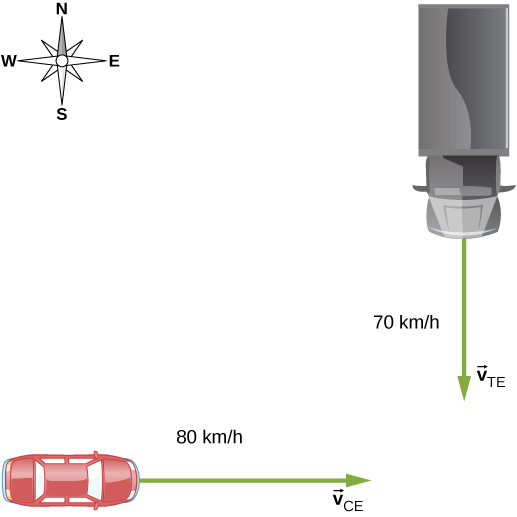
A truck is traveling south at a speed of 70 km/h toward an intersection. A car is traveling east toward the intersection at a speed of 80 km/h (Figure 4.27). What is the velocity of the car relative to the truck?
英語のヒント
トラックが交差点へ向け、南へ速さ70 km/hで走っている。乗用車は交差点へ向け、東へ速さ80 km/hで走っている(図4.27)。トラックに対する乗用車の速度は何か。
OpenStax / Rice University, University Physics Volume 1, CC BY 4.0. Source-book artwork retained. · CC BY 4.0 · Source出典

Figure 4.27図 4.27
A car travels east toward an intersection while a truck travels south toward the same intersection.
英語のヒント
乗用車が東へ交差点に向かう間、トラックは南へ同じ交差点に向かう。
Strategy方針
First, we must establish the reference frame common to both vehicles, which is Earth. Then, we write the velocities of each with respect to the reference frame of Earth, which enables us to form a vector equation that links the car, the truck, and Earth to solve for the velocity of the car with respect to the truck.
英語のヒント
まず、両車に共通する基準系として地球を定める。次に、地球の基準系に対するそれぞれの速度を書く。これにより、乗用車、トラック、地球をつなぐベクトルの式を作り、トラックに対する乗用車の速度を求められる。
Solution解答
The velocity of the car with respect to Earth is The velocity of the truck with respect to Earth is Using the velocity addition rule, the relative motion equation we are seeking is
英語のヒント
地球に対する乗用車の速度はである。地球に対するトラックの速度はである。速度の加算則を使うと、求める相対運動の式は次のようになる。
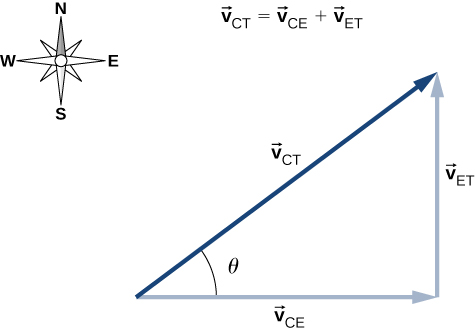
Here, is the velocity of the car with respect to the truck, and Earth is the connecting reference frame. Since we have the velocity of the truck with respect to Earth, the negative of this vector is the velocity of Earth with respect to the truck: The vector diagram of this equation is shown in Figure 4.28.
英語のヒント
ここで、はトラックに対する乗用車の速度であり、地球が両者をつなぐ基準系である。地球に対するトラックの速度が分かっているので、そのベクトルの負が、トラックに対する地球の速度となる。つまりである。この式のベクトル図を図4.28に示す。
OpenStax / Rice University, University Physics Volume 1, CC BY 4.0. Source-book artwork retained. · CC BY 4.0 · Source出典

Figure 4.28図 4.28
Vector diagram of the vector equation .
英語のヒント
ベクトルの式のベクトル図。
We can now solve for the velocity of the car with respect to the truck:
英語のヒント
これで、トラックに対する乗用車の速度を求められる。
and
英語のヒント
また、
Significance意味の検討
Drawing a vector diagram showing the velocity vectors can help in understanding the relative velocity of the two objects.
英語のヒント
速度ベクトルを表すベクトル図を描くと、二つの物体の相対速度を理解する助けになる。
Example 4.14例題 4.14
Flying a Plane in a Wind風の中で飛行機を飛ばす
A pilot must fly a plane due north to reach their destination. The plane can fly at 300 km/h in still air. A wind is blowing out of the northeast at 90 km/h. (a) In what direction must the pilot head the plane to fly due north? (b) What is the speed of the plane relative to the ground?
英語のヒント
パイロットは目的地へ達するため、飛行機を真北へ飛ばさなければならない。飛行機は静止した空気中で300 km/hで飛べる。北東から90 km/hの風が吹いている。(a)真北へ飛ぶため、機首をどの方向へ向ける必要があるか。(b)地面に対する飛行機の速さは何か。
Strategy方針
The pilot must point the plane somewhat east of north to compensate for the wind velocity. We need to construct a vector equation that contains the velocity of the plane with respect to the ground, the velocity of the plane with respect to the air, and the velocity of the air with respect to the ground. Since these last two quantities are known, we can solve for the velocity of the plane with respect to the ground. We can graph the vectors and use this diagram to evaluate the magnitude of the plane’s velocity with respect to the ground. The diagram will also tell us the angle the plane’s velocity makes with north with respect to the air, which is the direction the pilot must head the plane.
英語のヒント
風の速度を打ち消すには、パイロットは機首を北よりいくらか東へ向ける必要がある。地面に対する飛行機の速度、空気に対する飛行機の速度、地面に対する空気の速度を含むベクトルの式を作る。後の二つの量が分かっているので、地面に対する飛行機の速度を求められる。ベクトルを図に描けば、地面に対する飛行機の速度の大きさを求めるのに使える。さらに、空気に対する飛行機の速度が北となす角、つまりパイロットが機首を向けるべき方向も分かる。
Solution解答
The vector equation is where P = plane, A = air, and G = ground. From the geometry in Figure 4.29, we can solve easily for the magnitude of the velocity of the plane with respect to the ground and the angle of the plane’s heading,
英語のヒント
ベクトルの式はである。P = 飛行機、A = 空気、G = 地面を表す。図4.29の図形の関係から、地面に対する飛行機の速度の大きさと、機首の向きの角を容易に求められる。
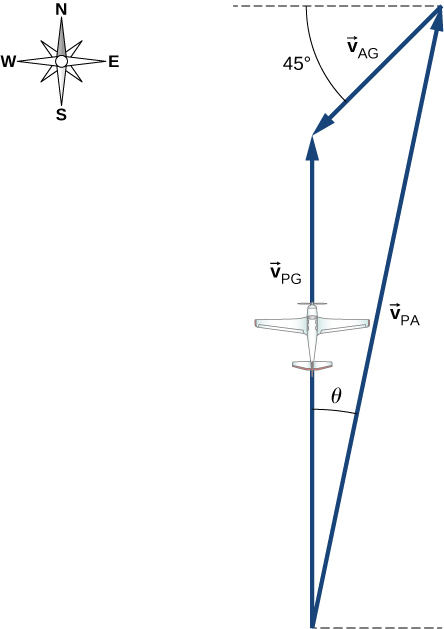
OpenStax / Rice University, University Physics Volume 1, CC BY 4.0. Source-book artwork retained. · CC BY 4.0 · Source出典

Figure 4.29図 4.29
Known quantities:
英語のヒント
既知の量:
(a) In the x direction we have the following:
英語のヒント
(a)x方向では、次のようになる。
- east of north
英語のヒント
北から東へ。
(b) In the y direction we have the following:
英語のヒント
(b)y方向では、次のようになる。