第4章二次元・三次元の運動
Constant Acceleration一定の加速度
Multidimensional motion with constant acceleration can be treated the same way as shown in the previous chapter for one-dimensional motion. Earlier we showed that three-dimensional motion is equivalent to three one-dimensional motions, each along an axis perpendicular to the others. To develop the relevant equations in each direction, let’s consider the two-dimensional problem of a particle moving in the xy plane with constant acceleration, ignoring the z-component for the moment. The acceleration vector is
英語のヒント
加速度が一定の多次元運動は、前章の1次元運動と同じように扱える。すでに見たように、3次元運動は、互いに垂直な三つの軸それぞれに沿う1次元運動と等価である。各方向の式を導くため、ひとまずz成分を無視し、粒子がxy平面内を一定の加速度で動く2次元の問題を考えよう。加速度ベクトルは次のようになる。
Each component of the motion has a separate set of equations similar to Equation 3.10–Equation 3.14 of the previous chapter on one-dimensional motion. We show only the equations for position and velocity in the x- and y-directions. A similar set of kinematic equations could be written for motion in the z-direction:
英語のヒント
(4.11)
(4.12)
(4.13)
(4.14)
(4.15)
(4.16)
(4.17)
(4.18)
Here the subscript 0 denotes the initial position or velocity. Equation 4.11 to Equation 4.18 can be substituted into Equation 4.2 and Equation 4.5 without the z-component to obtain the position vector and velocity vector as a function of time in two dimensions:
英語のヒント
The following example illustrates a practical use of the kinematic equations in two dimensions.
英語のヒント
次の例は、2次元の運動学の式を実際に使う方法を示す。
Example 4.6例題 4.6
A Skierスキーヤー
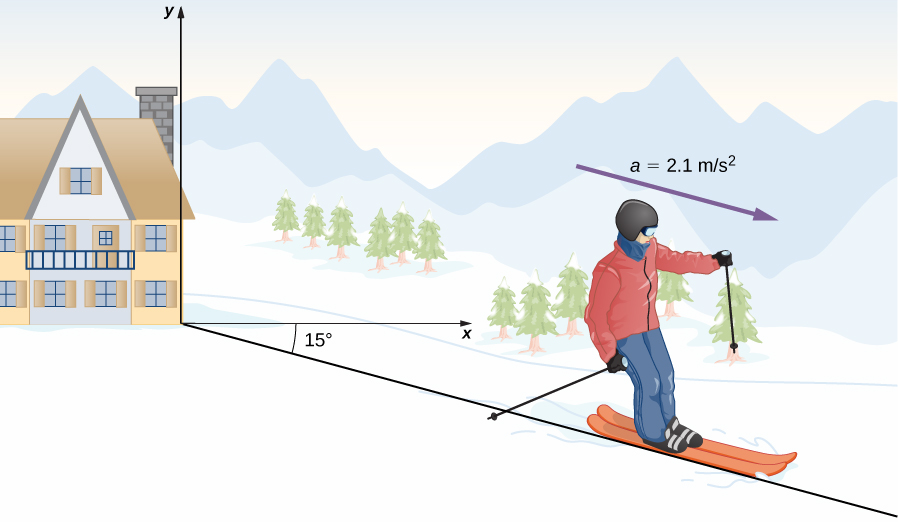
Figure 4.10 shows a skier moving with an acceleration of down a slope of at t = 0. With the origin of the coordinate system at the front of the lodge, her initial position and velocity are
英語のヒント
図4.10は、t = 0に角度の斜面を加速度で下るスキーヤーを示す。座標系の原点をロッジの前に置くと、初期位置と初速度は次のとおりである。
and
英語のヒント
および
(a) What are the x- and y-components of the skier’s position and velocity as functions of time? (b) What are her position and velocity at t = 10.0 s?
英語のヒント
(a)スキーヤーの位置と速度のx成分、y成分を時間の関数として求めよ。(b)t = 10.0 sでの位置と速度は何か。
OpenStax / Rice University, University Physics Volume 1, CC BY 4.0. Source-book artwork retained. · CC BY 4.0 · Source出典

Figure 4.10図 4.10
A skier has an acceleration of down a slope of The origin of the coordinate system is at the ski lodge.
英語のヒント
スキーヤーがの斜面を加速度で下る。座標系の原点はスキー場のロッジにある。
Strategy方針
Since we are evaluating the components of the motion equations in the x and y directions, we need to find the components of the acceleration and put them into the kinematic equations. The components of the acceleration are found by referring to the coordinate system in Figure 4.10. Then, by inserting the components of the initial position and velocity into the motion equations, we can solve for her position and velocity at a later time t.
英語のヒント
運動の式をx方向とy方向の成分ごとに計算するので、加速度の成分を求め、運動学の式へ入れる必要がある。加速度の成分は、図4.10の座標系を参照して求める。次に、初期位置と初速度の成分を運動の式へ代入すれば、後の時刻tでの位置と速度を求められる。
Solution解答
(a) The origin of the coordinate system is at the top of the hill with y-axis vertically upward and the x-axis horizontal. By looking at the trajectory of the skier, the x-component of the acceleration is positive and the y-component is negative. Since the angle is down the slope, we find
英語のヒント
(a)座標系の原点は丘の上にあり、y軸は鉛直上向き、x軸は水平である。スキーヤーの軌道から、加速度のx成分は正、y成分は負と分かる。斜面の角度は下向きになので、
Inserting the initial position and velocity into Equation 4.12 and Equation 4.13 for x, we have
英語のヒント
For y, we have
英語のヒント
yについては、次のようになる。
(b) Now that we have the equations of motion for x and y as functions of time, we can evaluate them at t = 10.0 s:
英語のヒント
(b)xとyの運動の式を時間の関数として得たので、t = 10.0 sでの値を求められる。
The position and velocity at t = 10.0 s are, finally,
英語のヒント
最終的に、t = 10.0 sでの位置と速度は次のとおりである。
The magnitude of the velocity of the skier at 10.0 s is 25 m/s, which is 60 mi/h.
英語のヒント
10.0 sでのスキーヤーの速度の大きさは25 m/sであり、60 mi/hに相当する。
Significance意味の検討
It is useful to know that, given the initial conditions of position, velocity, and acceleration of an object, we can find the position, velocity, and acceleration at any later time.
英語のヒント
物体の位置、速度、加速度の初期条件が与えられれば、その後の任意の時刻の位置、速度、加速度を求められるということを知っておくと役立つ。
With Equation 4.8 through Equation 4.10 we have completed the set of expressions for the position, velocity, and acceleration of an object moving in two or three dimensions. If the trajectories of the objects look something like the “Red Arrows” in the opening picture for the chapter, then the expressions for the position, velocity, and acceleration can be quite complicated. In the sections to follow we examine two special cases of motion in two and three dimensions by looking at projectile motion and circular motion.