第4章二次元・三次元の運動
4.3 Projectile Motion4.3 放物運動
Learning Objectives学習目標
Learning Objectives学習目標
By the end of this section, you will be able to:
英語のヒント
この節を終えると、次のことができるようになる。
- Use one-dimensional motion in perpendicular directions to analyze projectile motion.
英語のヒント
互いに垂直な方向の1次元運動を使って、放物運動を分析する。 - Calculate the range, time of flight, and maximum height of a projectile that is launched and impacts a flat, horizontal surface.
英語のヒント
平らな水平面で発射され、同じ面へ衝突する投射体の、水平到達距離、飛行時間、最高到達点の高さを計算する。 - Find the time of flight and impact velocity of a projectile that lands at a different height from that of launch.
英語のヒント
発射時と異なる高さへ着地する投射体の、飛行時間と衝突時の速度を求める。 - Calculate the trajectory of a projectile.
英語のヒント
投射体の軌道を計算する。
Projectile motion is the motion of an object thrown or projected into the air, subject only to acceleration as a result of gravity. The applications of projectile motion in physics and engineering are numerous. Some examples include meteors as they enter Earth’s atmosphere, fireworks, and the motion of any ball in sports. Such objects are called projectiles and their path is called a trajectory. The motion of falling objects as discussed in Motion Along a Straight Line is a simple one-dimensional type of projectile motion in which there is no horizontal movement. In this section, we consider two-dimensional projectile motion, and our treatment neglects the effects of air resistance.
英語のヒント
放物運動とは、空中へ投げ出されたり打ち出されたりした物体が、重力による加速度だけを受けて動く運動である。物理学や工学には数多くの応用がある。例えば、地球の大気へ入る流星、花火、スポーツのボールの運動が挙げられる。このような物体を投射体、その経路を軌道という。「直線に沿う運動」で扱った落下運動は、水平運動のない、単純な1次元の放物運動である。本節では2次元の放物運動を考え、空気抵抗の影響を無視する。
The most important fact to remember here is that motions along perpendicular axes are independent and thus can be analyzed separately. We discussed this fact in Displacement and Velocity Vectors, where we saw that vertical and horizontal motions are independent. The key to analyzing two-dimensional projectile motion is to break it into two motions: one along the horizontal axis and the other along the vertical. (This choice of axes is the most sensible because acceleration resulting from gravity is vertical; thus, there is no acceleration along the horizontal axis when air resistance is negligible.) As is customary, we call the horizontal axis the x-axis and the vertical axis the y-axis. It is not required that we use this choice of axes; it is simply convenient in the case of gravitational acceleration. In other cases we may choose a different set of axes. Figure 4.11 illustrates the notation for displacement, where we define to be the total displacement, and and are its component vectors along the horizontal and vertical axes, respectively. The magnitudes of these vectors are s, x, and y.
英語のヒント
ここで覚えておくべき最も重要な事実は、互いに垂直な各軸に沿う運動は独立しており、別々に分析できるということである。「変位ベクトルと速度ベクトル」でこの点を論じ、水平運動と鉛直運動が独立していることを見た。2次元の放物運動を分析する鍵は、水平軸に沿う運動と鉛直軸に沿う運動に分けることである。(重力加速度が鉛直なので、これは最も自然な軸の取り方である。空気抵抗が無視できれば、水平軸に沿う加速度は0になる。)慣例どおり、水平軸をx軸、鉛直軸をy軸と呼ぶ。この軸の選び方が必須なのではなく、重力加速度を扱う場合に便利なのである。別の状況では異なる軸を選んでもよい。図4.11に変位の記法を示す。を総変位とし、とを、それぞれ水平軸と鉛直軸に沿う成分ベクトルと定める。これらのベクトルの大きさはs、x、yである。
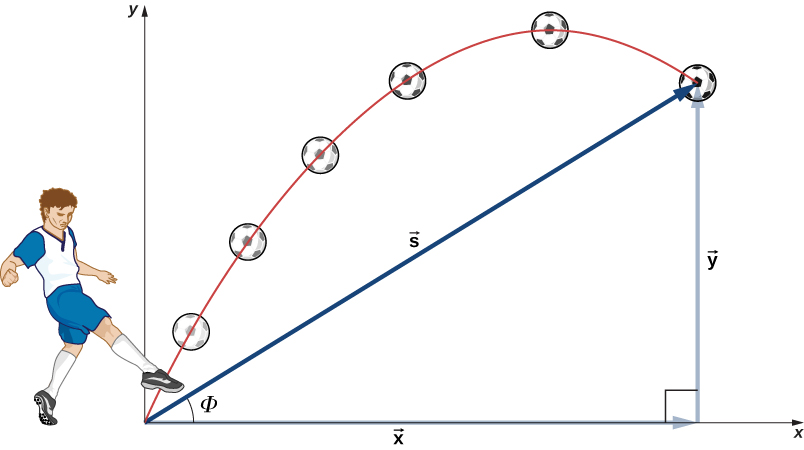
OpenStax / Rice University, University Physics Volume 1, CC BY 4.0. Source-book artwork retained. · CC BY 4.0 · Source出典

Figure 4.11図 4.11
The total displacement s of a soccer ball at a point along its path. The vector has components and along the horizontal and vertical axes. Its magnitude is s and it makes an angle Φ with the horizontal.
英語のヒント
サッカーボールが経路上のある点まで進んだ総変位s。ベクトルは、水平軸と鉛直軸に沿う成分、を持つ。大きさはsで、水平方向となす角はΦである。
To describe projectile motion completely, we must include velocity and acceleration, as well as displacement. We must find their components along the x- and y-axes. Let’s assume all forces except gravity (such as air resistance and friction, for example) are negligible. Defining the positive direction to be upward, the components of acceleration are then very simple:
英語のヒント
放物運動を完全に記述するには、変位に加えて速度と加速度も含め、x軸とy軸に沿う各成分を求めなければならない。空気抵抗や摩擦など、重力以外の力はすべて無視できるとしよう。上向きを正とすると、加速度の成分は非常に簡単になる。
Because gravity is vertical, If this means the initial velocity in the x direction is equal to the final velocity in the x direction, or With these conditions on acceleration and velocity, we can write the kinematic Equation 4.11 through Equation 4.18 for motion in a uniform gravitational field, including the rest of the kinematic equations for a constant acceleration from Motion with Constant Acceleration. The kinematic equations for motion in a uniform gravitational field become kinematic equations with
英語のヒント
Horizontal Motion
英語のヒント
水平運動
(4.19)
Vertical Motion
英語のヒント
鉛直運動
(4.20)
(4.21)
(4.22)
(4.23)
Using this set of equations, we can analyze projectile motion, keeping in mind some important points.
英語のヒント
この式の組を使い、いくつかの重要な点に注意しながら放物運動を分析できる。
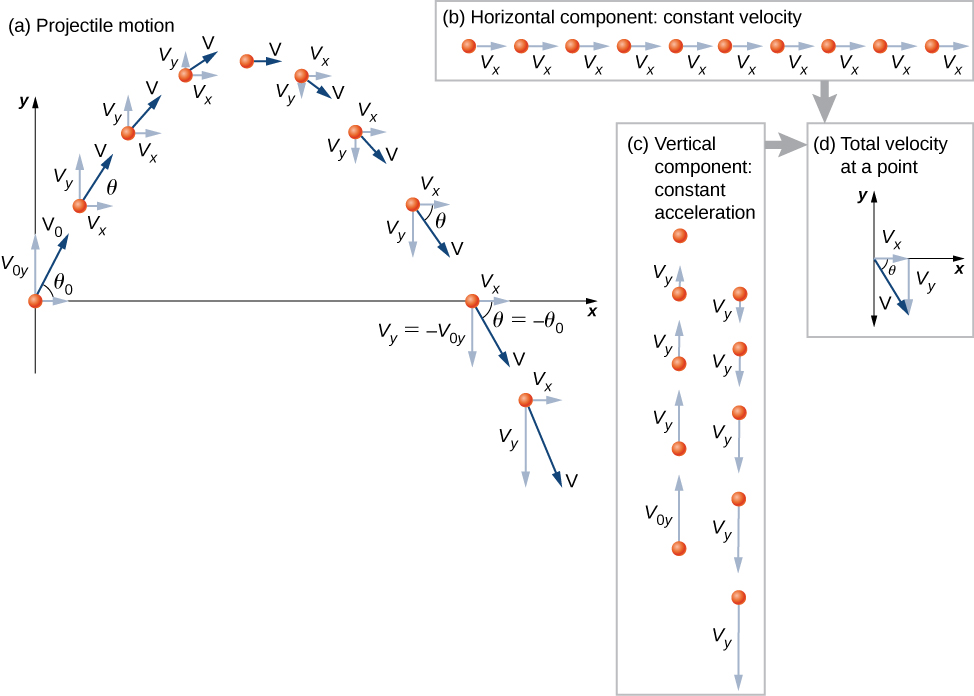
OpenStax / Rice University, University Physics Volume 1, CC BY 4.0. Source-book artwork retained. · CC BY 4.0 · Source出典

Figure 4.12図 4.12
(a) We analyze two-dimensional projectile motion by breaking it into two independent one-dimensional motions along the vertical and horizontal axes. (b) The horizontal motion is simple, because and is a constant. (c) The velocity in the vertical direction begins to decrease as the object rises. At its highest point, the vertical velocity is zero. As the object falls toward Earth again, the vertical velocity increases again in magnitude but points in the opposite direction to the initial vertical velocity. (d) The x and y motions are recombined to give the total velocity at any given point on the trajectory.
英語のヒント
(a)2次元の放物運動を、水平軸と鉛直軸に沿う二つの独立した1次元運動に分けて分析する。(b)では一定なので、水平運動は単純である。(c)上昇すると鉛直速度は小さくなり、最高点で0となる。再び地球へ向かって落ちると、鉛直速度の大きさは増えるが、向きは初めの鉛直速度と反対になる。(d)x方向とy方向の運動を再び組み合わせると、軌道上の任意の点での全体の速度が得られる。
Example 4.7例題 4.7
A Fireworks Projectile Explodes High and Away高く遠くで開く打ち上げ花火
During a fireworks display, a shell is shot into the air with an initial speed of 70.0 m/s at an angle of above the horizontal, as illustrated in Figure 4.13. The fuse is timed to ignite the shell just as it reaches its highest point above the ground. (a) Calculate the height at which the shell explodes. (b) How much time passes between the launch of the shell and the explosion? (c) What is the horizontal displacement of the shell when it explodes? (d) What is the total displacement from the point of launch to the highest point?
英語のヒント
花火大会で、花火の玉が初速70.0 m/s、水平方向から上への角度で打ち出される(図4.13)。導火線は、玉が地上の最高点へ達した瞬間に点火するよう調整されている。(a)玉が破裂する高さを求めよ。(b)打ち上げから破裂までにどれだけの時間がかかるか。(c)破裂時の水平変位はいくらか。(d)打ち上げ地点から最高点までの総変位は何か。
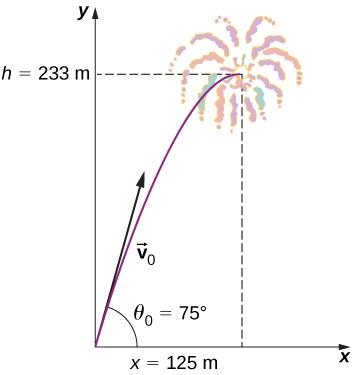
OpenStax / Rice University, University Physics Volume 1, CC BY 4.0. Source-book artwork retained. · CC BY 4.0 · Source出典

Figure 4.13図 4.13
The trajectory of a fireworks shell. The fuse is set to explode the shell at the highest point in its trajectory, which is found to be at a height of 233 m and 125 m away horizontally.
英語のヒント
花火の玉の軌道。導火線は軌道の最高点で玉を破裂させるよう設定されている。最高点は高さ233 m、水平距離125 mの位置と求められる。
Strategy方針
The motion can be broken into horizontal and vertical motions in which and We can then define and to be zero and solve for the desired quantities.
英語のヒント
運動を、の水平運動と、の鉛直運動へ分けられる。そのうえでとを0と定め、必要な量を求める。
Solution解答
(a) By “height” we mean the altitude or vertical position y above the starting point. The highest point in any trajectory, called the apex, is reached when Since we know the initial and final velocities, as well as the initial position, we use the following equation to find y:
英語のヒント
(a)ここで「高さ」とは、出発点より上の高度、すなわち鉛直位置yを意味する。軌道の最高点である頂点は、のときに達する。初速度、最終速度、初期位置が分かっているので、次の式でyを求める。
Because and are both zero, the equation simplifies to
英語のヒント
とはどちらも0なので、式は次のように簡単になる。
Solving for y gives
英語のヒント
yについて解くと、
Now we must find the component of the initial velocity in the y direction. It is given by where is the initial velocity of 70.0 m/s and is the initial angle. Thus,
英語のヒント
次に、初速度のy成分を求める。これはで与えられる。は初速70.0 m/s、は初めの角度である。したがって、
and y is
英語のヒント
yは次のようになる。
Thus, we have
英語のヒント
したがって、次の値を得る。
Note that because up is positive, the initial vertical velocity is positive, as is the maximum height, but the acceleration resulting from gravity is negative. Note also that the maximum height depends only on the vertical component of the initial velocity, so that any projectile with a 67.6-m/s initial vertical component of velocity reaches a maximum height of 233 m (neglecting air resistance). The numbers in this example are reasonable for large fireworks displays, the shells of which do reach such heights before exploding. In practice, air resistance is not completely negligible, so the initial velocity would have to be somewhat larger than that given to reach the same height.
英語のヒント
上向きを正としたため、初めの鉛直速度と最高点の高さは正だが、重力による加速度は負であることに注意しよう。また、最高点の高さは初速度の鉛直成分だけに依存する。したがって、初速度の鉛直成分が67.6 m/sなら、どの投射体も最高点233 mへ達する(空気抵抗を無視する)。この例の値は大規模な花火大会として妥当であり、実際に玉はこのような高さへ達してから破裂する。実際には空気抵抗を完全には無視できないため、同じ高さへ達するための初速度は、与えられた値より多少大きくなければならない。
(b) As in many physics problems, there is more than one way to solve for the time the projectile reaches its highest point. In this case, the easiest method is to use Because at the apex, this equation reduces to simply
英語のヒント
(b)多くの物理の問題と同じように、投射体が最高点へ達する時間には複数の求め方がある。この場合、最も簡単なのはを使う方法である。頂点ではなので、式は次のように簡単になる。
or
英語のヒント
すなわち、
This time is also reasonable for large fireworks. If you are able to see the launch of fireworks, notice that several seconds pass before the shell explodes. Another way of finding the time is by using This is left for you as an exercise to complete.
英語のヒント
この時間も、大きな打ち上げ花火として妥当である。打ち上げるところが見えるなら、玉が破裂するまで数秒かかることに注目しよう。別の求め方はを使う方法である。これは練習問題として各自で行ってみよう。
(c) Because air resistance is negligible, and the horizontal velocity is constant, as discussed earlier. The horizontal displacement is the horizontal velocity multiplied by time as given by where is equal to zero. Thus,
英語のヒント
(c)空気抵抗が無視できるためであり、先ほど述べたように水平速度は一定である。水平変位は水平速度と時間の積で、で与えられる。ここでは0である。したがって、
where is the x-component of the velocity, which is given by
英語のヒント
ここでは速度のx成分で、次の式で与えられる。
Time t for both motions is the same, so x is
英語のヒント
両方の運動で時間tは同じなので、xは次のようになる。
Horizontal motion is a constant velocity in the absence of air resistance. The horizontal displacement found here could be useful in keeping the fireworks fragments from falling on spectators. When the shell explodes, air resistance has a major effect, and many fragments land directly below.
英語のヒント
空気抵抗がなければ、水平運動の速度は一定である。ここで求めた水平変位は、花火の破片が観客へ落ちないようにするうえで役立つだろう。玉が破裂すると空気抵抗の影響が大きくなり、多くの破片は真下へ落ちる。
(d) The horizontal and vertical components of the displacement were just calculated, so all that is needed here is to find the magnitude and direction of the displacement at the highest point:
英語のヒント
(d)変位の水平成分と鉛直成分はすでに求めたので、残るのは最高点での変位の大きさと向きを求めることだけである。
Note that the angle for the displacement vector is less than the initial angle of launch. To see why this is, review Figure 4.11, which shows the curvature of the trajectory toward the ground level.
英語のヒント
変位ベクトルの角度は、打ち上げ時の角度より小さいことに注意しよう。その理由は、地面へ向かって曲がる軌道を示す図4.11を見直すと分かる。
When solving Example 4.7(a), the expression we found for y is valid for any projectile motion when air resistance is negligible. Call the maximum height y = h. Then,
英語のヒント
例題4.7(a)で得たyの式は、空気抵抗が無視できるあらゆる放物運動に適用できる。最高点の高さをy = hとすると、
This equation defines the maximum height of a projectile above its launch position and it depends only on the vertical component of the initial velocity.
英語のヒント
この式は、打ち上げ位置を基準とする投射体の最高点の高さを定める。その値は初速度の鉛直成分だけに依存する。
Example 4.8例題 4.8
Calculating Projectile Motion: Tennis Player放物運動の計算:テニス選手
A tennis player wins a match at Arthur Ashe stadium and hits a ball into the stands at 30 m/s and at an angle above the horizontal (Figure 4.14). On its way down, the ball is caught by a spectator 10 m above the point where the ball was hit. (a) Calculate the time it takes the tennis ball to reach the spectator. (b) What are the magnitude and direction of the ball’s velocity at impact?
英語のヒント
アーサー・アッシュ・スタジアムで試合に勝ったテニス選手が、ボールを速さ30 m/s、水平方向から上への角度で観客席へ打つ(図4.14)。ボールは下降中、打った位置より10 m高い場所にいる観客に捕られる。(a)ボールが観客へ達するまでの時間を求めよ。(b)衝突時のボールの速度の大きさと向きは何か。
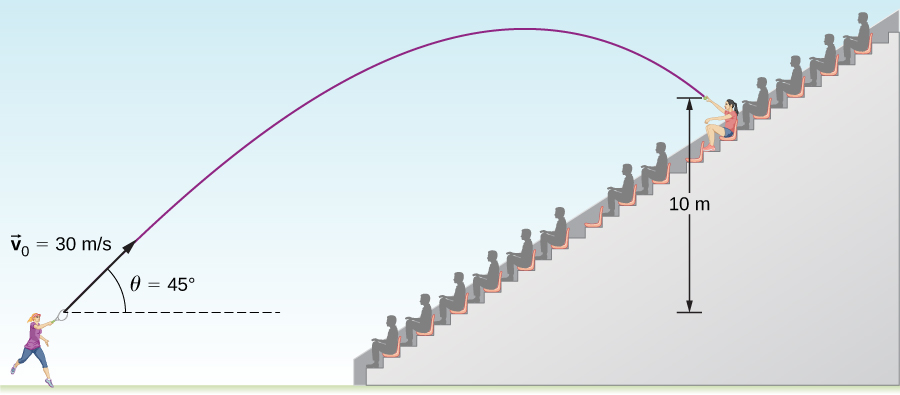
OpenStax / Rice University, University Physics Volume 1, CC BY 4.0. Source-book artwork retained. · CC BY 4.0 · Source出典

Figure 4.14図 4.14
The trajectory of a tennis ball hit into the stands.
英語のヒント
観客席へ打ち込んだテニスボールの軌道。
Strategy方針
Again, resolving this two-dimensional motion into two independent one-dimensional motions allows us to solve for the desired quantities. The time a projectile is in the air is governed by its vertical motion alone. Thus, we solve for t first. While the ball is rising and falling vertically, the horizontal motion continues at a constant velocity. This example asks for the final velocity. Thus, we recombine the vertical and horizontal results to obtain at final time t, determined in the first part of the example.
英語のヒント
ここでも、2次元運動を独立した二つの1次元運動へ分解すれば、必要な量を求められる。投射体が空中にいる時間は鉛直運動だけで決まるため、まずtを求める。ボールが鉛直方向に上がったり下がったりする間も、水平運動は一定の速度で続く。この例では最終速度を求める。したがって、前半で決めた最後の時刻tにおける鉛直成分と水平成分を組み合わせ、を得る。
Solution解答
(a) While the ball is in the air, it rises and then falls to a final position 10.0 m higher than its starting altitude. We can find the time for this by using Equation 4.22:
英語のヒント
(a)空中にある間、ボールは上昇してから下降し、出発時より10.0 m高い最終位置へ達する。この時間は式4.22から求められる。
If we take the initial position to be zero, then the final position is y = 10 m. The initial vertical velocity is the vertical component of the initial velocity:
英語のヒント
初期位置を0に取ると、最終位置はy = 10 mとなる。初めの鉛直速度は、初速度の鉛直成分である。
Rearranging terms gives a quadratic equation in t:
英語のヒント
項を整理すると、tの2次方程式を得る。
Use of the quadratic formula yields t = 3.79 s and t = 0.54 s. Since the ball is at a height of 10 m at two times during its trajectory—once on the way up and once on the way down—we take the longer solution for the time it takes the ball to reach the spectator:
英語のヒント
2次方程式の解の公式から、t = 3.79 sとt = 0.54 sを得る。ボールは軌道上で、上昇中と下降中の2回、高さ10 mを通る。観客へ達する時間には、長いほうの解を選ぶ。
The time for projectile motion is determined completely by the vertical motion. Thus, any projectile that has an initial vertical velocity of 21.2 m/s and lands 10.0 m above its starting altitude spends 3.79 s in the air.
英語のヒント
放物運動の時間は、鉛直運動だけで完全に決まる。したがって、初めの鉛直速度が21.2 m/sで、出発時より10.0 m高い場所へ着地する投射体は、どれも空中に3.79 sいる。
(b) We can find the final horizontal and vertical velocities and with the use of the result from (a). Then, we can combine them to find the magnitude of the total velocity vector and the angle it makes with the horizontal. Since is constant, we can solve for it at any horizontal location. We choose the starting point because we know both the initial velocity and the initial angle. Therefore,
英語のヒント
(b)(a)の結果から、最後の水平速度と鉛直速度を求められる。それらを組み合わせて、全体の速度ベクトルの大きさと、水平方向となす角を得る。は一定なので、水平方向のどの位置でも計算できる。初速度と初めの角度が分かっている出発点を選ぶ。したがって、
Since was found in part (a) to be 21.2 m/s, we have
英語のヒント
(a)では21.2 m/sと求めたので、
The magnitude of the final velocity is
英語のヒント
最終速度の大きさは、
The direction is found using the inverse tangent:
英語のヒント
向きは、逆正接を使って求める。
Significance意味の検討
(a) As mentioned earlier, the time for projectile motion is determined completely by the vertical motion. Thus, any projectile that has an initial vertical velocity of 21.2 m/s and lands 10.0 m above its starting altitude spends 3.79 s in the air. (b) The negative angle means the velocity is below the horizontal at the point of impact. This result is consistent with the fact that the ball is impacting at a point on the other side of the apex of the trajectory and therefore has a negative y component of the velocity. The magnitude of the velocity is less than the magnitude of the initial velocity we expect since it is impacting 10.0 m above the launch elevation.
英語のヒント
(a)先に述べたように、放物運動の時間は鉛直運動だけで完全に決まる。したがって、初めの鉛直速度が21.2 m/sで、出発位置より10.0 m高い場所へ着地する投射体は、どれも空中に3.79 sいる。(b)角度が負であることは、衝突時の速度が水平方向から下へ傾くことを意味する。これは、ボールが軌道の頂点を越えた側の点に当たり、速度のy成分が負であることと整合する。出発地点より10.0 m高い所に当たるので、予想どおり、速度の大きさは初速度の大きさより小さい。