第4章二次元・三次元の運動
Time of Flight, Trajectory, and Range飛行時間、軌道、水平到達距離
Of interest are the time of flight, trajectory, and range for a projectile launched on a flat horizontal surface and impacting on the same surface. In this case, kinematic equations give useful expressions for these quantities, which are derived in the following sections.
英語のヒント
平らな水平面から打ち出され、同じ面へ落ちる投射体について、飛行時間、軌道、水平到達距離に関心がある。この場合、運動学の式からこれらの量を表す便利な式が得られる。以下で導こう。
Time of flight飛行時間
We can solve for the time of flight of a projectile that is both launched and impacts on a flat horizontal surface by performing some manipulations of the kinematic equations. We note the position and displacement in y must be zero at launch and at impact on an even surface. Thus, we set the displacement in y equal to zero and find
英語のヒント
平らな水平面から打ち出されて同じ面へ落ちる投射体の飛行時間は、運動学の式を変形して求められる。平らな面では、打ち出し時と衝突時のy方向の位置と変位は0でなければならない。そこでy方向の変位を0と置くと、次のようになる。
Factoring, we have
英語のヒント
因数分解すると、
Solving for t gives us
英語のヒント
tについて解くと、
This is the time of flight for a projectile both launched and impacting on a flat horizontal surface. Equation 4.24 does not apply when the projectile lands at a different elevation than it was launched, as we saw in Example 4.8 of the tennis player hitting the ball into the stands. The other solution, t = 0, corresponds to the time at launch. The time of flight is linearly proportional to the initial velocity in the y direction and inversely proportional to g. Thus, on the Moon, where gravity is one-sixth that of Earth, a projectile launched with the same velocity as on Earth would be airborne six times as long.
英語のヒント
Trajectory軌道
The trajectory of a projectile can be found by eliminating the time variable t from the kinematic equations for arbitrary t and solving for y(x). We take so the projectile is launched from the origin. The kinematic equation for x gives
英語のヒント
投射体の軌道は、任意の時刻tに対する運動学の式から時間変数tを消去し、y(x)を求めれば得られる。原点から打ち出すものとしてとする。xの運動学の式から、
Substituting the expression for t into the equation for the position gives
英語のヒント
tの式を位置の式へ代入すると、
Rearranging terms, we have
英語のヒント
項を整理すると、
This trajectory equation is of the form which is an equation of a parabola with coefficients
英語のヒント
この軌道の式はの形であり、係数が次のような放物線の方程式である。
Range水平到達距離
From the trajectory equation we can also find the range, or the horizontal distance traveled by the projectile. Factoring Equation 4.25, we have
英語のヒント
軌道の式から、水平到達距離、すなわち投射体が進む水平距離も求められる。式4.25を因数分解すると、
The position y is zero for both the launch point and the impact point, since we are again considering only a flat horizontal surface. Setting y = 0 in this equation gives solutions x = 0, corresponding to the launch point, and
英語のヒント
ここでも平らな水平面だけを考えるため、打ち出し点と衝突点の両方でyは0である。この式でy = 0とすると、打ち出し点に対応する解x = 0と、
corresponding to the impact point. Using the trigonometric identity and setting x = R for range, we find
英語のヒント
衝突点に対応する解を得る。三角関数の恒等式を使い、水平到達距離をx = Rと置くと、
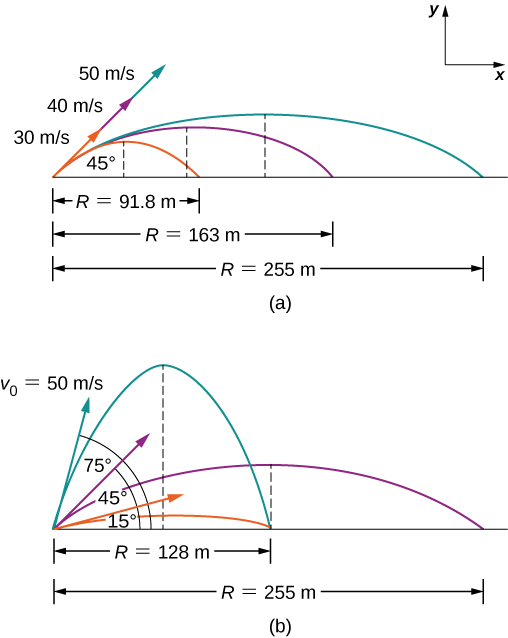
Note particularly that Equation 4.26 is valid only for launch and impact on a horizontal surface. We see the range is directly proportional to the square of the initial speed and , and it is inversely proportional to the acceleration of gravity. Thus, on the Moon, the range would be six times greater than on Earth for the same initial velocity. Furthermore, we see from the factor that the range is maximum at These results are shown in Figure 4.15. In (a) we see that the greater the initial velocity, the greater the range. In (b), we see that the range is maximum at This is true only for conditions neglecting air resistance. If air resistance is considered, the maximum angle is somewhat smaller. It is interesting that the same range is found for two initial launch angles that sum to The projectile launched with the smaller angle has a lower apex than the higher angle, but they both have the same range.
英語のヒント
式4.26が成り立つのは、打ち出しと衝突が同じ水平面上にある場合だけだという点に特に注意しよう。水平到達距離は初速の2乗とに比例し、重力加速度に反比例する。したがって月では、初速度が同じなら地球の6倍の距離へ達する。さらに、因子から、到達距離が最大になる角はと分かる。これらを図4.15に示す。(a)では初速度が大きいほど到達距離が大きい。(b)ではで到達距離が最大になる。これは空気抵抗を無視する場合だけ成り立つ。空気抵抗を考えると、最大距離を与える角は少し小さくなる。興味深いことに、和がとなる二つの打ち出し角は、同じ到達距離を与える。小さい角度で打ち出した投射体の最高点は、大きい角度の場合より低いが、到達距離は等しい。
OpenStax / Rice University, University Physics Volume 1, CC BY 4.0. Source-book artwork retained. · CC BY 4.0 · Source出典

Figure 4.15図 4.15
Trajectories of projectiles on level ground. (a) The greater the initial speed the greater the range for a given initial angle. (b) The effect of initial angle on the range of a projectile with a given initial speed. Note that the range is the same for initial angles of and although the maximum heights of those paths are different.
英語のヒント
平らな地面での投射体の軌道。(a)初めの角度が一定なら、初速が大きいほど到達距離が大きい。(b)初速が一定の投射体で、初めの角度が到達距離へ与える影響。とでは、軌道の最高点の高さは異なるが、到達距離は同じである。
Example 4.9例題 4.9
Comparing Golf Shotsゴルフのショットを比べる
A golfer encounters two different situations on different holes. On the second hole they are 120 m from the green and want to hit the ball 90 m and let it run onto the green. They angle the shot low to the ground at to the horizontal to let the ball roll after impact. On the fourth hole they are 90 m from the green and want to let the ball drop with a minimum amount of rolling after impact. Here, they angle the shot at to the horizontal to minimize rolling after impact. Both shots are hit and impacted on a level surface.
英語のヒント
ゴルファーが、二つのホールで異なる状況に直面する。2番ホールではグリーンまで120 mあり、ボールを90 m飛ばしてからグリーンへ転がしたい。着地後に転がるよう、水平方向に対しての低い角度で打つ。4番ホールではグリーンまで90 mあり、着地後の転がりをできるだけ小さくしたい。ここでは水平方向に対しての角度で打つ。どちらも、打つ場所と着地する場所は同じ高さの面上にある。
(a) What is the initial speed of the ball at the second hole?
英語のヒント
(a)2番ホールでのボールの初速はいくらか。
(b) What is the initial speed of the ball at the fourth hole?
英語のヒント
(b)4番ホールでのボールの初速はいくらか。
(c) Write the trajectory equation for both cases.
英語のヒント
(c)両方の場合の軌道の方程式を書け。
(d) Graph the trajectories.
英語のヒント
(d)軌道をグラフに描け。
Strategy方針
We see that the range equation has the initial speed and angle, so we can solve for the initial speed for both (a) and (b). When we have the initial speed, we can use this value to write the trajectory equation.
英語のヒント
到達距離の式には初速と角度が含まれるので、(a)、(b)のどちらも初速を求められる。初速が得られたら、その値を使って軌道の式を書ける。
Solution解答
(a)
(b)
(c)
(c)
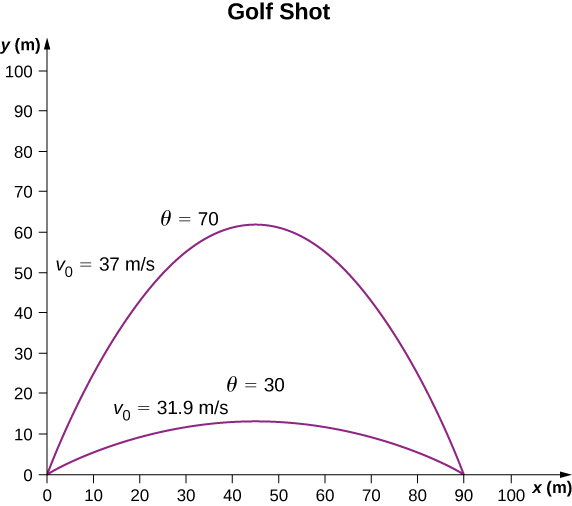
(d) Using a graphing utility, we can compare the two trajectories, which are shown in Figure 4.16.
英語のヒント
(d)グラフ作成ツールを使うと、図4.16のように二つの軌道を比較できる。
OpenStax / Rice University, University Physics Volume 1, CC BY 4.0. Source-book artwork retained. · CC BY 4.0 · Source出典

Figure 4.16図 4.16
Two trajectories of a golf ball with a range of 90 m. The impact points of both are at the same level as the launch point.
英語のヒント
到達距離90 mのゴルフボールの二つの軌道。どちらも、着地点は打ち出し地点と同じ高さにある。
Significance意味の検討
The initial speed for the shot at is greater than the initial speed of the shot at Note from Figure 4.16 that if the two projectiles were launched at the same speed but at different angles, the projectiles would have the same range as long as the angles were less than The launch angles in this example add to give a number greater than Thus, the shot at has to have a greater launch speed to reach 90 m, otherwise it would land at a shorter distance.
英語のヒント
のショットの初速は、のショットより大きい。図4.16から、二つの投射体を同じ速さで異なる角度で打ち出した場合、角度がより小さければ、到達距離は同じになることに注意しよう。この例では、打ち出し角の和がより大きい。したがってのショットが90 mへ達するには、より大きい打ち出し速度が必要となり、そうでなければ、もっと短い距離で着地する。
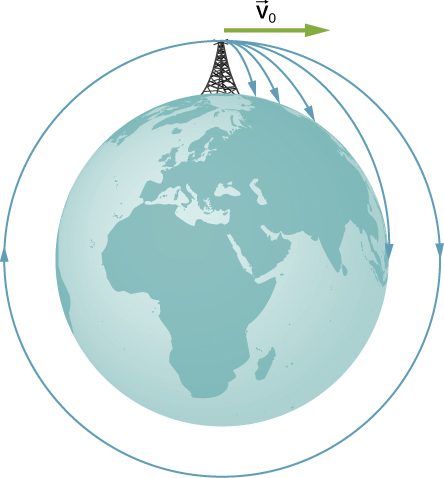
When we speak of the range of a projectile on level ground, we assume R is very small compared with the circumference of Earth. If, however, the range is large, Earth curves away below the projectile and the acceleration resulting from gravity changes direction along the path. The range is larger than predicted by the range equation given earlier because the projectile has farther to fall than it would on level ground, as shown in Figure 4.17, which is based on a drawing in Newton’s Principia. If the initial speed is great enough, the projectile goes into orbit. Earth’s surface drops 5 m every 8000 m. In 1 s an object falls 5 m without air resistance. Thus, if an object is given a horizontal velocity of 8000 m/s (or 18,000 mi/hr) near Earth’s surface, it will go into orbit around the planet because the surface continuously falls away from the object. This is roughly the speed of the Space Shuttle in a low Earth orbit when it was operational, or any satellite in a low Earth orbit. These and other aspects of orbital motion, such as Earth’s rotation, are covered in greater depth in Gravitation.
英語のヒント
平らな地面での投射体の到達距離を論じるとき、Rは地球の円周に比べて非常に小さいと仮定している。しかし到達距離が大きくなると、投射体の下で地球表面が曲がって遠ざかり、重力による加速度の向きも経路に沿って変わる。ニュートンの『プリンキピア』の図をもとにした図4.17のように、投射体は平らな地面の場合より長く落ち続けるため、先ほどの式が予測するより到達距離が大きくなる。初速が十分に大きければ、投射体は周回軌道に入る。地球表面は8000 m進むごとに5 m下がる。空気抵抗がなければ、物体は1 sで5 m落ちる。したがって地表近くで水平方向に8000 m/s(18,000 mi/h)の速度を与えると、表面が物体から絶えず下へ離れていくため、物体は地球を周回する。これは運用中のスペースシャトルや、地球低軌道を周回する衛星のおよその速さである。地球の自転などを含む軌道運動のこれらの側面は、「万有引力」でさらに詳しく扱う。
OpenStax / Rice University, University Physics Volume 1, CC BY 4.0. Source-book artwork retained. · CC BY 4.0 · Source出典

Figure 4.17図 4.17
Projectile to satellite. In each case shown here, a projectile is launched from a very high tower to avoid air resistance. With increasing initial speed, the range increases and becomes longer than it would be on level ground because Earth curves away beneath its path. With a speed of 8000 m/s, orbit is achieved.
英語のヒント
投射体から衛星へ。ここではどの場合も、空気抵抗を避けるため非常に高い塔から打ち出す。初速が増すほど到達距離は大きくなり、経路の下で地球表面が曲がって遠ざかるため、平らな地面の場合より遠くへ進む。速さ8000 m/sで周回軌道へ達する。