第4章二次元・三次元の運動
Equations of Motion for Uniform Circular Motion等速円運動を表す式
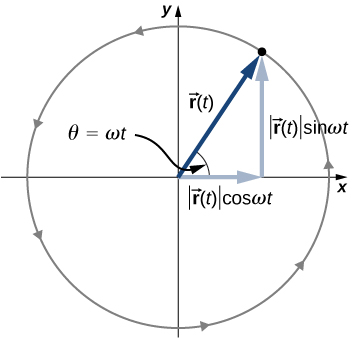
A particle executing circular motion can be described by its position vector Figure 4.20 shows a particle executing circular motion in a counterclockwise direction. As the particle moves on the circle, its position vector sweeps out the angle with the x-axis. Vector making an angle with the x-axis is shown with its components along the x- and y-axes. The magnitude of the position vector is and is also the radius of the circle, so that in terms of its components,
英語のヒント
円運動する粒子は、位置ベクトルで記述できる。図4.20は、反時計回りに円運動する粒子を示す。粒子が円周上を動くと、位置ベクトルが掃く角はx軸となす角になる。x軸と角をなすベクトルを、x軸とy軸に沿う成分とともに示す。位置ベクトルの大きさはで、円の半径でもある。したがって、成分で表すと次のようになる。
Here, is a constant called the angular frequency of the particle. The angular frequency has units of radians (rad) per second and is simply the number of radians of angular measure through which the particle passes per second. The angle that the position vector has at any particular time is .
英語のヒント
ここで、は粒子の角振動数と呼ばれる定数である。角振動数の単位はラジアン毎秒(rad/s)で、粒子が1秒間に進む角度をラジアンで測った値である。ある時刻に位置ベクトルがなす角は、となる。
If T is the period of motion, or the time to complete one revolution ( rad), then
英語のヒント
Tが運動の周期、つまり1周( rad)する時間なら、次が成り立つ。
OpenStax / Rice University, University Physics Volume 1, CC BY 4.0. Source-book artwork retained. · CC BY 4.0 · Source出典

Figure 4.20図 4.20
The position vector for a particle in circular motion with its components along the x- and y-axes. The particle moves counterclockwise. Angle is the angular frequency in radians per second multiplied by t.
英語のヒント
円運動する粒子の位置ベクトルと、x軸とy軸に沿う成分。粒子は反時計回りに動く。角は、ラジアン毎秒で表した角振動数にtを掛けたものである。
Velocity and acceleration can be obtained from the position function by differentiation:
英語のヒント
速度と加速度は、位置の関数を微分して求められる。
It can be shown from Figure 4.20 that the velocity vector is tangential to the circle at the location of the particle, with magnitude Similarly, the acceleration vector is found by differentiating the velocity:
英語のヒント
図4.20から、速度ベクトルは粒子の位置で円に接し、大きさはとなることを示せる。同様に、加速度ベクトルは速度を微分して求める。
From this equation we see that the acceleration vector has magnitude and is directed opposite the position vector, toward the origin, because
英語のヒント
この式から、加速度ベクトルの大きさはで、位置ベクトルと逆向き、つまり原点へ向くことが分かる。だからである。
Example 4.11例題 4.11
Circular Motion of a Proton陽子の円運動
A proton has speed and is moving in a circle in the xy plane of radius r = 0.175 m. What is its position in the xy plane at time At t = 0, the position of the proton is and it circles counterclockwise. Sketch the trajectory.
英語のヒント
陽子が速さで、xy平面内の半径r = 0.175 mの円周上を動いている。時刻におけるxy平面内の位置はどこか。t = 0で陽子の位置はであり、反時計回りに周回する。軌道を概略図に描け。
Solution解答
Since the period T is the time it takes an object to go once around a circle, and the distance around a circle is 2πr, we have:
英語のヒント
周期Tは物体が円を1周するのにかかる時間で、円周の長さは2πrなので、次を得る。
From the given data, the proton has period and angular frequency:
英語のヒント
与えられたデータから、陽子の周期と角振動数は次のようになる。
The position of the particle at with A = 0.175 m is
英語のヒント
A = 0.175 mのとき、時刻における粒子の位置は、次のようになる。
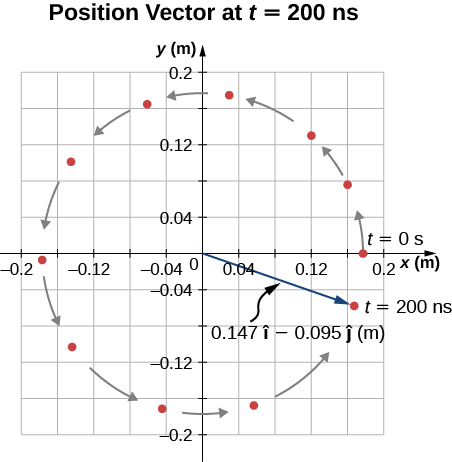
From this result we see that the proton is located slightly below the x-axis. This is shown in Figure 4.21.
英語のヒント
この結果から、陽子はx軸の少し下に位置すると分かる。図4.21にこれを示す。
OpenStax / Rice University, University Physics Volume 1, CC BY 4.0. Source-book artwork retained. · CC BY 4.0 · Source出典

Figure 4.21図 4.21
Position vector of the proton at The trajectory of the proton is shown. The angle through which the proton travels along the circle is 5.712 rad, which a little less than one complete revolution.
英語のヒント
時刻における陽子の位置ベクトルと軌道。陽子が円周上を進む角度は5.712 radで、1回転より少し小さい。
Significance意味の検討
We picked the initial position of the particle to be on the x-axis. This was completely arbitrary. If a different starting position were given, we would have a different final position at t = 200 ns.
英語のヒント
粒子の初期位置をx軸上に選んだ。これは完全に任意の選択である。別の出発位置が与えられていれば、t = 200 nsでの最終位置も異なるものになる。
Nonuniform Circular Motion非等速円運動
Circular motion does not have to be at a constant speed. A particle can travel in a circle and speed up or slow down, showing an acceleration in the direction of the motion.
英語のヒント
円運動は必ずしも一定の速さである必要はない。粒子は円周上を進みながら速くなったり遅くなったりでき、その場合には運動の方向に加速度を持つ。
In uniform circular motion, the particle executing circular motion has a constant speed and the circle is at a fixed radius. If the speed of the particle is changing as well, then we introduce an additional acceleration in the direction tangential to the circle. Such accelerations occur at a point on a top that is changing its spin rate, or any accelerating rotor. In Displacement and Velocity Vectors we showed that centripetal acceleration is the time rate of change of the direction of the velocity vector. If the speed of the particle is changing, then it has a tangential acceleration that is the time rate of change of the magnitude of the velocity:
英語のヒント
等速円運動では、円運動する粒子の速さは一定で、円の半径も一定である。粒子の速さも変化する場合には、円の接線方向にさらに加速度を導入する。このような加速度は、回転の割合が変わるこまの上の点や、加速する回転子で生じる。「変位ベクトルと速度ベクトル」では、向心加速度が速度ベクトルの向きの時間変化率であることを示した。粒子の速さが変化する場合には、速度の大きさの時間変化率である接線加速度を持つ。
The direction of tangential acceleration is tangent to the circle whereas the direction of centripetal acceleration is radially inward toward the center of the circle. Thus, a particle in circular motion with a tangential acceleration has a total acceleration that is the vector sum of the centripetal and tangential accelerations:
英語のヒント
接線加速度の向きは円に接する向きであり、向心加速度の向きは円の中心へ向かう半径方向の内向きである。したがって、円運動をして接線加速度を持つ粒子の全加速度は、向心加速度と接線加速度のベクトル和となる。
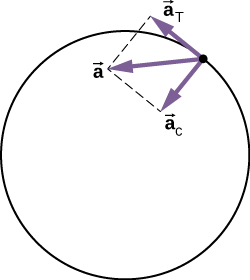
The acceleration vectors are shown in Figure 4.22. Note that the two acceleration vectors and are perpendicular to each other, with in the radial direction and in the tangential direction. The total acceleration points at an angle between and
英語のヒント
図4.22に加速度ベクトルを示す。二つの加速度ベクトルとは互いに垂直であり、は半径方向、は接線方向を向く。全加速度は、との間の角度をなす向きにある。
OpenStax / Rice University, University Physics Volume 1, CC BY 4.0. Source-book artwork retained. · CC BY 4.0 · Source出典

Figure 4.22図 4.22
The centripetal acceleration points toward the center of the circle. The tangential acceleration is tangential to the circle at the particle’s position. The total acceleration is the vector sum of the tangential and centripetal accelerations, which are perpendicular.
英語のヒント
向心加速度は円の中心へ向く。接線加速度は、粒子の位置で円に接する向きにある。全加速度は、互いに垂直な接線加速度と向心加速度のベクトル和である。
Example 4.12例題 4.12
Total Acceleration during Circular Motion円運動中の全加速度
A particle moves in a circle of radius r = 2.0 m. During the time interval from t = 1.5 s to t = 4.0 s its speed varies with time according to
英語のヒント
粒子が半径r = 2.0 mの円周上を動く。t = 1.5 sからt = 4.0 sの時間区間では、速さは次の式に従って時間とともに変化する。
What is the total acceleration of the particle at t = 2.0 s?
英語のヒント
t = 2.0 sでの粒子の全加速度は何か。
Strategy方針
We are given the speed of the particle and the radius of the circle, so we can calculate centripetal acceleration easily. The direction of the centripetal acceleration is toward the center of the circle. We find the magnitude of the tangential acceleration by taking the derivative with respect to time of using Equation 4.31 and evaluating it at t = 2.0 s. We use this and the magnitude of the centripetal acceleration to find the total acceleration.
英語のヒント
粒子の速さと円の半径が与えられているので、向心加速度は容易に計算できる。その向きは円の中心へ向く。接線加速度の大きさは、式4.31を使ってを時間で微分し、t = 2.0 sでの値を求めれば得られる。この値と向心加速度の大きさを使って、全加速度を求める。
Solution解答
Centripetal acceleration is
英語のヒント
向心加速度は次のようになる。
directed toward the center of the circle. Tangential acceleration is
英語のヒント
この加速度は円の中心へ向く。接線加速度は次のようになる。
Total acceleration is
英語のヒント
全加速度は次のようになる。
OpenStax / Rice University, University Physics Volume 1, CC BY 4.0. Source-book artwork retained. · CC BY 4.0 · Source出典

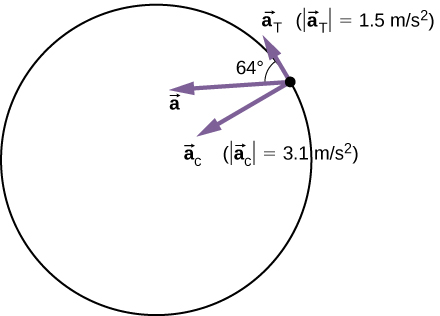
Figure 4.23図 4.23
The tangential and centripetal acceleration vectors. The net acceleration is the vector sum of the two accelerations.
英語のヒント
接線加速度ベクトルと向心加速度ベクトル。合成加速度は、この二つの加速度のベクトル和である。
Significance意味の検討
The directions of centripetal and tangential accelerations can be described more conveniently in terms of a polar coordinate system, with unit vectors in the radial and tangential directions. This coordinate system, which is used for motion along curved paths, is discussed in detail later in the book.
英語のヒント
向心加速度と接線加速度の向きは、半径方向と接線方向に単位ベクトルを持つ極座標系を使うと、より便利に記述できる。曲がった経路に沿う運動で使うこの座標系は、本書の後の箇所で詳しく扱う。