第4章二次元・三次元の運動
4.1 Displacement and Velocity Vectors4.1 変位ベクトルと速度ベクトル
Learning Objectives学習目標
Learning Objectives学習目標
By the end of this section, you will be able to:
英語のヒント
この節を終えると、次のことができるようになる。
- Calculate position vectors in a multidimensional displacement problem.
英語のヒント
多次元の変位の問題で位置ベクトルを計算する。 - Solve for the displacement in two or three dimensions.
英語のヒント
2次元や3次元の変位を求める。 - Calculate the velocity vector given the position vector as a function of time.
英語のヒント
時間の関数として与えられた位置ベクトルから、速度ベクトルを計算する。 - Calculate the average velocity in multiple dimensions.
英語のヒント
多次元での平均速度を計算する。
Displacement and velocity in two or three dimensions are straightforward extensions of the one-dimensional definitions. However, now they are vector quantities, so calculations with them have to follow the rules of vector algebra, not scalar algebra.
英語のヒント
2次元や3次元の変位と速度は、1次元の定義をそのまま拡張したものである。ただし、ここではベクトル量なので、計算ではスカラー代数ではなくベクトル代数の規則に従わなければならない。
Displacement Vector変位ベクトル
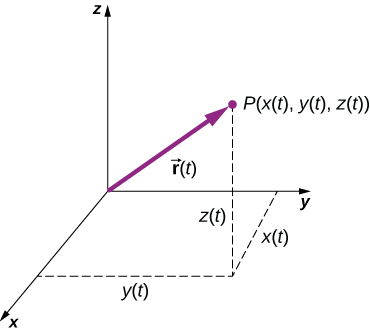
To describe motion in two and three dimensions, we must first establish a coordinate system and a convention for the axes. We generally use the coordinates x, y, and z to locate a particle at point P(x, y, z) in three dimensions. If the particle is moving, the variables x, y, and z are functions of time (t):
英語のヒント
2次元と3次元の運動を記述するには、まず座標系と各軸の取り方を定めなければならない。通常は座標x、y、zを使い、3次元空間内の粒子の位置を点P(x, y, z)で表す。粒子が動く場合、変数x、y、zは時間tの関数になる。
(4.1)
The position vector from the origin of the coordinate system to point P is In unit vector notation, introduced in Coordinate Systems and Components of a Vector, is
英語のヒント
座標系の原点から点Pへの位置ベクトルをとする。「座標系とベクトルの成分」で導入した単位ベクトルの記法では、は次のように表される。
Figure 4.2 shows the coordinate system and the vector to point P, where a particle could be located at a particular time t. Note the orientation of the x, y, and z axes. This orientation is called a right-handed coordinate system (Coordinate Systems and Components of a Vector) and it is used throughout the chapter.
英語のヒント
図4.2は座標系と、ある時刻tに粒子が存在しうる点Pへのベクトルを示す。x、y、z軸の向きに注意しよう。この配置を右手系という(「座標系とベクトルの成分」参照)。本章では一貫してこの配置を使う。
OpenStax / Rice University, University Physics Volume 1, CC BY 4.0. Source-book artwork retained. · CC BY 4.0 · Source出典

Figure 4.2図 4.2
A three-dimensional coordinate system with a particle at position P(x(t), y(t), z(t)).
英語のヒント
位置P(x(t), y(t), z(t))に粒子がある3次元座標系。
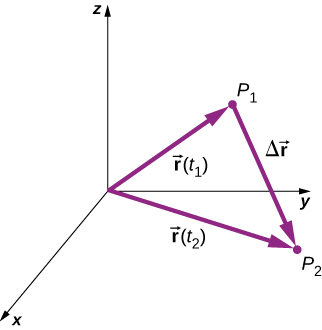
With our definition of the position of a particle in three-dimensional space, we can formulate the three-dimensional displacement. Figure 4.3 shows a particle at time located at with position vector At a later time the particle is located at with position vector . The displacement vector is found by subtracting from
英語のヒント
3次元空間内の粒子の位置を定義したので、3次元の変位を定式化できる。図4.3では、時刻の粒子はにあり、位置ベクトルはである。後の時刻には、粒子はにあり、位置ベクトルはとなる。変位ベクトルは、からを引いて求められる。
Vector addition is discussed in Vectors. Note that this is the same operation we did in one dimension, but now the vectors are in three-dimensional space.
英語のヒント
ベクトルの加算は「ベクトル」で論じた。これは1次元で行ったのと同じ操作だが、ここではベクトルが3次元空間内にあることに注意しよう。
OpenStax / Rice University, University Physics Volume 1, CC BY 4.0. Source-book artwork retained. · CC BY 4.0 · Source出典

Figure 4.3図 4.3
The displacement is the vector from to .
英語のヒント
変位は、からへのベクトルである。
The following examples illustrate the concept of displacement in multiple dimensions.
英語のヒント
次の例は、多次元での変位の概念を示す。
Example 4.1例題 4.1
Polar Orbiting Satellite極軌道を周回する衛星
A satellite is in a circular polar orbit around Earth at an altitude of 400 km—meaning, it passes directly overhead at the North and South Poles. What is the magnitude and direction of the displacement vector from when it is directly over the North Pole to when it is at latitude?
英語のヒント
衛星が高度400 kmの円形の極軌道で地球を周回している。つまり、北極と南極の真上を通過する。北極の真上にいるときから、緯度へ達するまでの変位ベクトルの大きさと向きは何か。
Strategy方針
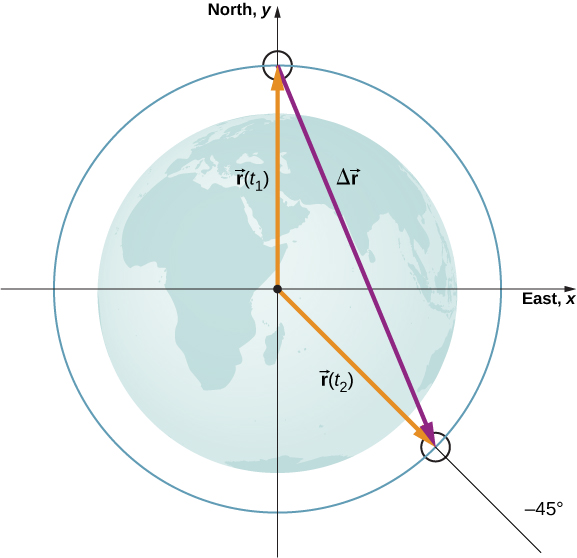
We make a picture of the problem to visualize the solution graphically. This will aid in our understanding of the displacement. We then use unit vectors to solve for the displacement.
英語のヒント
問題を図にして、解を視覚化する。変位を理解する助けになる。その後、単位ベクトルを使って変位を求める。
Solution解答
Figure 4.4 shows the surface of Earth and a circle that represents the orbit of the satellite. Although satellites are moving in three-dimensional space, they follow trajectories of ellipses, which can be graphed in two dimensions. The position vectors are drawn from the center of Earth, which we take to be the origin of the coordinate system, with the y-axis as north and the x-axis as east. The vector between them is the displacement of the satellite. We take the radius of Earth as 6370 km, so the length of each position vector is 6770 km.
英語のヒント
図4.4は、地球の表面と、衛星の軌道を表す円を示す。衛星は3次元空間を動くが、その軌道は楕円であり、2次元で描ける。位置ベクトルは地球の中心から描き、この中心を座標系の原点とする。y軸を北、x軸を東へ取る。二つの位置の間のベクトルが衛星の変位である。地球の半径を6370 kmとするので、各位置ベクトルの長さは6770 kmとなる。
OpenStax / Rice University, University Physics Volume 1, CC BY 4.0. Source-book artwork retained. · CC BY 4.0 · Source出典

Figure 4.4図 4.4
Two position vectors are drawn from the center of Earth, which is the origin of the coordinate system, with the y-axis as north and the x-axis as east. The vector between them is the displacement of the satellite.
英語のヒント
座標系の原点である地球の中心から、二つの位置ベクトルを描く。y軸を北、x軸を東へ取る。二つの位置を結ぶベクトルが衛星の変位である。
In unit vector notation, the position vectors are
英語のヒント
単位ベクトルで表すと、位置ベクトルは次のようになる。
Evaluating the sine and cosine, we have
英語のヒント
正弦と余弦の値を求めると、
Now we can find , the displacement of the satellite:
英語のヒント
これで衛星の変位を求められる。
The magnitude of the displacement is The angle the displacement makes with the x-axis is
英語のヒント
変位の大きさはである。変位がx軸となす角はである。
Significance意味の検討
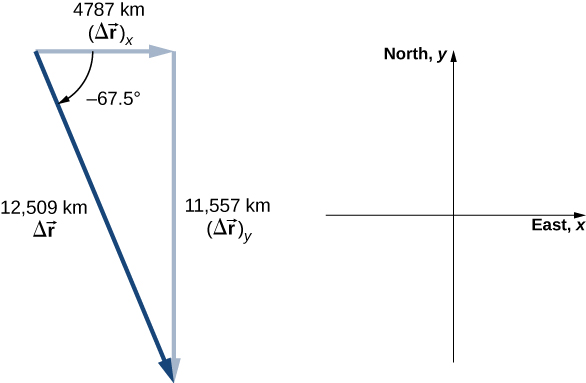
Plotting the displacement gives information and meaning to the unit vector solution to the problem. When plotting the displacement, we need to include its components as well as its magnitude and the angle it makes with a chosen axis—in this case, the x-axis (Figure 4.5).
英語のヒント
変位を図示すると、単位ベクトルで求めた解の情報と意味が分かる。変位を描く際は、その成分に加え、大きさと、選んだ軸(ここではx軸)となす角も含める必要がある(図4.5)。
OpenStax / Rice University, University Physics Volume 1, CC BY 4.0. Source-book artwork retained. · CC BY 4.0 · Source出典

Figure 4.5図 4.5
Displacement vector with components, angle, and magnitude.
英語のヒント
成分、角度、大きさを示した変位ベクトル。
Note that the satellite took a curved path along its circular orbit to get from its initial position to its final position in this example. It also could have traveled 4787 km east, then 11,557 km south to arrive at the same location. Both of these paths are longer than the length of the displacement vector. In fact, the displacement vector gives the shortest path between two points in one, two, or three dimensions.
英語のヒント
この例では、衛星は初期位置から最終位置まで、円軌道に沿う曲がった経路を進んだことに注意しよう。東へ4787 km進んでから南へ11,557 km進んでも、同じ場所へ達することはできた。どちらの経路も変位ベクトルの長さより長い。実際、変位ベクトルは、1次元、2次元、3次元のいずれでも、二点間の最短経路を与える。
Many applications in physics can have a series of displacements, as discussed in the previous chapter. The total displacement is the sum of the individual displacements, only this time, we need to be careful, because we are adding vectors. We illustrate this concept with an example of Brownian motion.
英語のヒント
前章で論じたように、物理学の多くの応用では変位がいくつも連続して生じる。総変位は個々の変位の和だが、今回はベクトルを加えるため注意が必要である。この概念をブラウン運動の例で示す。
Example 4.2例題 4.2
Brownian Motionブラウン運動
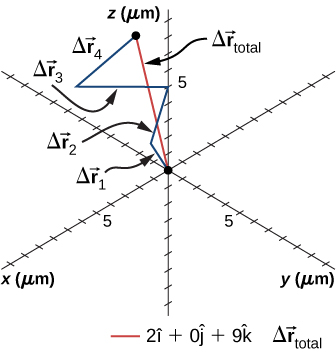
Brownian motion is a chaotic random motion of particles suspended in a fluid, resulting from collisions with the molecules of the fluid. This motion is three-dimensional. The displacements in numerical order of a particle undergoing Brownian motion could look like the following, in micrometers (Figure 4.6):
英語のヒント
ブラウン運動とは、流体中に浮かぶ粒子が、流体分子との衝突によって起こす不規則で無作為な運動である。この運動は3次元である。ブラウン運動する粒子の変位を順番に、マイクロメートル単位で示すと、例えば次のようになる(図4.6)。
What is the total displacement of the particle from the origin?
英語のヒント
粒子の原点からの総変位はいくらか。
OpenStax / Rice University, University Physics Volume 1, CC BY 4.0. Source-book artwork retained. · CC BY 4.0 · Source出典

Figure 4.6図 4.6
Trajectory of a particle undergoing random displacements of Brownian motion. The total displacement is shown in red.
英語のヒント
ブラウン運動で無作為な変位を繰り返す粒子の軌道。総変位を赤色で示す。
Solution解答
We form the sum of the displacements and add them as vectors:
英語のヒント
各変位の和を作り、ベクトルとして加える。
To complete the solution, we express the displacement as a magnitude and direction,
英語のヒント
解を完成させるため、変位を大きさと向きで表す。
with respect to the x-axis in the xz-plane.
英語のヒント
角度はxz平面内でx軸を基準に測る。
Significance意味の検討
From the figure we can see the magnitude of the total displacement is less than the sum of the magnitudes of the individual displacements.
英語のヒント
図から、総変位の大きさが、各変位の大きさの和より小さいことが分かる。