第4章二次元・三次元の運動
Summaryまとめ
- When analyzing motion of an object, the reference frame in terms of position, velocity, and acceleration needs to be specified.
英語のヒント
物体の運動を分析するときには、位置、速度、加速度を述べる基準系を明示する必要がある。 - Relative velocity is the velocity of an object as observed from a particular reference frame, and it varies with the choice of reference frame.
英語のヒント
相対速度とは、特定の基準系から観測した物体の速度であり、基準系の選択によって変わる。 - If S and are two reference frames moving relative to each other at a constant velocity, then the velocity of an object relative to S is equal to its velocity relative to plus the velocity of relative to S.
英語のヒント
Sとが、互いに一定の速度で相対運動する二つの基準系なら、Sに対する物体の速度は、に対する物体の速度と、Sに対するの速度の和に等しい。 - If two reference frames are moving relative to each other at a constant velocity, then the accelerations of an object as observed in both reference frames are equal.
英語のヒント
二つの基準系が互いに一定の速度で相対運動するなら、両方の基準系で観測した物体の加速度は等しい。
Key Equations重要な式
Position vector 位置ベクトル |
|
Displacement vector 変位ベクトル |
|
Velocity vector 速度ベクトル |
|
Velocity in terms of components 成分で表した速度 |
|
Velocity components 速度成分 |
|
Average velocity 平均速度 |
|
Instantaneous acceleration 瞬間加速度 |
|
Instantaneous acceleration, component form 瞬間加速度の成分表示 |
|
Instantaneous acceleration as second derivatives of position 位置の2階微分としての瞬間加速度 |
|
Time of flight 飛行時間 |
|
Trajectory 軌道 |
|
Range 水平到達距離 |
|
Centripetal acceleration 向心加速度 |
|
Position vector, uniform circular motion 等速円運動の位置ベクトル |
|
Velocity vector, uniform circular motion 等速円運動の速度ベクトル |
|
Acceleration vector, uniform circular motion 等速円運動の加速度ベクトル |
|
Tangential acceleration 接線加速度 |
|
Total acceleration 全加速度 |
|
Position vector in frame S is the position vector in frame plus the vector from the origin of S to the origin of 基準系Sの位置ベクトルは、基準系の位置ベクトルと、Sの原点からの原点へ向かうベクトルの和である |
|
Relative velocity equation connecting two reference frames 二つの基準系を結ぶ相対速度の式 |
|
Relative velocity equation connecting more than two reference frames 三つ以上の基準系を結ぶ相対速度の式 |
|
Relative acceleration equation 相対加速度の式 |
Conceptual Questions概念を確かめる問題
Exercises 64–68練習問題 64–68
Exercise 64問題 64
What frame or frames of reference do you use instinctively when driving a car? When flying in a commercial jet?
英語のヒント
車を運転するとき、どの基準系を自然に使っているか。旅客機に乗って飛ぶときはどうか。
Exercise 65問題 65
A basketball player dribbling down the court usually keeps his eyes fixed on the players around him. He is moving fast. Why doesn’t he need to keep his eyes on the ball?
英語のヒント
バスケットボール選手は、コートをドリブルで進むとき、通常、周囲の選手へ視線を向け続ける。本人は速く動いている。それでも、ボールを見続ける必要がないのはなぜか。
Solution解き方
If he is going to pass the ball to another player, he needs to keep his eyes on the reference frame in which the other players on the team are located.
英語のヒント
ほかの選手へパスしようとするなら、チームのほかの選手がいる基準系を見ている必要がある。
Exercise 66問題 66
If someone is riding in the back of a pickup truck and throws a softball straight backward, is it possible for the ball to fall straight down as viewed by a person standing at the side of the road? Under what condition would this occur? How would the motion of the ball appear to the person who threw it?
英語のヒント
ピックアップトラックの荷台に乗っている人が、ソフトボールを真後ろへ投げる。道路脇に立つ人から見て、ボールが真下へ落ちることはありうるか。どの条件でそうなるか。投げた本人には、ボールの運動はどう見えるか。
Exercise 67問題 67
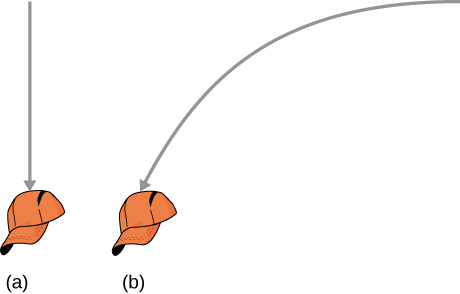
The hat of a jogger running at constant velocity falls off the back of his head. Draw a sketch showing the path of the hat in the jogger’s frame of reference. Draw its path as viewed by a stationary observer. Neglect air resistance.
英語のヒント
一定の速度で走るジョギング中の人の帽子が、頭の後ろへ落ちる。その人の基準系で見た帽子の経路を概略図に描け。静止した観測者から見た経路も描け。空気抵抗は無視せよ。
Exercise 68問題 68
A clod of dirt falls from the bed of a moving truck. It strikes the ground directly below the end of the truck. (a) What is the direction of its velocity relative to the truck just before it hits? (b) Is this the same as the direction of its velocity relative to ground just before it hits? Explain your answers.
英語のヒント
動いているトラックの荷台から土の塊が落ちる。塊はトラック後端の真下で地面に衝突する。(a)衝突直前の、トラックに対する塊の速度の向きは何か。(b)その向きは、衝突直前の地面に対する速度の向きと同じか。答えを説明せよ。
Problems問題
Exercises 69–78練習問題 69–78
Exercise 69問題 69
The coordinate axes of the reference frame remain parallel to those of , as moves away from at a constant velocity (a) If at time t = 0 the origins coincide, what is the position of the origin in the S frame as a function of time? (b) How is particle position for and as measured in S and respectively, related? (c) What is the relationship between particle velocities (d) How are accelerations related?
英語のヒント
基準系の座標軸は、がから一定の速度で遠ざかる間も、の座標軸と平行を保つ。(a)t = 0で両原点が一致するなら、S系での原点の位置を時間の関数として表せ。(b)Sとでそれぞれ測った粒子の位置とには、どの関係があるか。(c)粒子の速度の関係は何か。(d)加速度はどのように関係するか。
Solution解き方
a. ,
b. ,
c. , d. The accelerations are the same.
b. ,
c. , d. The accelerations are the same.
英語のヒント
(a)。(b) 。(c)。(d)加速度は等しい。
Exercise 70問題 70
The coordinate axes of the reference frame remain parallel to those of S, as moves away from S at a constant velocity . (a) If at time t = 0 the origins coincide, what is the position of origin in the S frame as a function of time? (b) How is particle position for and , as measured in S and respectively, related? (c) What is the relationship between particle velocities (d) How are accelerations related?
英語のヒント
基準系の座標軸は、がSから一定の速度で遠ざかる間も、Sの座標軸と平行を保つ。(a)t = 0で両原点が一致するなら、S系での原点の位置を時間の関数として表せ。(b)Sとでそれぞれ測った粒子の位置とには、どの関係があるか。(c)粒子の速度の関係は何か。(d)加速度はどのように関係するか。
Exercise 71問題 71
The velocity of a particle in reference frame A is The velocity of reference frame A with respect to reference frame B is and the velocity of reference frame B with respect to C is What is the velocity of the particle in reference frame C?
英語のヒント
基準系Aでの粒子の速度はである。基準系Bに対するAの速度は、Cに対するBの速度はである。基準系Cでの粒子の速度は何か。
Solution解き方
Exercise 72問題 72
Raindrops fall vertically at 4.5 m/s relative to the earth. What does an observer in a car moving at 22.0 m/s in a straight line measure as the velocity of the raindrops?
英語のヒント
雨滴が地球に対して鉛直下向き4.5 m/sで落ちる。直線上を22.0 m/sで走る車内の観測者は、雨滴の速度をいくらと測るか。
Exercise 73問題 73
A seagull can fly at a velocity of 9.00 m/s in still air. (a) If it takes the bird 20.0 min to travel 6.00 km straight into an oncoming wind, what is the velocity of the wind? (b) If the bird turns around and flies with the wind, how long will it take the bird to return 6.00 km?
英語のヒント
カモメは静止した空気中を速度9.00 m/sで飛べる。(a)向かい風にまっすぐ向かい、6.00 km進むのに20.0 minかかるなら、風の速度は何か。(b)カモメが向きを変えて風と同じ向きに飛ぶと、6.00 km戻るのにどれだけ時間がかかるか。
Solution解き方
a. A = air, S = seagull, G = ground
velocity of seagull with respect to still air
b.
velocity of seagull with respect to still air
b.
英語のヒント
(a)A = 空気、S = カモメ、G = 地面とする。は静止した空気に対するカモメの速度である。 。(b) 。
Exercise 74問題 74
A ship sets sail from Rotterdam, heading due north at 7.00 m/s relative to the water. The local ocean current is 1.50 m/s in a direction north of east. What is the velocity of the ship relative to Earth?
英語のヒント
船がロッテルダムから出航し、水に対して真北へ7.00 m/sで進む。その場所の海流は、東から北への方向に1.50 m/sで流れる。地球に対する船の速度は何か。
Exercise 75問題 75
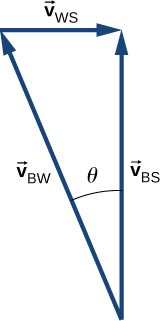
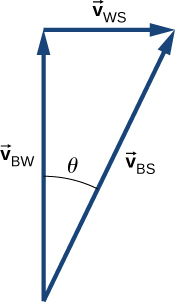
A boat can be rowed at 8.0 km/h in still water. (a) How much time is required to row 1.5 km downstream in a river moving 3.0 km/h relative to the shore? (b) How much time is required for the return trip? (c) In what direction must the boat be aimed to row straight across the river? (d) Suppose the river is 0.8 km wide. What is the velocity of the boat with respect to Earth and how much time is required to get to the opposite shore? (e) Suppose, instead, the boat is aimed straight across the river. How much time is required to get across and how far downstream is the boat when it reaches the opposite shore?
英語のヒント
ボートは静水中で8.0 km/hでこげる。(a)岸に対して3.0 km/hで流れる川を、下流へ1.5 kmこぐのにどれだけ時間が必要か。(b)戻るにはどれだけ時間が必要か。(c)川をまっすぐ横切ってこぐには、ボートをどの方向へ向ける必要があるか。(d)川幅が0.8 kmとする。地球に対するボートの速度と、対岸へ達するのに必要な時間は何か。(e)代わりに、ボート自体を川の真横へ向けるとする。渡り切るまでの時間と、対岸へ達したときの下流への移動距離は何か。
Solution解き方
Take the positive direction to be the same direction that the river is flowing, which is east. S = shore/Earth, W = water, and B = boat.
a.
b.
c. west of north
a.
b.
c. west of north
英語のヒント
正方向を川が流れる東向きに取る。S = 岸・地球、W = 水、B = ボートとする。(a) 。(b) 。(c)、北から西へ。
OpenStax / Rice University, University Physics Volume 1, CC BY 4.0. Source-book artwork retained. · CC BY 4.0 · Source出典
d.
e. but only the component of the velocity straight across the river is used to get the time
英語のヒント
(d) 。(e)だが、時間を求めるには川を真横に渡る速度成分だけを使う。
OpenStax / Rice University, University Physics Volume 1, CC BY 4.0. Source-book artwork retained. · CC BY 4.0 · Source出典
Downstream = 0.3 km
英語のヒント
。下流への移動距離 = 0.3 km。
Exercise 76問題 76
A small plane flies at 200 km/h in still air. If the wind blows directly out of the west at 50 km/h, (a) in what direction must the pilot head her plane to move directly north across land and (b) how long does it take her to reach a point 300 km directly north of her starting point?
英語のヒント
小型飛行機は静止した空気中を200 km/hで飛ぶ。西から50 km/hの風がまっすぐ吹く場合、(a)地上に対して真北へ進むには、パイロットは機首をどの方向へ向ける必要があるか。(b)出発点の真北300 kmの地点へ達するのに、どれだけ時間がかかるか。
Exercise 77問題 77
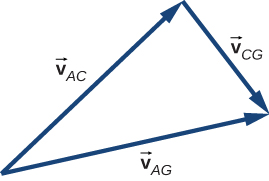
A cyclist traveling southeast along a road at 15 km/h feels a wind blowing from the southwest at 25 km/h. To a stationary observer, what are the speed and direction of the wind?
英語のヒント
自転車で道路を南東へ15 km/hで進む人が、南西から25 km/hで吹く風を感じる。静止した観測者から見た風の速さと向きは何か。


Exercise 78問題 78
A river is moving east at 4.0 m/s. A boat starts from the dock heading north of west at 7.0 m/s. If the river is 1800 m wide, (a) what is the velocity of the boat with respect to Earth and (b) how long does it take the boat to cross the river?
英語のヒント
川が東へ4.0 m/sで流れる。ボートが船着き場から、西から北への方向に7.0 m/sで出発する。川幅が1800 mの場合、(a)地球に対するボートの速度は何か。(b)川を渡るのにどれだけ時間がかかるか。