第4章二次元・三次元の運動
4.2 Acceleration Vector4.2 加速度ベクトル
Learning Objectives学習目標
Learning Objectives学習目標
By the end of this section, you will be able to:
英語のヒント
この節を終えると、次のことができるようになる。
- Calculate the acceleration vector given the velocity function in unit vector notation.
英語のヒント
単位ベクトルで表した速度関数から、加速度ベクトルを計算する。 - Describe the motion of a particle with a constant acceleration in three dimensions.
英語のヒント
3次元で一定の加速度を持つ粒子の運動を記述する。 - Use the one-dimensional motion equations along perpendicular axes to solve a problem in two or three dimensions with a constant acceleration.
英語のヒント
互いに垂直な各軸に沿う1次元運動の式を使い、2次元や3次元の等加速度運動の問題を解く。 - Express the acceleration in unit vector notation.
英語のヒント
加速度を単位ベクトルで表す。
Instantaneous Acceleration瞬間加速度
In addition to obtaining the displacement and velocity vectors of an object in motion, we often want to know its acceleration vector at any point in time along its trajectory. This acceleration vector is the instantaneous acceleration and it can be obtained from the derivative with respect to time of the velocity function, as we have seen in a previous chapter. The only difference in two or three dimensions is that these are now vector quantities. Taking the derivative with respect to time we find
英語のヒント
動く物体の変位ベクトルと速度ベクトルに加え、軌道上の任意の時刻での加速度ベクトルも知りたいことが多い。この加速度ベクトルが瞬間加速度であり、前章で見たように、速度関数を時間で微分すれば得られる。2次元や3次元で異なるのは、これらがベクトル量になることだけである。を時間で微分すると、次のようになる。
The acceleration in terms of components is
英語のヒント
加速度を成分で表すと、次のようになる。
Also, since the velocity is the derivative of the position function, we can write the acceleration in terms of the second derivative of the position function:
英語のヒント
また、速度は位置関数の導関数なので、加速度は位置関数の2階導関数で表せる。
Example 4.4例題 4.4
Finding an Acceleration Vector加速度ベクトルを求める
A particle has a velocity of (a) What is the acceleration function? (b) What is the acceleration vector at t = 2.0 s? Find its magnitude and direction.
英語のヒント
粒子の速度はである。(a)加速度関数は何か。(b)t = 2.0 sでの加速度ベクトルは何か。その大きさと向きを求めよ。
Solution解答
(a) We take the first derivative with respect to time of the velocity function to find the acceleration. The derivative is taken component by component:
英語のヒント
(a)速度関数を時間で1回微分し、加速度を求める。微分は各成分ごとに行う。
(b) Evaluating gives us the direction in unit vector notation. The magnitude of the acceleration is
英語のヒント
(b)を計算すると、単位ベクトルで向きが与えられる。加速度の大きさはである。
Significance意味の検討
In this example we find that acceleration has a time dependence and is changing throughout the motion. Let’s consider a different velocity function for the particle.
英語のヒント
この例では、加速度は時間に依存し、運動中ずっと変化している。次に、粒子の別の速度関数を考えよう。
Example 4.5例題 4.5
Finding a Particle Acceleration粒子の加速度を求める
A particle has a position function (a) What is the velocity? (b) What is the acceleration? (c) Describe the motion from t = 0 s.
英語のヒント
粒子の位置関数はである。(a)速度は何か。(b)加速度は何か。(c)t = 0 sからの運動を記述せよ。
Strategy方針
We can gain some insight into the problem by looking at the position function. It is linear in y and z, so we know the acceleration in these directions is zero when we take the second derivative. Also, note that the position in the x direction is zero for t = 0 s and t = 10 s.
英語のヒント
位置関数を見ると、問題についてある程度見通しがつく。y成分とz成分は1次式なので、2階微分を取ると、これらの方向の加速度は0と分かる。また、x方向の位置はt = 0 sとt = 10 sで0になることにも注意しよう。
Solution解答
(a) Taking the derivative with respect to time of the position function, we find
英語のヒント
(a)位置関数を時間で微分すると、次のようになる。
The velocity function is linear in time in the x direction and is constant in the y and z directions.
英語のヒント
速度関数は、x方向では時間の1次式、y方向とz方向では定数である。
(b) Taking the derivative of the velocity function, we find
英語のヒント
(b)速度関数を微分すると、次のようになる。
The acceleration vector is a constant in the negative x-direction.
英語のヒント
加速度ベクトルは一定で、x軸の負方向を向く。
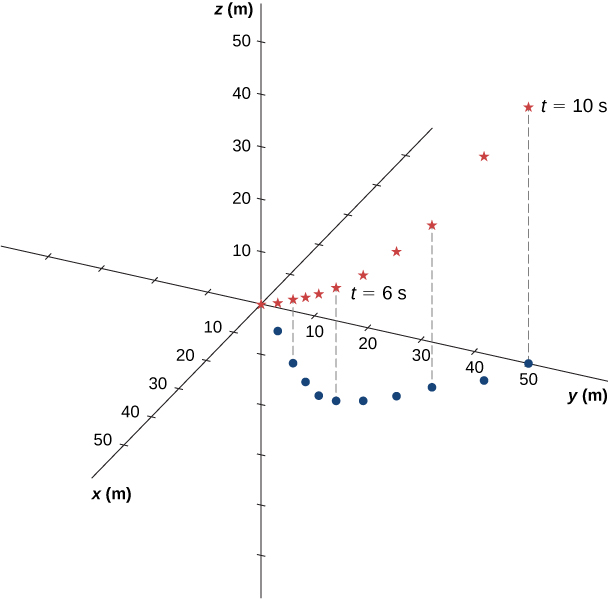
(c) The trajectory of the particle can be seen in Figure 4.9. Let’s look in the y and z directions first. The particle’s position increases steadily as a function of time with a constant velocity in these directions. In the x direction, however, the particle follows a path in positive x until t = 5 s, when it reverses direction. We know this from looking at the velocity function, which becomes zero at this time and negative thereafter. We also know this because the acceleration is negative and constant—meaning, the particle is accelerating in the opposite direction. The particle’s position reaches 25 m, where it then reverses direction and begins to accelerate in the negative x direction. The position reaches zero at t = 10 s.
英語のヒント
(c)粒子の軌道を図4.9に示す。まずy方向とz方向を見よう。これらの方向では速度が一定で、位置は時間とともに着実に増加する。一方、x方向では、粒子はt = 5 sまで正方向へ進み、そこで向きを逆にする。速度関数がこの時刻に0となり、その後は負になることから分かる。また、加速度が負で一定、つまり運動と逆向きに加速していることからも分かる。x方向の位置は25 mへ達したところで折り返し、負方向へ加速し始める。t = 10 sで位置は0へ戻る。
OpenStax / Rice University, University Physics Volume 1, CC BY 4.0. Source-book artwork retained. · CC BY 4.0 · Source出典

Figure 4.9図 4.9
The particle starts at point (x, y, z) = (0, 0, 0) with position vector as shown with red stars. The projection of the trajectory onto the xy-plane is shown with blue dots. The values of y and z increase linearly as a function of time, whereas x has a turning point at t = 5 s and 25 m, when it reverses direction. At this point, the x component of the velocity becomes negative. At t = 10 s, the particle is back to 0 m in the x direction.
英語のヒント
粒子は点(x, y, z) = (0, 0, 0)、位置ベクトルから出発する。軌道を赤い星で示し、xy平面への射影を青い点で示す。yとzは時間の1次関数として増加するが、xはt = 5 s、25 mの点で折り返す。この点で速度のx成分は負へ変わる。t = 10 sでは、粒子のx方向の位置は0 mへ戻る。
Significance意味の検討
By graphing the trajectory of the particle, we can better understand its motion, given by the numerical results of the kinematic equations.
英語のヒント
粒子の軌道を図に描けば、運動学の式の数値結果が表す運動を、よりよく理解できる。